
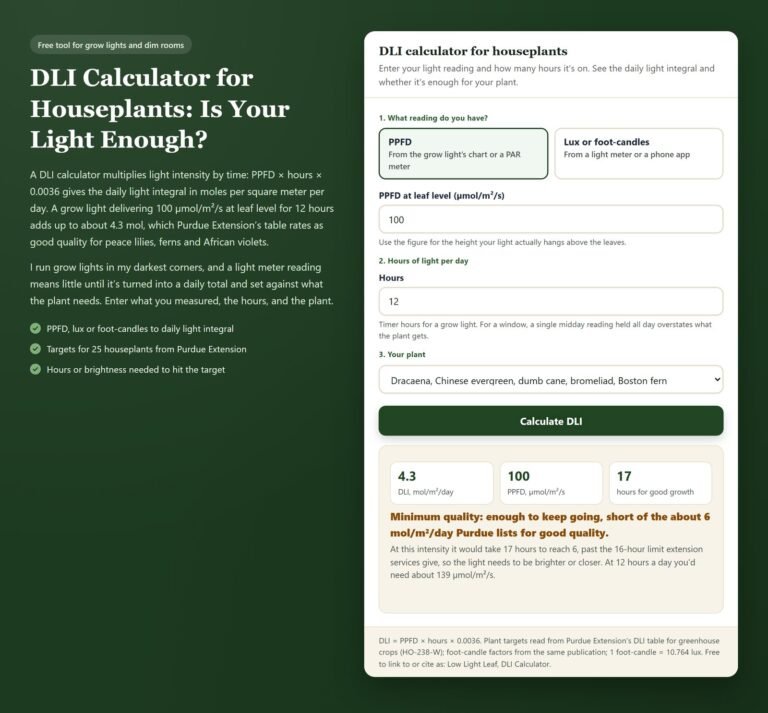
DLI Calculator
Turn a light reading and hours of light into a daily light total.
48 houseplants with the light level a university extension service gives each one, in foot-candles and lux, where to put it by a window, and whether the ASPCA lists it as safe for cats and dogs.
In University of Missouri Extension’s scale, low light for a houseplant is 50 to 250 foot-candles (about 538 to 2,691 lux), medium is 250 to 1,000, and high is at least 1,000. Other extension services draw the lines in different places. University of Maryland calls 25 to 100 foot-candles low, and Colorado State stretches low all the way to 500. That’s why one plant can be “low light” on one list and “medium” on another.
My apartment’s windows face north, so the low-light rows are the ones I read first. Every figure below is kept the way the source wrote it, with the source named on each row. The lux numbers are a straight unit conversion, 1 foot-candle = 10.764 lux.
How to read the table. “Light level” is the lowest light the source says the plant copes with; where the source says it grows, fills out or flowers better with more, the better level follows “best”. Missouri groups plants by the minimum light they need and notes that growth is often best at the top of a range. The foot-candle column repeats each source’s own range or figure, and the lux column converts it at 1 fc = 10.764 lux, rounded to the nearest whole lux.
“Rated by” says whose rating the row uses: MU is University of Missouri Extension’s Lighting Indoor Houseplants (G6515, 2017 revision), UMD is University of Maryland Extension’s Lighting for Indoor Plants (updated March 10, 2023), CSU is Colorado State University Extension’s PlantTalk 1352, Interior Plants and Light, and NCSU is the NC State Extension Plant Toolbox, which describes light in words and gives no foot-candle figure, so those rows are marked “Not graded”. The pets column is each plant’s verdict in the ASPCA toxic and non-toxic plants database, from our plant toxicity table.
| Plant | Light level | Foot-candles | Lux (converted) | Where to put it | Rated by | Pets (ASPCA) |
|---|---|---|---|---|---|---|
| African violetSaintpaulia spp. | Medium | Grows and flowers at 500–1,000 fc | Grows and flowers at ≈5,382–10,764 lux | North window, or to the side of a south one, from late spring to early fall (MU)Other sources: UMD: medium-bright (100–500 fc). CSU: medium.MU also calls it a small, low-light plant suited to light gardens. | MU | CatsNon-toxicDogsNon-toxic |
| Aluminum plantPilea cadierei | Low | Tolerates 50–250 fc | Tolerates ≈538–2,691 lux | North window (MU)Needs high humidity (MU). | MU | CatsNon-toxicDogsNon-toxic |
| Arrowhead vineSyngonium podophyllum | Lowbest:Medium | Tolerates 50–250 fc; Denser at 250–1,000 fc | Tolerates ≈538–2,691 lux; Denser at ≈2,691–10,764 lux | East or west window (MU) | MU | CatsToxicDogsToxic |
| Asparagus fernAsparagus densiflorus 'Sprengeri', A. setaceus | Lowbest:Medium | Tolerates 50–250 fc; Fuller at 250–1,000 fc | Tolerates ≈538–2,691 lux; Fuller at ≈2,691–10,764 lux | East or west window (MU) | MU | CatsToxicDogsToxic |
| CrotonCodiaeum variegatum | Mediumbest:High | Smaller 'Aucubaefolium' type copes with 250–1,000 fc; Most crotons need 1,000+ fc | Smaller 'Aucubaefolium' type copes with ≈2,691–10,764 lux; Most crotons need ≈10,764+ lux | South window (MU)Other sources: UMD: high (500–1,000 fc).MU says most crotons need high light for good color and growth. | MU | CatsNo ASPCA entryDogsNo ASPCA entry |
| BegoniasBegonia spp. | Medium | Medium 250–1,000 fc | Medium ≈2,691–10,764 lux | East or west window (MU)MU gives them 14 to 18 hours of light a day. | MU | CatsToxicDogsToxic |
| Cacti and succulentsCactaceae and other succulents | High | At least 1,000+ fc | At least ≈10,764+ lux | South window with some direct sun (MU)Other sources: UMD: direct sun, over 1,000 fc, 4 to 6 hours.Pet safety varies by species; check each one. | MU | Varies |
| Cast iron plantAspidistra elatior | Low | Low 50–250 fc | Low ≈538–2,691 lux | North window (MU)Other sources: UMD: low (25–100 fc). CSU: low.MU calls it one of the best plants where only low light exists. | MU | CatsNon-toxicDogsNon-toxic |
| Chinese evergreenAglaonema modestum | Low | Tolerates as low as 10 fc | Tolerates as low as ≈108 lux | North window (MU)Other sources: UMD: medium-bright (100–500 fc).The two sources put this plant in different groups. | MU | CatsToxicDogsToxic |
| DieffenbachiaDieffenbachia maculata | Medium | Medium 250–1,000 fc | Medium ≈2,691–10,764 lux | East or west window (MU)Medium light prevents loss of lower leaves (MU). | MU | CatsToxicDogsToxic |
| Dracaena (corn plant, dragon tree, Janet Craig)Dracaena fragrans, D. marginata, D. deremensis | Lowbest:Medium | Tolerates 50–250 fc; Does well at 250–1,000 fc | Tolerates ≈538–2,691 lux; Does well at ≈2,691–10,764 lux | East or west window (MU)Other sources: UMD: medium-bright (100–500 fc). | MU | CatsToxicDogsToxic |
| Boston fernNephrolepis exaltata 'Bostoniensis' | Lowbest:Medium | Tolerates 50–250 fc; Prefers 250–1,000 fc | Tolerates ≈538–2,691 lux; Prefers ≈2,691–10,764 lux | East or west window (MU)Other sources: CSU: some ferns are low-light choices. | MU | CatsNon-toxicDogsNon-toxic |
| Bird's nest fernAsplenium nidus | Lowbest:Medium | Tolerates 50–250 fc; Prefers 250–1,000 fc | Tolerates ≈538–2,691 lux; Prefers ≈2,691–10,764 lux | East or west window (MU) | MU | CatsNo ASPCA entryDogsNo ASPCA entry |
| Rubber plantFicus elastica | Medium | Medium 250–1,000 fc | Medium ≈2,691–10,764 lux | East or west window (MU)Other sources: UMD: medium-bright (100–500 fc).Low light may make it drop leaves (MU). | MU | CatsGenus entry (toxic)DogsGenus entry (toxic) |
| Fiddle leaf figFicus lyrata | Medium | Medium 250–1,000 fc | Medium ≈2,691–10,764 lux | East or west window (MU)Low light may make it drop leaves (MU). | MU | CatsGenus entry (toxic)DogsGenus entry (toxic) |
| Weeping figFicus benjamina | Medium | Medium 250–1,000 fc | Medium ≈2,691–10,764 lux | East or west window (MU)Other sources: CSU: medium.Low light may make it drop leaves (MU). | MU | CatsToxicDogsToxic |
| GloxiniaSinningia speciosa | Medium | Medium 250–1,000 fc | Medium ≈2,691–10,764 lux | East or west window (MU)Medium light keeps stems from stretching and helps it flower (MU). | MU | CatsNon-toxicDogsNon-toxic |
| Hoya (wax plant)Hoya carnosa | Lowbest:High | Tolerates 50–250 fc; Grows at 250–1,000 fc; Flowers at 1,000+ fc | Tolerates ≈538–2,691 lux; Grows at ≈2,691–10,764 lux; Flowers at ≈10,764+ lux | South window to flower (MU)Other sources: UMD: high (500–1,000 fc). NCSU: bright indirect light year-round is ideal. | MU | CatsNon-toxicDogsNon-toxic |
| English ivyHedera helix | Mediumbest:High | Medium to bright 250+ fc | Medium to bright ≈2,691+ lux | East, west or south window (MU) | MU | CatsToxicDogsToxic |
| Jade plantCrassula ovata (C. argentea) | Lowbest:High | Tolerates as low as 25 fc | Tolerates as low as ≈269 lux | South window (MU)Other sources: UMD: high (500–1,000 fc).Growth is thin and leaves small at low light; most crassulas prefer sun (MU). | MU | CatsToxicDogsToxic |
| Dwarf umbrella treeSchefflera arboricola | Mediumbest:High | Tolerates 250–1,000 fc; Prefers 1,000+ fc | Tolerates ≈2,691–10,764 lux; Prefers ≈10,764+ lux | South window (MU) | MU | CatsToxicDogsToxic |
| Umbrella treeSchefflera actinophylla (Brassaia) | Lowbest:High | Short spells at 50–250 fc; Prefers 1,000+ fc | Short spells at ≈538–2,691 lux; Prefers ≈10,764+ lux | South window (MU)Drops leaves after long spells of poor light (MU). | MU | CatsToxicDogsToxic |
| Norfolk Island pineAraucaria heterophylla | Lowbest:Medium | Tolerates 50–250 fc; Better at 250–1,000 fc | Tolerates ≈538–2,691 lux; Better at ≈2,691–10,764 lux | East or west window (MU)Other sources: UMD: medium-bright (100–500 fc).May lose its symmetry in low light (MU). | MU | CatsNon-toxicDogsNon-toxic |
| Citrus (calamondin, Meyer lemon)Citrus spp. | Mediumbest:High | Midwinter 250–1,000 fc; Prefers 1,000+ fc | Midwinter ≈2,691–10,764 lux; Prefers ≈10,764+ lux | South window (MU)Other sources: UMD: direct sun, over 1,000 fc. CSU: high. | MU | Not in our table |
| OrchidsPhalaenopsis and others | High | Mature plants 1,000+ fc | Mature plants ≈10,764+ lux | South window (MU)Other sources: CSU: medium.MU names Phalaenopsis among the orchids better suited to growing under lights. Pet verdict is for Phalaenopsis. | MU | CatsNon-toxicDogsNon-toxic |
| Parlor palmChamaedorea elegans | Low | Low 50–250 fc | Low ≈538–2,691 lux | North window (MU)MU says it and kentia are the palms most tolerant of low light. | MU | CatsNon-toxicDogsNon-toxic |
| Kentia palmHowea forsteriana | Low | Low 50–250 fc | Low ≈538–2,691 lux | North window (MU) | MU | CatsNon-toxicDogsNon-toxic |
| Areca palmDypsis lutescens | Medium | Medium 250–1,000 fc | Medium ≈2,691–10,764 lux | East or west window (MU)Bright light may fade some palms (MU). | MU | CatsNon-toxicDogsNon-toxic |
| Bamboo palmChamaedorea erumpens | Medium | Medium 250–1,000 fc | Medium ≈2,691–10,764 lux | East or west window (MU) | MU | CatsNon-toxicDogsNon-toxic |
| PeperomiaPeperomia obtusifolia, P. caperata | Lowbest:Medium | Short spells at 50–250 fc; Medium 250–1,000 fc | Short spells at ≈538–2,691 lux; Medium ≈2,691–10,764 lux | East or west window (MU) | MU | CatsNon-toxicDogsNon-toxic |
| Heartleaf philodendronPhilodendron hederaceum | Lowbest:Medium | Tolerates 50–250 fc; Best at 250–1,000 fc | Tolerates ≈538–2,691 lux; Best at ≈2,691–10,764 lux | East or west window (MU) | MU | CatsToxicDogsToxic |
| Song of IndiaDracaena reflexa (Pleomele) | Lowbest:Medium | Tolerates 50–250 fc; Best at 250–1,000 fc | Tolerates ≈538–2,691 lux; Best at ≈2,691–10,764 lux | East or west window (MU) | MU | CatsToxicDogsToxic |
| PothosEpipremnum aureum | Lowbest:Medium | Low and medium 50–1,000 fc | Low and medium ≈538–10,764 lux | North, east or west window (MU) | MU | CatsToxicDogsToxic |
| Snake plantDracaena trifasciata (Sansevieria) | Lowbest:High | Tolerates 50–250 fc; Best at 250+ fc | Tolerates ≈538–2,691 lux; Best at ≈2,691+ lux | East, west or south window (MU)Other sources: UMD: low (25–100 fc). | MU | CatsToxicDogsToxic |
| Peace lilySpathiphyllum spp. | Lowbest:Medium | Grows at 50–250 fc; Flowers at 250–1,000 fc | Grows at ≈538–2,691 lux; Flowers at ≈2,691–10,764 lux | North window; east or west to flower (MU)Other sources: UMD: low (25–100 fc). | MU | CatsToxicDogsToxic |
| Spider plantChlorophytum comosum | Lowbest:Medium | Tolerates 50–250 fc; Best at 250–1,000 fc | Tolerates ≈538–2,691 lux; Best at ≈2,691–10,764 lux | East or west window (MU)Other sources: CSU: low. | MU | CatsNon-toxicDogsNon-toxic |
| Swedish ivyPlectranthus verticillatus | Lowbest:Medium | Tolerates 50–250 fc; Denser at 250–1,000 fc | Tolerates ≈538–2,691 lux; Denser at ≈2,691–10,764 lux | East or west window (MU) | MU | CatsNon-toxicDogsNon-toxic |
| ZZ plantZamioculcas zamiifolia | Low | Low 25–100 fc | Low ≈269–1,076 lux | North window or an artificially lit room (UMD)Other sources: NCSU: grows in very low light, even fluorescent light only, but does best in bright indirect light; direct sun scalds the leaves. | UMD | CatsNo ASPCA entryDogsNo ASPCA entry |
| HibiscusHibiscus rosa-sinensis | High | High 500–1,000 fc | High ≈5,382–10,764 lux | South or some west windows (UMD) | UMD | CatsNon-toxicDogsNon-toxic |
| GardeniaGardenia jasminoides | High | Direct sun, over 1,000+ fc | Direct sun, over ≈10,764+ lux | 4 to 6 hours of direct sun: a sunroom or unshaded south bay window (UMD) | UMD | CatsToxicDogsToxic |
| Air plantTillandsia spp. | High | Direct sun, over 1,000+ fc | Direct sun, over ≈10,764+ lux | 4 to 6 hours of direct sun: a sunroom or unshaded south bay window (UMD) | UMD | CatsNo ASPCA entryDogsNo ASPCA entry |
| Nerve plantFittonia albivenis | Low | Low 50–500 fc | Low ≈538–5,382 lux | Within 2 ft of a north window (Oct–Mar), or 2 to 6 ft back from a south window (Apr–Sep) (CSU) | CSU | CatsNon-toxicDogsNon-toxic |
| Piggyback plantTolmiea menziesii | Low | Low 50–500 fc | Low ≈538–5,382 lux | Within 2 ft of a north window (Oct–Mar), or 2 to 6 ft back from a south window (Apr–Sep) (CSU) | CSU | Not in our table |
| ColeusColeus scutellarioides | Medium | Medium 500–1,000 fc | Medium ≈5,382–10,764 lux | 2 to 6 ft back from, or 1 ft beside, an east or west window (CSU) | CSU | CatsToxicDogsToxic |
| AmaryllisHippeastrum spp. | High | High 1,000+ fc | High ≈10,764+ lux | Within 2 ft of a south window (Oct–Mar), or of an east or west window all year (CSU) | CSU | CatsToxicDogsToxic |
| BromeliadsBromeliaceae | High | High 1,000+ fc | High ≈10,764+ lux | Within 2 ft of a south window (Oct–Mar), or of an east or west window all year (CSU) | CSU | CatsNon-toxicDogsNon-toxic |
| MonsteraMonstera deliciosa | Not graded | Not graded | Not graded | Moderate brightness, no direct sun (NCSU)NCSU says variegated forms need more sun than dark green ones. No foot-candle figure given. | NCSU | CatsToxicDogsToxic |
| Peacock plant (calathea)Goeppertia makoyana | Not graded | Not graded | Not graded | Bright indirect sun or partial shade (NCSU)NCSU lists it as intolerant of low light and of direct sun. No foot-candle figure given. | NCSU | CatsNon-toxicDogsNon-toxic |
Low Light Leaf. “Houseplant Light Requirements Chart: Foot-Candles by Plant.” Compiled from University of Missouri Extension G6515, University of Maryland Extension, Colorado State University Extension PlantTalk 1352 and the NC State Extension Plant Toolbox, November 17, 2026. https://lowlightleaf.com/houseplant-light-requirements-chart/
You’re welcome to link to the table, use the CSV or quote the figures with credit to the original extension service.
Link to the table: copy the HTML below.
<a href="https://lowlightleaf.com/houseplant-light-requirements-chart/#light-requirements-table">Houseplant light requirements chart (foot-candles and lux by plant)</a>, Low Light LeafUpdate log
A foot-candle is the light falling on one square foot of surface one foot from a standard candle; lux is the metric unit, light per square meter. Most US extension guides use foot-candles, and most phone apps and light meters sold today read in lux, so here are the three schemes side by side. The lux figures are converted (fc × 10.764), not taken from the sources.
| Source | Low | Medium | High | Direct sun |
|---|---|---|---|---|
| Missouri (MU) | 50–250 fc ≈538–2,691 lux | 250–1,000 fc ≈2,691–10,764 lux | 1,000+ fc ≈10,764+ lux | Not a separate band |
| Maryland (UMD) | 25–100 fc ≈269–1,076 lux | Medium-bright 100–500 fc ≈1,076–5,382 lux | 500–1,000 fc ≈5,382–10,764 lux | Over 1,000 fc ≈10,764+ lux |
| Colorado State (CSU) | 50–500 fc ≈538–5,382 lux | 500–1,000 fc ≈5,382–10,764 lux | 1,000+ fc ≈10,764+ lux | Not a separate band |
Missouri adds two details worth knowing. Under artificial light, a few low-light plants can be held at as little as 10 foot-candles, and medium-light plants grow best above 750 foot-candles unless they also get long spells of direct sun. Colorado State notes that few plants tolerate less than 50 foot-candles. For a sense of scale, Maryland puts the peak of direct outdoor sun at about 10,000 foot-candles.
If you want to turn a reading into a daily total of light, the DLI calculator does that from a reading and the hours of light.
Missouri’s rule of thumb is simple. South windows give the brightest light for the longest time and suit plants that need bright light and some direct sun; east and west windows suit many medium-light plants; north windows are satisfactory only for low-light plants. Large windows let you set plants farther back, but even low-light plants usually don’t get enough light more than 10 feet from an average window.
Colorado State gets more specific with distances, using its own bands (low 50 to 500, medium 500 to 1,000, high 1,000+ foot-candles):
| Light (CSU) | Where CSU says you’ll find it |
|---|---|
| High | Within 2 ft of a south window from October through March, or within 2 ft of an east or west window all year; at least 4 to 6 hours of sun a day |
| Medium | Within 2 ft of a north window from April through September, or 2 to 6 ft back from (or 1 ft to the side of) an east or west window; 10 to 14 hours a day of fluorescent office lighting also counts |
| Low | Within 2 ft of a north window from October through March, or 2 to 6 ft back from (or 1 ft to the side of) a south window from April through September; 6 to 10 ft back from a south window in those months is low light too |
Maryland lists the things that cut light at any window: curtains, insect screens, weather, the season, shade from trees and buildings, and dirty or tinted glass. Pale walls bounce some light back. It also warns that too much direct sun turns leaves pale and then brown, and suggests moving the plant back or hanging a light shade such as a sheer curtain in summer.
Your eyes won’t tell you. Missouri points out that the human eye is a poor judge of light intensity because it adjusts to the light it’s in, and that even a light meter reading in foot-candles should be used only as a guide.
A phone app is a rougher guide still. DIAL, a German lighting lab, tested several lux-meter apps on iPhones and on Samsung, Sony and Nokia phones against a reference meter. Readings were off by anywhere from 3% to 113%; the median ran about 60% high on Android and Windows phones and about 60% low on iPhones. The error was not even constant: one app on one iPhone read 180% high at 10 lux and 50% low at 10,000 lux. The phones in that test were older models, so a newer phone may do better, but nothing in the test shows it.
So use a reading to put a spot in the right band, not to hit an exact number. If a reading lands near the line between two bands, go by how the plant grows.
Missouri lists the signs that a healthy plant isn’t getting enough light: long stretches of stem between leaves, leaves smaller than normal, pale green stems and leaves, and lower leaves that yellow and drop. No new growth can mean poor light too, though it can have other causes.
If a window can’t give a plant what it needs, Missouri suggests keeping plant tips 6 to 12 inches from fluorescent tubes, with 16 to 18 hours of light a day for plants that get no window light, or 12 to 14 hours where they get some. Maryland’s advice is to keep the total at no more than 16 hours a day, since most plants need a dark period; the two sources don’t quite agree on the top of that range. My grow lights for indoor plants guide covers the lights themselves.
Plants that none of these sources rates are left out rather than guessed at.
It depends on the source: 50 to 250 foot-candles in University of Missouri Extension’s scale, 25 to 100 in University of Maryland’s and 50 to 500 in Colorado State’s. Missouri adds that a few plants can be held at as little as 10 foot-candles under artificial light.
One foot-candle is 10.764 lux. So 50 foot-candles is about 538 lux, 250 is about 2,691 and 1,000 is about 10,764.
Missouri says even low-light plants usually don’t get enough light more than 10 feet from an average window. Colorado State counts 6 to 10 feet back from a south window in spring and summer as low light.
Only roughly. In a DIAL lab test, phone lux apps were off by 3% to 113%, reading high on most Android phones and low on iPhones. Use the number to judge the band a spot falls in, not the exact figure.
In this table: aluminum plant, cast iron plant, boston fern, hoya, norfolk island pine, parlor palm, kentia palm, peperomia, spider plant, swedish ivy and nerve plant. Each is non-toxic to cats and dogs on the ASPCA list, and the light ratings are from the sources named on each row.
Turn a light reading and hours of light into a daily light total.
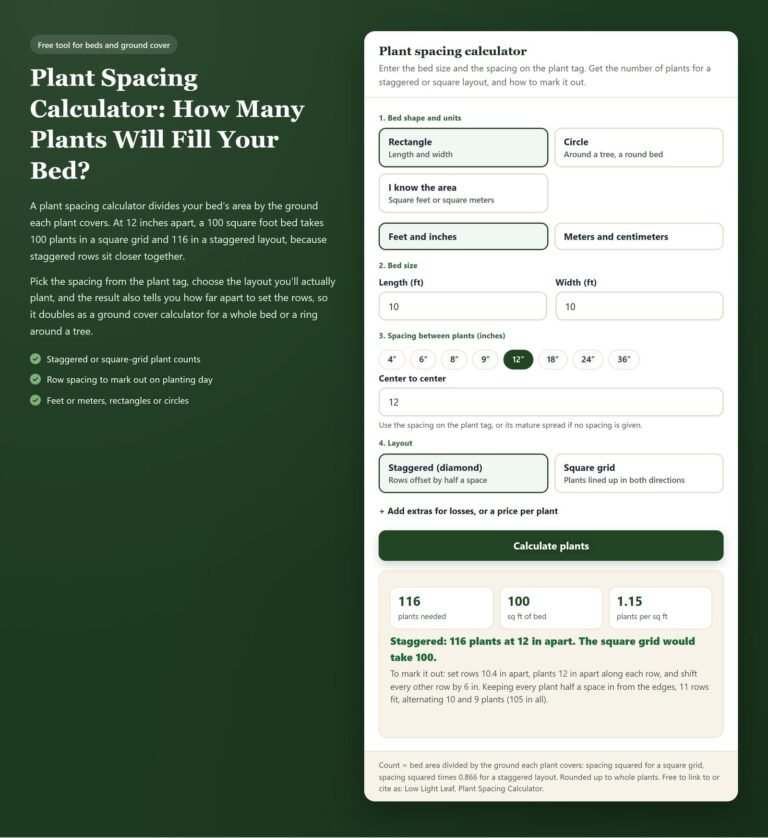
See how many plants fill a bed, in a grid or staggered.
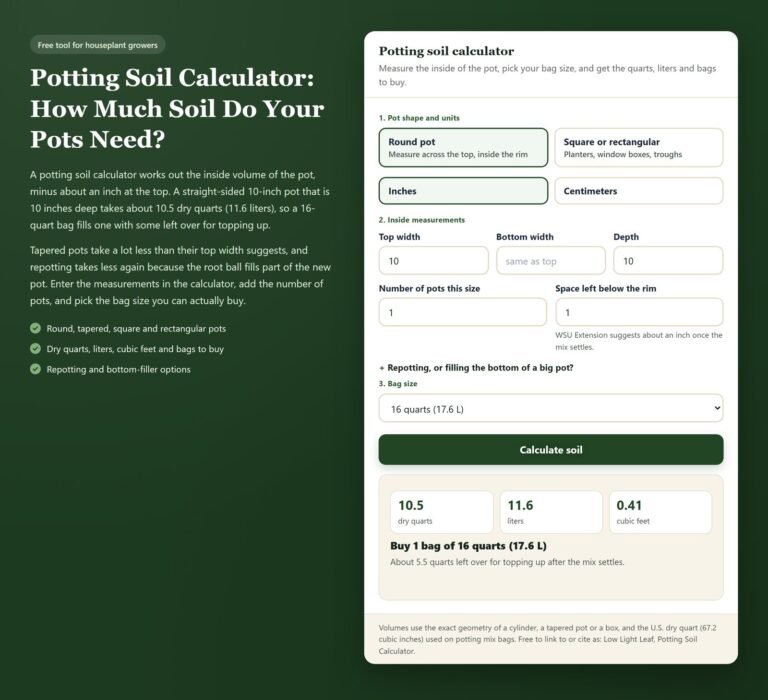
Work out how much potting mix your pots need, and how many bags.
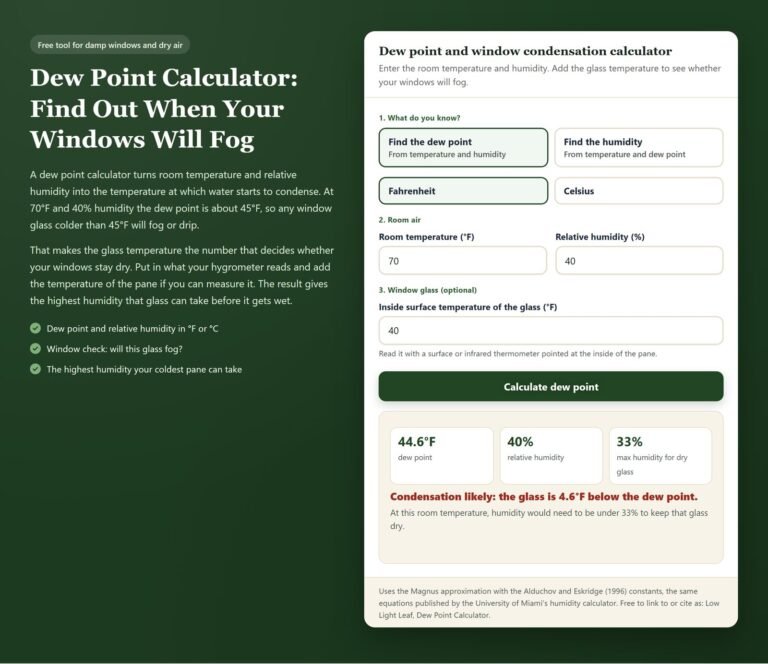
Find the glass temperature at which your windows start to fog.