Last updated on November 3, 2026
Peace lily light requirements come down to bright, indirect light with no direct sun, per UF/IFAS Extension. A peace lily (Spathiphyllum) survives in low light, but University of Missouri Extension notes it needs medium light, roughly 250 to 1,000 foot-candles, to flower.
Put as a daily total, Purdue Extension’s light chart places peace lilies at about 2 moles of light per square meter per day to get by and about 4 for good growth. On a phone light meter, that second figure works out to an average near 460 foot-candles across 12 hours of daylight. I lived for years in a north-facing apartment, which is exactly the kind of room where the gap between those two numbers decides whether you ever see a white flower.
How much light does a peace lily need?
A peace lily needs bright, indirect light for steady growth and flowers, and it tolerates low light for foliage alone. Clemson Extension’s Home & Garden Information Center says peace lilies grow best in bright indirect light and should stay out of direct sun, because the heat scorches the leaves.
“Tolerates low light” is the part that gets stretched. University of Missouri Extension’s guide to lighting indoor houseplants defines low-light houseplants as ones that get by on 50 to 250 foot-candles and medium-light plants as ones that want 250 to 1,000, with the best growth above 750. Peace lilies sit across that line: they keep their leaves in the low band and need the medium band to bloom.
So the useful question for your room is how much light the plant collects over a whole day, which the next section turns into a number you can measure.
Peace lily light in numbers
The number that matters is the daily light integral (DLI): the total amount of usable light a leaf receives in a day, counted in moles per square meter. Purdue Extension’s publication on measuring daily light integral puts Spathiphyllum in its lowest group, alongside ferns, prayer plant, moth orchids and African violets.
Read off Purdue’s bar chart, which steps in 2-mole columns, peace lilies sit at about 2 moles a day for minimum acceptable quality, about 4 for good quality and 6 to 10 for top quality. Treat each figure as give or take 1. These are greenhouse production targets, the light that grows a plant a nursery would sell, so a peace lily below 2 can hang on for a while; it just won’t do much.
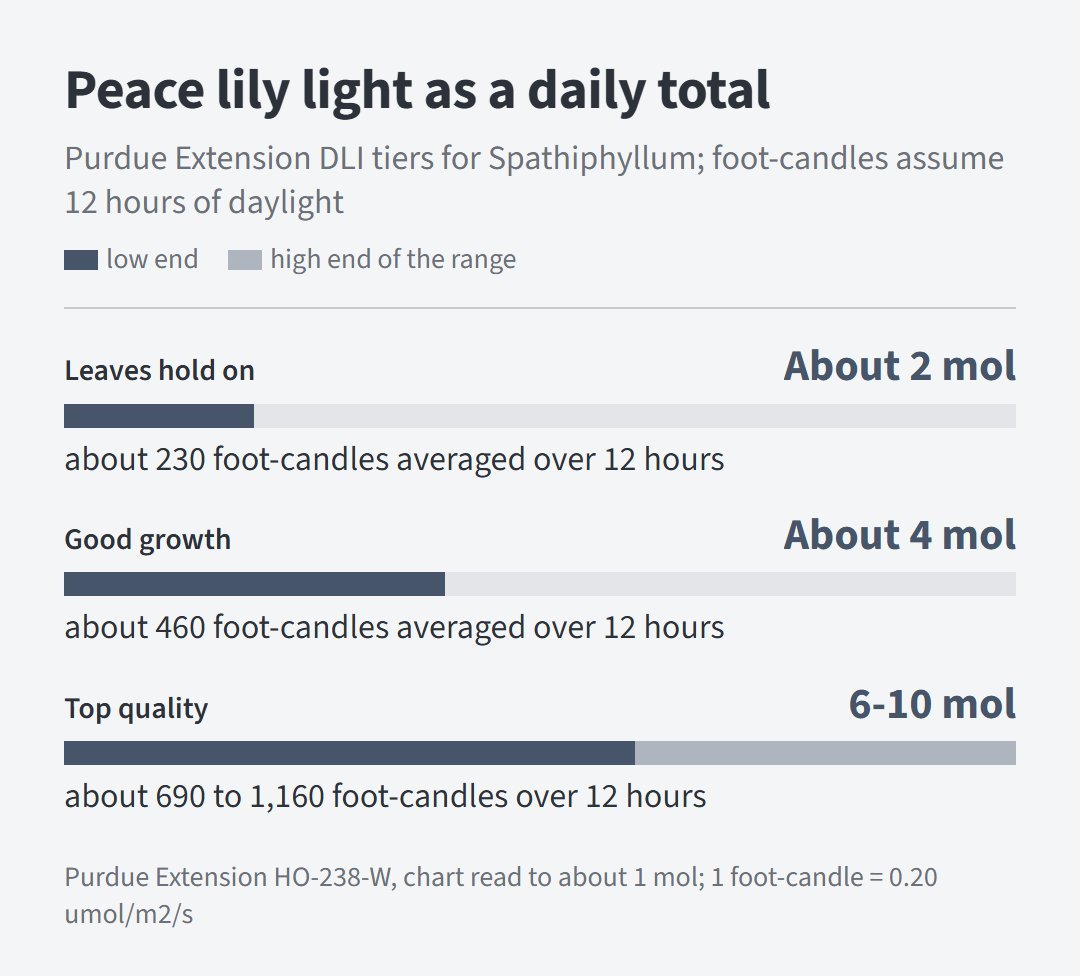
A phone app or a cheap meter shows foot-candles or lux, which is a snapshot, and Purdue makes the point that one reading taken at one moment doesn’t describe a day. To turn a snapshot into a daily total, Purdue’s conversion for sunlight is 1 foot-candle = 0.20 µmol/m²/s, and DLI = µmol/m²/s × hours × 0.0036. Run that backward and you get the average reading a spot needs to hold through the day:
| Your situation | Hours of usable light | Average reading to aim for | What it buys you |
|---|---|---|---|
| Bright room that gets daylight from morning to evening | About 12 | About 460 foot-candles (about 4,950 lux) | Purdue’s good-quality tier, about 4 moles a day |
| Window that only gives a few good hours | About 8 | About 690 foot-candles | The same 4 moles, packed into fewer hours |
| Dim corner you can’t change | About 12 | About 230 foot-candles | About 2 moles: foliage hangs on, flowers are unlikely |
| No window, grow light on a timer | 12 or 14 | About 93 or 79 µmol/m²/s at leaf height | About 4 moles a day from the lamp alone |
Two things throw these numbers off. Take the reading where the leaves are, not against the glass; a meter pressed to the window and the same meter on the plant three feet back are measuring different rooms. And a single midday reading held up as the whole day’s average overstates what the plant gets, because the morning and late afternoon are dimmer.
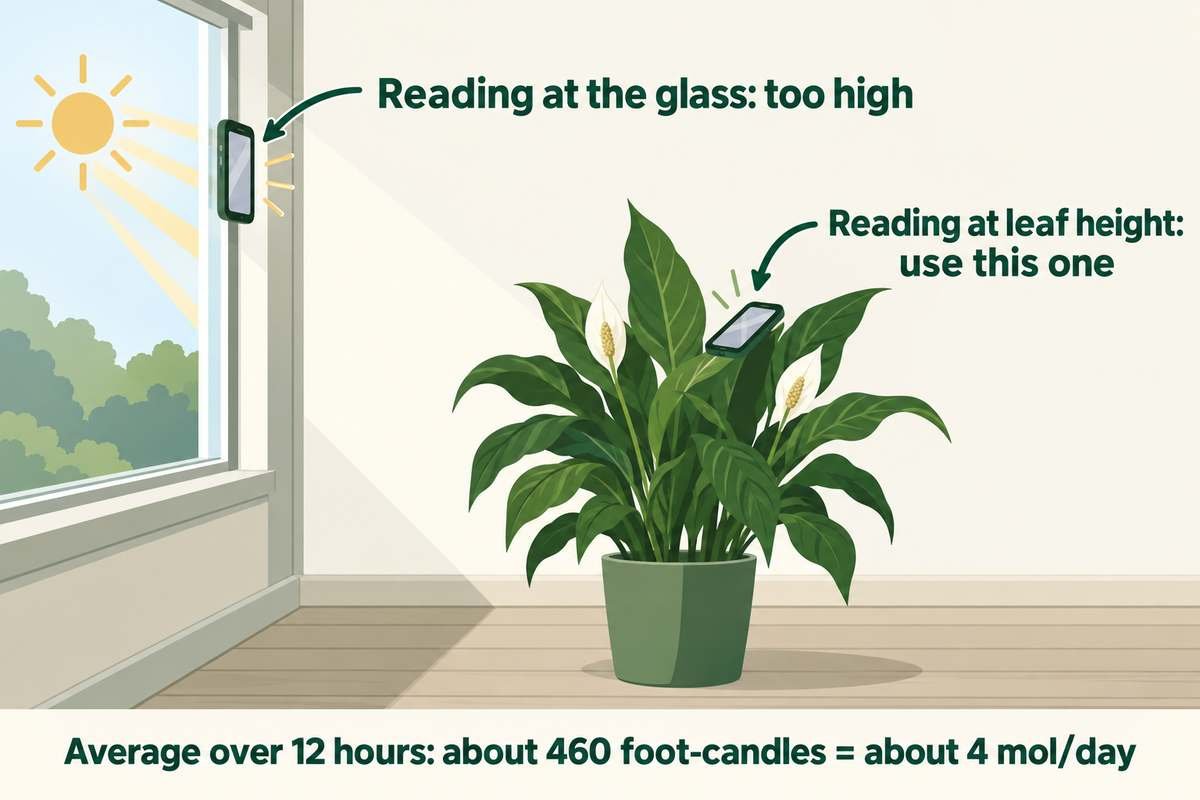
If you’d rather not do the arithmetic, the DLI calculator takes a lux, foot-candle or PPFD reading plus the hours, and peace lily is one of its preset plants.
Which window works best for a peace lily?
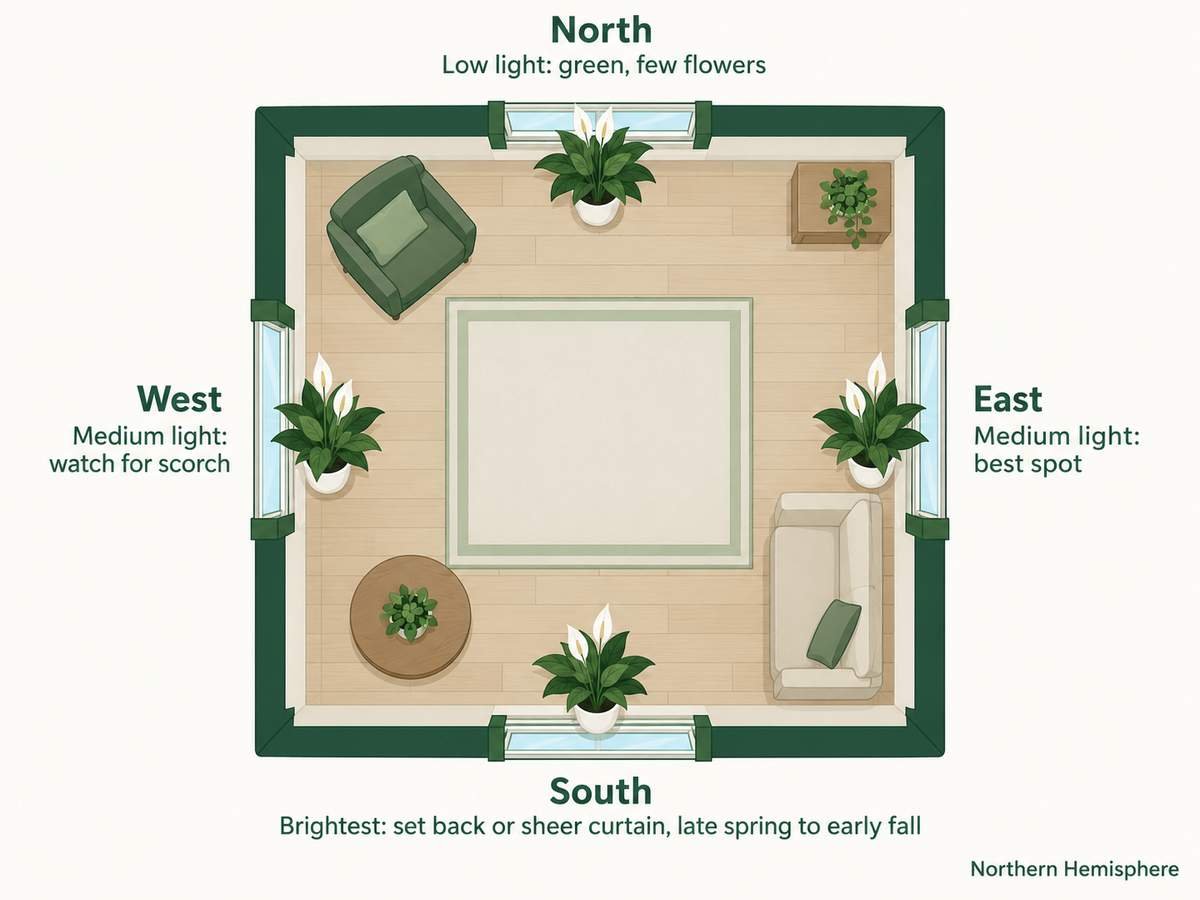
An east or west window suits a peace lily best, because University of Missouri Extension rates those exposures as medium light. A north window keeps it in low light, and a south window needs distance or a sheer curtain from late spring to early fall.
- North: MU Extension says north windows are satisfactory only for low-light plants. A peace lily stays green there; expect few or no flowers unless you add a lamp.
- East: medium light by MU’s grouping, and the easiest place to reach the 4-mole tier without sun damage.
- West: also medium light. Watch the window-side leaves for scorch, since this is where the strongest direct sun of the day lands.
- South: the brightest exposure. MU warns that plants that don’t need bright light can sunburn at south windows in late spring, summer and early fall, and suggests the side or the interior of the room instead. In winter the same window is a good spot.
North light is the room I know best. That apartment is the reason I ended up running grow lights in the darkest corners. For a peace lily, a lamp is the most direct way to get from MU’s low band into the medium band it needs to flower. Given one east window and one west window, I’d give the peace lily the east one.
Can a peace lily take direct sun?
A peace lily handles short spells of gentle sun, but not long hours of strong sun. NC State Extension rates it for deep shade to partial shade (no more than 2 to 6 hours of direct sun), UF/IFAS says no direct sun, and Clemson warns the heat scorches the leaves.
Growers argue about this more than the extension sheets suggest. In a long r/houseplants thread aimed at “the ‘peace lillies don’t like direct light’ crowd”, a reply with 186 upvotes drew the line I’d draw too:
“Lower angle sun is fine for peace lillies. But people often misconstrue what a plant can tolerate and what it wants.”
– r/houseplants, July 2023 (186 upvotes)
The other end of the argument is easy to find on r/plantclinic, where a badly collapsed plant came with this explanation:
“My girlfriends peace lily 😿 can this be saved? It was accidentally left in full sun for a day”
– r/plantclinic, February 2023 (1,028 upvotes)
Both are true at once. Early or late sun through glass, for an hour or two, sits inside NC State’s partial-shade range. A full day outdoors, or a summer afternoon in an unshaded south or west window, is the heat Clemson is talking about. The practical rule: if sun lands on the leaves for more than a couple of hours, or the leaves facing the window go pale or crisp at the edges, pull the pot back a few feet or hang a sheer curtain. If you would rather move it outside for the summer, a peace lily can live outside as long as it stays in full shade and the nights stay warm.
Why does a peace lily stay green but not bloom?
A peace lily in a dim spot usually stays green because it can keep its leaves on less light than it needs to flower. University of Missouri Extension says peace lilies adapt to low light conditions but need medium light to bloom.
One r/houseplants post put the frustration plainly: “All I want is one flower.” Clemson’s factsheet adds a fair counterpoint, calling the peace lily one of the few foliage plants that will flower in low light. Both statements fit together once you read them as a comparison: next to other foliage plants, peace lilies flower in surprisingly dim rooms, but by MU’s measure they still need the medium band to do it reliably. That ability to flower in dimmer rooms than most foliage plants is one of the peace lily benefits that holds up to the evidence.
Light is not the only reason a peace lily skips flowering. A plant that has packed its pot with roots often stops blooming too, and one r/plantclinic poster who finally tipped out a plant that hadn’t flowered in months found the soil was “90% roots.” Repot first in that case.
Seasons change the answer as well. A spot that reaches 4 moles a day in June can fall well short in December, which is why MU suggests winter is the time any houseplant benefits from a south window.
How many hours of light does a peace lily need?
A peace lily has no fixed hour count in daylight; the daily total is what counts. Under lamps, University of Missouri Extension’s general rule for houseplants is 16 to 18 hours a day with no window light, or 12 to 14 hours when a window adds some.
Hours and brightness trade against each other. With Purdue’s formula, a grow light giving about 93 µmol/m²/s at leaf height reaches 4 moles in 12 hours, and about 79 µmol/m²/s gets there in 14. A dimmer lamp can make up the difference with more hours, which is why MU’s longer schedule exists. If your lamp’s maker publishes a PPFD chart by hanging height, use the figure for the height your light actually hangs, not the headline number on the box.
This is the order I’d work through it:
- Measure the spot at leaf height around midday, and note how many hours it actually gets usable light.
- Convert the reading to a daily total with the table or the calculator, remembering a midday reading runs high.
- Below about 2 moles, move the plant closer to an east or west window or add a lamp on a timer. Between 2 and 4, expect leaves without many flowers.
- Give it a few weeks, then judge the newest leaves: full-sized, dark green leaves on upright stems mean the light is enough.
I’d fix the light before reaching for fertilizer, since a plant that can’t make enough energy has little use for extra feed.
Too much light or too little: what the leaves show
The plant tells you which way it’s off, though a few signs overlap with watering problems.
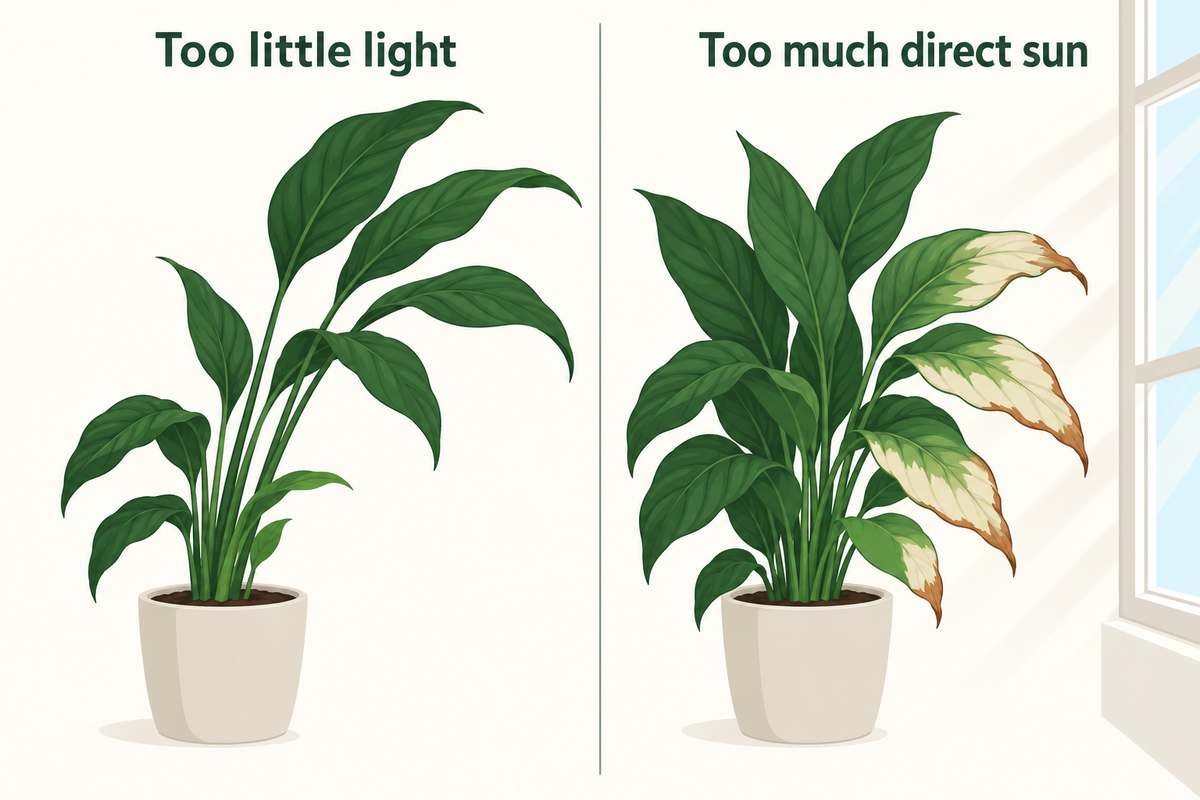
- Too little light: no flowers, slow growth with small new leaves, and long leaf stalks leaning toward the window. Soil tends to stay wet longer in a dim spot, so the same watering habit that worked in a bright room can rot roots in a dark one. The peace lily watering schedule walks through matching water to the spot.
- Too much light: pale or bleached patches and crisp edges on the leaves nearest the window. NC State Extension lists excessive direct sun as one cause of brown leaf tips, alongside underwatering and low humidity, so look at where the damage sits: window side only points to sun, the whole plant points to water or air.
If the leaves are browning and you’re not sure which cause it is, peace lily brown leaves sorts the causes by pattern, and peace lily yellow leaves covers the yellowing side.
Peace lily light requirements FAQ
Does a peace lily need more light in winter?
A peace lily usually needs a brighter spot in winter, because shorter, dimmer days cut its daily light total. University of Missouri Extension notes that any houseplant benefits from a south window in winter, the same window that can scorch it in summer.
Can a peace lily live in a windowless bathroom?
A peace lily can live in a windowless bathroom only with a grow light, since the room’s ceiling fixture is rarely on long enough. MU Extension’s general rule for plants with no outdoor light is 16 to 18 hours of lamp light a day.
A plug-in timer handles the hours, and the bathroom humidity is a bonus for the leaf tips.
Is a phone light meter accurate enough?
A phone light meter is accurate enough to compare two spots in your home, but not to measure plant light exactly. Purdue Extension points out that foot-candles and lux are based on what the human eye sees, not on the light plants use.
For daylight, Purdue’s conversion factor makes the reading usable. Under an LED grow light the same conversion is only a rough estimate, so trust the lamp’s own PPFD chart over the phone.
When the new leaves come in full-sized and the plant puts up a flower again, the spot is bright enough. When it stays leafy and flowerless through a whole season in an east window, look at the roots before you buy another lamp.

Ellie Marsh
Houseplant grower who spent years in a north-facing apartment. Writes practical care guides for low light homes, checked against extension and botanical garden sources.