Last updated on October 31, 2026
Good calathea care starts with measuring your light and your air. UF/IFAS Extension says a calathea tolerates indoor light as low as 75 foot-candles but looks best at 150 to 200, and keeps its looks at 40 to 60% humidity. Water when the surface of the mix has dried slightly, use distilled or rainwater, and keep it between 65 and 80°F.
NC State Extension says calatheas require higher maintenance, and plenty of owners in r/calatheas would agree. Most failures trace back to two things you can measure, light and humidity, so those come first below, followed by water, brown edges and the smaller jobs.
How much light does a calathea need?
A calathea needs medium, indirect light: at least 75 foot-candles to survive and 150 to 200 to look its best, according to UF/IFAS Extension’s calathea guidelines. Direct sun scorches the leaves, NC State warns, and UF’s peacock plant sheet adds that bright light washes out the leaf colors.
Too little light shows up differently. NC State notes that a rose-painted calathea’s leaf color fades when light is inadequate, so a plant that’s slowly losing its pattern is telling you it wants a brighter spot, not more water.
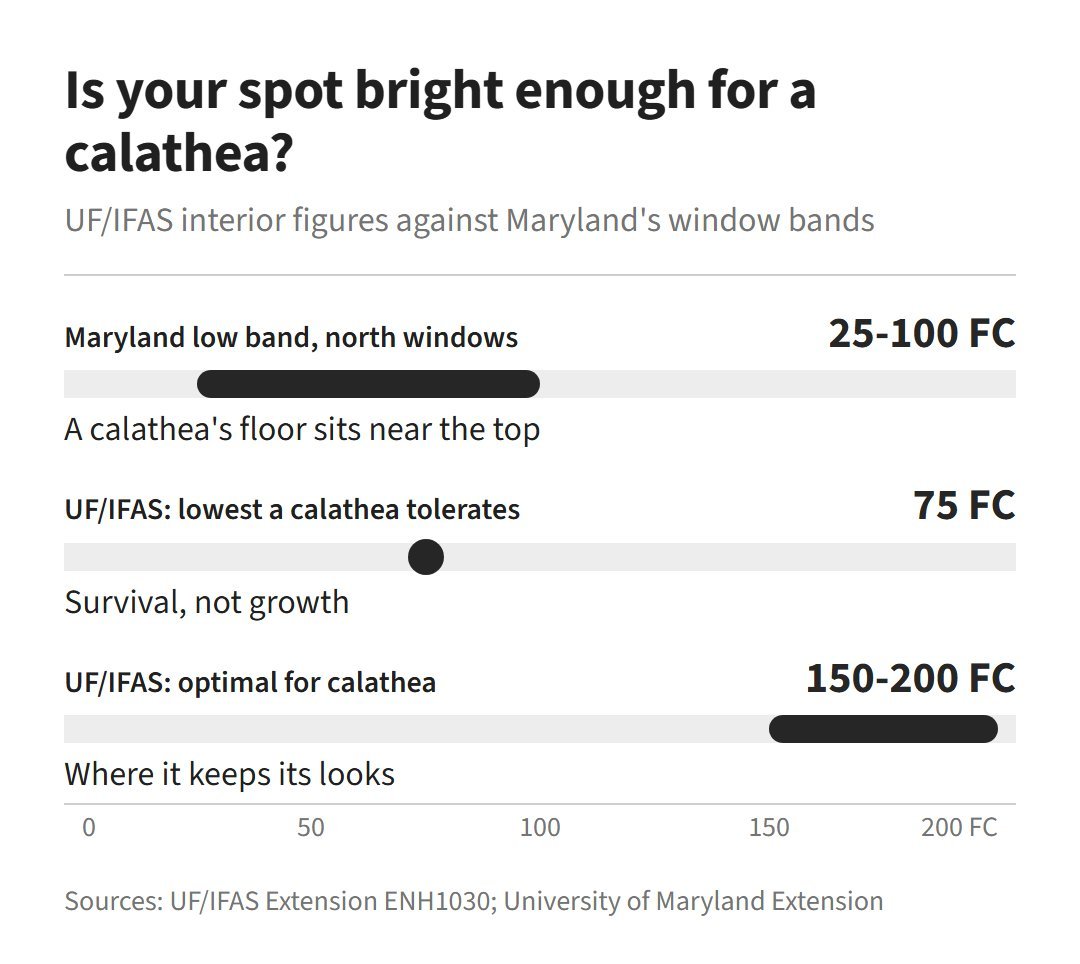
That comparison is the catch for a dim room. University of Maryland Extension puts north windows in its low band, 25 to 100 foot-candles. A calathea’s floor of 75 sits near the top of that band, and its preferred range is above it. So a north window can work if the plant sits close to the glass, but a spot across the room probably reads under the floor.
The only way to know is to measure. Take a reading at leaf height with a phone light meter and run it through the DLI calculator. I live in a north-facing apartment and use grow lights, and a calathea is the kind of plant I’d give one; grow lights for indoor plants covers what to buy and how far to hang it. For more plants that suit the same window, see north-facing window plants; if your spot is dimmer than a calathea likes, Chinese evergreen care covers the green types Clemson rates for low light.
Calathea humidity: how much is enough?
For a calathea in a home, 40 to 60% relative humidity is enough. That is the range UF/IFAS gives for interior plants, and it’s lower than the figure most care guides repeat. The sources don’t agree, and the reason is mostly about where the plant is growing:
| Source | Humidity figure | Setting |
|---|---|---|
| UF/IFAS ENH1030 | 40 to 60% | Indoor display: plants “maintain their aesthetic appearance better” in this range |
| UF/IFAS ENH1030 | 50 to 100% | Commercial greenhouse production |
| NC State, rose-painted calathea | Above 60% | Home care |
| UF/IFAS FPS86, peacock plant | “High humidity is vital,” with daily misting | Houseplant |
Several plant shop guides ask for 60% or more. I’d treat 40 to 60% as the target and the higher numbers as what a greenhouse can offer, because there is a cost to pushing a heated room toward 60% in winter.
That cost is condensation. Using the same formula as the site’s dew point calculator, air at 70°F and 40% humidity has a dew point of about 45°F. At 60%, it rises to about 55°F. Any window or exterior wall colder than that collects water, so glass that sits between about 45 and 55°F on a winter night fogs at 60% and stays clear at 40%. If your windows run wet, that’s a sign you’ve gone past what the house can hold, and how to lower humidity in the house covers the fix.
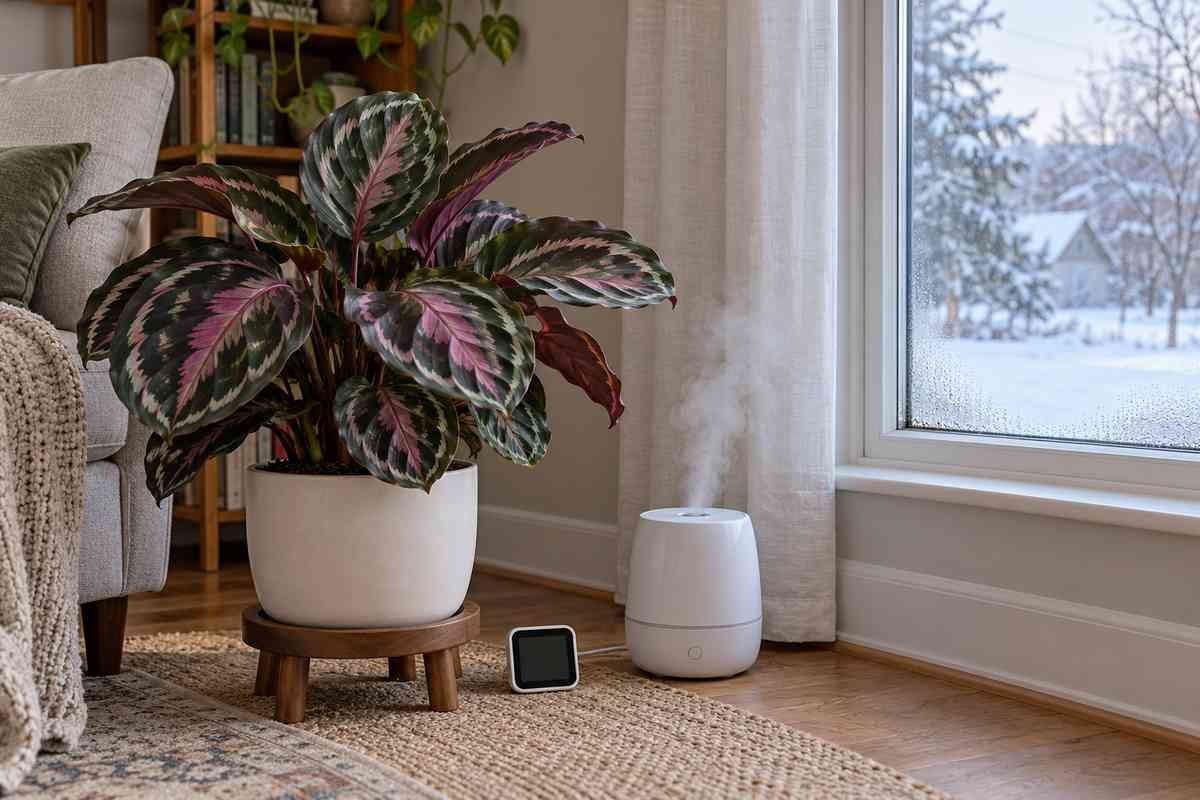
How to get there matters too. UF recommends daily misting for the peacock plant, but NC State lists leaf spot from wetting the leaves or poor air circulation as a problem on rose-painted calatheas. NC State’s suggestions are a humidifier, a pebble tray, or a bathroom or kitchen. One owner in r/calatheas, whose leaves were browning and dying, named the change that worked:
“I had this too – the leaves were browing and dying – I asked for advice here – I started fertilizing more regularly, use an LED light and then the biggest difference was the cool air humidifier. It’s made all my plants so much happier – especially the calatheas.”
– r/calatheas, September 2026 (5 upvotes)
A small hygrometer next to the pot tells you which side of 40% you’re on. How to increase humidity in the house compares humidifiers, trays and grouping plants.
What water to use and how often to water
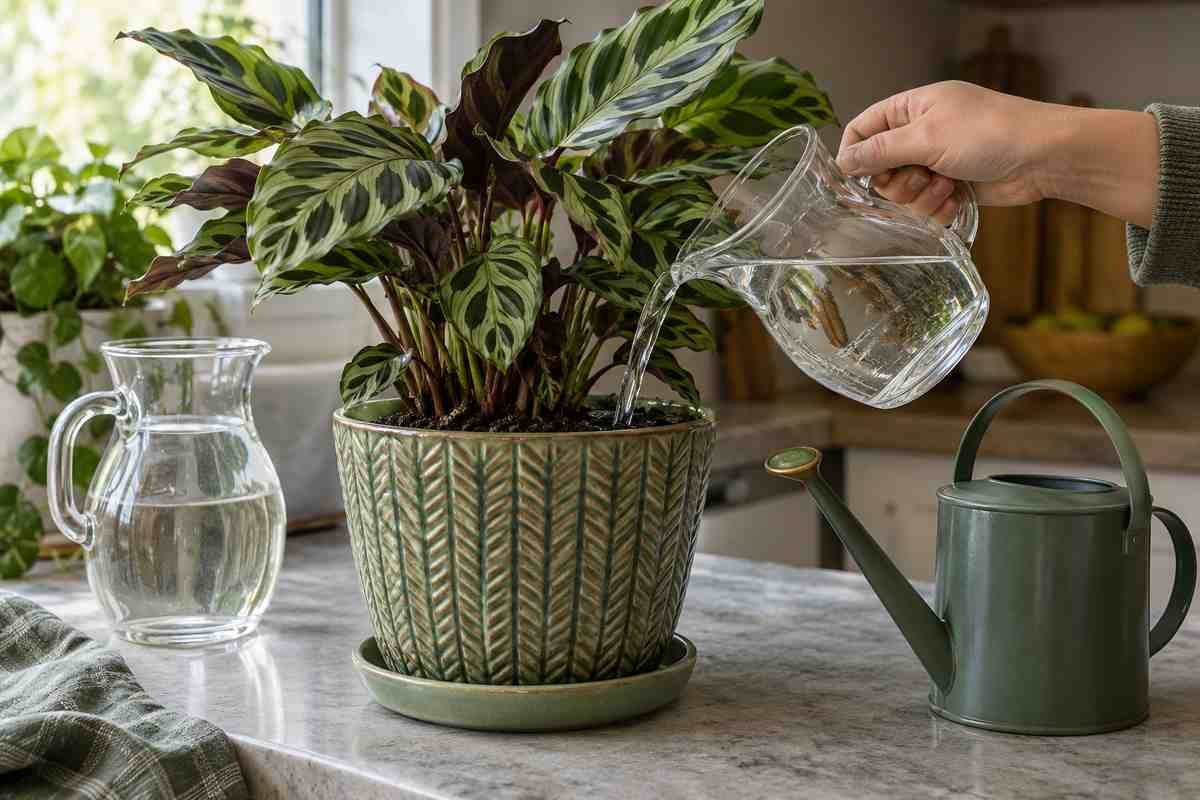
Water a calathea with distilled water or rainwater when the surface of the potting mix has dried slightly. NC State says to avoid tap water because it can damage the leaves.
Its rose-painted calathea page names the culprit: fluoride in tap water turns the foliage brown. UF lists fluoride toxicity among calathea problems and says to avoid water and fertilizer that contain it.
On timing, the extension sources describe a moisture level rather than a schedule. UF says to let the surface dry slightly; NC State wants a moist, well-drained mix that is never soggy. UF’s peacock plant sheet warns against constantly wet soil because root rots are damaging. In practice that means checking the mix with a finger instead of watering on a fixed day.
The prayer plant care guide covers the less obvious fluoride sources, perlite and superphosphate fertilizer, since maranta has the same sensitivity.
Why are my calathea leaves turning brown?
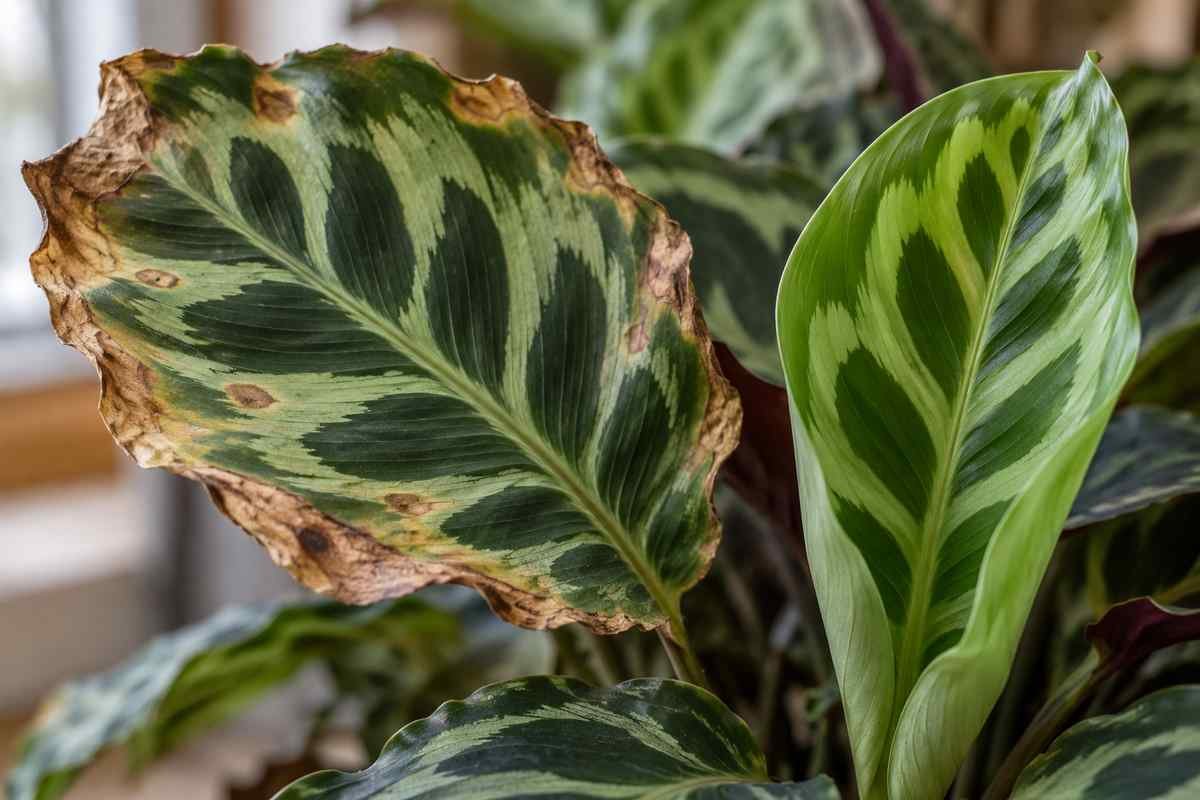
Calathea leaves turn brown for three main reasons: fluoride in the water, dry air, or too much fertilizer. Where the brown shows up helps tell them apart, using UF/IFAS’s problem table and NC State’s notes:
- Dead spots near the leaf edges: fluoride toxicity, per UF. Switch to distilled or rainwater and check that your fertilizer doesn’t contain fluoride.
- Brown, crispy edges and tips: low humidity, which NC State names on both its calathea pages. Measure the air before changing anything else.
- Dead tissue along the margins or tips after feeding: UF links this to low soil pH or excess fertilizer, particularly too much manganese, and recommends keeping the pH near 6. Feed less and at half strength.
- Bleached or scorched patches on the side facing the window: direct sun, which NC State says scorches calatheas. Move it back from the glass or diffuse the light.
Tissue that has already died won’t turn green again, so judge any fix by the leaves that come in after it.
Curling, yellowing and other calathea problems
Most other calathea problems point to water, cold or pests. NC State and UF sort them like this:
- Curling leaves: underwatering or low humidity (NC State).
- Yellowing leaves: underwatering, per NC State; UF adds too little fertilizer, overwatering or too much light.
- Drooping leaves and soft, rotting stems: overwatering or cold (NC State). Let the mix dry and move the plant away from cold glass and drafts.
- Wilting: drought or root disease, per UF, which says to keep the mix evenly moist but not wet.
- Sticky residue, cottony clumps or fine webbing: NC State lists aphids, scale, mealybugs and spider mites. How to get rid of mealybugs covers the most common one.
- Fuzzy gray growth: gray mold, also on NC State’s list.
- Spots on the leaves: leaf spot, which NC State links to wet leaves or poor air circulation.
UF’s peacock plant sheet calls the plant very sensitive to pests and diseases, so it’s worth checking under the leaves when you water. Plenty of owners struggle with it anyway. As one reply in r/calatheas put it:
“Honestly, I just wish you all the luck. I have two calatheas and neither of them are sparking joy at the moment”
– r/calatheas, September 2026 (9 upvotes)
Temperature, feeding and repotting
Keep a calathea between 65 and 75°F, NC State’s range; UF’s indoor guideline runs to 80°F. NC State also asks for ventilation without drafts and warns against sudden temperature changes, so skip the spot beside an exterior door or a heating vent.
Feed only in the growing season. NC State’s genus page says half strength; its rose-painted calathea page says monthly from spring through summer. Given UF’s warning about fertilizer burn at the leaf edges, the lighter end is the safer one.
Repot every year or two, preferably in spring, NC State says, into a rich, well-drained mix; UF’s peacock plant sheet asks for a porous one high in organic matter. Repotting is also the time to divide. UF notes that calatheas are propagated by division, with each piece keeping at least one leaf.
Calathea, Goeppertia and the prayer plant
If a plant tag says Goeppertia, it’s still a calathea. NC State explains that many species once called Calathea were moved to the genus Goeppertia, though the old name is still used in the trade and in the literature. Rose-painted calathea, for example, is now Goeppertia roseopicta.
Calatheas belong to the prayer plant family, Marantaceae, along with maranta, and NC State notes that the family is known for folding its leaves at night. So leaves that stand up in the evening and lie flat in the morning are normal behavior, not a problem. The rattlesnake plant (G. insignis), peacock plant (G. makoyana) and network prayer plant (G. kegeljanii) are all Goeppertia species on NC State’s list.
Are calatheas safe for cats and dogs?
Yes. The ASPCA lists calathea (Calathea spp.) as non-toxic to dogs, cats and horses, and its prayer plant entry, under the old name Calathea insignis, is non-toxic too. With my cat Miso at home, the ASPCA list is the first place I check, and calathea passes.
Check the botanical name before you buy, though. The ASPCA’s own prayer plant entry lists maranta, peacock plant, rattlesnake plant and zebra plant as other names, which shows how loosely the common names get used. The plant toxicity checker looks up a name against the ASPCA list.
Calathea care FAQ
Where is the best place to put a calathea?
The best place for a calathea is close to a window without direct sun on the leaves, in a spot that measures at least 75 foot-candles and ideally 150 to 200. NC State suggests a bathroom or kitchen for the extra humidity, as long as the room has a window. Keep it away from drafts and heating vents.
How do you know if a calathea is happy?
A happy calathea keeps its leaf pattern, puts out new leaves without brown edges, and folds its leaves up at night. Fading color points to low light, crispy edges to dry air or fluoride, and curling to thirst or dry air, per NC State.
Can calathea grow outdoors?
Calathea grows outdoors year-round only in frost-free climates: UF gives USDA zones 10 to 11 for the peacock plant, and NC State gives zones 11 to 12 for the genus. Outdoors it needs shade: UF says it grows in shade, and NC State says direct sun scorches it.
Is calathea care hard?
Calathea care is harder than most low-light houseplants, which is why NC State calls them higher maintenance. If you can hold 40 to 60% humidity and give the plant 150 foot-candles or a grow light, it’s manageable. If your spot reads under 75 foot-candles and you don’t want to add a light, a different plant will be happier there.

Ellie Marsh
Houseplant grower who spent years in a north-facing apartment. Writes practical care guides for low light homes, checked against extension and botanical garden sources.