Last updated on October 16, 2026
To lower humidity in a house, stop the moisture at its source, then push damp air outside: run the bathroom and kitchen exhaust fans, vent the clothes dryer outdoors, use air conditioning in summer, and add a dehumidifier only where a room stays damp. The EPA’s target is under 60 percent relative humidity, ideally 30 to 50.
Working out how to lower humidity in house air starts with a number, so buy a hygrometer before anything else. The EPA puts a basic humidity meter at $10 to $50 at many hardware stores. After that, the order matters: free fixes first, a machine last, and a lower target in January than in July.
What humidity should a house be?
A house should stay under 60 percent relative humidity all year, and ideally between 30 and 50 percent, the EPA says. In cold weather the number should drop: University of Minnesota Extension calls 25 percent in winter to 50 percent in summer healthy and comfortable for people, and better for the house.
ENERGY STAR lands in between, calling 30 to 50 percent the optimum for a building and 30 to 40 percent the range for the heating season in colder climates, to keep condensation off the windows.
ASHRAE, the heating and air-conditioning engineers’ society, sets a wider band of 30 to 60 percent, which Penn State Extension cites. All four agree on the shape: never above 60, and lower when it’s cold outside.
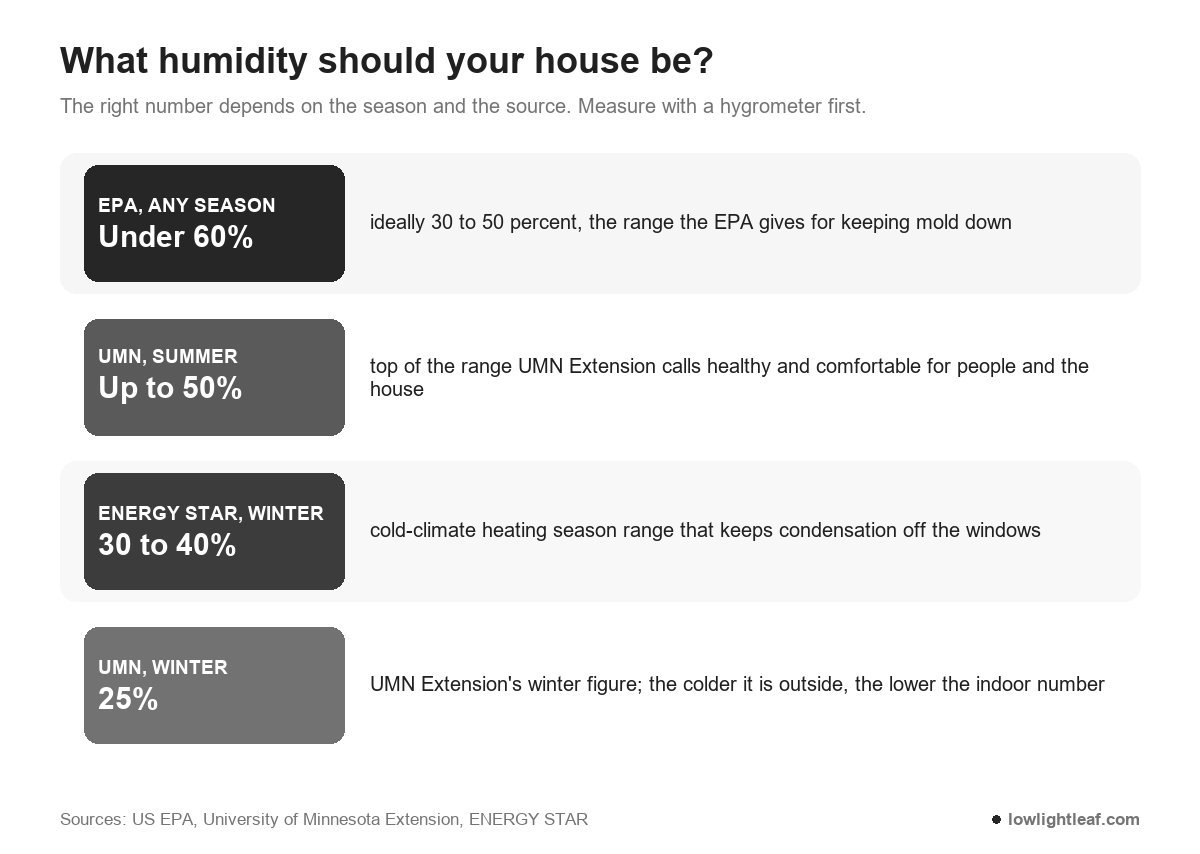
So is 63 percent too high? Yes, by the EPA’s ceiling. Seventy percent is well past it. UMN warns that moisture problems may start once relative humidity goes above 50 percent. The early signs it lists are easy to spot: water on the inside of windows in winter, bathroom mildew that keeps coming back, mold in the corner of a closet, paint that peels or blisters, and dust allergies from dust mites.
What causes high humidity in a house?
High humidity in a house comes from everyday living plus a few hidden sources. UMN Extension names bathing, cooking, dishwashing and breathing first, then plants, humidifiers, stored firewood, plumbing leaks, unvented appliances, humid outdoor air and damp soil under basements and crawl spaces.
The last item on that list hides well, since nothing about it looks wet from upstairs, and one first-time homeowner in Georgia traced the problem below the floor:
“Do you have a crawlspace? If so, does it have a vapor barrier over the dirt? This is one of the main causes of high humidity in a home and is what I’m going through as a first time homeowner. I bought a crawlspace dehumidifier and have a regular dehumidifier on my main floor. Im laying plastic soon.”
– r/Georgia, October 2025 (65 upvotes)
Water coming from the building itself sets a limit on what a fan or a portable unit can do. Bring in a contractor for a leak, damp soil under the house, or gaps that let warm, moist air into the walls and attic, which UMN says should be sealed. The EPA’s line for mold is about 10 square feet, roughly a 3-by-3-foot patch: below that, the agency says you can usually clean it up yourself, and above it, or after a lot of water damage, the agency points to experienced professionals. If you suspect mold inside the heating and cooling system, the EPA says not to run it.
Cheapest fix first: how to lower humidity in house rooms
Work down this list and stop when the hygrometer shows the number you want. The same order works whether you need to reduce humidity in a room or across the whole house, and the first seven steps cost little or nothing.
- Take a baseline reading. Put the hygrometer in the room that feels worst and check it at the same time of day for several days, so you’re judging a pattern and not one muggy afternoon.
- Fix the water you can see. Repair plumbing leaks, and dry anything that gets wet within 24 to 48 hours, which the EPA says usually keeps mold from growing. Keep the air conditioner’s drip pan clean and its drain line flowing.
- Run the exhaust fans every time. Turn on the bathroom fan, or open the window, while you shower, and use the kitchen fan when you cook or run the dishwasher. If a fan barely moves air, UMN suggests having it inspected and repaired.
- Vent the dryer and stove outside. The EPA lists clothes dryers, stoves and kerosene heaters as moisture producers to vent outdoors where possible, since combustion appliances add water vapor whenever they burn. Switch off any humidifier while you’re bringing the number down.
- In summer, let the air conditioner work. UMN recommends a properly sized air conditioner or a stand-alone dehumidifier for summer humidity. Keep the windows shut while it runs, because UMN counts humid outdoor air as a moisture source in its own right.
- In winter, open the windows a little. UMN’s cold-weather advice is to crack the windows briefly so warm, moist air leaves and cold, dry air comes in. Cold outdoor air holds less moisture to begin with and heating dries it further, Penn State Extension explains, so a short airing works in January and adds moisture on a sticky July afternoon.
- Keep air moving at cold surfaces. Where condensation collects, the EPA suggests more air movement: open interior doors and use fans. It also lists the wall behind furniture among the places condensation forms, so leave a gap between a sofa and a cold outside wall.
- Add a dehumidifier where a room stays damp. Basements and laundry rooms are the usual candidates, and ENERGY STAR sizes one by how damp the room is.
- Check that it worked. After a week, the hygrometer should hold under 50 percent in summer, the windows should stay clear on cold mornings, and any musty smell should fade. If the number won’t move, the water is probably coming from the structure and not from daily life.
In winter the problem shows up on the glass first, and a renter wiping pools of water off the sills every morning got a blunt answer:
“Usually due to bad ventilation. Do you have a ventilation system or do you open your windows from time to time? Just in your sleep you exhale enough moisture to cause that.”
– r/fixit, January 2026 (27 upvotes)
Breathing is on UMN’s list of moisture sources, and window condensation in winter is the first symptom it names. The full EPA checklist, including the condensation steps, is in its guide to mold, moisture and your home.
What size dehumidifier do you need?
A dehumidifier for a small to medium room needs 20 to 30 pints a day if the space feels damp with an occasional musty smell, ENERGY STAR says. A room that always smells damp needs 25 to 40 pints, and a wet one with sweating walls needs 30 to 50.
- Slightly to moderately damp (50 to 75 percent, musty now and then): 20 to 30 pints a day, or 30 and up for a large room over 2,000 square feet.
- Very damp (75 to 90 percent, damp spots on walls and floors): 25 to 40 pints, or 40 and up for a large room.
- Wet (90 to 100 percent, sweating walls, seepage, or laundry drying indoors): 30 to 50 pints, or 50 and up for a large room.
ENERGY STAR’s rule is that oversizing beats undersizing, and if you’re replacing an old unit, judge by how much water you empty each day. Three details decide whether it works once it’s home. Keep the doors and windows to that space closed while it runs. In a basement that stays below 65°F, look for a model rated for lower temperatures, because frost can form on the coils and the unit cycles without pulling water. Then set the humidistat to your target; every ENERGY STAR model has one, and certified units use 20 percent less energy than similar conventional ones, per the ENERGY STAR dehumidifier guide.
A whole-home dehumidifier is a bigger job. ENERGY STAR puts the fit at a fairly well-sealed house with central air that shows readings above 55 percent throughout, and the installation belongs to an HVAC professional.
Will lower humidity hurt your houseplants?
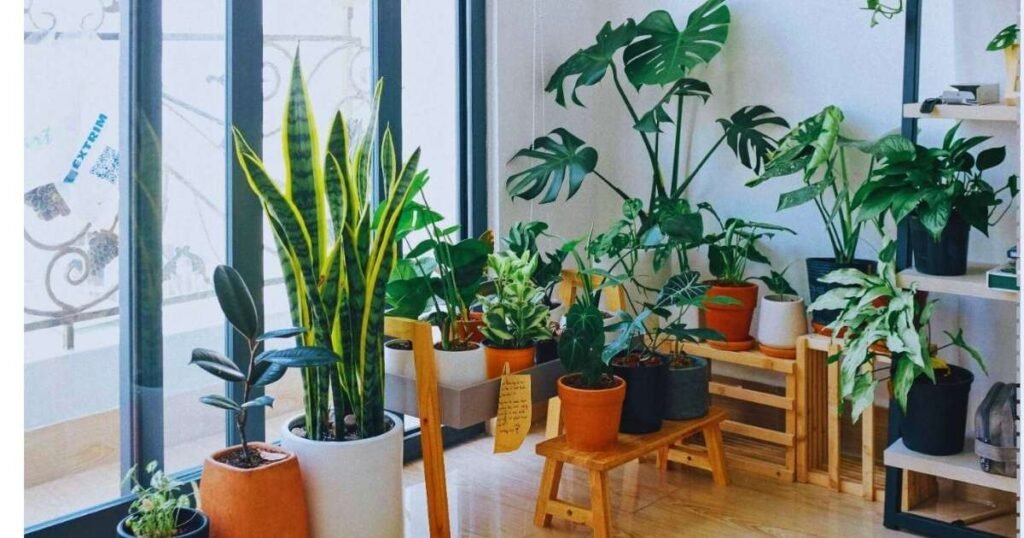
Lower humidity won’t hurt most houseplants if the air is comfortable for you. Penn State Extension says that if your home’s humidity is comfortable enough for people, plants should tolerate it through winter, and Colorado State notes that cacti and succulents adapt well to dry indoor air.
Anyone with a shelf of tropicals knows the pull in two directions, and one plant owner summed it up:
“My calatheas are happy, but I can’t breathe! 😩 Anyone got creative tricks for humidity balance?”
– r/houseplants, November 2025 (39 upvotes)
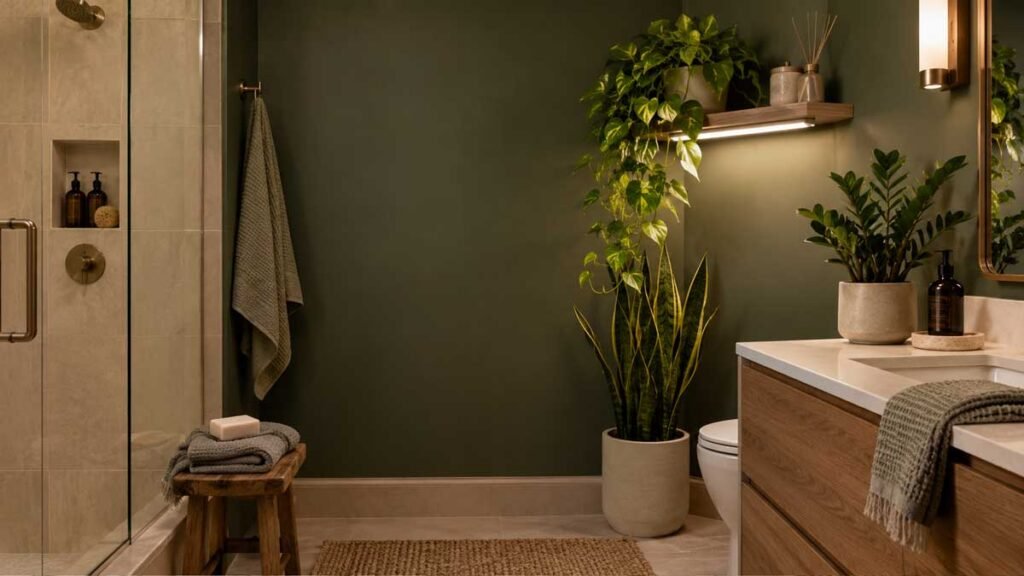
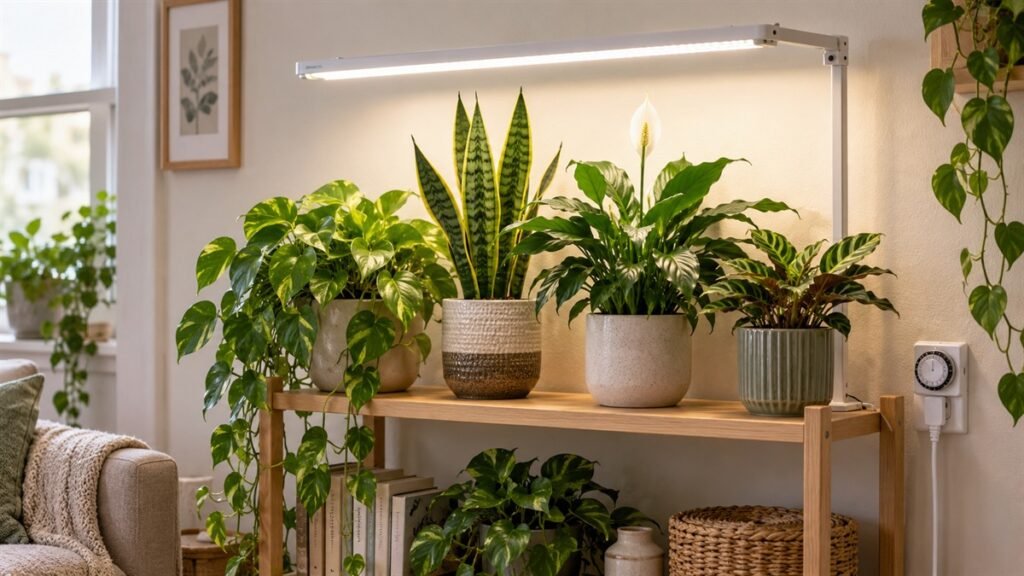
Colorado State explains the gap: most tropical houseplants come from climates at 70 to 90 percent relative humidity, while heated or air-conditioned homes can fall below 10 percent. You don’t have to run the whole house at rainforest levels to keep them going. Penn State’s suggestion is to group plants and grow the fussiest ones under glass, in a terrarium or a clear cloche that holds moisture around the leaves. A closed terrarium does that without adding moisture to the room. The bathroom is less dependable than it sounds: Penn State says its humidity depends on how often the shower runs, and bathrooms often lack light, so check which plants cope in a dim bathroom before moving anything in.
Two popular fixes do very little. Misting raises humidity only until the water evaporates, which Penn State says can take minutes, and the moisture from a pebble tray spreads into the whole room with almost no effect on the reading. If leaf edges or tips are browning, a symptom Nebraska Extension ties to low humidity, check the heating vents first; Colorado State says plants near heating or cooling vents lose water faster. In a house you’re trying to dry out, plants already suited to dry air are the easy keepers, and the succulents that handle low light are a good place to start.
Do any houseplants absorb humidity?
No houseplant works as a dehumidifier. Plants pull water from the soil and release it through tiny openings in their leaves, a process Colorado State and Nebraska Extension both explain as transpiration, which is why UMN lists plants among household moisture sources. A big collection counts as a source, not a fix. I wouldn’t buy a fern to dry out a bathroom; I’d switch on the fan.
Quick answers
Does running the heat lower humidity?
Running the heat lowers relative humidity. Penn State Extension says cold outdoor air holds less moisture to begin with and the heating process removes more, so winter indoor humidity can easily fall below 30 percent. UMN treats window condensation in winter as a sign of excess moisture indoors, so fogged glass with the heat on points to a source inside the house.
How can I dehumidify a room without a dehumidifier?
You can dehumidify a room without a dehumidifier by cutting the moisture and moving damp air out: exhaust fans during showers and cooking, a dryer vented outside, air conditioning in summer, and brief window openings in winter. Those are the EPA’s and UMN’s first steps for how to reduce humidity in house rooms, and a machine is for the room that still shows damp.

Ellie Marsh
Houseplant grower who spent years in a north-facing apartment. Writes practical care guides for low light homes, checked against extension and botanical garden sources.