Last updated on October 15, 2026
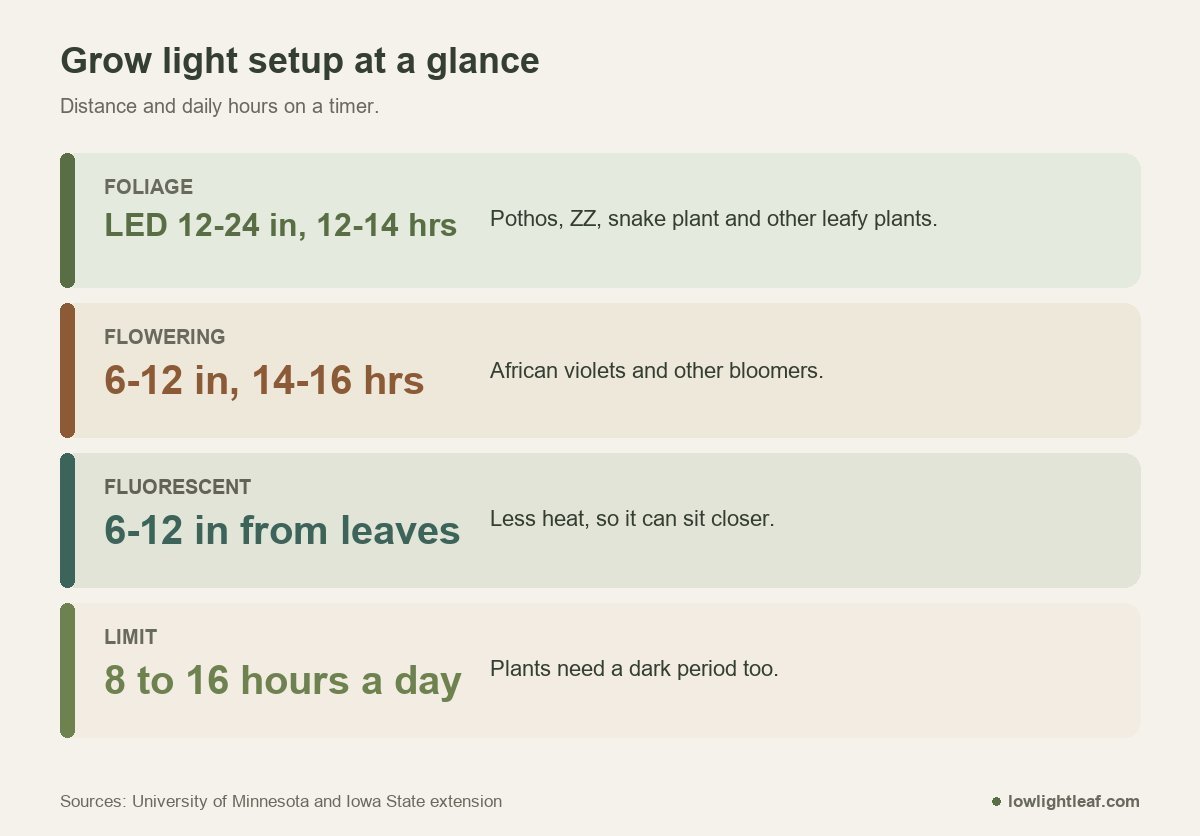
Grow lights for indoor plants work best as an LED fixture set 12 to 24 inches above leafy houseplants for 12 to 14 hours a day on a timer, closer and a little longer for flowering plants. University of Minnesota Extension gives those numbers, and Iowa State University Extension says to keep any schedule between 8 and 16 hours so plants still get a dark period.
I use grow lights for the darkest corners of my place, and the numbers matter more than the brand. Below is how to tell whether you need one, how to set it up for your situation, and how to read a label that lists lumens and watts but not much a plant can use.
Do you need a grow light?
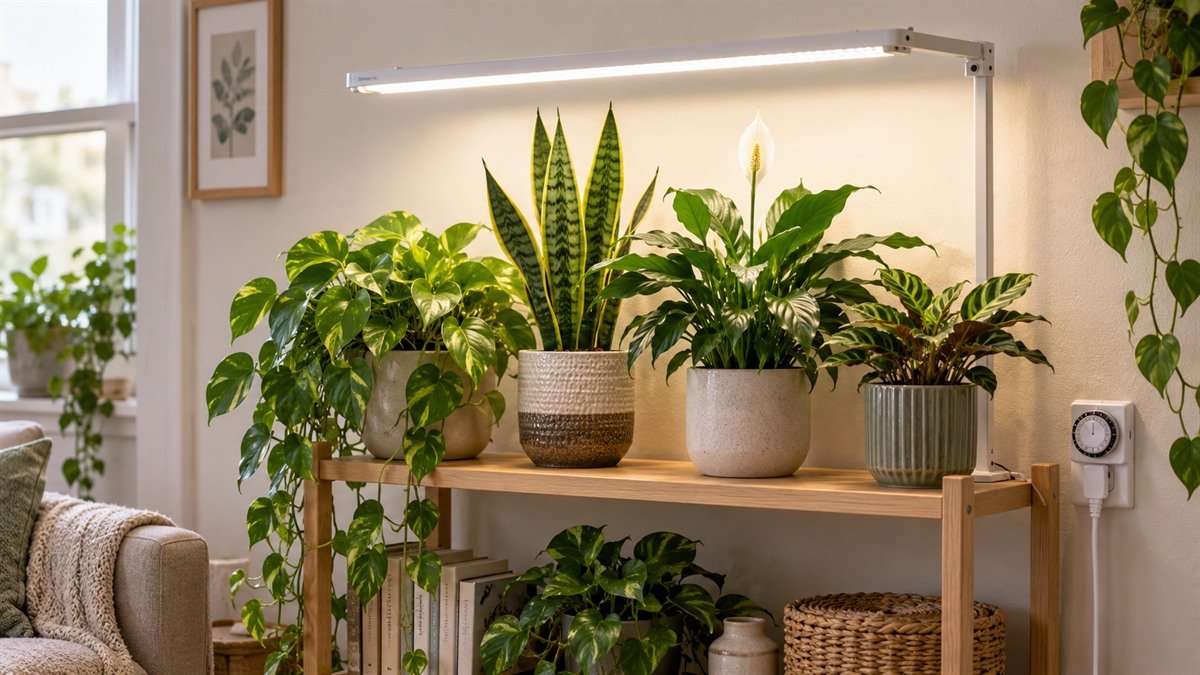
You need a grow light when a plant’s spot gives it less light than it needs, which usually means a north window, a room far from the glass, or no window at all. University of Maryland Extension puts north-facing windows at 25 to 100 foot-candles, enough only for low-light plants like ZZ, snake plant, cast iron plant and peace lily.
The signs show up in the plant first, and Maryland lists leggy stems that stretch toward the light, a lean, faded leaf color and poor flowering, while Minnesota adds that variegated leaves can revert to plain green.
A bright window is the other side of it. When a beginner asked whether a new light was doing anything for a plant beside a big southwest window, the top reply was blunt:
“That light is not adding anything above what that window is providing, Id just return it honestly”
– r/houseplants, September 2026 (1,074 upvotes)
Grow light setup by situation
Find your situation in the first column; the distances are measured from the top of the leaves to the light.
| Your situation | Fixture | Distance | Hours a day | Source |
|---|---|---|---|---|
| Leafy plants by a dim window (pothos, ZZ, snake plant) | LED grow light | 12-24 in | 12-14 total, counting daylight | University of Minnesota |
| Flowering houseplants (African violets and similar) | LED or fluorescent grow light | 6-12 in | 14-16 total | University of Minnesota |
| No natural light, made-for-plants fixture | LED or fluorescent grow light | Per the package | 14 | Iowa State |
| No natural light, budget shop fixture | 4-ft full-spectrum (“daylight”) LED shop light, at least 3,000 lumens | 18 in | 14 | Iowa State |
| No natural light, fluorescent shop fixture | 4-ft fixture, two 40-watt T5 high-output full-spectrum bulbs | 9 in | 14 | Iowa State |
| Holiday bloomers (poinsettia, Christmas cactus, kalanchoe) in fall | Daytime light only | As above | 11 or fewer; dark nights | University of Maryland; Iowa State |
The last row trips people up. Maryland says poinsettia, kalanchoe and Christmas cactus only set buds when days are 11 hours or shorter, and Iowa State warns that room lamps and street lights can “pollute” the dark period. A grow light left on into the evening can keep them from flowering, which is the same problem covered in how to get Christmas cactus to bloom.
Don’t chase precision, either. Iowa State says most home gardeners don’t need exact numbers: set the light up with the general recommendations, then adjust if growth looks wrong, and add a side light or a reflector if only the parts of the plant farthest from the fixture struggle.
How far should grow lights be from plants?
Grow lights should be 12 to 24 inches from the leaves for most LED fixtures and 6 to 12 inches for fluorescent ones. Iowa State gives those ranges by fixture type, and Minnesota uses 12 to 24 inches for foliage houseplants and 6 to 12 inches for flowering plants.
Distance matters more than people expect. Maryland notes that light intensity falls off quickly as you move away from the source, so a light that looks bright from across the room may be doing little at plant height. Fluorescent tubes run cooler than old incandescent bulbs, which is why Iowa State says they can sit closer.
A light meter settles the question faster than guessing. University of Florida’s IFAS Extension calls a hand-held digital meter that reads foot-candles or lux, accurate to one foot-candle, the best tool for houseplants, and the same meter tells you how much a window already provides.
How many hours of grow light do houseplants need?
Most leafy houseplants need 12 to 14 hours of light a day in total, and flowering houseplants 14 to 16, Minnesota says. Count daylight in that total if the plant gets some, and put the light on a timer.
Don’t leave a grow light on around the clock, since Iowa State keeps timers between 8 and 16 hours and Maryland says to stay at or under 16 hours a day in total, especially when artificial and natural light are combined.
Placement changes how much of that light reaches the leaves, as one reply to a beginner asking how long to run a light pointed out:
“12 hours. I would try to get the light away from the wall a bit, you are losing a ton of light to the wall”
– r/houseplants, September 2026 (15 upvotes)
Iowa State makes the same point about reflectors: white or Mylar surfaces bounce more of the light back toward the plant.
What to look for when you buy one
Look for an LED grow light that lists its output in PPF, plus a timer, and ignore wattage as a measure of brightness. Here is why, from the extension guides:
- Full spectrum. Iowa State recommends full-spectrum or “daylight” fixtures, or mixing cool white and warm white tubes, so plants get both blue and red light.
- PPF beats lumens and watts. Minnesota explains that lumens measure brightness to the human eye and miss wavelengths plants use, and watts measure energy use, not light. PPF, in micromoles per square meter per second, is the plant-usable number.
- LED over fluorescent over incandescent. Iowa State says LEDs run cooler, last longer and don’t fade like fluorescent tubes. It calls incandescent bulbs poor plant lights, and Minnesota adds that their far-red light makes plants stretch.
- Match the light level. Minnesota rates low-light plants at 50 to 150 PPF (50 to 250 foot-candles), medium at 150 to 250 PPF and high at 250 to 450 PPF.
- A built-in or plug-in timer. Minnesota recommends a timer so the hours stay consistent.
- Color temperature as a tuning knob. Iowa State lists switching to warmer (lower Kelvin) or cooler (higher Kelvin) bulbs as one of the adjustments when plants aren’t growing well, so it’s worth noting the Kelvin rating when you buy.
The pink or purple glow of many LED grow lights is normal, because Iowa State explains that those fixtures emit mostly red and blue, the wavelengths plants use most.
Living with a grow light
The hardest part for many people isn’t the setup but living with the glare. One new owner described the first morning with strong lights:
“recently bought some grow lights, set them up last night and this is what they looked like in the morning … I’m not sure this is right? they’re just sooo bright like is this normal? from inside the house they are blinding too, to the point it’s hard to stay in the room while they’re on edit: 1. no they were not on overnight, this was taken at 8am 2. i understand I’m supposed to get whiter lights? if anybody has recommendation for an inexpensive solution please so share \^\^”
– r/houseplants, December 2025 (1,198 upvotes)
A full-spectrum or “daylight” fixture looks closer to ordinary white light than a purple one, which Iowa State recommends anyway for a balanced spectrum, and pointing the light down at the plant instead of across the room helps too.
For a living room, a plant-light bulb in a regular lamp is often the easiest compromise, and growers suggest it often:
“You can also use a floor lamp with multiple lights/arms (forget what they’re called) and replace regular bulbs with grow bulbs that can point towards the plants.”
– r/houseplants, September 2026 (100 upvotes)
Grow lights for indoor plants FAQ
What can I use instead of a grow light?
A standard 4-foot full-spectrum LED shop light can stand in for a grow light. Iowa State suggests one with at least 3,000 lumens, hung 18 inches above the plants and on for 14 hours a day, for plants that need medium to high light.
How can you tell if a grow light is too strong or too weak?
Watch the leaves, because Iowa State says yellowing foliage or missing flowers call for more light, while excessive reddening means the light is too strong, so move the fixture or change the bulb accordingly.
Do low-light plants need a grow light?
Not if they sit near a north window. Maryland rates ZZ plant, snake plant, cast iron plant and peace lily as low-light plants for 25 to 100 foot-candles, which a north window provides; a grow light helps when they sit farther back in the room.
Start with plants that suit the light you already have, then add a light for the ones that want more. The plants that cope best without much sun are in low light indoor plants, and windowless rooms are covered in best plants for bathroom.

Ellie Marsh
Houseplant grower who spent years in a north-facing apartment. Writes practical care guides for low light homes, checked against extension and botanical garden sources.