Last updated on October 20, 2026
How to get rid of mealybugs: move the plant away from the others, dab every visible insect with rubbing alcohol diluted to 70% or less, rinse the plant, and repeat weekly until none come back. The UC Statewide IPM Program attaches one condition: try the alcohol on a small part of the plant a day or two first.
One round rarely finishes them. The eggs sit in cottony wax that sprays barely get through, so the repeats matter more than the first treatment. And for a plant that’s covered, University of Maryland Extension’s advice is to discard it.
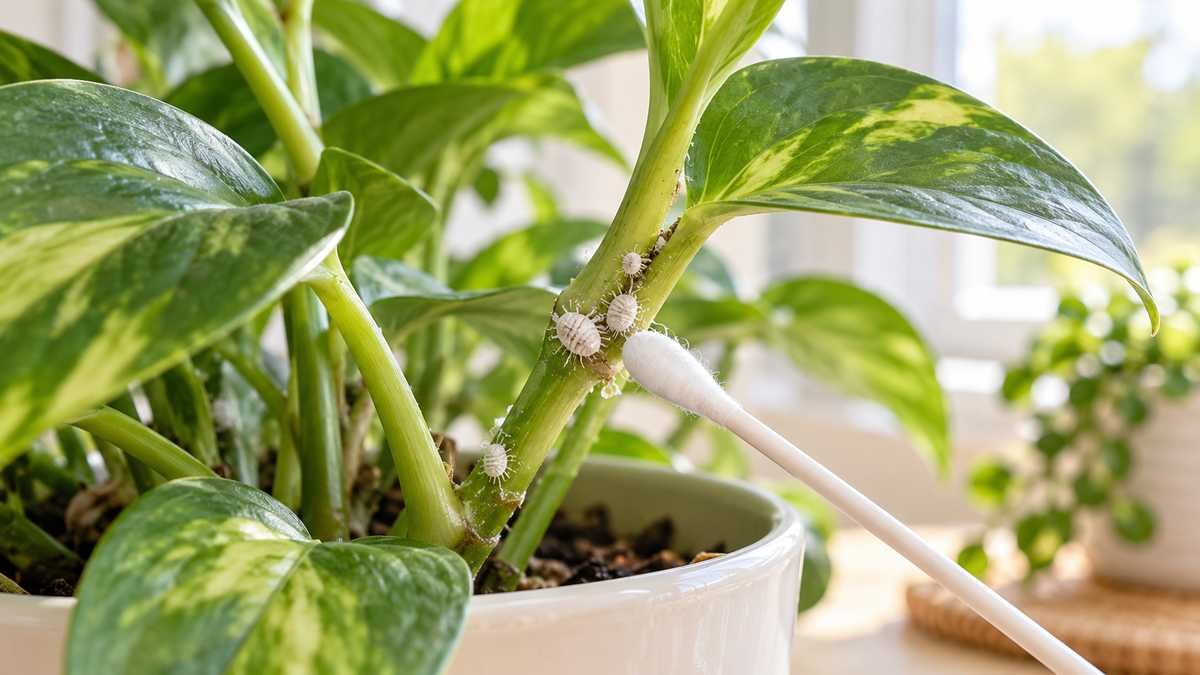
What mealybugs look like, and what they aren’t
Mealybugs are soft, slow insects about 1/20 to 1/5 of an inch long, coated in white or grey cottony wax, with waxy filaments at the rear that can look like a tail, according to University of Wisconsin-Madison Extension. University of Maryland Extension calls that cottony white wax the usual first sign of them.
They settle where they’re sheltered. UC IPM lists the crown of a plant, branch crotches and stems right at the soil line, and University of Maryland Extension adds the undersides of leaves, the flowers and even the outside of the pot. You’ll often find the sticky evidence before the insects: honeydew on the leaves or on the table below, black sooty mold growing on it, and ants walking up the stem to feed.
The damage comes from sap feeding. Healthy plants tolerate low numbers, UC IPM says, but heavier feeding brings yellow leaves, stunted growth, leaf drop and eventually a dead plant, per University of Maryland Extension and the Missouri Botanical Garden.
Several other pests wear white wax too. UC IPM names cottony cushion scale, woolly aphids, some soft scales and whiteflies as the usual mix-ups and says to look at the insect under the coating. Mealybugs keep their legs and do move, if slowly. White fuzz spread across the soil surface is a different question, covered in mold in plant soil.
The two common houseplant species don’t breed the same way. Citrus mealybugs lay 300 to 600 eggs in a fluffy egg sac, Iowa State University Extension explains, while longtailed mealybugs give birth to live young and leave no egg sacs at all. UC IPM identifies the longtailed kind by two tail filaments longer than its body. A plant with no visible egg sacs can still be raising the next generation.
“Besides being what happens when a bedbug and a locust love each other very much, I mean. I have three hoyas, a wax plant and two Hindu ropes. I’ve had them for like ten years and never seen a pest but all of a sudden my apartment is Mealybug Central.”
– r/houseplants, April 2026 (41 upvotes)
Where do they come from? Usually from another plant. Iowa State says mealybugs typically arrive on an infested plant, UC IPM adds pots and tools, and the Missouri Botanical Garden says ants carry them from one plant to the next.
Treating one plant: how to get rid of mealybugs
Isolate the plant, remove every insect you can see, and treat the places they hide, then plan to do it again. For a light infestation, UC IPM and University of Maryland Extension both start with a cotton swab dipped in rubbing alcohol.
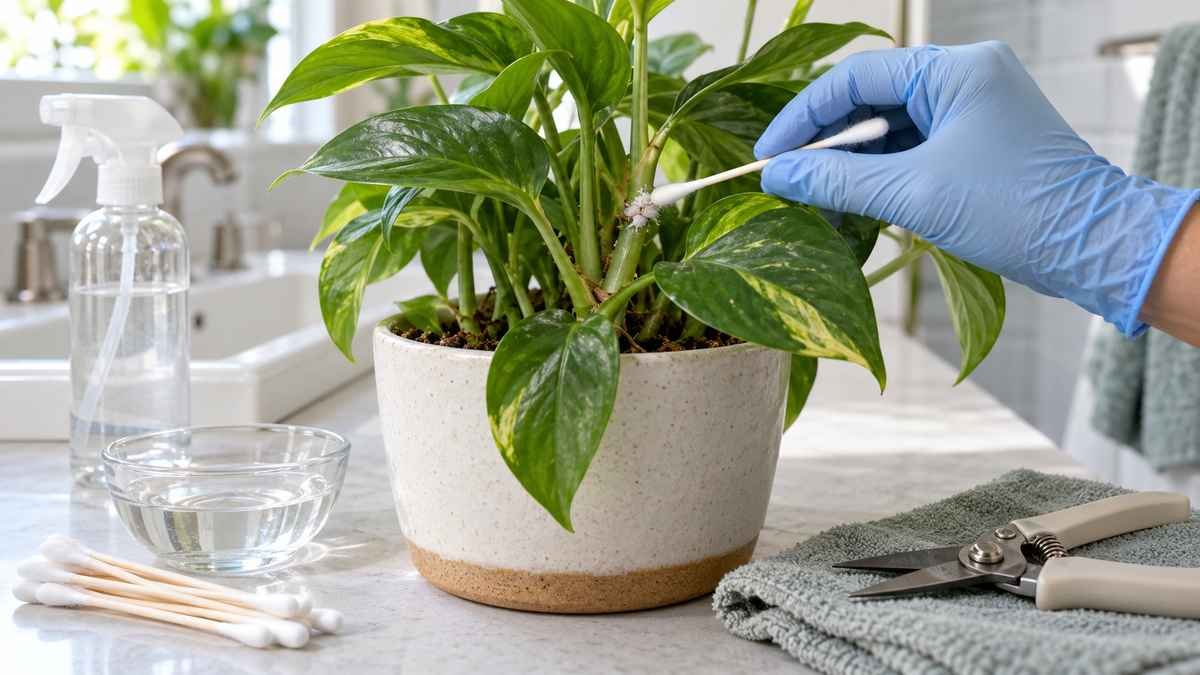
- Move it. Put the plant in another room, or at least well away from the rest. Iowa State says mealybugs crawl from plant to plant, especially where leaves overlap.
- Look everywhere. Leaf joints, leaf undersides, the crown, the stem at the soil line, the pot rim and the drainage holes. White masses around the drainage holes are Wisconsin Extension’s cue to look at the roots.
- Prune the worst growth. Washington State University Extension recommends pinching or cutting off heavily infested leaves and shoots.
- Dab the rest with alcohol. Use isopropyl (rubbing) alcohol at 70% or weaker on a cotton swab and touch the insects, not the leaves. UC IPM says to try it on a small part of the plant 1 to 2 days ahead and watch for leaf burn. Treated mealybugs turn light brown, according to University of Maryland Extension.
- Rinse. On a sturdy plant, a brisk spray of water in a tub or shower knocks off the exposed ones (Iowa State), and UC IPM suggests repeating that every few days.
- Clean the pot and stakes. UC IPM says to look over pots, stakes and other materials for egg sacs and throw out anything infested.
- Look again at every watering. University of Maryland Extension’s follow-up is to inspect the plant each time you water and treat again when you find more.
When there are too many to dab one at a time, UC IPM gives a weaker mix for spraying: a 10 to 25% isopropyl alcohol solution in a spray bottle, applied every week until the infestation is gone.
Herbs are the exception. WSU Extension doesn’t recommend chemical controls on edible plants grown indoors, and UC IPM lists rosemary and sage among the houseplants mealybugs often go after. On those, stay with the non-chemical options WSU lists: crushing, wiping and pruning them off, plus a rinse.
How often to repeat, and how long it takes
Plan on two to three treatments 10 to 14 days apart, University of Wisconsin-Madison Extension’s schedule, because the eggs and adults are protected from most insecticides. UC IPM’s alcohol method repeats every week until the mealybugs are gone.
The timing follows the life cycle. The Missouri Botanical Garden says eggs hatch in 1 to 2 weeks and females reach adulthood in about a month. The newly hatched crawlers, yellow to pink and not yet waxed, are the stage soaps and oils reach best, according to UC IPM, and they don’t stay bare for long. Indoors, every stage can be present at once, all year.
How fast do they spread? Slowly on their own. Adult females can’t fly, UC IPM says, and they don’t crawl far or fast, so outbreaks usually travel on plants, pots and tools. Overlapping leaves and ants speed things up, per Iowa State and the Missouri Botanical Garden. Wisconsin puts one generation at every one to three months, depending on temperature.
Some households stretch it out further. One commenter described the routine that worked in their house:
“When we had them on a plant we removed all the visible ones with q-tips and diluted isopropyl alcohol after isolating the plant. I would periodically check the plant (every other day or so) for more and then remove them with the alcohol mix. At the same time we sprayed the plant (and soil!) with insecticidal soap every week for a month then went to every two weeks for another few months.”
– r/IndoorPlants, May 2026 (4 upvotes)
That’s one household’s routine rather than a published one, but it agrees with the extension schedules on the point that matters: the first clean week isn’t the end.
Alcohol, soap, neem or the trash
Match the method to how bad it is: alcohol on a swab for a few insects, a dilute alcohol spray or insecticidal soap for many, and the trash for a plant coated in them. UC IPM and University of Maryland Extension both treat discarding as a sound choice for severe cases.
| Your situation | What to do | Source |
|---|---|---|
| A few mealybugs on a sturdy plant | Dab each with 70% or weaker alcohol, then rinse | UC IPM, University of Maryland |
| Many insects on stems and leaves | 10-25% alcohol spray weekly, or insecticidal soap with thorough coverage, repeated | UC IPM, University of Maryland, Colorado State |
| Herbs you cook with | Crush, wipe or prune them off and rinse; no chemical controls | WSU Extension |
| Plant is white with them, or they keep coming back | Discard it before they spread | University of Maryland, Iowa State, UC IPM |
| Yellowing or wilting with no bugs on top | Slide it out of the pot and look at the roots | Wisconsin Extension |
Dish soap is where the sources split. Iowa State’s 2004 article suggests washing plants with one tablespoon of liquid dish detergent in a quart of water. Colorado State University Extension says household soaps and cleaning products shouldn’t be used as pesticides at all, because dish detergents can injure plants and homemade mixes aren’t tested. I’d follow Colorado State and use insecticidal soap instead; it lists mealybugs among the pests most susceptible to it.
Insecticidal soap kills only on contact and leaves no residue, so each insect has to get wet. Colorado State also says some plants are sensitive to it and suggests trying a small area a day or two before spraying the whole thing.
Neem oil belongs in the same group. UC IPM says insecticidal soap, horticultural oil or neem oil applied directly can suppress mealybugs, mostly the young ones with less wax, and says to try each for leaf damage first.
Systemic insecticides are the last tier. UC IPM says imidacloprid spikes or granules may reduce crawler numbers on houseplants, but they’re less reliable against mealybugs than against other sap feeders and best avoided on flowering plants. Iowa State discourages granular soil-applied systemics because of toxicity concerns. With my cat Miso in the house, that caution settles it for me.
When it’s time to stop, UC IPM’s advice is to consider discarding a severely infested houseplant rather than treating it again and again, and to toss older “grandmother” plants that keep reinfesting newer ones.
Mealybugs in the soil and roots
Root mealybugs live in the soil and are even harder to control than the ones on leaves, according to UC IPM, which advises getting rid of infested plants quickly before the pests reach clean ones. UC IPM says they turn up most often on African violets and gardenias.
You usually see the plant before the bugs. Wisconsin Extension says yellowed or wilted foliage with no visible pests may mean an underground infestation, and white cottony masses around the drainage holes are the cue to look at the roots. UC IPM describes these ground mealybugs as having no obvious filaments, so on the roots they look more like white fluff than the tailed insects on the leaves. For mealybugs feeding just below the surface, WSU Extension says some soil may need to come away from the crown so a spray can reach them.
Keeping them out of the house
Mealybugs usually arrive on a new plant, Iowa State says, so the best defense is a quarantine shelf. Iowa State suggests 7 to 10 days, the Missouri Botanical Garden 2 to 3 weeks, and WSU Extension about a month for plants moved in from outdoors.
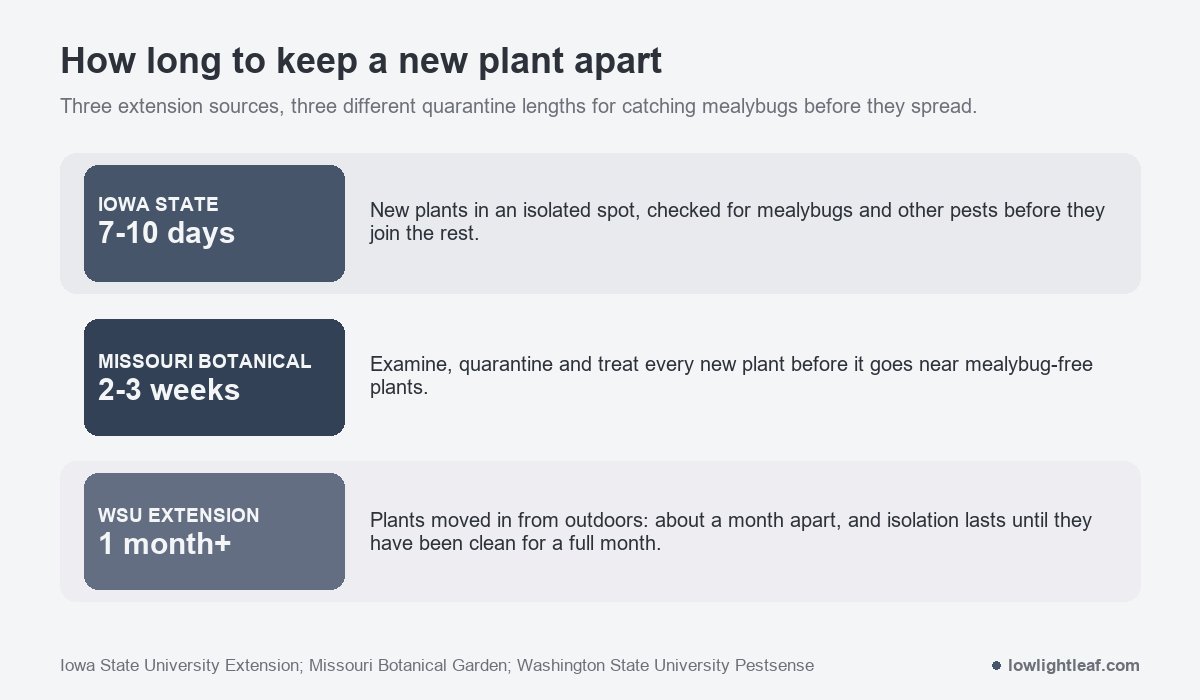
The longer windows exist for a reason. A plant can look clean when you bring it home:
“I brought this monstera adansonii a couple of weeks ago from a local nursery. It looked fine this entire time. I’ve been watching a leaf unfurl the past few days. Yesterday, it open a lot more and to my horror I saw mealy bugs inside. 😭 Upon closer inspection, mealy bug were in several places along the stem.”
– r/IndoorPlants, May 2026 (4 upvotes)
A couple of weeks would have cleared Iowa State’s window and only just reached the low end of the Missouri Botanical Garden’s.
Plants coming in for winter are the other risk. WSU’s first advice is not to move outdoor plants inside at all; if you must, keep them in a spare room and treat them until they’ve been clean for at least a full month before they rejoin the others. That applies to anything carried in for the cold months, including overwintered geraniums.
Go easy on fertilizer, too. WSU says mealybugs thrive on lush new growth and suggests a lower-nitrogen or slow-release product, and UC IPM links heavy nitrogen to the tender growth where mealybugs lay their eggs.

Ellie Marsh
Houseplant grower who spent years in a north-facing apartment. Writes practical care guides for low light homes, checked against extension and botanical garden sources.