Last updated on October 22, 2026
A Norfolk Island pine needs a bright east, west or south window, water when the top inch of soil is dry, humidity close to 50%, and a spot away from heat vents. Purdue University’s consumer horticulture team says the plant thrives at 50% relative humidity, while a heated house can drop to about 15% in winter.
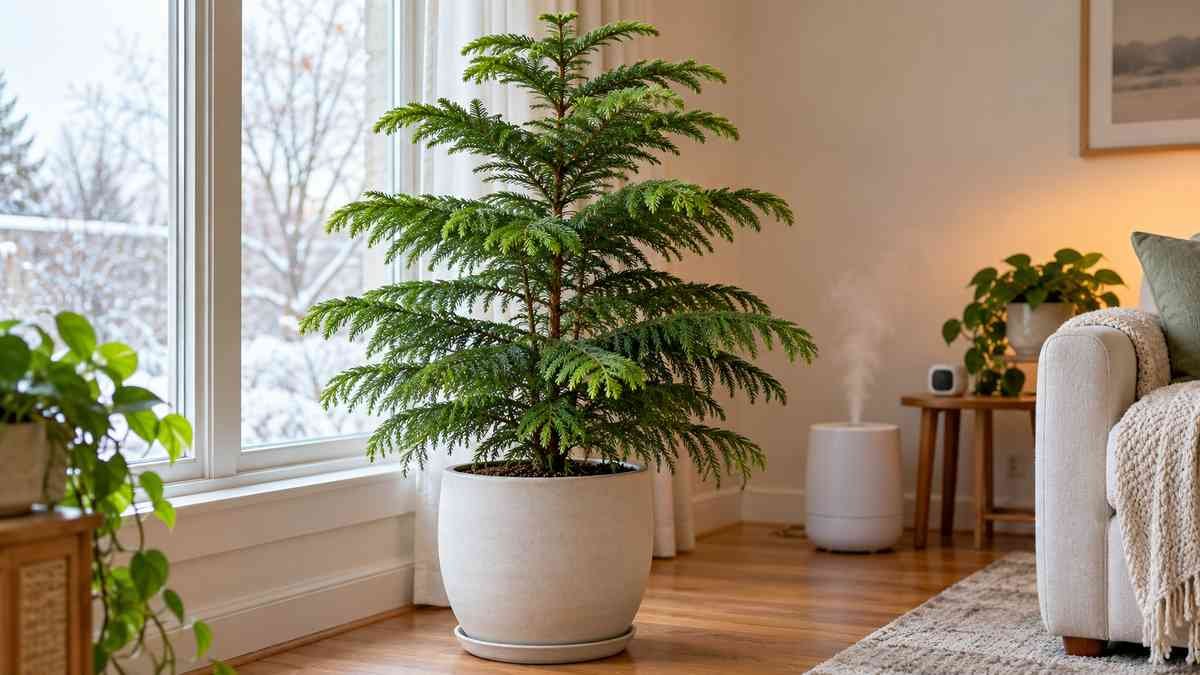
That gap is where most Norfolk Island pine care goes wrong after the holidays. The tree is sold as a tabletop Christmas decoration, but it is a subtropical conifer, Araucaria heterophylla, from Norfolk Island in the South Pacific, and branches it drops under stress never grow back.
Can a Norfolk Island pine live in low light?
A Norfolk Island pine can’t live well in low light. The New York Botanical Garden says northern light is not strong enough and that needles fall when light is too weak; it wants an east, west or south window instead.
That makes it an odd fit for a site about dim rooms, and I’d rather say so plainly. After years in a north-facing apartment, this is one holiday plant I wouldn’t put in that kind of window. If you still want to try, a grow light is the only route I’d consider, and none of the sources here test one for this tree, so treat it as an experiment. Plants that do cope with northern light are in north-facing window plants. A holiday plant that copes better with a dim window is a Christmas cactus, which Purdue says adapts to low light, though it flowers less; see Christmas cactus care.
Where light is good, the details still matter. NYBG suggests a spot close to an east window, a few feet back in a bright south-facing room, or a west window with protection from harsh late-afternoon sun. Purdue says the tree adapts to bright, indirect light but looks best with a couple of hours of direct sun each day.
Low light shows up slowly. Illinois Extension says the branches grow long and droopy and top growth slows, and NYBG describes lanky, lopsided trees. Turn the pot a quarter turn each week, Purdue suggests, so it doesn’t lean toward the window.
One Illinois Extension writer allows more room: the tree can tolerate lower light if it is moved down in steps, because it came from a greenhouse in full sun. That is a gradual move from a sunnier spot, not a reason to start it in a dim corner.
Watering a Norfolk Island pine
Water a Norfolk Island pine thoroughly when the top inch of soil feels dry, then pour off what drains into the saucer after about 15 minutes. That is Purdue’s method, and NYBG gives the same 15-minute window for emptying the dish.
How dry is too dry is where the advice splits. NYBG says not to let the roots dry completely and not to keep the soil wet. One Illinois Extension post says to let the soil dry completely between waterings; another from the same extension service just says to let it dry between waterings. Iowa State waters when the surface is dry.
The consistent warning is about extremes. Illinois says overwatering can cost the tree its branches, and NYBG lists both overwatering and underwatering as causes of brown needles. A pot full of roots dries out fast, NYBG adds, so a tree that dries out much faster than it used to may need a bigger pot.
In winter, NYBG lowers the watering a little along with the room temperature, so the plant rests while light is low, but it still keeps the soil just moist. It also suggests tepid water rather than cold.
Norfolk Island pine care in winter: humidity and temperature
Winter Norfolk Island pine care is mostly about air. Purdue says the plant needs about 50% relative humidity and that ordinary heated homes fall to around 15%, which is why it calls humidity the most challenging part for home growers. NYBG puts the target above 50% and suggests keeping a hygrometer near the plant. I’d put that in place first, because the reading tells you whether any of the fixes below are working.
Purdue rates a humidifier as the most effective fix. A pebble tray helps too: UF IFAS describes a saucer of water and gravel with the pot resting on the stones, not in the water. NYBG also suggests misting twice a day, and Iowa State recommends a humidifier or pebble tray for the same winter problem. If you want the bigger picture of raising humidity in a dry house, it’s in how to increase humidity in house air.
Temperature has a range rather than a single number, and the sources set it slightly differently:
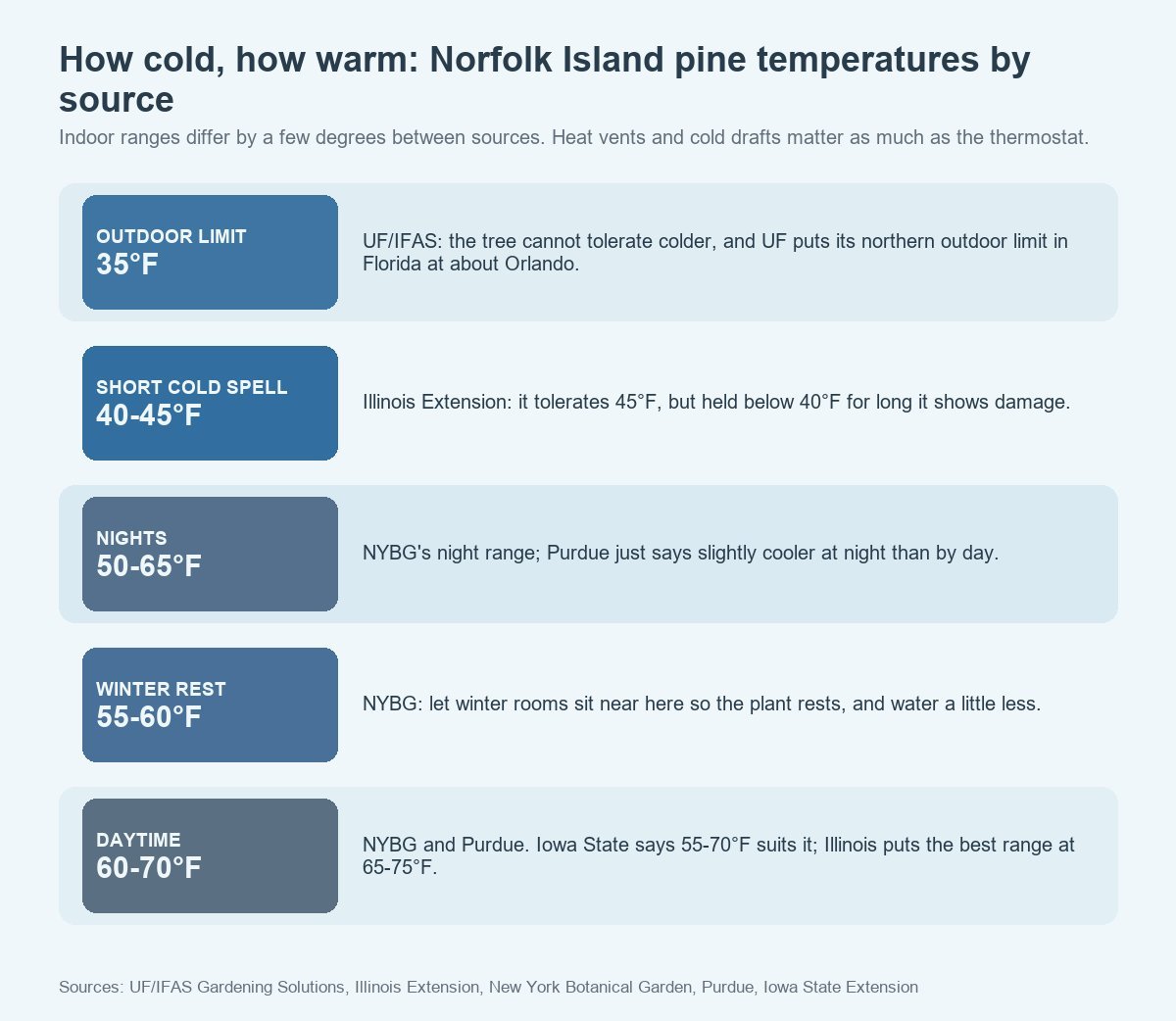
In text: NYBG and Purdue give 60 to 70°F by day and a little cooler at night, Iowa State says 55 to 70°F suits the tree, and Illinois puts its best range at 65 to 75°F. NYBG suggests letting winter rooms sit around 55 to 60°F so the plant can rest, and warns that the tree isn’t a good long-term choice for a home kept on the warm side.
Drafts count as much as the thermostat. NYBG says blasts of hot or cold air from a heating or air-conditioning vent stress the tree, and that floor and ceiling vents are easy to miss. Keep it away from outside doors and drafty windows too. Illinois adds that the plant should be covered for the trip home from the store, because sudden dry or cold air causes needle drop.
Brown needles and bare branches: what’s normal and what isn’t
A few brown needles on the lowest branches, appearing slowly, are normal aging. Purdue and NYBG both say so, and Purdue adds that lower light can also be behind it. Browning that spreads across many branches, or shows up above the bottom tier, means something in the plant’s conditions is wrong.
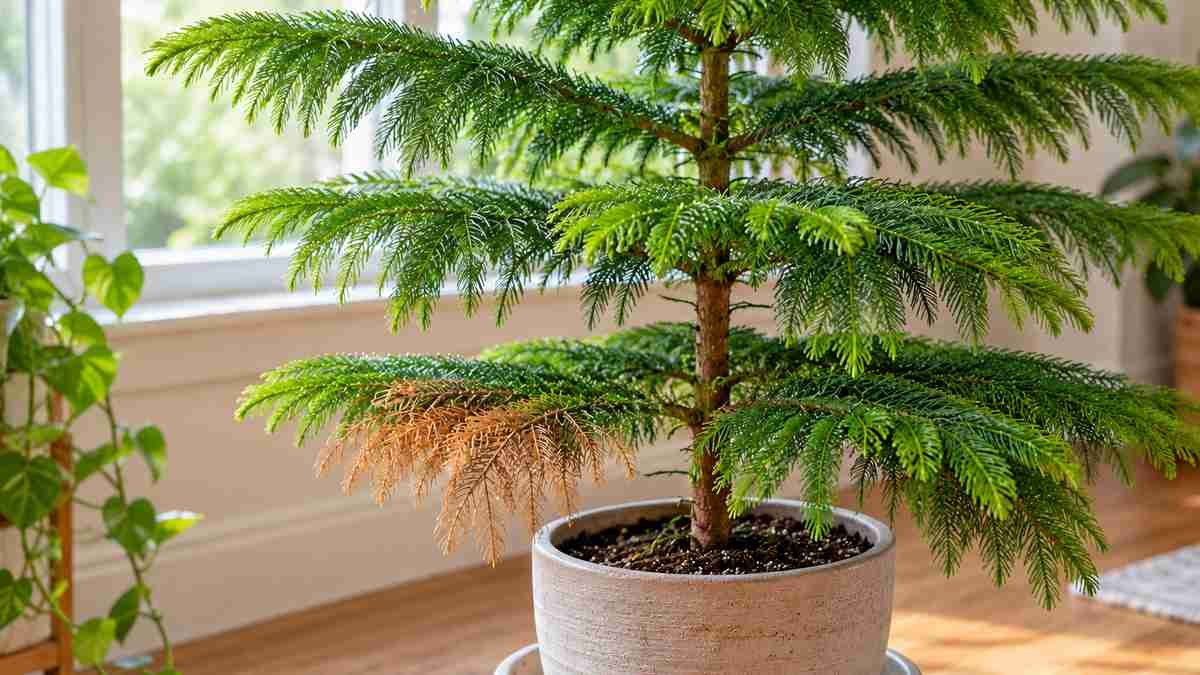
Work through the likely causes in order:
- Dry air. NYBG says low winter humidity, when the heat runs most, is very frequently the source of browning. Iowa State links low humidity to brown branch tips and lost lower branches.
- Watering in either direction. A pot with no drain hole or a saucer that never gets emptied overwaters the tree; a pot packed with roots underwaters it (NYBG).
- Drafts. Hot or cold blasts from vents, doors and windows brown the needles or make them drop (NYBG, Purdue, Illinois).
- Harsh sun. A couple of hours of direct sun is fine, NYBG says, but harsh midday sun can burn the needles.
- Spider mites. NYBG says they like warm, dry rooms. Look for fine webbing in the brown areas, rinse the branches with water, and raise the humidity.
- Too little light. Iowa State lists insufficient light alongside dry air and dry soil as causes of lost lower branches.
Fixing the cause stops the damage from spreading. It won’t undo it. NYBG answers a reader whose tree had a bare trunk with branches only at the top: the lost branches will not grow back, and the tree will always look somewhat like a palm. Illinois says the same about branches broken by passing traffic, so place the pot out of the way.
So the honest answer to bringing a Norfolk pine back is partial. You can save the branches it still has and the new growth at the top. Bare stretches of trunk stay bare.
Feeding, repotting and why you shouldn’t top it
Feeding is the easy part of Norfolk Island pine care: feed only while it grows. NYBG uses a dilute houseplant fertilizer every two weeks from March through September, Iowa State feeds every 2 to 4 weeks from spring to early fall, and Purdue skips fertilizer during the winter rest. NYBG also warns that too many feedings make the plant’s structure weak.
Repot in spring, and not often. NYBG says every two to three years is usually enough, or when roots show on the soil surface or through the bottom of the pot. The roots are delicate, so handle the root ball gently.
- Choose a pot only one size bigger, such as 8 inches to 10, NYBG says. A much larger pot leaves a ring of new soil with no roots in it, which stays wet and can rot the roots.
- Use a mildly acidic, soil-based mix with peat moss and coarse sand or perlite, in a pot with a drain hole.
- Water it in and drain it the same way as any other watering.
- If the tree leans and the next pot size still isn’t enough, NYBG suggests staking it and repotting again the following spring.
Pruning is where a mistake becomes permanent. NYBG says cutting off the top stops the tree growing from that point, and that trimming side branches to control size removes the soft branch tips that give the tree its look; most gardeners who try it end up unhappy with the result. The same rule applies to propagation: only a cutting from the very top grows into a symmetrical tree, and side-branch cuttings won’t grow upright. Small plantlets that sprout at the base can be potted up on their own, NYBG notes.
Decorating it as a Christmas tree
Using it as a small living Christmas tree is normal. Iowa State notes that many people decorate theirs with miniature lights, ribbons and ornaments, and Purdue calls it a terrific living Christmas tree. Illinois Extension notes that some are sold already decorated with little balls and tinsel.
With Miso in the house, I looked it up before anything else. The ASPCA lists Norfolk Island pine, under the name Australian pine, as non-toxic to cats, dogs and horses. Tinsel and a cat are a separate problem, and the comparison with a cut tree is in are Christmas trees toxic to cats.
Norfolk Island pine questions
How big do Norfolk pines get indoors?
Indoors, a Norfolk pine grows slowly, about 3 to 6 inches a year according to Illinois Extension, and NYBG puts it at no more than about 6 inches. UF IFAS says it may reach 5 to 8 feet as a houseplant after about a decade, and Illinois describes mature houseplants around six feet tall and four feet wide.
Can a Norfolk pine stay outside in winter?
A Norfolk pine can stay outside in winter only in USDA zones 10 and 11, according to NYBG and Illinois Extension. UF IFAS says it can’t tolerate temperatures below 35°F, and Illinois says a tree held below 40°F for long shows damage, so bring it in well before frost.
Is a Norfolk Island pine a real pine?
A Norfolk Island pine is not a true pine. NYBG, Illinois and UF all place it in Araucariaceae, an ancient conifer family separate from the true pines, and in its native range it can reach about 200 feet tall.

Ellie Marsh
Houseplant grower who spent years in a north-facing apartment. Writes practical care guides for low light homes, checked against extension and botanical garden sources.