A heartleaf philodendron grows in anything from bright indirect light to a north window or ordinary room light, as long as it gets no direct sun. Water it when the top inch of soil is dry, keep it above 50°F, and keep it away from pets, because the ASPCA lists it as toxic to cats and dogs.
The plant is Philodendron hederaceum, sold under several older names, and Clemson Extension is comfortable placing it at a north window or under ordinary room light. The harder part is often making sure you have one, because it is easily confused with pothos.
How much light does a heartleaf philodendron need?
A heartleaf philodendron needs less light than most houseplants. Clemson Extension says it grows well near a north, east or west window or under artificial or existing room light, and NC State says it can survive long periods in extremely low light.
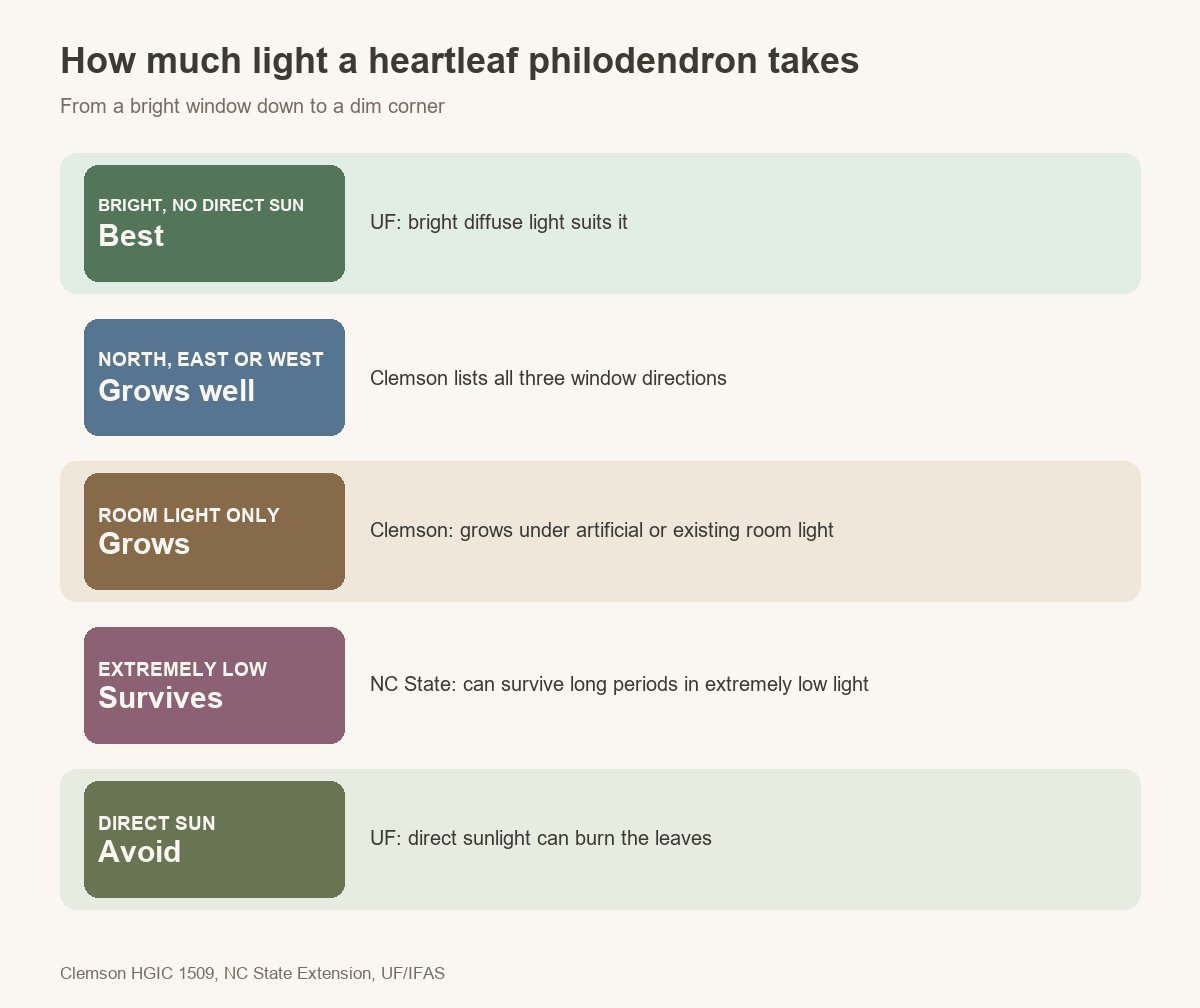
That north window matters to me. After years in a north-facing apartment, I’d put this plant near the top of the list for a room like that, and I’d still give it the brightest spot the room has, because UF/IFAS says it enjoys bright, diffuse light and NC State says it prefers medium light even though it tolerates low. A north-facing window is still a place it grows. Farther from the glass, NC State’s word is survive, not thrive.
Direct sun is the one placement to avoid. UF says direct sunlight can burn the leaves, and a west window with a little evening sun can be enough to mark them, as one grower found:
“It sits by a large west facing window, maybe 1-2 hours of direct evening light per day, indirect light the rest of the day.”
– r/plantclinic, August 2026 (6 upvotes)
The replies in that thread read the dry brown spots as burn damage. UF’s advice is to keep the plant out of direct sun, so moving it back from that window is the fix.
Watering and temperature
Water a heartleaf philodendron when the top inch of soil feels dry. That is the University of Florida’s rule, and it pairs it with a light, well-drained potting mix so the roots never sit wet.
Clemson and NC State lean slightly wetter. Clemson says to keep the soil evenly moist but not soggy and never let the pot stand in water; NC State says slightly moist, with less water in winter. In a dim room the soil dries slowly, so I’d go by the UF top-inch method there and let the winter slowdown happen on its own. Clemson’s warning is the one all three share: root rot comes from a mix that drains slowly or from watering too often.
Temperature is the stricter limit. UF says temperatures below 50°F are too cool, and Clemson puts the heartleaf’s comfort range at 70 to 85°F by day and 65 to 75°F at night. Both UF and Clemson say it tolerates the low humidity of a typical home, and NC State adds that it appreciates misting.
Feeding, repotting and yellow leaves
Feed lightly. UF suggests fertilizer every three to four months, and Clemson recommends a dilute water-soluble houseplant fertilizer or a time-release product. Both say too much fertilizer makes the leaf tips curl and turn brown.
Yellow lower leaves point to the other two mistakes. Clemson links yellowing lower leaves and dying growing tips to too little light or overwatering, and UF names the same pair. In a dim room, I’d fix the watering first, since moving to brighter light isn’t always possible.
Repotting has no fixed schedule. Clemson says an overcrowded plant can be repotted in any season using a general-purpose potting soil. Pests are uncommon, but all three extension services list aphids, mealybugs, scale and spider mites; if mealybugs turn up, see how to get rid of mealybugs.
Heartleaf philodendron vs pothos: two checks
Two checks separate a heartleaf philodendron from pothos. Clemson says pothos leaf stalks are grooved and philodendron leaf stalks aren’t, and that each new philodendron leaf emerges from a sheath that dries up and falls off, which pothos doesn’t have.
| Look at | Heartleaf philodendron | Pothos (Epipremnum aureum) |
|---|---|---|
| The leaf stalk (petiole) | No groove (Clemson, NC State) | Grooved along its length (Clemson) |
| A new leaf unfurling | Wrapped in a sheath that dries and falls off; NC State notes messy, falling stipules on older growth | No sheath (Clemson) |
| The leaf surface | Glossy green, bronzed when young (Clemson) | Folded along the midrib, often flecked with gold, white or yellow (Clemson) |
| Light it needs | Copes with very low light (Clemson) | Needs brighter light and warmer temperatures (Clemson) |
The sheath can look odd when it colors up. A grower who asked about giant red-orange new growth on a heartleaf got this answer:
“It’s just a cataphyll, the sheath that holds a new leaf. Sometimes they are red with light changes or as the plant matures or temp or humidity changes, it’s just a way they express their colors.”
– r/houseplants, November 2025 (5 upvotes)
The light row is why the difference matters in a dim home. If the plant on your north windowsill turns out to be pothos, Clemson’s note means it wants a brighter spot than a philodendron would. The chartreuse look-alikes, Lemon Lime philodendron and Neon pothos, are compared in pothos plant varieties.
Brasil, micans and the other forms
Philodendron Brasil, philodendron micans and the plain green heartleaf are all one species. NC State lists P. micans, P. oxycardium and P. scandens as former names of Philodendron hederaceum, and Clemson describes the green and velvet plants as two forms of it, so the care above applies to all of them.
Philodendron Brasil and other striped cultivars
‘Brasil’ has a yellow to light green stripe down the center of each leaf with dark green borders, NC State says, and NC State describes its variegation as unstable. NC State’s list also includes ‘Lemon Lime’ (bright yellow to chartreuse), ‘Rio’ (silver and cream center, dark green edges), ‘Cream Splash’, ‘Silver Stripe’ and ‘Gabby’, whose leaves may turn entirely cream. Clemson adds ‘Aureum’, with chartreuse leaves, and a ‘Variegatum’ whose gray, green and cream streaks show more in a cool, shaded spot.
Philodendron micans, the velvet form
Philodendron micans is the velvet form. Clemson describes velvet-textured, heart-shaped leaves that are usually bronze, with reddish-brown undersides, and lists ‘Miduhoi’ (sometimes sold as jumbo velvet hearts) and ‘Silver Sheen’ as selections of it.
Propagating heartleaf philodendron
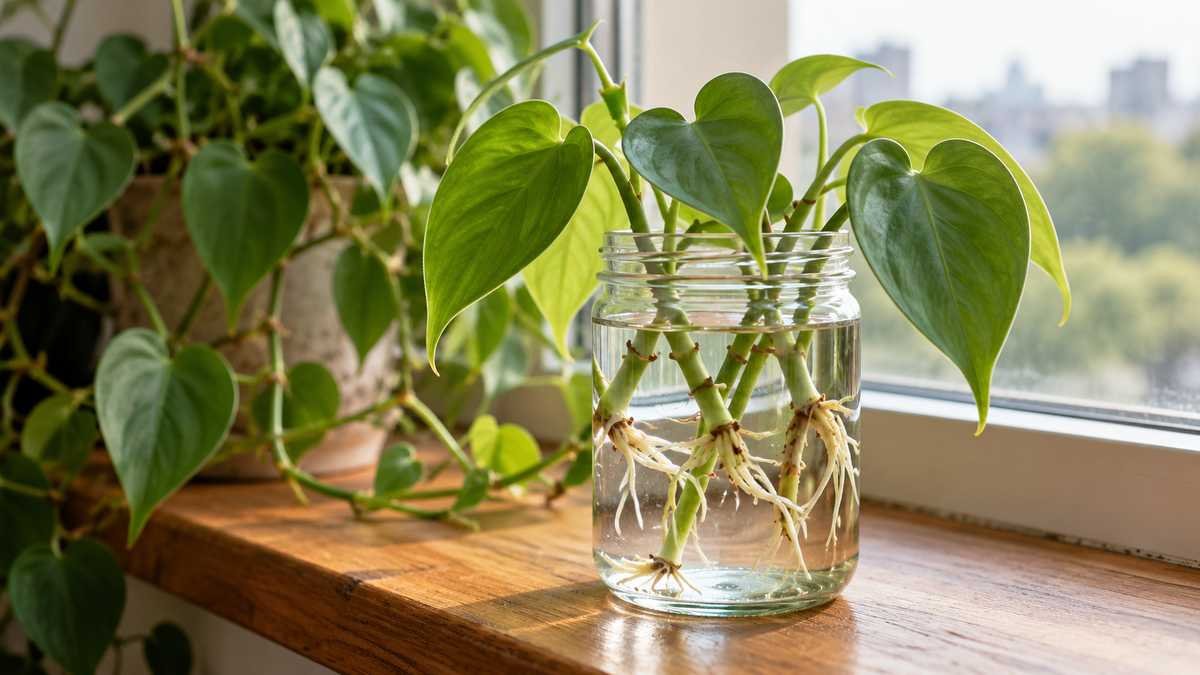
Heartleaf philodendron is propagated from short stem cuttings planted in clean potting mix, UF says, and Clemson adds that cuttings or air layering work in any season. NC State lists stem cuttings as the recommended method. Rooting isn’t always quick, though, and one grower who rooted both noticed the difference:
“I have noticed a consistent theme: heartleaf Philo cuttings take FAR longer to do anything than any pothos.”
– r/pothos, October 2025 (6 upvotes)
Is heartleaf philodendron toxic to cats?
Yes, heartleaf philodendron is toxic to cats. The ASPCA lists it as toxic to cats, dogs and horses because of insoluble calcium oxalates, with signs that include mouth pain and swelling, heavy drooling, vomiting and difficulty swallowing.
Clemson says all parts of the plant are toxic if eaten, and UF adds that the sap can give people an itchy rash. With Miso in the house, I’d only keep one where a cat can’t reach it, such as a high hanging basket, which is also UF’s advice: place it where curious paws can’t get to it. The same calcium oxalate problem applies to pothos, covered in is pothos toxic to cats, and safer picks are in pet friendly indoor plants.
Heartleaf philodendron questions
How big does a heartleaf philodendron get?
A heartleaf philodendron can reach up to 13 feet, according to NC State, but indoors its size depends on its support, training and pruning, UF says. Its leaves are usually 2 to 4 inches across.
Can heartleaf philodendron grow outside?
Heartleaf philodendron grows outside year-round only in USDA zones 10B to 11, according to UF/IFAS, where it can cover shady ground or climb a tree. UF says leaves on a climbing plant there can reach 12 inches or more, far larger than the 2- to 4-inch leaves of a houseplant.

Ellie Marsh
Houseplant grower who spent years in a north-facing apartment. Writes practical care guides for low light homes, checked against extension and botanical garden sources.