Last updated on November 15, 2026
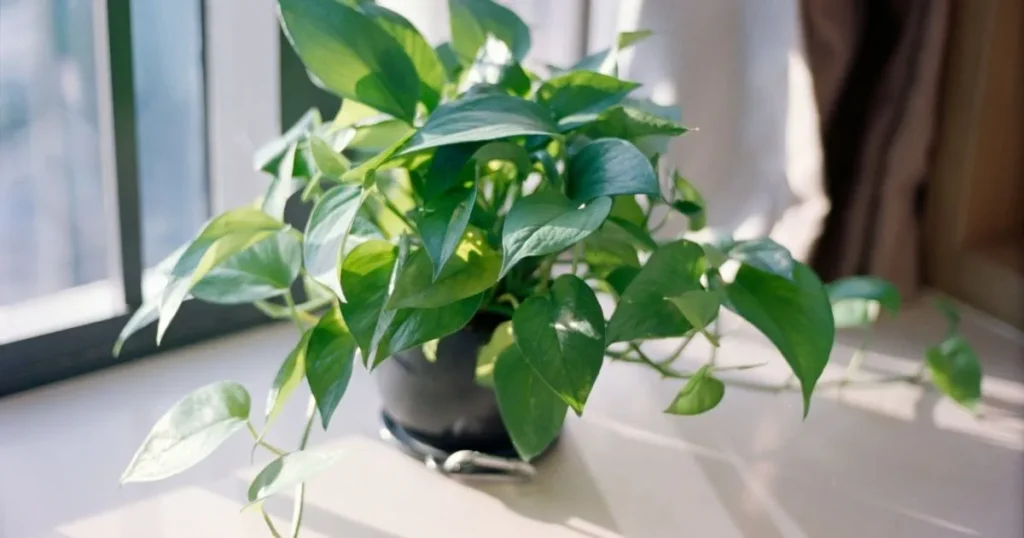
If you’ve ever wanted a houseplant that looks beautiful without demanding constant attention, pothos varieties are probably exactly what you’re looking for. These easygoing indoor plants fit almost anywhere, whether you want a trailing vine for a shelf, a climbing plant near a window, or something low-maintenance to brighten up your desk or bedroom. And the best part? There isn’t just one type. Some pothos varieties stay deep green and simple, while others show off bold variegation, silvery patterns, neon foliage, or even curled tropical leaves.
One reason so many people fall in love with pothos is that they don’t make indoor gardening feel difficult. If you occasionally forget to water your plants or don’t get perfect sunlight indoors, pothos usually won’t punish you for it, though picking up a few pothos care basics helps you get even better results. Most varieties grow happily in normal indoor conditions and still make your space feel greener and more alive.
At the same time, if you enjoy collecting unique houseplants, there are plenty of rare pothos varieties with unusual colors and leaf textures. In this guide, you’ll discover some of the most beautiful pothos varieties, from beginner-friendly classics to rare houseplants owners.
A quick note: Like many tropical plants, pothos can be toxic to pets if they decide to nibble. If you have animals at home, browsing plants that are safe around pets before expanding your collection is a smart move.
Pothos varieties at a glance
Use this table to compare all 22 varieties in this guide before you read the details. Sixteen of them have a photo further down, which helps if you’re trying to put a name to a pothos you already own. Leaf color, light and growth habit come from each variety’s quick specs below. As a rule, the more white or cream a leaf has, the more bright, indirect light it needs and the slower it grows.
| Variety | Leaf color | Light | Growth |
|---|---|---|---|
| Golden Pothos Epipremnum aureum | Green with golden-yellow variegation | Low to bright indirect | Fast-growing, trailing or climbing |
| Jade Pothos Epipremnum aureum ‘Jade’ | Solid medium to deep green | Low to bright indirect | Consistently grows; trails or climbs with support |
| Neon Pothos Epipremnum aureum ‘Neon’ | Neon green to chartreuse | Medium to bright indirect | Fast-growing; trails or climbs with support |
| Marble Queen Pothos Epipremnum aureum ‘Marble Queen’ | Green with creamy white variegation | Medium to bright indirect | Trailing or climbing with moderate growth |
| Manjula Pothos Epipremnum aureum ‘Manjula’ | Creamy white with light and dark green variegation | Bright indirect | Slow-growing; compact, lightly trailing |
| Jessenia Pothos Epipremnum aureum ‘Jessenia’ | Medium green with yellow-green variegation | Medium to bright indirect | Moderate; trailing or climbing |
| N’Joy Pothos Epipremnum aureum ‘N’Joy’ | White-edged light green leaves; white/cream variegation | Medium to bright indirect | Compact; lightly trailing with trimming |
| Pearls and Jade Pothos Epipremnum aureum ‘Pearls and Jade’ | White-edged light green leaves with white/cream variegation | Medium to bright indirect | Slow-growing; compact trailing |
| Glacier Pothos Epipremnum aureum ‘Glacier’ | White-edged light green leaves; white/cream variegation with silvery h | Medium to bright indirect | Compact; slow to moderately trailing |
| Dragon’s Tail Pothos Epipremnum pinnatum ‘Dragon Tail’ | Jade green | Medium to bright indirect | Climbing; fenestrates with age |
| Cebu Blue Pothos Epipremnum pinnatum ‘Cebu Blue’ | Silvery blue-green | Bright indirect | Climbing; develops fenestrations with maturity |
| Baltic Blue Pothos Epipremnum pinnatum ‘Baltic Blue’ | Deep green-blue | Medium to bright indirect | Fast climbing; fenestrates early |
| Global Green Pothos Epipremnum aureum ‘Global Green’ | Light green and dark green | Medium to bright indirect | Moderate trailing or climbing |
| Variegated Neon Pothos Epipremnum aureum ‘Variegated Neon’ | Variegated bright green/yellow | Bright indirect | Moderate trailing or climbing |
| Snow Queen Pothos Epipremnum aureum ‘Snow Queen’ | White with medium green variegation | Bright indirect | Slow to moderate trailing |
| Harlequin Pothos Epipremnum aureum ‘Harlequin’ | White with dark green variegation | Bright indirect | Moderate trailing |
| Satin Pothos Scindapsus pictus ‘Argyraeus’ | Green with slight green spots and a shimmery hue | Low to bright indirect | Vining; moderate growth |
| Silver Satin Pothos Scindapsus pictus ‘Silver Satin’ | Dark green with shimmery silver variegation | Bright indirect | Vining; moderate growth |
| Lemon Meringue Pothos Epipremnum aureum ‘Lemon Meringue’ | Medium green centers with light green to golden-yellow edges | Medium to bright indirect | Moderate trailing or climbing |
| Shangri-La Pothos Epipremnum aureum ‘Shangri-La’ | Green with occasional golden variegation | Medium to bright indirect | Twisted; compact, slow-growing |
| Champs-Élysées Pothos Epipremnum aureum ‘Champs-Élysées’ | Bright green | Medium to bright indirect | Climbing; textured leaves increase with maturity |
| Silver Streak Pothos Epipremnum amplissimum | Dark green with silver streaks | Medium to bright indirect | Upright to climbing; narrow foliage |
Best Pothos Varieties for Different Indoor Spaces
| Best Pothos Variety | Need / Room Type | Why It Works Well |
|---|---|---|
| Jade Pothos | Low-light room | Handles dim indoor conditions better than most variegated varieties. |
| Marble Queen Pothos | Bright window shelf | Bright indirect light helps maintain strong white variegation. |
| Golden Pothos | Beginner-friendly choice | Fast-growing, forgiving, and easy to maintain indoors. |
| N’Joy Pothos | Small desk or tabletop | Compact growth stays tidy without producing long trailing vines. |
| Neon Pothos | Hanging baskets | Bright lime-green foliage creates strong visual contrast indoors. |
| Harlequin Pothos | Rare collector plant | Highly variegated foliage gives the plant a rare collector appeal. |
| Silver Streak Pothos | Modern minimalist décor | Long narrow leaves with silver streaks create a sleek modern look. |
| Dragon’s Tail Pothos | Tropical climbing display | Develops larger split leaves as the plant matures and climbs. |
| Shangri-La Pothos | Unique textured foliage | Curled twisted leaves create a bold sculptural appearance. |
| Silver Satin Pothos | Soft silver foliage | Velvety leaves with metallic silver markings stand out beautifully indoors. |
1_ Golden Pothos (Epipremnum aureum)
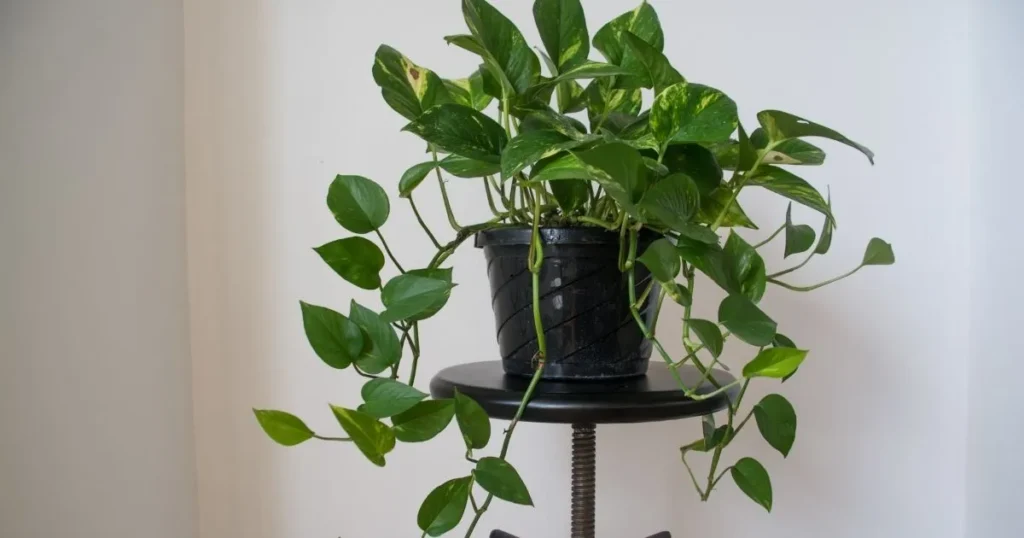
Golden pothos (Epipremnum aureum) is the classic variety most people meet first, and for good reason. Its glossy, heart-shaped leaves streaked with warm yellow bring instant life to shelves, hanging pots, and plant totems. There is also a lot more to this plant than just looks, as the full list of golden pothos plant benefits shows how much it brings to an indoor space.
One of the things plant lovers enjoy most about this variety is its unpredictable variegation. A little extra light often encourages bolder color, making each new leaf a small surprise.
Quick Specs
Leaf Color: Green with golden-yellow variegation
Light: Low to bright indirect light
Growth Habit: Fast-growing, trailing or climbing
2_ Jade Pothos (Epipremnum aureum ‘Jade’)

Jade pothos keeps things simple with its solid green foliage and steady, unfussy nature. Its smooth, heart-shaped leaves bring a classic look that works especially well alongside other indoor plants that tolerate lower light conditions naturally. It’s an easy plant to keep in almost any room, whether at home or at work. The plant holds its shape well, whether trailing from a shelf or trained to climb, and stays easygoing across a wide range of lighting conditions.
Quick specs
Light: Low to bright indirect light
Leaf Color: Solid medium to deep green
Growth Habit: Consistently grows; trails or climbs with support
3_ Neon Pothos (Epipremnum aureum ‘Neon’)

Neon pothos really earns its name; the leaves come in a bright, almost electric green that’s hard to miss. The newest leaves usually show off the strongest color, giving the plant a fresh, lively look wherever you put it. Even so, Neon pothos remains just as easygoing as other pothos varieties. It trails or climbs with minimal effort, making it an eye-catching yet low-maintenance addition to your collection, and it consistently stands out in indoor hanging plant displays.
Quick specs
Leaf Color: Neon green to chartreuse
Leaf Size: 2 to 4 inches
Light: Medium to bright indirect light
Growth Habit: Fast-growing; trails or climbs with support
4_ Marble Queen Pothos (Epipremnum aureum ‘Marble Queen’)

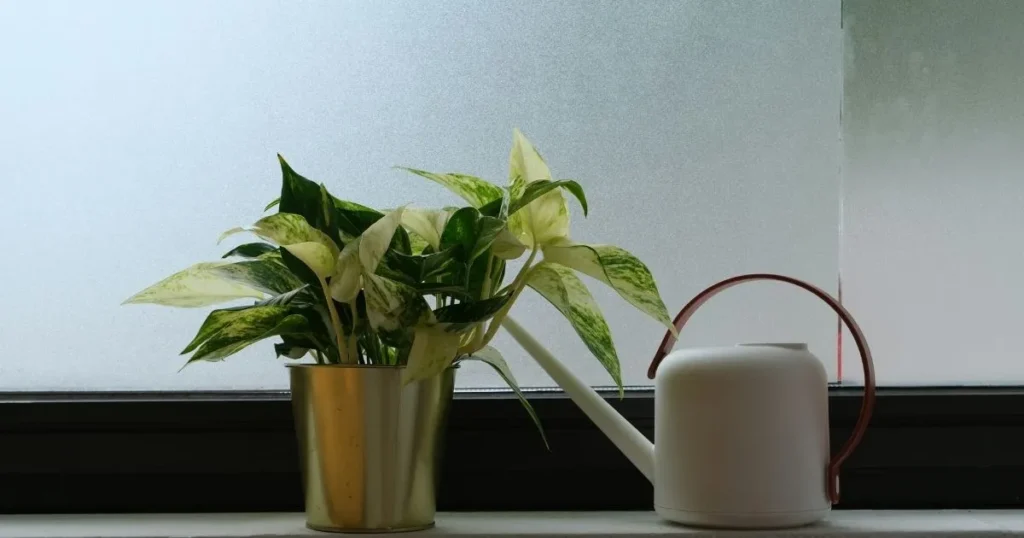
Marble Queen pothos is famous for its striking mixture of green and creamy white, creating a soft marbled look across each leaf. Some leaves come heavily patterned, while others show gentler streaks. Every vine has its own character. Because this variety leans heavily into white variegation, it usually needs brighter indirect light to keep those pale tones from fading, brighter spots also dry out faster, so watering pothos a bit more often helps this variety stay consistent between light checks.
Even with its ornamental appearance, Marble Queen stays just as easygoing as other pothos types. It trails nicely, grows steadily, and adds a lighter, more textured look to any pothos collection.
Quick specs
Leaf Color: Green with creamy white variegation
Leaf Size: 2 to 5 inches
Light: Medium to bright indirect light
Growth Habit: Trailing or climbing with moderate growth
5_ Manjula Pothos (Epipremnum aureum ‘Manjula’)

Manjula has a way of pulling your attention without trying. As it grows, the leaves don’t follow any strict pattern; they shift, curve, and take on their own look, almost like each one decided to do its own thing. It isn’t a fast grower, though. It stays a bit compact, which makes it easier to style beside other attractive indoor foliage plants like peace lily without overcrowding shelves or desks.
With good indirect light, the leaf contrast holds up well, and the plant keeps its soft, slightly curled shape, making it easy to place on a desk or shelf.
Quick specs
Leaf Color: Creamy white with light and dark green variegation
Leaf Size: 3 to 5 inches
Light: Bright, indirect light
Growth Habit: Slow-growing; compact, lightly trailing
6_ Jessenia Pothos (Epipremnum aureum ‘Jessenia’)

I’ve tried to grab this plant more than once, but it always seems to disappear before I get there. Jessenia has this easy mix of green and lighter lime tones that gives it a softer look than many pothos, even though people often compare it to Marble Queen. It handles medium to bright, indirect light well, and the variegation holds up as it grows, just at a slower, steadier pace. A well-aerated Pothos growing mix also helps keep the roots from sitting in excess moisture.
Quick Specs:
Leaf Color: Medium green with yellow-green variegation
Leaf Size: 1 to 5 inches
Light: Medium to bright, indirect light
Growth Habit: Moderate; trailing or climbing
7_ N’Joy Pothos (Epipremnum aureum ‘N’Joy’)

I wasn’t expecting the N’Joy pothos to grow on me as quickly as it did, yet it really does have its own charm. Although it often gets confused with Pearls and Jade, the N’Joy has cleaner white sections that make each leaf look a bit sharper. Because the internodes stay short, it forms a fuller, bushier shape. It’s better for shelves or tabletops rather than long trailing displays. And with medium to bright, indirect light, the variegation stays crisp while the plant grows at a calm, steady pace. If that growth unexpectedly slows or stops, a Pothos that stops producing new growth may need a closer look at its growing conditions.
Quick specs
Leaf Color: White-edged light green leaves; white/cream variegation
Leaf Size: 2 to 4 inches
Light: Medium to bright indirect light
Growth Habit: Compact; lightly trailing with trimming
8_ Pearls and Jade Pothos (Epipremnum aureum ‘Pearls and Jade’)

At first glance, it’s easy to mix this one up with N’Joy, and honestly, I did too, but the Pearl and Jade pothos has a few details that start to stand out once you look closer. The leaves stay smaller and slightly thinner, and the variegation shows more flecking around the edges, thanks to its Marble Queen parentage. Although it’s a slower grower, it really shines in brighter, indirect light, where those patterned edges become more defined. If you like this variety enough to grow more of it, propagating pothos from cuttings is straightforward even for beginners.
Quick specs
Leaf Color: White-edged light green leaves with white/cream variegation
Leaf Size: 2 to 4 inches
Light: Medium to bright, indirect light
Growth Habit: Slow-growing; compact trailing
9_ Glacier Pothos (Epipremnum aureum ‘Glacier’)

I have to laugh a little when I look at these three side by side. They’re so similar that they almost feel like siblings. Still, the Glacier pothos has its own look once you notice the softer, slightly silvery cast on the leaves. The shape is a bit broader and flatter which helps it stand out from the other pothos varieties in this trio. And while it’s not the easiest plant to find, it does well with medium to bright, indirect light, which keeps its variegation stable.
Quick specs
Leaf Color: White-edged light green leaves; white/cream variegation with silvery hue
Leaf Size: 2 to 4 inches
Light: Medium to bright, indirect light
Growth Habit: Compact; slow to moderately trailing
10_ Dragon’s Tail Pothos (Epipremnum pinnatum ‘Dragon Tail’)

Here’s where things shift a bit: Dragon’s Tail pothos isn’t part of the usual E. aureum group, yet it still behaves much like the pothos varieties you already know. Its leaves start small and narrow, but as the plant matures, they stretch, sharpen, and eventually split, giving it a look closer to a mini Monstera. Because of that change, the plant feels almost dynamic as it grows. Medium to bright, indirect light helps it develop those mature features more reliably. Plant owners who enjoy slow visual transformation indoors often end up appreciating ZZ plants for similar reasons.
Quick specs
Leaf Color: Jade green
Leaf Size: 3 to 20 inches (larger with maturity)
Light: Medium to bright, indirect light
Growth Habit: Climbing; fenestrates with age
11_ Cebu Blue Pothos (Epipremnum pinnatum ‘Cebu Blue’)

Originally from Cebu Island in the Philippines, the Cebu blue pothos stands out quickly among common pothos varieties. Instead of the usual variegation, it carries thin, blue-green leaves that almost shimmer with a soft metallic tint. As the plant matures and with steady, bright, indirect light, those smooth leaves begin to split, giving it a look that feels part pothos, part miniature Monstera. Its unusual blue-green foliage also pairs nicely with other textured indoor plants grown in softer lighting conditions.
Quick specs
Leaf Color: Silvery blue-green
Leaf Size: 4 to 7 inches
Light: Bright, indirect light
Growth Habit: Climbing; develops fenestrations with maturity
12_ Baltic Blue Pothos (Epipremnum pinnatum ‘Baltic Blue’)
The Baltic blue pothos is another clone of E. pinnatum, but it separates itself from Cebu Blue with deeper green leaves that take on a blue cast as they mature. The leaves grow larger as well, and they tend to form fenestrations earlier, especially when the plant gets steady medium to bright, indirect light. Because of that quicker leaf development, it often looks more dramatic at a younger age compared to other pinnatum types.
Quick specs
Leaf Color: Deep green-blue
Leaf Size: 4 to 36 inches
Light: Medium to bright, indirect light
Growth Habit: Fast climbing; fenestrates early
13_ Global Green Pothos (Epipremnum aureum ‘Global Green’)

The Global green pothos is a newer variety that’s gained attention for its dark-and-light green mottled pattern. At first glance, it resembles N’Joy or Pearls and Jade, yet its green-on-green contrast gives it a look of its own. As it becomes more popular, you’ll see it appearing more often in plant shops, even though it’s still considered somewhat rare. Medium to bright, indirect light helps the variegation stay clear and consistent, which is one reason it fits well alongside indoor plant collections built around snake plant care and other low-maintenance growers.
Quick specs
Leaf Color: Light green and dark green
Leaf Size: 1 to 4 inches
Light: Medium to bright, indirect light
Growth Habit: Moderate trailing or climbing
14_ Variegated Neon Pothos (Epipremnum aureum ‘Variegated Neon’)

Unlike a regular neon pothos, which may show occasional light patches, the variegated form maintains a more consistent pattern across its leaves. The bright tones stand out quickly, but they can fade or revert if the plant sits in low light. Because of that, choosing a spot with steady, bright, indirect light helps maintain its color and overall look.
Quick specs
Leaf Color: Variegated bright green/yellow
Leaf Size: 2 to 4 inches
Light: Bright, indirect light
Growth Habit: Moderate trailing or climbing
15_ Snow Queen Pothos (Epipremnum aureum ‘Snow Queen’)

The Snow Queen pothos is often mistaken for the Marble Queen, but it has a much brighter look. Most of the leaf is crisp white or soft cream, giving it the same bold visual contrast many plant owners enjoy in textured snake plant varieties grown indoors. Because there’s so little green to support the plant, it needs bright, indirect light to hold its pattern and avoid any fading or reversion.
Quick specs
Leaf Color: White with medium green variegation
Leaf Size: 3 to 6 inches
Light: Bright, indirect light
Growth Habit: Slow to moderate trailing
16_ Harlequin Pothos (Epipremnum aureum ‘Harlequin’)

Among the rarer pothos varieties, the Harlequin catches attention right away with its sharp contrast of bright white and deep green. At first glance, it can look a bit like a Manjula, but the absence of cream or yellow tones gives it a cleaner, cooler appearance. Because its leaves carry so much white, it needs bright, indirect light to keep the variegation strong, especially in indoor plant setups focused on healthy foliage and beginner-friendly growing.
Quick specs
Leaf Color: White with dark green variegation
Leaf Size: 2 to 4 inches
Light: Bright indirect light
Growth Habit: Moderate trailing
17_ Satin Pothos (Scindapsus pictus ‘Argyraeus’)
Often called the satin pothos, this plant isn’t a true pothos, but it fits in easily thanks to its similar look and care needs. Its small, velvety green leaves catch the light with soft silver markings, giving the vine a slightly shimmery finish. Because it handles a wide range of indirect light, it blends naturally with other hardy indoor foliage plants, including cast iron plants commonly grown in dimmer rooms.
Quick specs
Leaf Color: Green with slight green spots and a shimmery hue
Leaf Size: 1 to 3 inches
Light: Low to bright, indirect light
Growth Habit: Vining; moderate growth
18_ Silver Satin Pothos (Scindapsus pictus ‘Silver Satin’)

This silver pothos is another form of S. pictus, but it has a unique appearance with broader, thicker leaves and bold, silvery splashes that catch the light. For steady growth and to prevent stretching, bright, indirect light works best. The foliage is noticeably darker and larger than the ‘Argyraeus’ type, giving it a fuller look that blends naturally with peace lily care collections and other foliage-heavy indoor plant setups.
Quick specs
Leaf Color: Dark green with shimmery silver variegation
Leaf Size: 3 to 4 inches
Light: Bright, indirect light
Growth Habit: Vining; moderate growth
19_ Lemon Meringue Pothos (Epipremnum aureum ‘Lemon Meringue’)
It surfaced as a surprise mutation within Global Green and quickly drew attention. The edges shift from soft green to a bright yellow as light increases, giving the plant a fresh, almost citrus look. However, in lower light, those yellow tones fade, so colorful, indirect light keeps the color lively and consistent.
Quick specs
Leaf Color: Medium green centers with light green to golden-yellow edges
Leaf Size: 2 to 4 inches
Light: Medium to bright, indirect light
Growth Habit: Moderate trailing or climbing
20_ Shangri-La Pothos (Epipremnum aureum ‘Shangri-La’)

The Shangri-La pothos looks a bit wild at first. Its leaves never open flat; they stay curled, folded, and a little chaotic, which is why people call it the “sleeping pothos.” You’ll even see ridges underneath as it matures. It may flash a bit of yellow here and there, but really, the twisted shape is the star and if you ever see more than an occasional fleck, it’s worth checking whether it’s ordinary yellowing rather than natural coloring.
Quick Specs:
Leaf Color: Green with occasional golden variegation
Leaf Size: 2 to 6 inches
Light: Medium to bright, indirect light
Growth Habit: Twisted; compact, slow-growing
21_ Champs-Élysées Pothos (Epipremnum aureum ‘Champs-Élysées’)
At first glance, this one can pass for a Neon Pothos, but a closer look gives it away. The Champs-Élysées pothos grows little crests, almost like tiny gills, along the undersides of its leaves. As the plant matures, those textures become more noticeable, giving it a surprising amount of character. And just like other pothos varieties, it develops larger leaves when it’s allowed to climb in warm, bright, indirect light.
Quick specs
Leaf Color: Bright green
Leaf Size: 2 to 6 inches
Light: Medium to bright, indirect light
Growth Habit: Climbing; textured leaves increase with maturity
22_ Silver Streak Pothos (Epipremnum amplissimum)
The Silver Streak pothos immediately gives a striking look, mainly because it looks so different from the usual varieties. Its long, slim leaves pick up soft silver streaks, giving the plant a sleek, modern feel. And even though it looks unusual, it still grows just as easily as other pothos, so beginners can enjoy it, and indoor plant enthusiasts get something fresh at the same time.
Quick specs
Leaf Color: Dark green with silver streaks
Leaf Size: 6 to 20 inches
Light: Medium to bright, indirect light
Growth Habit: Upright to climbing; narrow foliage
How to tell similar pothos apart
Several pothos look alike, especially as young plants or in low light, when variegation fades. These are the pairs people mix up most often and what to check.
Marble Queen vs Snow Queen
Look at the ratio of white to green. Marble Queen leaves are mostly green, marbled and streaked with cream. Snow Queen leaves are mostly white with green streaks, and the white is brighter and cleaner. Snow Queen also grows more slowly because it has less green tissue.
N’Joy vs Pearls and Jade vs Glacier
All three have small, light green leaves with white sections. N’Joy has crisp, solid blocks of white and green with clean edges. Pearls and Jade has white sections that are speckled with green and gray flecks. Glacier is the most compact of the three, with smaller, rounder leaves and silvery white patches dotted with green.
Manjula vs Marble Queen
Manjula leaves are wider and more heart-shaped, often with wavy edges, and the variegation comes in larger patches of cream, silver and green rather than fine marbling. Manjula also grows more slowly and stays more compact.
Neon pothos vs Lemon Lime philodendron
Both are bright chartreuse. Pothos leaves are thicker, waxier and slightly textured, and each new leaf unfurls from the stem of the previous leaf. Lemon Lime philodendron leaves are thinner, softer and more heart-shaped, and new leaves emerge from a papery sheath that dries and turns brown. Lemon Lime is a cultivar of heartleaf philodendron, which NC State lists alongside Brasil and Rio. The wider comparison of the two plants is in pothos vs philodendron.
Satin “pothos” is not a true pothos
Satin and Silver Satin pothos are Scindapsus pictus, a different genus from true pothos (Epipremnum). Their leaves are matte, thicker and dotted with silver, and they prefer to dry out a little more between waterings.
Cebu Blue vs Baltic Blue
Both are Epipremnum pinnatum. Cebu Blue has narrower, silvery blue-green leaves. Baltic Blue is a deeper blue-green and tends to develop splits (fenestrations) earlier as it climbs.
Pothos Variegation Care & Reversion Prevention
Variegated pothos looks incredible, but they can be a bit moody. Now and then, a plant that once flashed bright white or lime streaks suddenly starts producing plain green leaves. This shift called reversion, usually happens when the plant isn’t getting enough energy. According to horticulture research on indoor pothos care, variegated leaves contain less chlorophyll, which is why lower light conditions often trigger greener reversion growth over time.
Why Pothos Revert
Most reversions happen due to:
- Low or inconsistent light
- Crowded vines that shade each other
- Aging growth is losing its pattern
- Naturally unstable variegation in varieties like Manjula, Harlequin, Snow Queen, and N’Joy
In short, the plant reverts because it’s trying to survive more efficiently.
How to Maintain Variegation
Variegated pothos need steady, bright, indirect light to hold their color. When light levels of pothos plant drop, the plant shifts toward green to conserve energy. Rotating the pot every week, keeping the leaves clean, and avoiding dim corners all help keep the patterns sharp.
Best Lighting Angles
Side light usually brings out broader patches, while overhead light creates tighter contrasts. Low light won’t harm the plant, but the variegation will fade fast. If your home runs mostly on dim natural light, this roundup of best low light indoor plants for beginners helps you figure out what else can thrive in the same conditions.
Pruning to Prevent Reversion
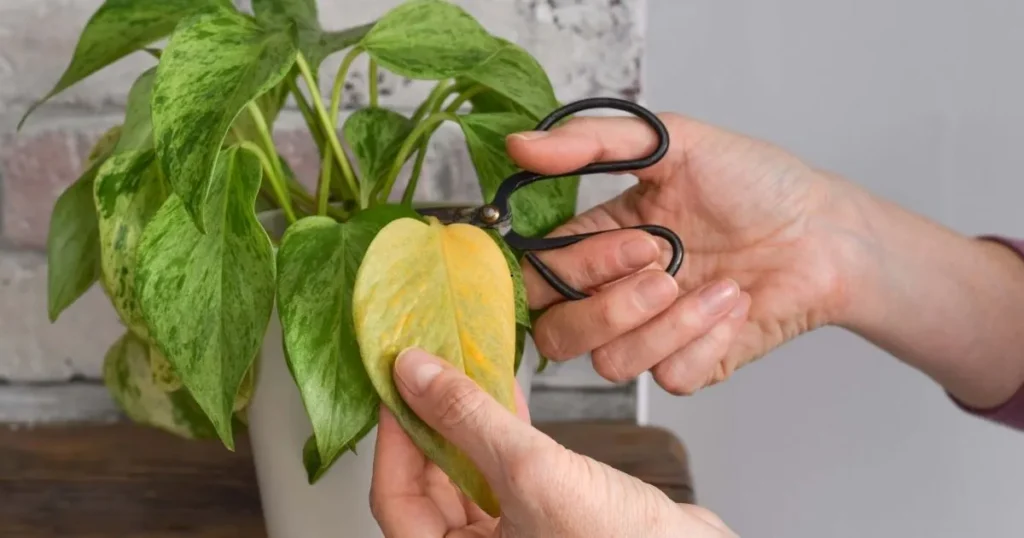
If a vine starts producing solid green leaves, cut it back to the last patterned leaf. Clearing crowded stems and training climbing types upward also helps keep the coloring consistent.
FAQs: Pothos Varieties
How many different types of pothos are there?
Botanically, pothos belongs mainly to the Epipremnum genus, which contains dozens of species. However, most popular indoor pothos varieties come from cultivated forms of Epipremnum aureum, so the total number of pothos types grown by collectors is much higher than the official species count.
What is the most unique pothos variety?
Shangri-La Pothos (Epipremnum aureum ‘Shangri-La’) is often considered one of the most unusual pothos varieties because of its tightly curled, twisted foliage. Unlike the flat, heart-shaped leaves seen on most pothos plants, Shangri-La develops crinkled leaves that stay folded and textured as they mature, giving the plant a bold, sculptural appearance indoors.
What is the rarest pothos?
Epipremnum pinnatum ‘Albo-Variegata’ is one of the rarest pothos among uncommon plant lovers. It starts with narrow green leaves and matures into large fenestrated foliage resembling a White Monstera. Its striking white variegation makes each leaf look different, which is one reason collectors value it so highly. Because stable variegation can be difficult to maintain during propagation, healthy mature plants are usually harder to find and often sell at premium prices.
Which pothos is the best?
It depends on what you need. Golden Pothos grows quickly and tolerates low light better than most common varieties, making it one of the easiest choices for beginners. Jade Pothos works especially well in lower-light rooms, while Marble Queen is popular for its bold white variegation. If you want something brighter and more eye-catching, Neon Pothos stands out with its vivid lime-green foliage.
Conclusion
Pothos plants offer far more variety than most people expect. Some stay compact and neat, while others trail into long cascading vines or climb upward with bigger leaves as they mature.
These plants work well in almost any home because they don’t need constant attention. Beginners find them easy to manage, and busy plant owners appreciate how little they demand day to day. But plant enthusiasts aren’t left out either; rare varieties with silver markings, dramatic variegation, or curled foliage give them something genuinely unusual to grow.
If you’re just starting out, Golden, Jade, or Neon Pothos are reliable, easy-to-maintain choices. Once you get comfortable with their care, exploring more unique varieties makes indoor gardening even more enjoyable.

Ellie Marsh
Houseplant grower who spent years in a north-facing apartment. Writes practical care guides for low light homes, checked against extension and botanical garden sources.
Explore more: