Last updated on November 18, 2026
Satin pothos (Scindapsus pictus), also sold as silver pothos, is not a true pothos, but satin pothos care is simple: bright indirect light, water when the mix has dried out, and warm rooms. NC State Extension lists curling leaves as a sign of underwatering and yellow leaves as a sign of overwatering.
That covers the basics for a velvety, silver-splashed plant fresh from the store. The sections below sort out the name, the light, the watering rhythm and what each leaf problem means.
Is satin pothos a real pothos?
No. Satin pothos is Scindapsus pictus, a different genus from the common pothos (Epipremnum aureum), though both sit in the arum family. Silver pothos and silk pothos are the same plant under other names, according to NC State Extension’s Plant Toolbox.
The same entry lists its older names, Scindapsus argyraeus and Pothos argyraeus, so an older plant tag may carry one of those. A Reddit reply under a popular satin pothos photo put the identity question in one line:
“Correct, notably *not* a pothos (*Epiprenum sp*).”
– r/houseplants (51 upvotes)
The name matters for watering. A retailer care guide from House of Kojo describes the leaves as thicker than a pothos leaf, with a matte, velvety finish, and says they hold a little moisture in reserve. A plant built that way forgives a late watering far more easily than an early one.
If you already grow the glossy kind, our guide to pothos varieties shows how the true pothos differs.
How much light does satin pothos need?
Satin pothos needs bright, indirect light. NC State Extension says it does not tolerate direct sunlight, so House of Kojo’s pick, a spot near an east-facing window or set back from a brighter one, is a safe default.
Low light will not kill it, but it changes how the plant looks. House of Kojo reports that in dim rooms the plant keeps growing slowly, with smaller leaves and less silver, and that direct sun scorches the leaves and fades the markings. A plant that has gone plain green with long gaps between leaves is asking for light, not water.
I lived for years with a north-facing window and little direct sun. In that kind of room, put the plant in the brightest corner you have and add a small grow light for the darkest spots, which is what I do in my own home.
How often should you water satin pothos?
Water satin pothos when the top half of the potting mix has dried out, then soak it until water runs from the drainage holes. House of Kojo gives roughly once a week in spring and summer as a starting point, stretching to every two to three weeks in autumn and winter.

Treat those numbers as a first guess. A small pot in a bright window dries faster than a big one in a dim corner, so push a finger into the mix and let the soil decide.
A thirsty satin pothos droops slightly and, per House of Kojo, recovers within hours of a good soak. That makes underwatering the easier mistake to undo. An overwatered plant gives different signals: soft yellow leaves starting low on the stems, mix that stays damp for days, and in bad cases mushy stems at the base. NC State Extension adds that root rot can develop in poorly drained or wet soil.
A chunky, fast-draining mix is the cheapest insurance. Our soil guide for pothos has a recipe that works here too, since NC State describes the same moist but well-drained mix for this plant.
What your satin pothos leaves are telling you
Satin pothos leaves signal trouble early: curling usually points to thirst, yellowing to too much water, and pale, small leaves to too little light. The table below gives the likely cause and fix for each sign, with the source named in every row.
| What you see | Likely cause | What to do |
|---|---|---|
| Leaves curling or drooping, mix dry | Underwatering (NC State Extension) | Soak thoroughly; leaves usually recover within hours |
| Soft yellow leaves low on the stems, mix still damp | Overwatering (NC State Extension, House of Kojo) | Let the top half dry out; check the roots if stems feel mushy |
| Small leaves, faded silver, long bare stems | Too little light (House of Kojo) | Move closer to a bright window or add a grow light |
| Bleached or scorched patches | Direct sun (NC State Extension, House of Kojo) | Pull back from the glass into bright, indirect light |
| Brown, crispy tips | Very dry air, reported below about 40% humidity (House of Kojo) | Group plants or add a small humidifier |
Curling deserves a second look before you reach for the watering can.
If the leaves curl but the mix is still wet, more water is the wrong answer. Look at the roots instead, because wet mix is where NC State says root rot appears, and a rotting root system cannot take up water no matter how much you give it.
The underside of a satin pothos leaf is paler and has no silver blotches, according to NC State. That is normal.
Satin pothos care: temperature, humidity and trimming
NC State Extension puts the best room temperatures at 65 to 85 degrees Fahrenheit and says cooler air is not tolerated. House of Kojo gives the lowest temperature the plant can withstand as around 12°C, roughly 54°F, below which growth stops and dark, water-soaked patches can appear, especially when the mix is wet.
On humidity, the same retailer says 50% to 60% is preferred but ordinary household levels are comfortable, so a humidifier is optional unless winter heating dries the air a lot. A bright bathroom or kitchen is an easy way to get a little extra moisture.
For feeding, Oramicin’s care guide suggests a balanced liquid fertilizer at half strength every three to four weeks in spring and summer, and none in winter or low light.
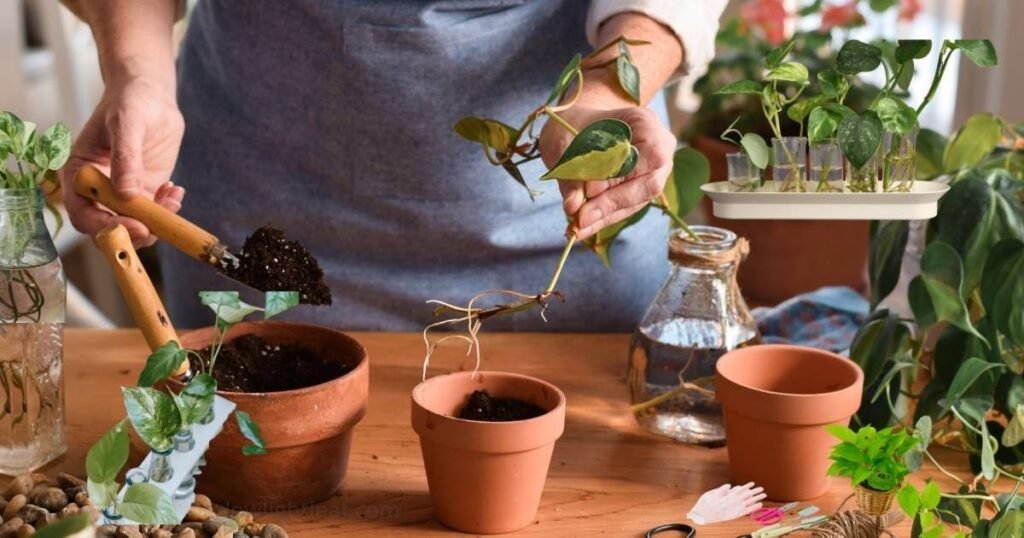
NC State notes that pinching the stems keeps the plant tidy and that stem cuttings root easily. Cut just below a node, and House of Kojo reports roots in water typically appear within two to four weeks. Root the trimmings and tuck them back into the pot for a fuller plant.
Is satin pothos safe around cats and dogs?
No. The ASPCA lists satin pothos as toxic to dogs, cats and horses. I check every plant against that list because of my cat, Miso. Our pothos and pets guide covers the signs to watch for and when to call.

Ellie Marsh
Houseplant grower who spent years in a north-facing apartment. Writes practical care guides for low light homes, checked against extension and botanical garden sources.