Last updated on November 17, 2026
Spider plant temperature tolerance is wider than most windowsills test, and two university extension services put the line in two places: NC State says to keep temperatures above 45°F, while UF/IFAS calls anything below 55°F too cool. Frost is the one thing both treat as off limits. If you want one number for a winter windowsill, plan around 55°F and treat 45°F as the floor you don’t test.
That gap matters in November, when a plant that did fine all summer is suddenly sitting an inch from cold glass. The room can read 68°F on the thermostat while the sill does something else entirely. Below is what each source actually says, what neither one tells you, and how to check your own spot instead of guessing.
Spider plant temperature tolerance: what two sources say
The figures below come from two extension pages written for home growers. They’re guidance sentences, not experiments, so read them as ranges to plan around rather than lab thresholds.
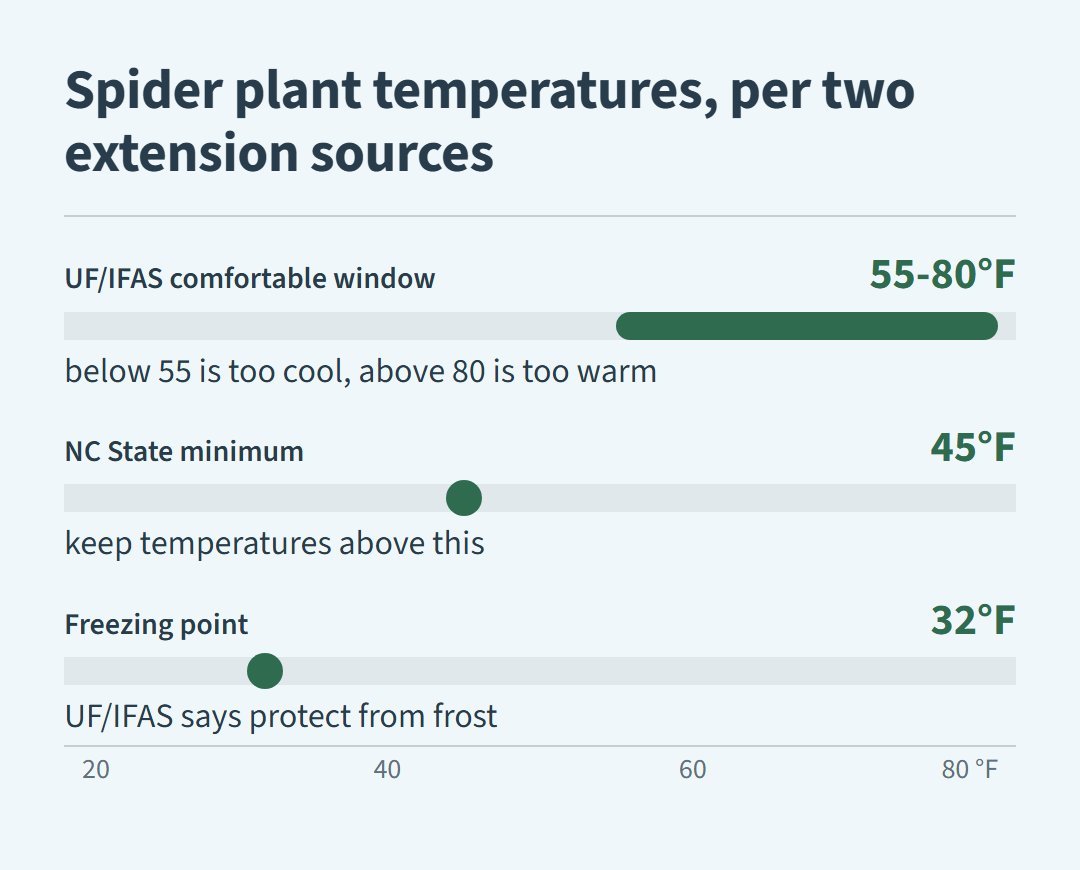
UF/IFAS puts it plainly: temperatures below 55°F are too cool for spider plants, and anything above 80°F is too warm. That gives a comfortable window of 55-80°F, which is just a normal heated home. NC State’s Plant Toolbox sets a lower bar, saying to keep temperatures above 45°F. The UF/IFAS Gardening Solutions page also notes the plant should be protected from frost.
| Your reading at leaf level | What the sources support |
|---|---|
| Above 80°F | Too warm, according to UF/IFAS. |
| 55-80°F | The comfortable window UF/IFAS describes. Nothing to fix. |
| 45-55°F | Below UF/IFAS’s “too cool” line but above NC State’s floor. Neither page says what happens here or for how long, so move the plant rather than wait to find out. |
| Below 45°F | Under NC State’s minimum. Bring it somewhere warmer the same day. |
| 32°F or lower | Frost. Both sources are firm that the plant needs protecting from it. |
Which number to plan around
I’d plan around 55°F. The two pages aren’t really disagreeing, because they answer different questions. UF/IFAS describes where the plant is comfortable, and NC State describes how low you can let it go. A plant held at the floor is surviving, not growing, so treating the floor as your target is how a houseplant ends up looking tired by February.
There’s also a gap neither source fills. Nobody I could find publishes how many hours at 50°F a spider plant takes before it shows damage, so any article that gives you one is guessing. What you can say honestly is that 45°F is a minimum to stay above, and every degree closer to it leaves you less room for a cold night.
The winter windowsill is the real test
Most spider plants don’t get hurt by the room. They get hurt by the one spot in the room that runs colder than the thermostat says. Glass, an exterior wall and a door that opens onto a porch can all sit well below the room average on a cold night, and a spider plant in a hanging basket by a window gets the worst of it.
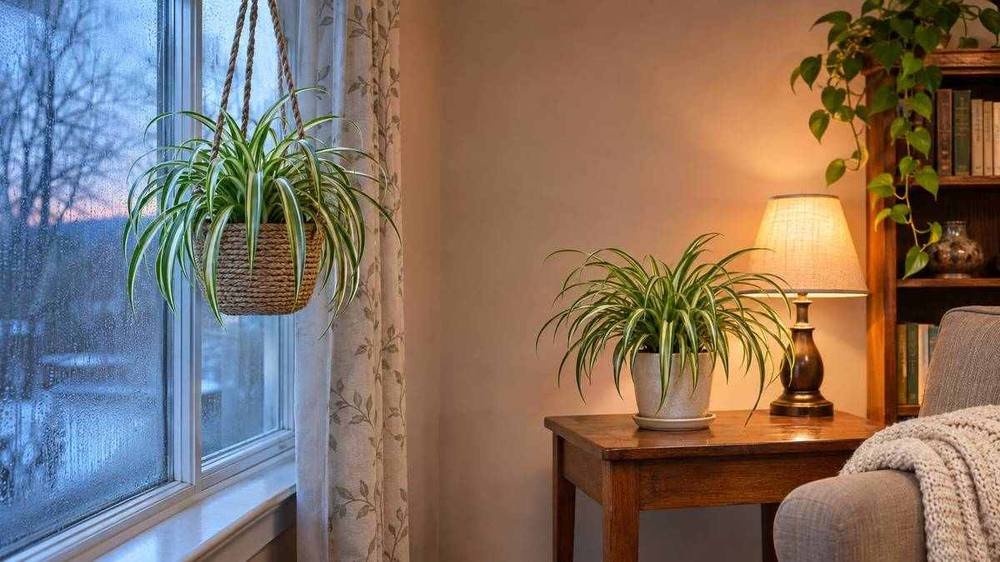
The fix is cheap. Leave a basic thermometer on the sill, right next to the leaves, overnight, and read the low in the morning. If it stays above 55°F, you’re fine. If it dips toward 45°F, slide the pot a foot or two into the room, or put a sheet of cardboard between the plant and the glass.
A sill beside a leaky window or a vent can run colder than the still air in the middle of the room, so put the thermometer exactly where the leaves sit. If the plant is drooping rather than browning, why a spider plant droops covers the other causes.
NC State also says to reduce watering in winter. A cool sill and a wet pot make a poor pair, because the soil dries slowly when the plant isn’t growing. Check the pot with your finger before you pour, and let it dry a little more between waterings than you did in summer.
Brown tips in winter aren’t always cold
Brown leaf tips show up every winter, and the cold gets the blame. Both extension sources point somewhere else first. NC State warns that the chlorine and fluorides in tap water can cause leaf tip burn, and UF/IFAS says spider plants are particularly sensitive to fluoridated water, suggesting rainwater or distilled water if yours is treated.
That doesn’t clear the cold. It means a brown tip alone doesn’t tell you which one is responsible, and moving the plant won’t fix a water problem. If the tips are the main complaint, the spider plant brown tips guide walks through the causes in order.
Outdoors: frost, zones and summering outside
NC State lists spider plant hardiness as USDA zones 9a through 11b. That’s the warm end of the map, the places where a freeze is rare. Everywhere colder, it’s a houseplant, and the 32°F line on the chart is the one to respect.
Growers do report different results at the edge of that range. One gardener on r/GardeningIRE described it like this:
“Spider plant is actually a reliable comeback perennial here in Ireland! They’re always sold as houseplant but they are actually really cold hardy and come back from the ground every spring when the foliage is killed by the frost.”
– r/GardeningIRE (44 upvotes)
It’s one person’s report from one climate, and it sits next to extension guidance that stops at zone 9. I’d read it as “the roots sometimes survive where the leaves don’t”, not as a reason to leave a pot outside. The frost still killed the foliage in that account.
If you do summer your plant outdoors, a reply in the same thread makes a useful point about the move itself:
“They need time to grow outdoor leaves because the leaves grown indoors are usually more fragile. Best to plant out early summer for it to adjust.”
– r/GardeningIRE (7 upvotes)
That matches how I’d handle the autumn move back in: bring the pot inside well before nights approach 55°F, not when they reach 45°F, so the plant never takes a surprise.
Too warm is the quieter problem
UF/IFAS’s upper figure is 80°F. In most homes you only hit it next to a heater, a sunny south window in a closed room, or a spot above a radiator. If the plant lives there, the usual remedy is the same as for cold: shift it a little toward the middle of the room. NC State adds that spider plants are intolerant of direct sunlight, so a hot, bright window is a double hit.
Quick answers
What temperature is too cold for a spider plant?
UF/IFAS calls anything below 55°F too cool, NC State says to keep temperatures above 45°F, and both want it kept away from frost. Treat 55°F as the practical lower limit and 45°F as the floor.
Can a spider plant survive a freeze?
Neither extension source gives a survival time, and both say to protect it from frost. Grower reports exist of roots regrowing after the foliage was killed, but that’s a bet on a single climate, not a plan for your pot.
Is a cold windowsill safe for a spider plant?
It depends on the low, not the room’s thermostat reading. Leave a thermometer on the sill overnight. Above 55°F is fine, and below it you should move the pot back from the glass.
Are spider plants safe if my cat sits by the same window?
Spider plants are listed as non-toxic to cats and dogs by the ASPCA, and you can look it up alongside the other plants in our toxicity checker. The temperature advice doesn’t change either way.

Ellie Marsh
Houseplant grower who spent years in a north-facing apartment. Writes practical care guides for low light homes, checked against extension and botanical garden sources.