
Plants Poisonous to Cats and Dogs: Toxicity Checker
The plants poisonous to cats that do the most harm are true lilies and daylilies, which the FDA says can cause fatal kidney failure in less than 3 days, and sago palm, which the ASPCA links to liver failure. Pothos, philodendron, monstera, peace lily and dieffenbachia are far more common indoors, and they mostly burn the mouth.
Dogs face nearly the same list. On the ASPCA’s plant lists, the only entries flagged as toxic to cats but not to dogs are lilies, daylilies and catnip. I share my home with a cat, Miso, so any plant that comes through my door gets looked up on those lists first, with the verdict for cats and the verdict for dogs side by side.
- Verdicts for 109 plants from the ASPCA database
- Cats and dogs side by side, with the toxin and signs
- Lily timing from the U.S. FDA
Houseplant toxicity checker
Type a plant name to see what the ASPCA lists for cats and for dogs.
Pet already chewed a plant? ASPCA Animal Poison Control (888) 426-4435 · Pet Poison Helpline (855) 764-7661. A consultation fee may apply.
Plants poisonous to cats and dogs, A to Z
Of 109 common houseplants, holiday flowers, bulbs and herbs, the ASPCA lists 54 as toxic to cats and 49 as toxic to dogs, and 46 as non-toxic to both. Three more fall under a genus-wide entry, and six popular houseplants have no entry at all.
Every verdict comes from the plant’s own page in the ASPCA toxic and non-toxic plants database. “Genus entry” means the ASPCA lists the whole genus, such as Ficus sp. or Dracaena spp., rather than that exact species.
| Plant | Scientific name | Cats | Dogs | Toxin the ASPCA names |
|---|---|---|---|---|
| African Violet | Saintpaulia spp. | Non-toxic | Non-toxic | None listed |
| Air Plant | Tillandsia | Not listed | Not listed | No ASPCA entry |
| Alocasia (Elephant Ear) | Alocasia spp. | Toxic | Toxic | Insoluble calcium oxalates |
| Aloe Vera | Aloe vera | Toxic | Toxic | Saponins, anthraquinones |
| Aluminum Plant (Pilea cadierei) | Pilea cadieri | Non-toxic | Non-toxic | None listed |
| Amaryllis | Amaryllis spp. | Toxic | Toxic | Lycorine and others |
| Anthurium (Flamingo Flower) | Anthurium scherzeranum | Toxic | Toxic | Insoluble calcium oxalates |
| Areca Palm | Dypsis lutescens | Non-toxic | Non-toxic | None listed |
| Arrowhead Vine | Syngonium podophyllum | Toxic | Toxic | Insoluble calcium oxalates |
| Asparagus Fern | Asparagus densiflorus cv sprengeri | Toxic | Toxic | Not stated |
| Azalea | Rhododendron spp | Toxic | Toxic | Grayanotoxin |
| Baby Rubber Plant (Peperomia) | Peperomia obtusifolia | Non-toxic | Non-toxic | None listed |
| Bamboo Palm | Chamaedorea elegans | Non-toxic | Non-toxic | None listed |
| Basil | Ocimum basilicum | Non-toxic | Non-toxic | None listed |
| Begonia | Begonia spp. | Toxic | Toxic | Soluble calcium oxalates |
| Bird of Paradise (Strelitzia) | Strelitzia reginae | Toxic | Toxic | GI irritants |
| Bird's Nest Fern | Asplenium nidus | Not listed | Not listed | No ASPCA entry |
| Boston Fern | Nephrolepis exalta bostoniensis | Non-toxic | Non-toxic | None listed |
| Bromeliad (Neoregelia) | Neoregalia spp. | Non-toxic | Non-toxic | None listed |
| Burro's Tail | Sedum morganianum | Non-toxic | Non-toxic | None listed |
| Caladium | Caladium hortulanum | Toxic | Toxic | Insoluble calcium oxalates |
| Calathea | Calathea spp. | Non-toxic | Non-toxic | None listed |
| Calla Lily | Zantedeschia aethiopica | Toxic | Toxic | Insoluble calcium oxalates |
| Cast Iron Plant | Aspidistra elatior | Non-toxic | Non-toxic | None listed |
| Catnip | Nepeta cataria | Toxic | Not listed | Nepetalactone |
| Chamomile | Anthemis nobilis | Toxic | Toxic | Volatile oil; bisabolol, chamazulene, anthemic acid, tannic acid |
| Chinese Evergreen | Aglaonema modestum | Toxic | Toxic | Insoluble calcium oxalates |
| Christmas Cactus | Schlumbergera bridgesii | Non-toxic | Non-toxic | None listed |
| Chrysanthemum (Mum) | Chrysanthemum spp. | Toxic | Toxic | Sesquiterpene, lactones, pyrethrins and other potential irritants |
| Cilantro | Coriandrum sativum | Non-toxic | Non-toxic | None listed |
| Coleus | Coleus ampoinicus | Toxic | Toxic | Essential Oils |
| Corn Plant (Dracaena fragrans) | Dracaena fragrans | Toxic | Toxic | Saponins |
| Croton | Codiaeum variegatum | Not listed | Not listed | No ASPCA entry |
| Cyclamen | Cyclamen spp | Toxic | Toxic | Terpenoid saponins |
| Daffodil | Narcissus spp | Toxic | Toxic | Lycorine and other alkaloids |
| Daylily | Hemerocallis spp. | Toxic | Non-toxic | Unknown |
| Dieffenbachia (Dumb Cane) | Dieffenbachia | Toxic | Toxic | Insoluble calcium oxalates, proteolytic enzyme |
| Dill | Anethum graveolena | Non-toxic | Non-toxic | Essential oils |
| Dracaena (other species) | Dracaena spp. | Toxic | Toxic | Saponins |
| Easter Lily | Lilium longiflorum | Toxic | Non-toxic | Unknown |
| Echeveria (Hens and Chickens) | Echeveria elegans | Non-toxic | Non-toxic | None listed |
| English Ivy | Hedera helix | Toxic | Toxic | Triterpenoid saponins (hederagenin) |
| Fiddle-Leaf Fig | Ficus lyrata | Toxic (genus entry) | Toxic (genus entry) | Proteolytic enzyme (ficin), psoralen (ficusin) |
| Friendship Plant (Pilea involucrata) | Pilea involucrata | Non-toxic | Non-toxic | None listed |
| Gardenia | Gardenia jasminoides | Toxic | Toxic | Geniposide, gardenoside |
| Geranium (Pelargonium) | Pelargonium species | Toxic | Toxic | Geraniol, linalool |
| Gloxinia | Sinningia speciosa | Non-toxic | Non-toxic | None listed |
| Haworthia | Haworthia species | Non-toxic | Non-toxic | None listed |
| Heartleaf Philodendron | Philodendron hederaceum | Toxic | Toxic | Insoluble calcium oxalates |
| Hibiscus | Hibiscus syriacus | Non-toxic | Non-toxic | None listed |
| Hosta | Hosta plataginea | Toxic | Toxic | Saponins |
| Hoya (Wax Plant) | Hoya carnosa 'krinkle kurl' | Non-toxic | Non-toxic | None listed |
| Hyacinth | Hyacinthus orientalis | Toxic | Toxic | Possibly narcissus-like alkaloids |
| Inch Plant (Tradescantia) | Tradescantia flumeninsis | Toxic | Toxic | Not stated |
| Jade Plant | Crassula argentea | Toxic | Toxic | Unknown |
| Japanese Aralia (Fatsia) | Fatsia japonica | Non-toxic | Non-toxic | None listed |
| Jasmine (Jasminum) | Jasminum species | Non-toxic | Non-toxic | None listed |
| Kalanchoe | Kalanchoe spp | Toxic | Toxic | Bufodienolides |
| Kentia Palm | Howea forsteriana | Non-toxic | Non-toxic | None listed |
| Lady Palm | Rhapis flabelliformus | Non-toxic | Non-toxic | None listed |
| Lavender | Lavendula angustifolia | Toxic | Toxic | Linalool, linalyl acetate |
| Lily (true lilies) | Lilium species | Toxic | Non-toxic | Unknown |
| Lily of the Valley | Convallaria majalis | Toxic | Toxic | Cardenolides (convallarin, and others) |
| Lipstick Plant | Aeschynanthus humilis | Non-toxic | Non-toxic | None listed |
| Lucky Bamboo | Dracaena sanderiana | Toxic (genus entry) | Toxic (genus entry) | Saponins |
| Maidenhair Fern | Adiantum | Not listed | Not listed | No ASPCA entry |
| Majesty Palm | Ravenea rivularis | Non-toxic | Non-toxic | None listed |
| Mint | Mentha sp. | Toxic | Toxic | Essential Oils |
| Mistletoe Cactus (Rhipsalis) | Rhipsalis cassutha | Non-toxic | Non-toxic | None listed |
| Money Tree | Pachira aquatica | Non-toxic | Non-toxic | None listed |
| Monstera (Swiss Cheese Plant) | Monstera deliciosa | Toxic | Toxic | Insoluble calcium oxalates |
| Nerve Plant (Fittonia) | Fittonia verschaffeltii | Non-toxic | Non-toxic | None listed |
| Norfolk Island Pine | Araucaria heterophylla | Non-toxic | Non-toxic | None listed |
| Oleander | Nerium oleander | Toxic | Toxic | Cardiac glycosides |
| Oregano | Origanum vulgare hirtum | Toxic | Toxic | Gastrointestinal irritants |
| Parlor Palm | Chamaedorea elegans | Non-toxic | Non-toxic | None listed |
| Parsley | Petroselinum crispum | Toxic | Toxic | Furanocoumarins |
| Peace Lily | Spathiphyllum | Toxic | Toxic | Insoluble calcium oxalates |
| Pencil Cactus | Euphorbia tirucalli | Toxic | Toxic | Irritant Sap (latex) |
| Petunia | Petunia species | Non-toxic | Non-toxic | None listed |
| Phalaenopsis Orchid | Phalaenopsis sp. | Non-toxic | Non-toxic | None listed |
| Poinsettia | Euphorbia pulcherrima | Toxic | Toxic | Irritant sap |
| Polka Dot Plant | Hypoestes phyllostachya | Non-toxic | Non-toxic | None listed |
| Ponytail Palm | Beaucarnea recurvata | Non-toxic | Non-toxic | None listed |
| Pothos (Golden Pothos, Devil's Ivy) | Epipremnum aureum | Toxic | Toxic | Insoluble calcium oxalates |
| Prayer Plant (Maranta / Calathea) | Calathea insignis | Non-toxic | Non-toxic | None listed |
| Purple Passion | Gynura aurantica | Non-toxic | Non-toxic | None listed |
| Rattlesnake Plant | Calathea lancifolia | Non-toxic | Non-toxic | None listed |
| Ripple Peperomia | Peperomia caperata | Non-toxic | Non-toxic | None listed |
| Rosemary | Rosmarinus officinalis | Non-toxic | Non-toxic | None listed |
| Rubber Tree | Ficus elastica | Toxic (genus entry) | Toxic (genus entry) | Proteolytic enzyme (ficin), psoralen (ficusin) |
| Sage | Salvia officinalis | Non-toxic | Non-toxic | None listed |
| Sago Palm | Cycas revoluta, zamia species | Toxic | Toxic | Cycasin |
| Schefflera (Umbrella Tree) | Schefflera | Toxic | Toxic | Calcium oxalate crystals |
| Shamrock Plant (Oxalis) | Oxalis spp. | Toxic | Toxic | Soluble calcium oxalates |
| Snake Plant (Mother-in-Law's Tongue) | Sansevieria trifasciata | Toxic | Toxic | Saponins |
| Spider Plant | Chlorophytum comosum | Non-toxic | Non-toxic | None listed |
| Staghorn Fern | Platycerium bifurcatum | Non-toxic | Non-toxic | None listed |
| String of Pearls | Curio rowleyanus | Not listed | Not listed | No ASPCA entry |
| Sunflower | helianthus angustifolius | Non-toxic | Non-toxic | None listed |
| Swedish Ivy | Plectranthus australis | Non-toxic | Non-toxic | None listed |
| Ti Plant (Cordyline) | Cordyline terminalis | Toxic | Toxic | Saponins |
| Tiger Lily | Lilium tigrinum | Toxic | Non-toxic | Unknown |
| Tree Philodendron (Selloum) | Philodendron selloum | Toxic | Toxic | Calcium oxalate crystals |
| Tulip | Tulipa spp. | Toxic | Toxic | Tulipalin A and B |
| Venus Flytrap | Dionaea muscipula | Non-toxic | Non-toxic | None listed |
| Weeping Fig (Ficus) | Ficus sp. | Toxic | Toxic | Proteolytic enzyme (ficin), psoralen (ficusin) |
| Yucca | Yucca spp. | Toxic | Toxic | Saponins |
| ZZ Plant | Zamioculcas zamiifolia | Not listed | Not listed | No ASPCA entry |
Which poisonous plants are an emergency?
Lilies (for cats), sago palm and the plants that disturb heart rhythm are the ones the ASPCA and FDA tie to organ failure or death. Most other toxic houseplants on the list cause mouth pain, drooling or vomiting instead, and the ASPCA calls a couple of famous ones over-rated.
True lilies and daylilies: kidney failure in cats
“Just coming home from a funeral where I was gifted one of the flower arrangements. Just started panicking that something might not be cat safe. Any help would be appreciated as we’d like to keep the arrangement if possible. I don’t know anything about plants at all.”
– r/cats, May 2026 (2,684 upvotes)
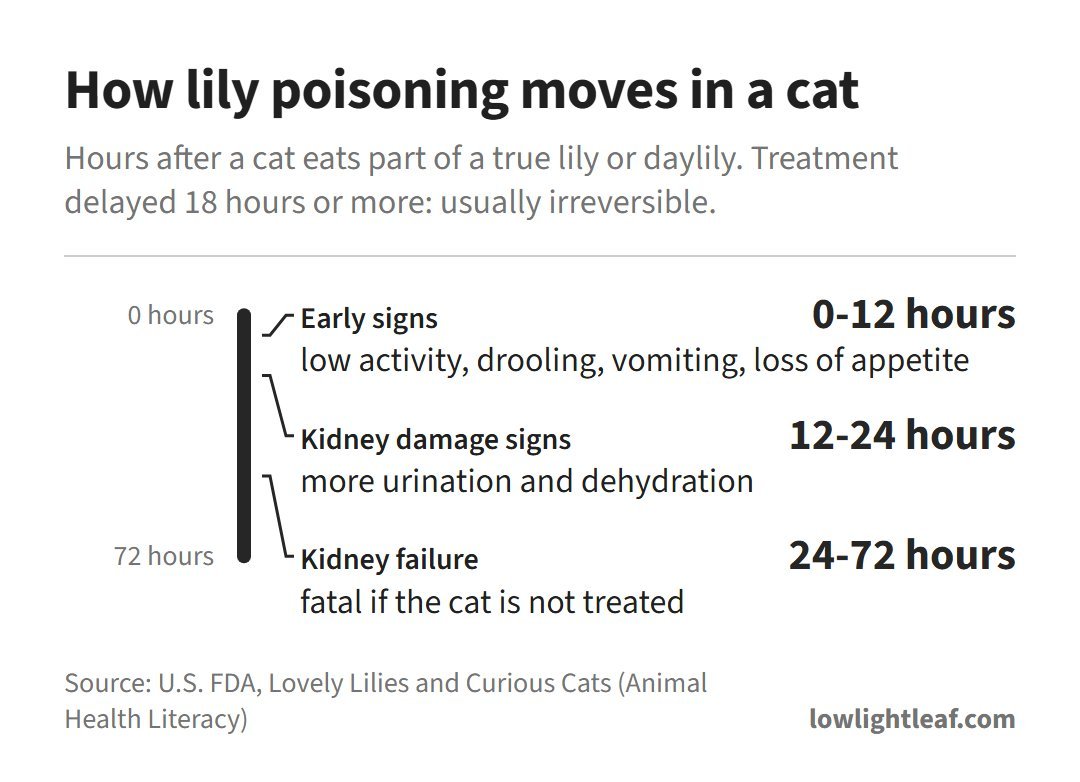
The FDA points out that lilies are common in bouquets as well as garden beds, and it calls plants in the true lily (Lilium) and daylily (Hemerocallis) families very dangerous for cats. Every part is toxic, including the pollen and the water in the vase: a small bite of leaf or petal, a few pollen grains licked off fur, or a drink from the vase can lead to fatal kidney failure in less than 3 days.
The FDA sets out the timing. Early signs such as low activity, drooling, vomiting and loss of appetite start 0-12 hours after eating. Signs of kidney damage, more urination and dehydration, start at about 12-24 hours, and kidney failure follows at 24-72 hours. If treatment is delayed by 18 hours or more, the FDA says the kidney failure is generally irreversible.
Dogs that eat lilies may get a minor stomach upset but don’t develop kidney failure, according to the FDA. Peace lilies and calla lilies belong to neither family. They hurt the mouth with calcium oxalate crystals, and the FDA says they don’t cause kidney failure in cats.
Sago palm: liver failure
Sago palm (Cycas revoluta), which the ASPCA groups with the cycads, contains cycasin. The ASPCA’s list of signs for cats and dogs runs from vomiting and black, tarry stool to jaundice, bruising, clotting problems, liver failure and death.
Heart rhythm: lily of the valley, oleander, azalea and kalanchoe
For lily of the valley, the ASPCA lists irregular heartbeat, low blood pressure, disorientation, seizures and coma, and the FDA describes the abnormal heart rhythm as life-threatening. Oleander contains cardiac glycosides, and death is among the signs the ASPCA gives. Azalea’s grayanotoxin can cause cardiac failure.
Kalanchoe is milder. For its bufodienolides the ASPCA lists vomiting and diarrhea, and it calls an abnormal heart rhythm rare. Large amounts of cyclamen tuber or daffodil bulb can also upset heart rhythm, the ASPCA says, and for daffodils the bulb is the most poisonous part.
Mouth pain: the calcium oxalate plants
Many of the most familiar houseplants carry calcium oxalate crystals: pothos, heartleaf and tree philodendron, monstera, peace lily, dieffenbachia, Chinese evergreen, arrowhead vine, alocasia, caladium, anthurium, calla lily and schefflera. The ASPCA lists much the same signs for all of them: oral irritation, pain or burning of the mouth, tongue and lips, heavy drooling, vomiting and difficulty swallowing. Writing about peace and calla lilies, the FDA says pawing at the face, drooling and foaming usually go away on their own, and that swelling bad enough to affect breathing can happen but is uncommon. The FDA adds that those signs may show immediately.
Stomach upset: saponins and irritant sap
Snake plant, dracaena, corn plant, ti plant, yucca, hosta and aloe contain saponins. The ASPCA lists vomiting for all of them, diarrhea for snake plant, hosta and aloe, and for the dracaenas and ti plant also depression, drooling and dilated pupils in cats. English ivy, tulip and hyacinth land in the same vomiting-and-diarrhea range, with the tulip’s toxin most concentrated in the bulb, while jade plant can cause vomiting, depression and incoordination.
Poinsettia and pencil cactus have an irritant sap that can irritate the mouth and stomach, and the ASPCA calls both “generally over-rated in toxicity.” Shamrock plant (Oxalis) and begonia contain soluble calcium oxalates. The ASPCA lists kidney failure for shamrock but calls it rare in dogs and cats, and for begonia it says the underground parts are the most toxic.
Toxic to cats but not dogs
Lilies, daylilies and catnip are the only plants the ASPCA flags as toxic to cats but not to dogs. Going the other way, its dog-only entries are black walnut, macadamia nut (also filed as Australian and Queensland nut) and hops, none of them houseplants.
I counted that from the ASPCA’s two published plant lists in October 2026: 985 common-name entries, with 423 marked toxic to cats and 416 toxic to dogs. The count goes by common name, so one plant can appear more than once (snake plant is filed under three names), and it only covers plants the ASPCA has reviewed. Neither list says how much of a plant causes harm.
Catnip is the odd one.
The ASPCA notes that many cats love it, but it can cause vomiting and diarrhea, and it leaves some cats sedated and others stimulated. It isn’t on the dog list at all.
Same name, different plant
Common names cause most of the confusion: one name can sit on a toxic plant’s label and a safe plant’s label at the same time. Match the scientific name on the plant tag before trusting any verdict, including the ones here.
- Rubber plant. The rubber tree (Ficus elastica) falls under the ASPCA’s toxic fig-genus entry. Baby rubber plant and American rubber plant are Peperomia obtusifolia, which is non-toxic.
- Fiddle-leaf. The ASPCA’s “Fiddle-Leaf” entry is Philodendron bipennifolium, toxic. The fiddle-leaf fig (Ficus lyrata) has no entry of its own beyond the toxic Ficus one.
- Bird’s nest. The ASPCA files snake plant as “Golden Bird’s Nest.” Bird’s nest fern (Asplenium nidus) isn’t listed.
- Ribbon plant. The ASPCA uses the name for a dracaena, which is toxic, and for spider plant, which isn’t.
- Ivy. English ivy and devil’s ivy (pothos) are toxic. Swedish ivy (Plectranthus) is non-toxic.
- Jasmine. True jasmine (Jasminum) is non-toxic. Cape jasmine is a gardenia, which is toxic.
- Palm. Parlor, areca, kentia, majesty, lady and ponytail palms are non-toxic. Sago palm can kill.
- Lily. True lilies and daylilies damage a cat’s kidneys, peace and calla lilies burn the mouth, and lily of the valley affects the heart.
- Panda plant. The ASPCA uses the name for Philodendron bipennifolium. The fuzzy succulent sold as panda plant is a kalanchoe. Both are toxic.
Popular houseplants the ASPCA doesn’t list
ZZ plant, croton, bird’s nest fern, maidenhair fern, air plants and string of pearls have no entry on the ASPCA lists. A missing entry is not a safety verdict, so treat these as unknown and keep them out of reach of a pet that chews leaves.
Three more are covered only through a whole-genus entry. Fiddle-leaf fig and rubber tree sit under the ASPCA’s Ficus sp. listing, and lucky bamboo (Dracaena sanderiana) under Dracaena spp. Both genus entries are marked toxic to cats and dogs.
If your cat or dog chewed a plant
Phone your vet or a pet poison line right away rather than waiting for symptoms. The ASPCA Animal Poison Control Center is (888) 426-4435 and Pet Poison Helpline is 855-764-7661, both listed by the FDA. The ASPCA says a consultation fee may apply.
Have the plant’s name ready, or take the plant or a photo of it with you. The FDA says that helps a vet tell whether it’s one of the dangerous lilies. For anything not in the A to Z list, the ASPCA database holds about a thousand entries, and a tag with the scientific name settles most of the name confusion.
With a cat and any true lily or daylily, I’d go straight to the vet even if the cat seems fine.
The FDA’s 18-hour window leaves no room to wait and see. I’m not a vet, and nothing on a plant list replaces one who has examined your pet.
Plant toxicity questions
What is the most poisonous plant for cats?
Of all the plants poisonous to cats, true lilies and daylilies are the most dangerous: the FDA says a small bite, licked pollen or vase water can cause fatal kidney failure in less than 3 days. Sago palm is the other one the ASPCA links to liver failure and death.
Are succulents safe for cats?
Some succulents are safe for cats and some aren’t. The ASPCA lists haworthia, echeveria, burro’s tail and Christmas cactus as non-toxic to cats and dogs, and jade plant, aloe, kalanchoe and pencil cactus as toxic. If you’re choosing one for a dim room, my low light succulents list sorts out which ones cope.
Is monstera toxic to cats?
Monstera is toxic to cats and dogs on the ASPCA list. Monstera deliciosa contains insoluble calcium oxalates, so a bite causes mouth pain, drooling, vomiting and trouble swallowing rather than organ damage.
Which houseplants are safe for cats and dogs?
Spider plant, parlor palm, Boston fern, cast iron plant, calathea, peperomia, African violet and phalaenopsis orchids are all listed by the ASPCA as non-toxic to cats and dogs. My pet friendly indoor plants picks are the ones that also cope with low light, and spider plants and cats have a page of their own.
Non-toxic doesn’t mean edible. The ASPCA’s money tree entry still mentions nausea, vomiting and loose stool, and its polka dot plant entry mentions mild vomiting and diarrhea.