Cyclamen care comes down to a cool room, bright light out of direct sun, and water given from below or at the edge of the pot. Clemson Extension puts the ideal at 60 to 65°F by day and about 50°F at night, and says that above 70°F the buds fail to develop.
That’s one authority’s set of numbers. The New York Botanical Garden and the Chicago Botanic Garden give slightly different ones, and they disagree more about what to do once flowering ends. Most care tags print a single version as if it were settled.
Cyclamen care indoors: where to put it
Put a cyclamen in the coolest bright spot you have, away from heat vents. All three sources agree on cool and bright; they differ on how cool.
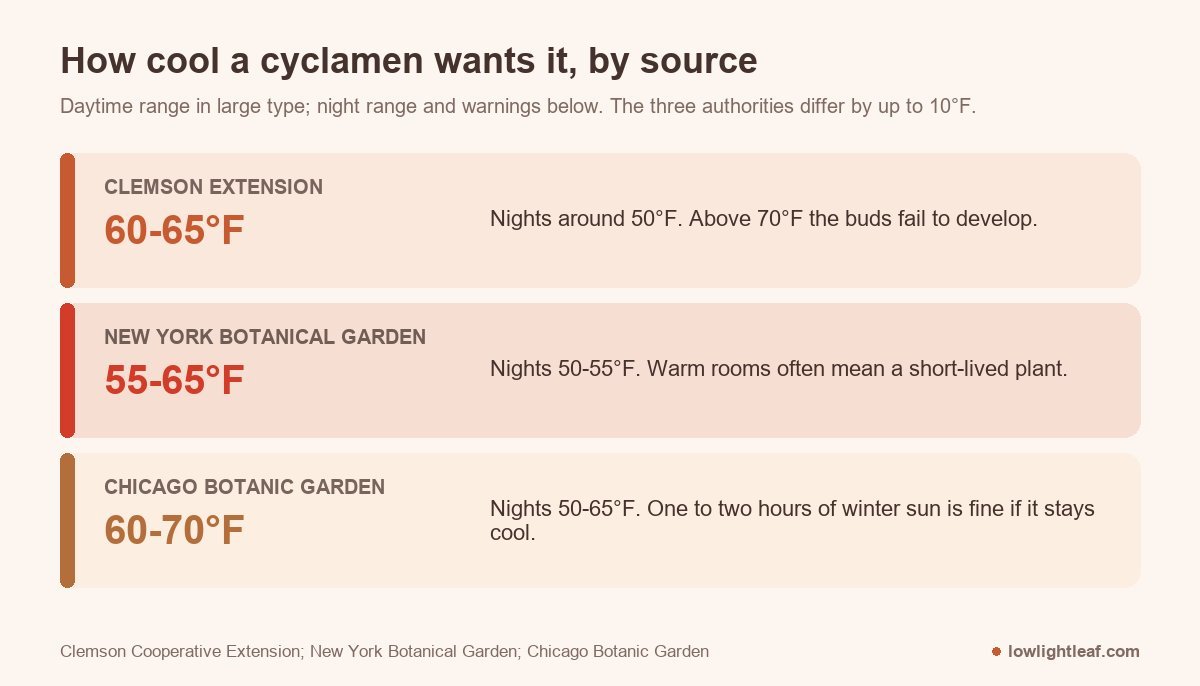
In text: Clemson wants 60 to 65°F days, NYBG 55 to 65°F and Chicago Botanic 60 to 70°F, with nights between 50 and 65°F depending on the source.
The New York Botanical Garden wants bright light all day without direct sun, as long as the spot isn’t hot, and suggests an east-facing window or a place farther back from a south-facing one. Chicago Botanic allows one to two hours of direct winter sun if the plant doesn’t warm up. Clemson and NYBG both warn against heat vents, which dry the soil too fast.
A north-facing apartment like the one I lived in for years is on the dim side of that advice. The light is gentle enough, but it rarely counts as bright all day.
Cool doesn’t mean cold and damp, though. One grower on Reddit, whose post title reads “Cyclamen going strong indoors at 70-80 F,” found the opposite problem:
“Per the internet’s advice, I had initially put it in the coldest room of my house which happened to be my bathroom. But the combination of low temp, high humidity, and stagnant air was a recipe for stem/crown rot. Leaf petioles (“stems”) started turning to mush…”
– r/houseplants, February 2026 (249 upvotes)
That’s one plant, and it runs against all three sources’ ranges. It’s still a fair warning: the cool spot also needs moving air and soil that dries between waterings.
Watering from the edge or from below
The watering half of cyclamen care is simple to state: water when the top of the soil feels dry, and keep water off the center of the plant. NYBG explains why: the corm-like tuber sits partly exposed and waterlogs easily, and Chicago Botanic says water in the center can lead to crown rot.
- Touch the top of the soil. If it’s still damp, wait, NYBG says.
- To water from below, set the pot in a shallow bowl of water for about 15 minutes.
- Lift it out as soon as the surface starts to look moist, and let it drain in the sink for about 15 minutes.
- Never leave it standing in a saucer of runoff.
- If you water from the top instead, pour as close to the pot’s rim as you can.
The sources word the target a little differently. Clemson says moist but not soggy, Chicago Botanic says slightly moist at all times, and NYBG says the plant dislikes both wet and dry soil. In practice they meet at the same habit: water when the surface dries, and never let the pot sit wet.
Why a cyclamen droops or turns yellow
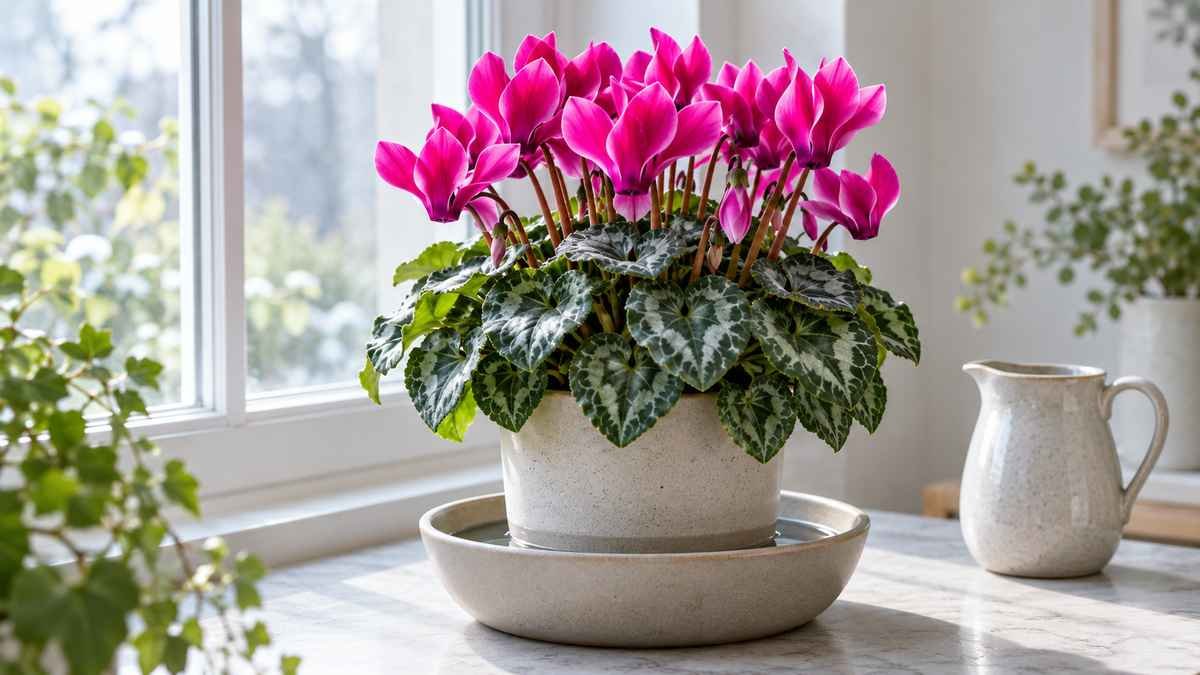
A cyclamen that suddenly flops has usually been kept too wet, NYBG says; it even has a name for the collapse, “cyclamen faint.” Gardeners on Reddit describe the same flop from a pot left too dry, so feel the soil before deciding which one you have.
“I’d be dramatic too if I only got a thimble coffee a day.”
– r/GardeningUK, September 2026 (29 upvotes)
Yellow leaves have more causes. NYBG lists too little sun, a spot that’s too warm, and too much or too little water, plus the gradual yellowing of late spring when the plant heads into dormancy. Scorched leaves mean the sun is too strong, and buds that never open mean the room is warmer than the plant’s range.
Pull spent flowers off completely. Clemson says to grab the faded stem and pull it free from the crown, which helps more flowers develop. With good care, Clemson expects blooming to continue for up to four weeks; Chicago Botanic says a well-placed plant can keep flowering for several months. NYBG’s shopping advice follows from that: choose the plant with the most buds, because the blooming lasts longer.
Pests are occasional, and Clemson splits them in two:
- Aphids, mealybugs, spider mites and thrips: controlled with insecticidal soap.
- Cyclamen mites: hard to control, so the plant is best thrown out. NYBG adds that they go after plants in warm, dry rooms.
Humidity and the pebble-tray question
NYBG prefers relative humidity above 50 percent and suggests a tray of moist pebbles or a humidifier. Penn State Extension disagrees about the tray: the water from it spreads through the whole room, with almost no overall effect on humidity. A humidifier does raise it, and the limits of running one in winter are in how to increase humidity in house air.
Keep it after flowering, or let it go?
Keep a cyclamen after flowering only if you have a cool, bright window for its regrowth. Clemson Extension says reblooming a compact plant at home is difficult because home light is usually too low, which tends to give a weak plant with long leaf stalks and smaller, paler flowers.
In a dim apartment, enjoy it for the winter and let it go; the same keep-or-toss choice comes up with poinsettias.
If you keep it, the three sources run dormancy differently:
| Source | Water during dormancy | Where and how long | Restart |
|---|---|---|---|
| NYBG | Cut back over several weeks; stop once all leaves are yellow | Cool (about 50°F) and dry, 6 to 8 weeks; or the cleaned tuber in vermiculite | Repot with the tuber half buried; water lightly; feed every two weeks after dormancy |
| Chicago Botanic | Just enough to keep the roots from drying out | Dark and cool, about three months | Fresh sterile potting soil; diluted fertilizer monthly; blooms in two to three months |
| Clemson | Keep the soil from drying out completely | Shade until new leaves appear in mid-September | Bright, full-sun spot; regular water; monthly feeding; 50°F nights; reblooms by midwinter |
NYBG and Clemson agree on how the rest ends: new leaves appear in late summer or by mid-September, and that’s the signal to bring the plant back to a cool, bright spot and water again. NYBG adds that if nothing has grown after eight weeks, moving the pot to 55 to 65°F can wake it.
Can a cyclamen go outside? Not the florist kind in most of the US. The North Carolina Extension Gardener toolbox says florist’s cyclamen are frost tender and winter hardy only in USDA Zones 9 to 11.
“They are the wrong type of cyclamen, you need Cyclamen coum, the ones you have been sold are florist cyclamen that are not hardy .”
– r/GardeningUK, February 2026 (19 upvotes)
Starting new plants isn’t much of a shortcut either. Clemson says seed takes 9 to 15 months to reach a blooming plant even in a greenhouse, cut tubers tend to dry out or rot, and buying a new plant is the practical route.
Cyclamen, cats and dogs
The ASPCA lists cyclamen as toxic to dogs, cats and horses, with salivation, vomiting and diarrhea as the usual signs. The tuber is the dangerous part: after large ingestions of tubers, it lists heart rhythm abnormalities, seizures and death.
I check every plant against that list because of my cat, Miso, and cyclamen is one I’d keep out of reach. Plants on the safe side of the list are gathered in pet-friendly indoor plants. If you keep a cyclamen through dormancy, the risk moves with the tuber: a pot of vermiculite in a closet is exactly where a curious pet can dig one out.

Ellie Marsh
Houseplant grower who spent years in a north-facing apartment. Writes practical care guides for low light homes, checked against extension and botanical garden sources.