Last updated on October 14, 2026
Amaryllis care comes down to a snug pot with part of the bulb above the soil, a sunny window, light watering until growth starts, then evenly moist soil, and flowers about six to eight weeks after planting. University of Maryland Extension calls bright sunlight the single most important factor for getting it to bloom again the following year.
That last point is the one most gift bulbs miss. I spent years in a north-facing apartment, and a window like that is where I’d plan on a grow light for an amaryllis. Below are the steps from potting to a second winter of flowers, with the numbers from three university extension services and the one place they disagree.
Potting an amaryllis bulb
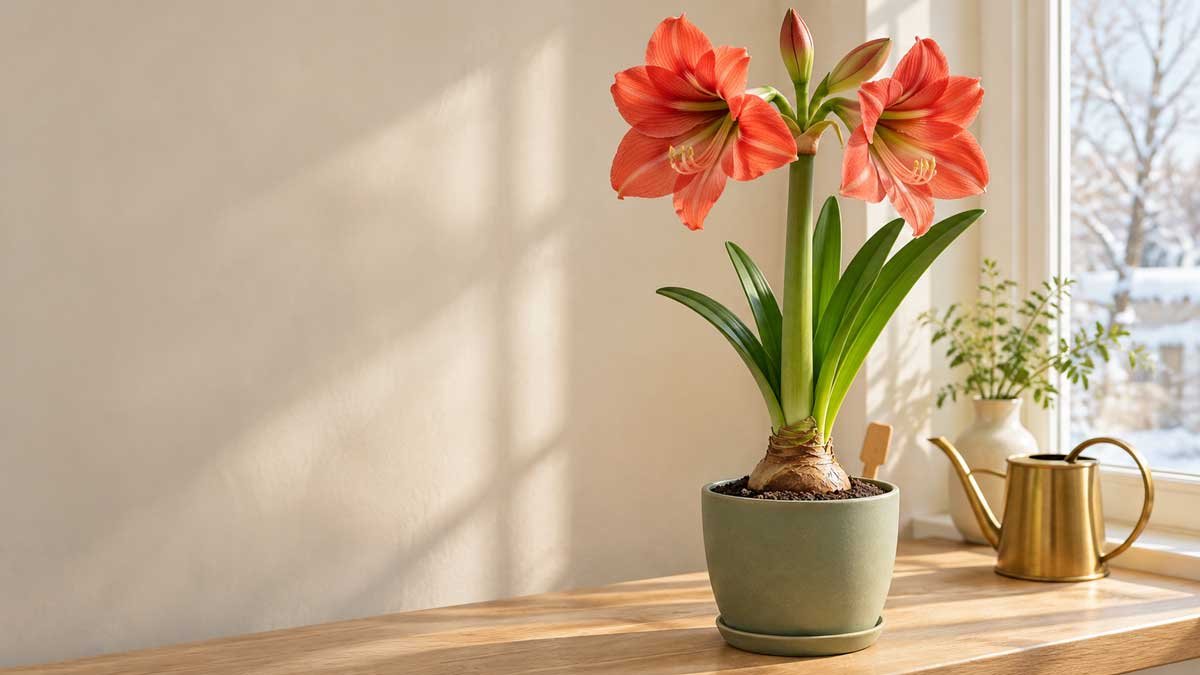
Pot the bulb in a container only a little wider than it is, with part of the bulb sitting above the soil. Maryland says amaryllis bloom better slightly pot-bound, and University of Minnesota Extension suggests a pot about an inch wider than the bulb and twice as tall.
- Pick a firm bulb. Minnesota says the largest bulbs give more stalks and flowers the first year; choose one with bright green growth and no spots.
- Leave part of it exposed. Maryland says about a third of the bulb, Minnesota one-third to one-half, and the University of Florida at least half to two-thirds to encourage early flowering.
- Water once, then wait. Florida says no more water is needed until the bulb sprouts, and Maryland keeps the mix barely moist until there’s 2 to 3 inches of growth.
Florida expects blooms within six to eight weeks of planting and watering.
Light, water and feeding while it grows and blooms
An amaryllis needs a sunny window while it grows, moist but not soggy soil, and a cooler spot out of direct sun once it opens. Maryland asks for bright light with some direct sun during active growth and warns that spindly, floppy leaves mean the light is too weak.
Weak light costs more than a leaning stalk. Maryland says it weakens the bulb and can reduce or stop next year’s bloom. Turn the pot a little each time you water so the stalk grows straight.
Watering advice varies by source. Maryland lets the top half inch dry between waterings, while Minnesota waits until the top 2 inches feel dry, and both say never to leave the pot standing in water. Minnesota feeds at half strength with each watering once growth shows, using a high-phosphorus houseplant fertilizer.
Once the flowers open, move the plant out of direct sun, since Maryland says temperatures over 65°F shorten the bloom and each flower lasts about two weeks.
Amaryllis care after blooming
After the flowers fade, cut off the flower stalk but keep every leaf, then grow the plant in the sunniest spot you have. Maryland says the leaves make the energy the bulb needs to rebloom, and Minnesota says seed formation drains the bulb’s reserves.
Plenty of growers only learn about the seed pod when it appears. One owner hoping for a second flower found this instead, and the top reply explained it:
“Those are seeds the seeds are small bumps in the middle of the black sheet-like covers.”
– r/houseplants, August 2026 (545 upvotes)
Cut the stalk before the pod swells, and the bulb keeps that energy for next year.
- Cut the flower stalk once the last flower fades, as Maryland advises.
- Keep the leaves growing. Minnesota’s advice is the sunniest indoor spot, with regular water and an all-purpose houseplant fertilizer.
- Move it outside after frost if you can. Minnesota starts in shade and works up to at least six hours of full sun; Maryland introduces it slowly to partial sun. Minnesota notes it won’t survive frost, so bring it in before the first one.
- Feed through summer. Minnesota fertilizes monthly outdoors.
A bare green fan of leaves with no flower stalk the second winter usually traces back to this stage. Minnesota says a bulb that doesn’t flower likely didn’t store enough after blooming.
Getting amaryllis to rebloom: rest or no rest
An amaryllis can rebloom with or without a rest period, depending on which extension service you follow. Maryland says a dormancy period is required for rebloom, while Minnesota says amaryllis don’t need one and will bloom again if they keep growing, and uses a rest only to control when flowers appear.
| Stage | University of Maryland | University of Minnesota |
|---|---|---|
| Is a rest needed? | Yes, for rebloom | No; it only times the bloom |
| When to start | Late summer to early fall, for holiday flowers | After bringing the pot indoors |
| Where | Cool (40-50°F), dry spot such as a basement; light doesn’t matter | Cool, dry, dark spot such as a basement or closet |
| Water | Withhold until the leaves yellow and wither | None; let the leaves brown before cutting them off |
| How long | About 6 to 8 weeks, until regrowth shows | 8 to 12 weeks |
| Then | Start the growing process again | Sunny spot; flowers in about 4 to 6 weeks |
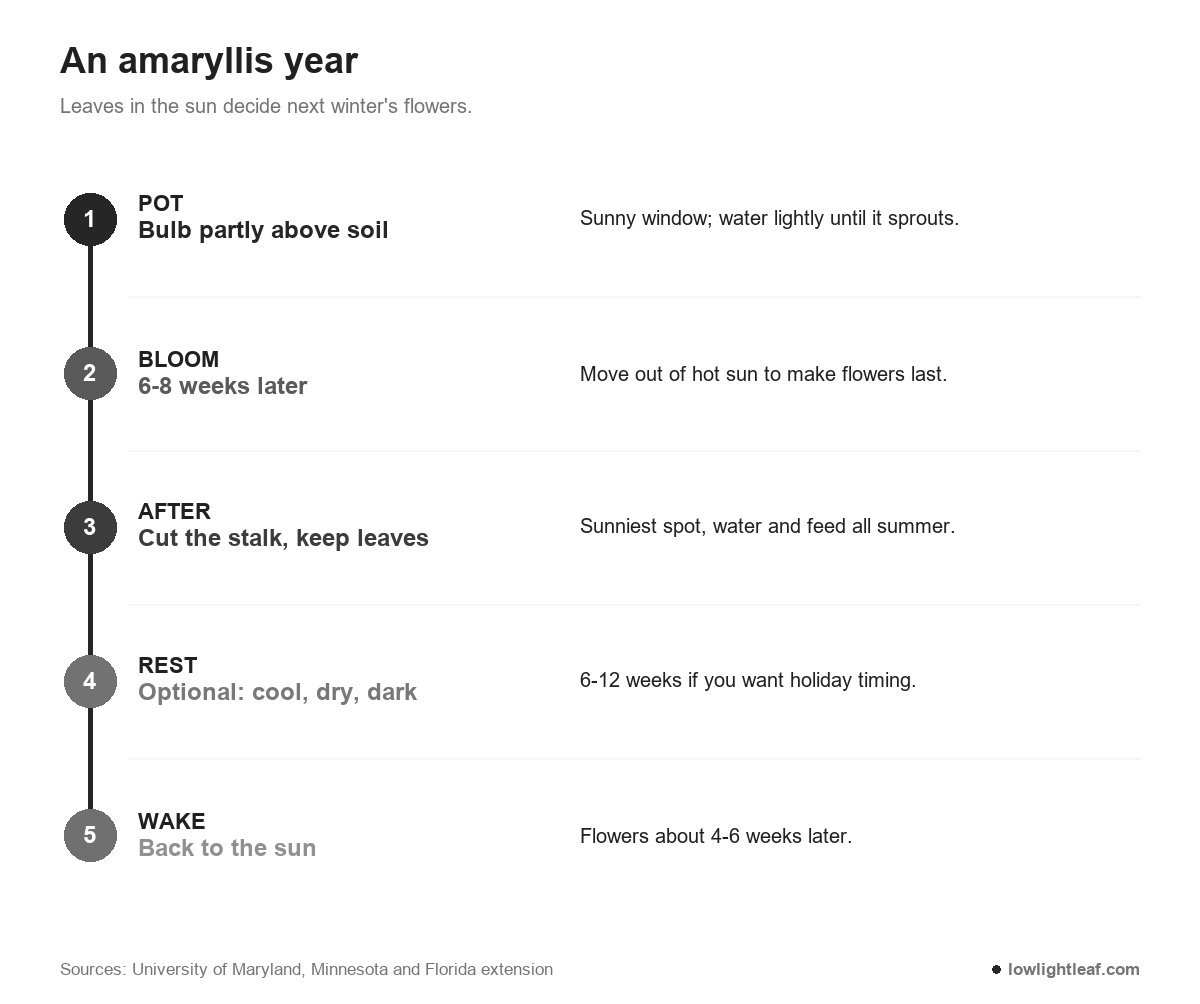
I’d decide by the calendar. For flowers in December, give it the rest in early fall; if you don’t mind when it blooms, keep it growing in good light and let it flower when it’s ready, which skips the basement entirely. Either way, the summer of leaf growth matters more than the weeks in the dark.
A grower on r/flowergardening revived a 20-year-old bulb that had made only leaves for about a decade, by cutting the leaves as winter set in and resting it in a dark corner:
“This is my mom’s amaryllis that used to flower profusely when I was in school. For the last 10 years or so however, it merely grew large leaves and became evergreen but bore no flowers. It also had brown spots on the leaves that were probably the result of fungal infection. I took it upon myself to restore it. Last year, I cut off the leaves as winter set in, let the bulbs rest inside the soil in a dark corner for months. When I brought it out in summer, I repotted the bulbs and separated them…” [excerpt — 884 characters in full]
– r/flowergardening, July 2026 (1,362 upvotes)
One bulb doesn’t settle the disagreement between Maryland and Minnesota, but if yours has stopped flowering while staying green all year, a rest is worth trying.
Repotting is rarely needed. Minnesota repots only every three or four years, ideally right after the rest, and Florida says a bulb can stay in its container for two or more years.
Amaryllis care FAQ
How do you care for a waxed amaryllis bulb?
Set a waxed amaryllis bulb in bright, indirect light and don’t water it. Iowa State University Extension says waxed bulbs need no water or soil and bloom for up to three weeks, and that they’re meant for one season, so discard the bulb after flowering.
How many times will an amaryllis flower?
An amaryllis can flower every year for decades. Minnesota says bulbs have been known to bloom for up to 75 years, and each season Maryland expects two to four flowers per stalk, each lasting about two weeks.
What happens if I keep my amaryllis growing all year?
It can still bloom again. Minnesota says amaryllis don’t require a rest and will rebloom if allowed to keep growing; you just give up control over when the flowers appear.
Is amaryllis toxic to cats and dogs?
Yes. The ASPCA lists amaryllis as toxic to cats, dogs and horses, with signs that include vomiting, diarrhea, drooling and tremors, so keep the pot and the bulb out of reach. How it compares with other holiday plants is in is Christmas cactus toxic to cats. Safer options are in pet friendly indoor plants.
If your windows are dim and an amaryllis feels like a stretch, the plants that cope best without much sun are in low light indoor plants.

Ellie Marsh
Houseplant grower who spent years in a north-facing apartment. Writes practical care guides for low light homes, checked against extension and botanical garden sources.