To get rid of fungus gnats, let the top 1 to 2 inches of potting mix dry between waterings, treat the soil for larvae with Bti or beneficial nematodes, and keep it up for at least one full life cycle, about three to four weeks. Yellow sticky cards and a slice of raw potato in the pot tell you whether it’s working.
The flies you see are only the last stage. UC IPM says most of a fungus gnat’s life is spent as a larva and pupa in the potting mix, so learning how to get rid of fungus gnats is mostly about what happens under the soil surface.
Are they fungus gnats?
Fungus gnats (mostly Bradysia species) are dark, delicate flies about 1/16 to 1/8 inch long that stay close to your pots. UC IPM says they are weak fliers that run across the potting mix and rest on leaves, and that they drift toward windows because they’re attracted to light.
The University of Minnesota warns that they are easy to confuse with fruit flies and other small flies, so the location is the useful clue: flies walking on damp potting mix point to fungus gnats. The larvae are the confirmation. UC IPM describes them as legless and whitish to clear, with a shiny black head, living in the moist mix.
Are fungus gnats harmful? Not to you: Colorado State and UC IPM both say the adults don’t bite. For plants, the sources split. Minnesota says fungus gnats rarely if ever damage indoor plants, while UC IPM says large numbers of larvae can damage roots, especially on seedlings and young plants, and that heavy infestations in moist, organic-rich mix have killed houseplants.
Why fungus gnats show up in fall and winter
Colorado State says fungus gnats are most noticeable in late fall and winter, for three reasons: plants that spent summer outdoors come in carrying them, shorter days and cooler temperatures slow how fast plants use water, and potting mix holds more moisture as it ages and breaks down. Moist mixes high in peat moss are especially attractive to egg-laying females.
A dim room makes the second point worse, and it’s the same light the north-facing window plants on this site are picked for. After years in a north-facing apartment, I’d treat any pot that stays wet long after watering as a likely gnat nursery, and the same wet mix is what feeds mold in plant soil.
The life cycle sets the schedule
One fungus gnat generation takes about 17 days at 75°F, according to UC IPM: eggs hatch in about 3 days, larvae feed for about 10, and adults emerge about 4 days after pupating. Colorado State puts the full cycle at three to four weeks at typical room temperatures of 65 to 75°F.
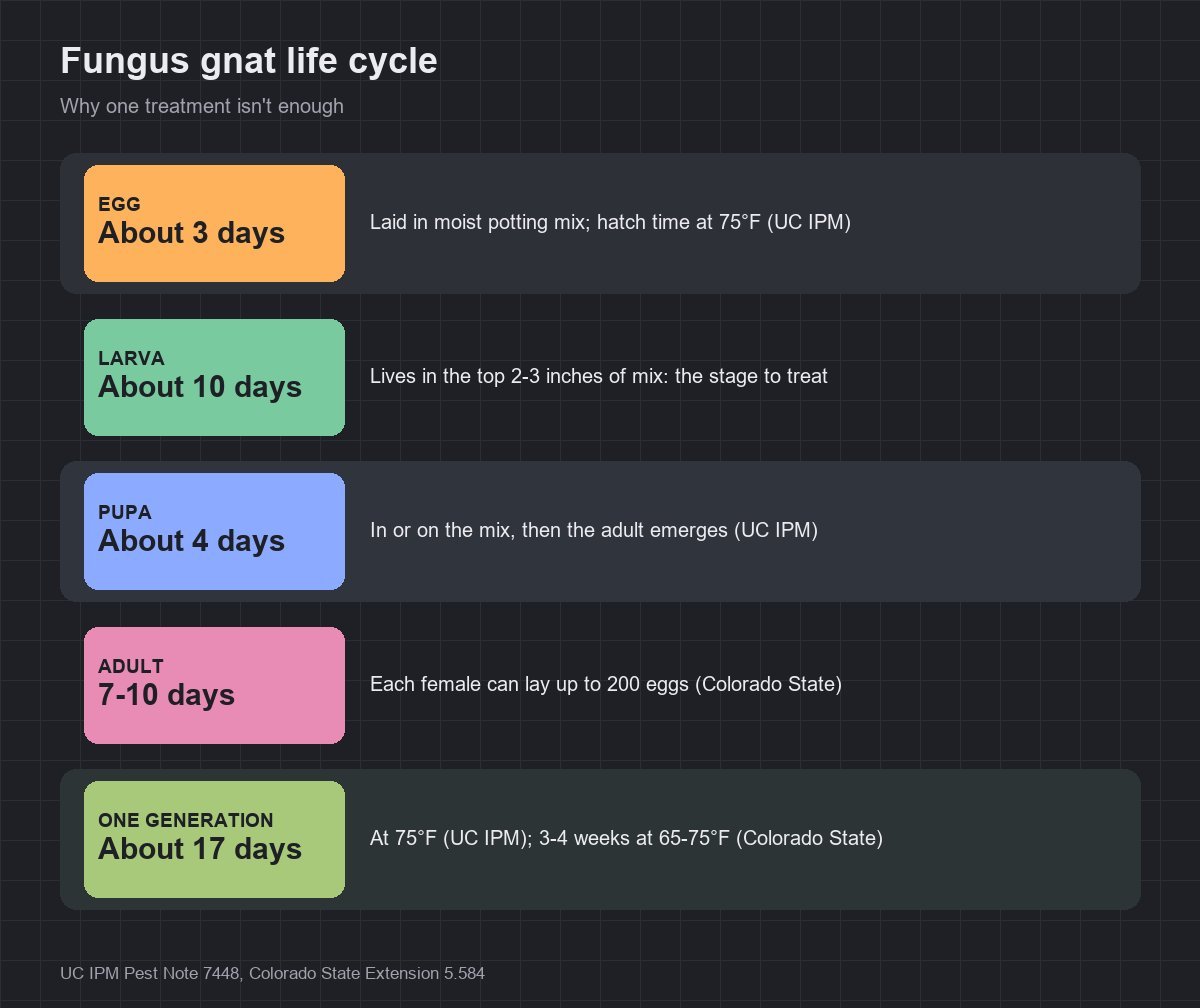
Two numbers from Colorado State explain why gnats seem to come back after you’ve swatted every adult. Adults live only seven to 10 days, but each female can lay up to 200 eggs, and the larvae sit in the top 2 to 3 inches of the mix where a spray aimed at flying gnats never reaches. Anything you do has to cover at least one full generation, which is why I’d plan on four weeks and not judge the results after one.
“Takes a while as you need to break the life cycle but keep at it.”
– r/houseplants, June 2026 (6 upvotes)
How to get rid of fungus gnats without a spray
In this plan, built from UC IPM, Colorado State and Minnesota Extension advice, steps 2 and 3 do the work, while the potato slices and sticky cards tell you whether it’s working.
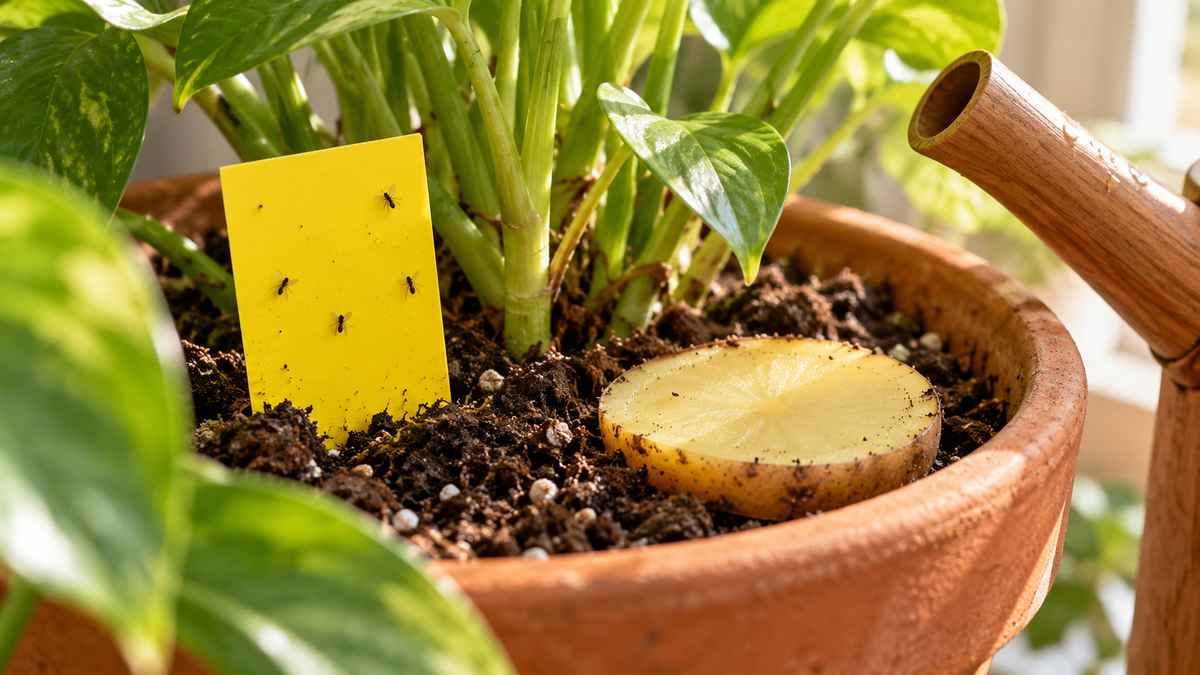
- Confirm the larvae. Press a 1/4-inch slice of raw potato into the surface of each suspect pot, as Colorado State suggests. Larvae move to it within a few days; turn it over to look underneath. UC IPM uses chunks with the cut side down and replaces them every few days, which also pulls larvae away from the roots.
- Dry out the top of the mix. Let the top 1 to 2 inches dry between waterings, Colorado State says, because dry mix cuts the survival of eggs and larvae and makes the pot less attractive to females. Minnesota adds a limit: dry the surface as much as possible without letting the plant wilt. Tip out saucers too, since UC IPM’s advice is to clean up standing water.
- Treat the larvae. Drench the mix with Bti (Bacillus thuringiensis subspecies israelensis) or the nematode Steinernema feltiae. UC IPM says Bti doesn’t persist indoors, so repeat it about every five days, and that the Bt sold for caterpillars won’t work on gnat larvae. Colorado State says nematode-infected larvae die within three to four days.
- Trap the adults. Set yellow sticky cards at the edge of the pot or under the leaves, where Colorado State says they catch egg-laying females.
- Replace tired mix. If the potting mix has broken down and stays soggy, Colorado State recommends repotting. Minnesota says to wash the old soil off the roots and use fresh mix in a clean pot, and UC IPM says to use only pasteurized potting mix. Pull out decaying roots or bulbs, which Colorado State says feed the larvae. UC IPM also suggests raising the share of perlite or sand in the mix so it drains faster.
- Keep the plant where it is. UC IPM advises against moving an infested plant to a new spot where emerging flies can reach other pots.
- Repeat the potato check. After about four weeks, set fresh potato slices again. Clean slices and few new gnats on the cards are a good sign the cycle is broken.
What each tool does, and where the sources disagree
Sticky cards catch adults, Bti and nematodes kill larvae, and fresh mix removes the breeding ground. UC IPM, Colorado State and Minnesota agree on that much, but they split on how much traps help and how easy Bti is to buy:
| If you’re seeing | What to use | What the sources say about its limits |
|---|---|---|
| Adults flying around the plant | Yellow sticky cards | Colorado State says mass-trapping females can shrink the next generation; Minnesota says traps only detect adults and shouldn’t be the only method |
| Larvae on the potato slice | Bti drench | Kills larvae only and doesn’t persist indoors, so repeat about every five days (UC IPM) |
| Larvae, and you’d rather treat less often | Steinernema feltiae nematodes | Work best at 60 to 90°F in moist mix and can give long-term control after several applications (UC IPM); live product, applied right away |
| Gnats still there weeks after you changed the watering | Fresh, pasteurized mix; insecticide as a last step | Colorado State suggests insecticides only if the problem persists several weeks after watering is adjusted; UC IPM says they are rarely warranted at home |
Finding Bti is the other disagreement. UC IPM says Bti products are easy to find at nurseries and garden centers, while Colorado State says Bti formulations sold specifically for fungus gnats generally aren’t available at retail. UC IPM’s own examples of easy-to-find Bti include a product sold for mosquitoes. One claim that comes up about those products is that a single application keeps working:
“Right but you don’t need to retreat as it’s constantly released every watering…”
– r/IndoorGarden, June 2026 (5 upvotes)
UC IPM says the opposite: Bti doesn’t reproduce or persist indoors, and potting mix infestations may need repeat applications about every five days. It also says Bti is toxic only to fly larvae, such as mosquitoes and fungus gnats. I’d go by UC IPM and keep treating through the full cycle, whatever form the Bti comes in.
Hydrogen peroxide, cinnamon and sprays
Hydrogen peroxide, cinnamon and vinegar traps aren’t on the fungus gnat control lists from UC IPM, Colorado State or the University of Minnesota. Those lists cover drying the mix, Bti, nematodes, sticky cards and fresh potting mix, so I can’t give a safe hydrogen peroxide dilution or vouch for any of the three. The one kitchen item the sources do use is a raw potato, mainly for finding larvae, though UC IPM notes the pieces also pull some away from the roots.
Insecticide sprays are a last resort. UC IPM says insecticides are rarely warranted for fungus gnats in and around the home; if you do use one, it suggests a houseplant-labeled pyrethrin product on the soil surface, never fogged or sprayed at flying gnats, with the plant moved outdoors for treatment and brought back about a day later. Colorado State adds that sprays aimed at adults don’t touch the larvae in the mix.
With Miso around, that order suits me.
UC IPM describes Bti and the nematodes as essentially nontoxic to people, and I’d use them and a drier watering routine long before anything in a spray bottle.
Fungus gnat questions
Why do fungus gnats keep coming back?
Fungus gnats usually come back because the mix is still wet or a new batch arrived with plants or soil, so getting rid of them for good depends on fixing both. Colorado State says plants summered outdoors bring them in, and Minnesota says never to pot indoor plants in garden soil or in potting soil from bags left open outside.
What kills fungus gnats fast?
None of the three extension sources offers a quick fix. Colorado State says larvae infected by Steinernema feltiae nematodes die within three to four days, but UC IPM’s timings put adults about four days behind the pupal stage, so pupae already in the mix can keep producing flies for several days after the larvae are dead.
How long does it take to get rid of fungus gnats?
Getting rid of fungus gnats takes at least one full life cycle, which UC IPM puts at about 17 days at 75°F and Colorado State at three to four weeks at 65 to 75°F. Colorado State only suggests insecticides if gnats persist several weeks after watering has been adjusted.

Ellie Marsh
Houseplant grower who spent years in a north-facing apartment. Writes practical care guides for low light homes, checked against extension and botanical garden sources.