Last updated on October 25, 2026
Most spider plant varieties are cultivars of one species, Chlorophytum comosum, and you tell them apart by where the pale stripe runs, whether the leaves curl and how compact the plant is. The NC State Extension plant toolbox lists eight named cultivars, from ‘Vittatum’ to the curly ‘Bonnie’.
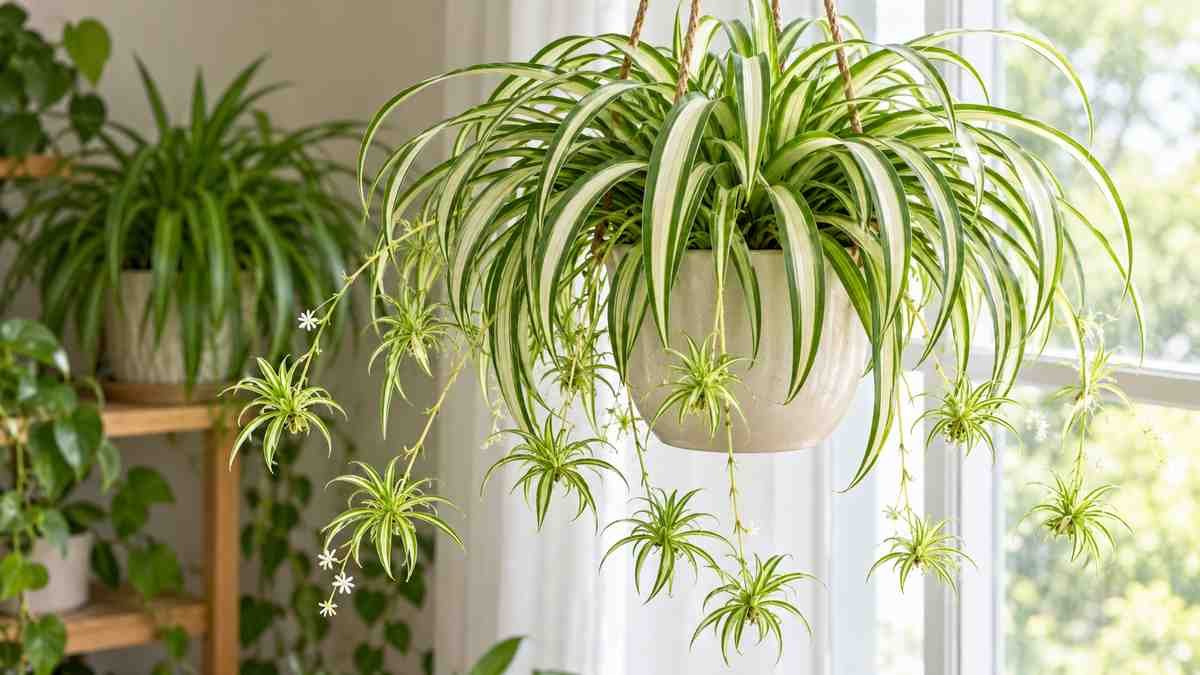
A few plants sold alongside them belong to other species in the same genus. The Royal Horticultural Society says two of those, ‘Green Orange’ and C. capense ‘Variegatum’, never make the dangling plantlets spider plants are best known for.
How many types of spider plants are there?
No official count exists for the types of spider plants. NC State lists eight cultivars of Chlorophytum comosum, Wisconsin Extension recommends four, and the RHS growing guide suggests six forms of the species plus three related species.
The related species are where longer lists come from. NC State gives Fire Flash the common names green orange spider plant and mandarin spider plant, though it is C. orchidastrum, and it says Bichetii grass, C. laxum, is often confused with the spider plant. Some names on tags, such as ‘Atlantic’, ‘White Lightning’ and ‘Mandaianum’, aren’t described by NC State, Wisconsin or the RHS, so I can’t confirm what sets them apart. If you’re trying to name a plant you already own, I’d skip the count and go straight to the leaf.
Identify a spider plant by its stripe
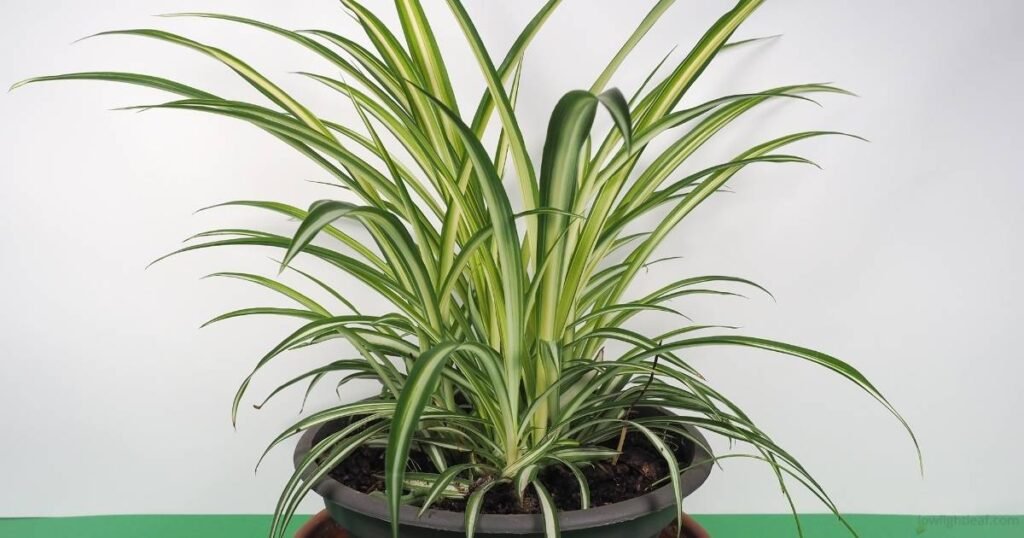
With spider plant varieties, start with where the pale band sits. A wide white or cream stripe down the middle of each leaf is ‘Vittatum’, which NC State describes as medium green with a creamy white central stripe. A green middle with white or cream edges is ‘Variegatum’.
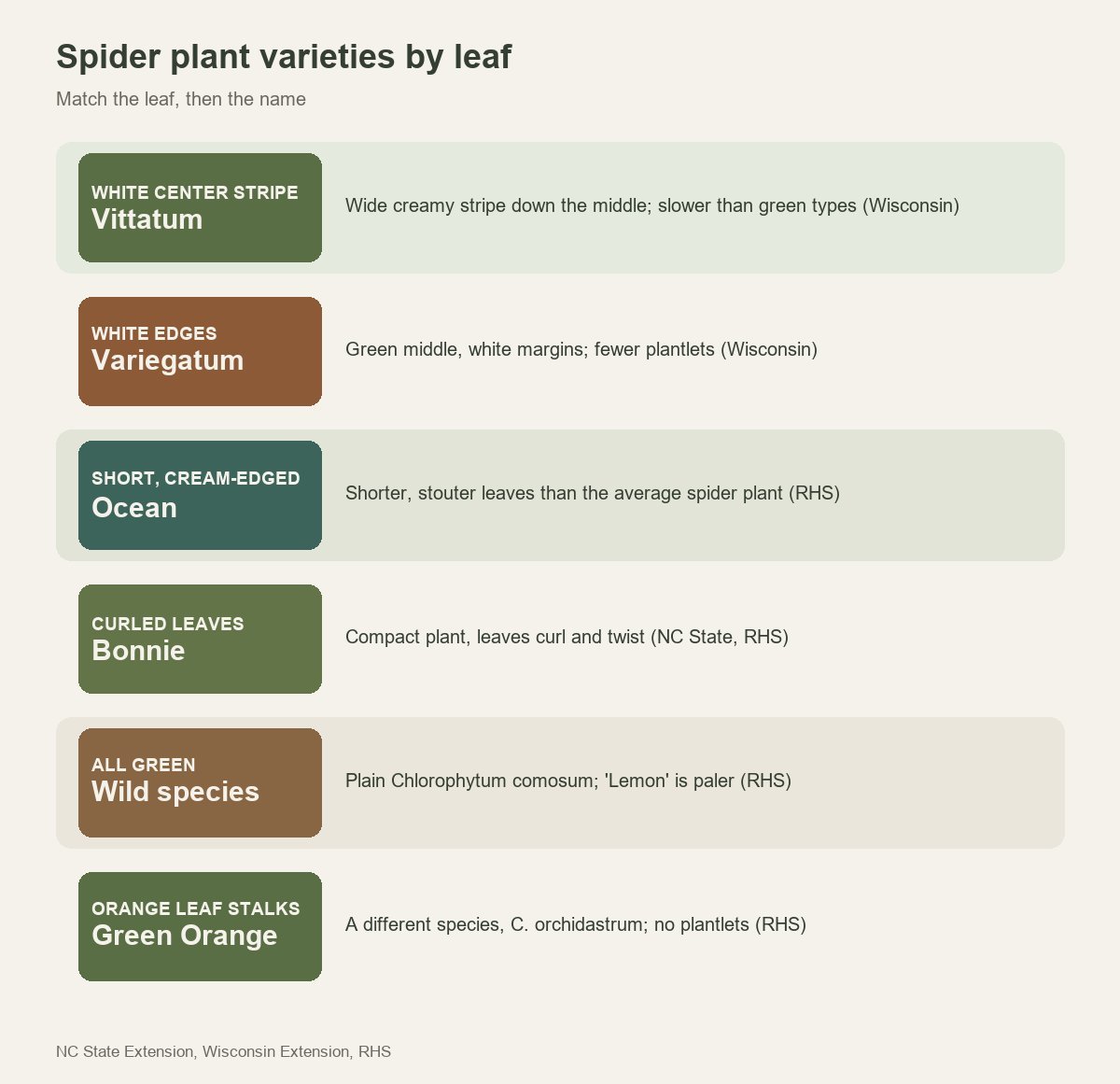
The names are where it gets muddled. The RHS growing guide describes ‘Ocean’ as reverse-variegated, with a green central stripe and cream margins. That is the same arrangement as ‘Variegatum’, so a tag reading “reverse spider plant” tells you the stripe is on the edges. It doesn’t tell you which cultivar you have. One grower posted photos after seeing listings that sold the wrong look as reverse:
“Just so you know, my 1st pic is actual reverse with white on the outside”
– r/houseplants, February 2022 (8 upvotes)
To separate ‘Ocean’ from ‘Variegatum’, look at leaf length. The RHS says ‘Ocean’ has shorter, stouter leaves than the average spider plant, while ‘Variegatum’ leaves reach about 45 cm, roughly 18 inches.
Even the reference sources disagree about which one counts as the ordinary spider plant. The RHS says ‘Variegatum’ is the traditional form and the most widely available. UF/IFAS says ‘Vittatum’ is the most common. Both carry the RHS Award of Garden Merit, so I wouldn’t lose sleep over which one a shop handed you.
Spider plant varieties, cultivar by cultivar
Every plant here is Chlorophytum comosum, so the care is shared and the basics are in spider plant care. What changes from one to the next is the leaf, the size and how freely the plant makes babies.
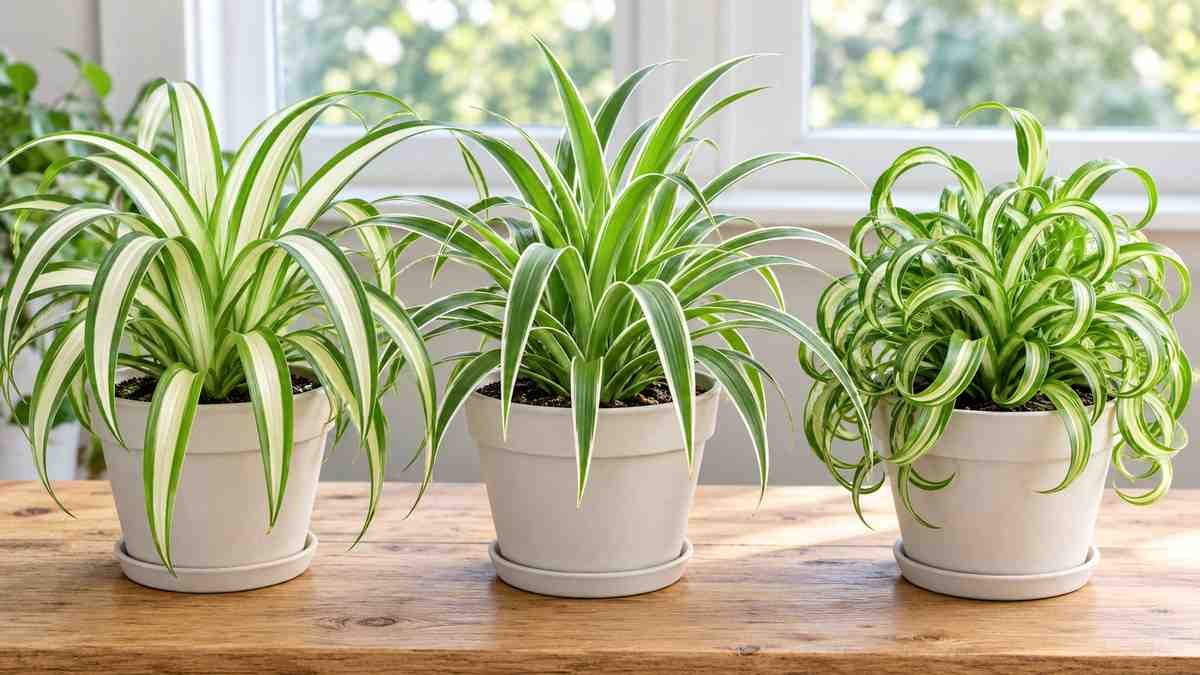
‘Vittatum’, the center stripe
‘Vittatum’ has a broad creamy white stripe down the center of a medium green leaf, per NC State. The RHS adds two details: its leaves are longer and more arching than those of ‘Variegatum’, and plantlets often appear among the flowers. Wisconsin Extension says it tends to grow more slowly than the green types.
‘Variegatum’, often sold as the reverse spider plant
‘Variegatum’ has green leaves edged in white or cream, and the RHS lists it under the common name variegated spider plant. Wisconsin describes the leaves as relatively broad and the plant as making fewer plantlets than other types, though it still forms them on its flower stems. If you want plenty of babies to give away, that’s the one thing I’d weigh against it.
‘Ocean’, short cream-edged leaves
‘Ocean’ is a compact plant with bright green leaves edged in cream, the RHS says, and its leaves are shorter and stouter than most. It still forms plantlets along branching flower stems.
‘Bonnie’, the curly spider plant
‘Bonnie’ is the curly spider plant, with green leaves that curl and twist. NC State lists it next to a separate ‘Bonnie Variegated’ with creamy white stripes, and the RHS profile for ‘Bonnie’ describes that striped form, compact, with a creamy stripe down each dark green leaf and plantlets along branching flower stems. So a Bonnie spider plant can be plain or striped, and the curl is what identifies it.
‘Hawaiian’
NC State’s only note on ‘Hawaiian’ is that its new leaves are variegated and the variegation fades with age. By that description, an older Hawaiian spider plant can look mostly green without having been mislabeled.
‘Milky Way’, ‘Picturatum’ and ‘White Stripe’
Three more cultivars turn up in the extension lists:
- ‘Milky Way’ has a broad white to cream center with green margins, which Wisconsin says makes the whole plant look much lighter than other cultivars.
- ‘Picturatum’ has a yellow stripe down the center (NC State).
- ‘White Stripe’ has only a narrow white or cream line on the center vein, which Wisconsin says is lost as the leaf ages, and its flower stalks are cream to yellowish instead of green.
Plain green spider plants
An all-green spider plant is the wild species, the RHS says, and its ‘Lemon’ cultivar is all green but noticeably paler. UF/IFAS calls all-green plants the rarest variety, which may be where the rare label comes from. One grower who posted theirs was skeptical:
“But I was told and read that all green spider plants are rare. This just looks like a regular house plant to me?”
– r/RareHouseplants, October 2024 (38 upvotes)
The RHS lists the all-green plant as the wild species itself, not a special cultivar, so I’d pay a normal price for one.
Which spider plants are actually another species?
Three plants sold near spider plants are separate Chlorophytum species: Fire Flash or Green Orange (C. orchidastrum), Bichetii grass (C. laxum) and C. capense. The RHS says Green Orange and C. capense ‘Variegatum’ make no plantlets.
- Fire Flash, Green Orange or mandarin plant (C. orchidastrum). NC State describes broad, lance-shaped green leaves with orange stalks and midribs on an upright clump 8 to 16 inches tall. It wants more warmth and humidity than a spider plant: above 60°F and 50 to 60% humidity, against 45°F as the spider plant’s floor. NC State lists division as the way to propagate it.
- Bichetii grass (C. laxum). NC State says it is more compact, 8 to 12 inches tall, with creamy banding either down the center or along the edges, and a flower stalk only 1 to 3 inches long whose flowers are rarely seen. Zebra grass is one of its common names, so a plant labeled “zebra” may be this one.
- C. capense ‘Variegatum’. The RHS describes broad variegated leaves and no plantlets.
Broad, upright leaves on a plant that has never sent out a long runner are the giveaway. Before blaming your watering for a lack of babies, make sure the plant is a C. comosum in the first place.
Choosing a spider plant variety for your room and your cat
For a dim room, any C. comosum form is a reasonable start. NC State says the species prefers medium light but tolerates deep shade, and the RHS says spider plants are happy in bright or low light indoors. Both warn against direct sun. After years in a north-facing apartment, I’d be a little careful with ‘Vittatum’ in a dim room, since Wisconsin already rates it slower than the green types. How much light each form needs is in spider plant light requirements.
If plantlets are the point, stick to the C. comosum spider plant varieties and go easy on fertilizer. NC State and Wisconsin both say heavy feeding cuts plantlet production, and NC State says the runners form after at least three weeks of short days, under 12 hours of light. A plant that hasn’t made any yet may simply need that, and other causes of a stalled plant are in spider plant not growing.
With Miso in the house, toxicity was my first question. The ASPCA lists Chlorophytum comosum as non-toxic to cats and dogs, and every cultivar above is that species. NC State tags C. orchidastrum as non-toxic for cats and dogs too. I couldn’t find a toxicity entry for Bichetii grass in the sources I used, so I’d treat that one as unknown. The detail on spider plants and cats is in are spider plants toxic to cats.
For the rest of what I’ve written about this plant, start from the spider plant page, which groups every guide in one place.
Spider plant variety questions
Why did my spider plant lose its stripes?
A spider plant can lose its stripes because some cultivars do it as they age. NC State says ‘Hawaiian’ variegation fades on older leaves, and Wisconsin says the center line of ‘White Stripe’ disappears as each leaf ages.
Do spider plant babies look like the parent?
Spider plant babies grown from plantlets are the usual way to get more of the same plant; seed is where the look changes. Wisconsin Extension says seedlings won’t necessarily have the parent’s leaf coloration. One grower raising crosses from seed ended up with plants they hadn’t owned before:
“im keeping a good bit of all green bonnies simply because i didnt have any in my collection and none of my friends have them either”
– r/spiderplants, May 2026 (52 upvotes)
Can spider plant varieties grow outdoors?
Spider plant varieties can go outside for summer as annuals, Wisconsin Extension says, planted after the last frost and kept out of full sun. NC State puts year-round outdoor growing at USDA zones 9 to 11. In Florida, UF/IFAS no longer recommends the plant at all, because its assessment predicts spider plant will become invasive there.

Ellie Marsh
Houseplant grower who spent years in a north-facing apartment. Writes practical care guides for low light homes, checked against extension and botanical garden sources.