Last updated on October 29, 2026
The real peace lily benefits are practical ones: it flowers in rooms too dim for most flowering plants, it wilts visibly when it needs water, and tending plants has measurable calming effects in a small 2015 study. Cleaner air is the oversold claim, according to a 2019 Drexel University review.
That review found you would need 10 to 1,000 potted plants per square meter of floor to match the air exchange an ordinary building already gets. So the case for a peace lily (Spathiphyllum) rests on what it does for your room and your routine, and it comes with one firm downside: the ASPCA lists it as toxic to both cats and dogs.
Peace lily benefits at a glance
Each claim below is graded against the source that actually tested or documented it.
| Claim you’ll hear | What the evidence says | Source | Verdict |
|---|---|---|---|
| It flowers in low light | Called one of the few foliage plants that will flower in low light; MU Extension adds it needs medium light to flower reliably | Clemson HGIC; University of Missouri Extension | True, with a light caveat |
| It tells you when it needs water | Wilts when the soil dries out too far, then recovers after watering | Clemson HGIC | True and useful |
| Caring for it lowers stress | Repotting a plant lowered diastolic blood pressure and nervous-system arousal compared with a computer task, in 24 young men | Lee et al., 2015 | Supported, small study |
| It purifies the air in your home | Sealed-chamber results don’t scale to real rooms: median 0.023 m³ of clean air per hour per plant | Cummings and Waring, Drexel, 2019 | Oversold |
| It brings peace, luck or good energy | A matter of tradition and meaning; no study measures it | None | Your call |
| It’s safe around pets | Toxic to cats and dogs: insoluble calcium oxalate crystals | ASPCA | False |
Two of the six claims stand up cleanly, one stands up with fine print, and the most repeated one, air purification, is the weakest.
Does a peace lily clean the air?
A peace lily does not measurably clean the air in a normal home. Drexel University engineers Cummings and Waring reviewed 12 chamber studies and found a single potted plant delivers a median of 0.023 cubic meters of clean air an hour, far below ordinary ventilation.
Belief in air-cleaning houseplants traces back to a 1989 NASA report led by B.C. Wolverton, which screened a dozen common houseplants, including the peace lily cultivar ‘Mauna Loa’, for removing chemicals like benzene and trichloroethylene. Those tests ran in small sealed chambers over 24-hour exposure periods. A sealed box with one plant and a dose of solvent is a very different space from a living room with a door, a window and a heating system moving air through it.
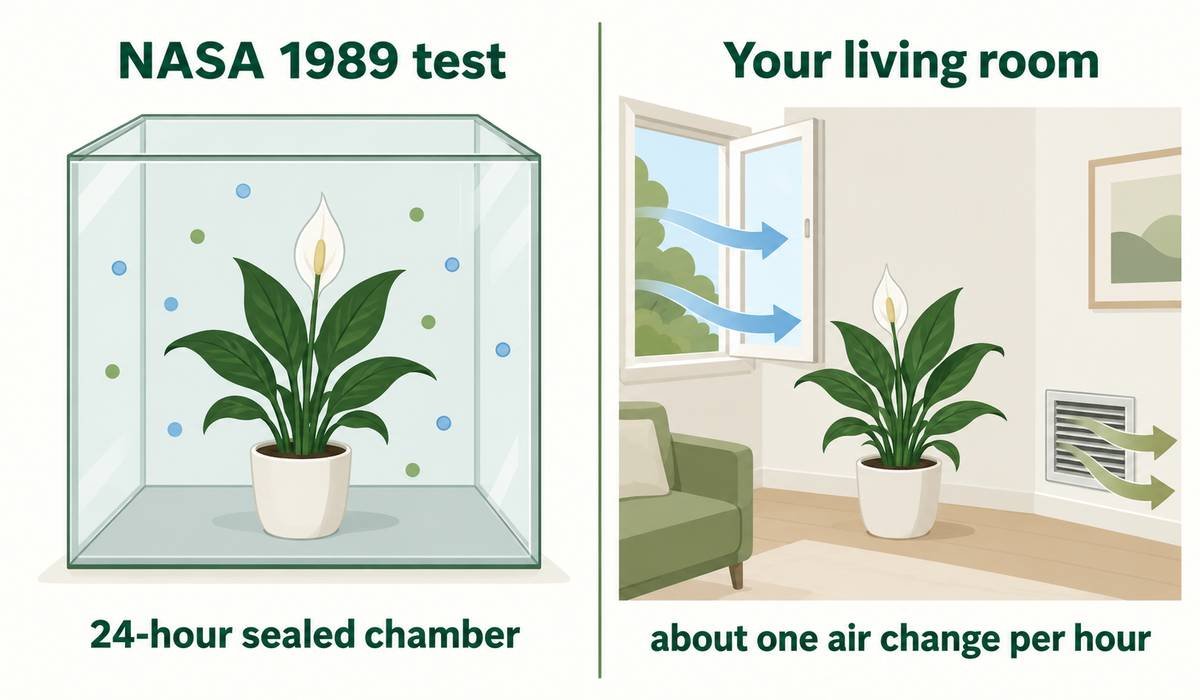
Cummings and Waring, writing in the Journal of Exposure Science and Environmental Epidemiology, translated 196 of those chamber results into a clean air delivery rate, the same measure used to rate air purifiers. They concluded it would take 10 to 1,000 plants per square meter of floor for plants to match the air exchange of a typical building, roughly one full change of air an hour.
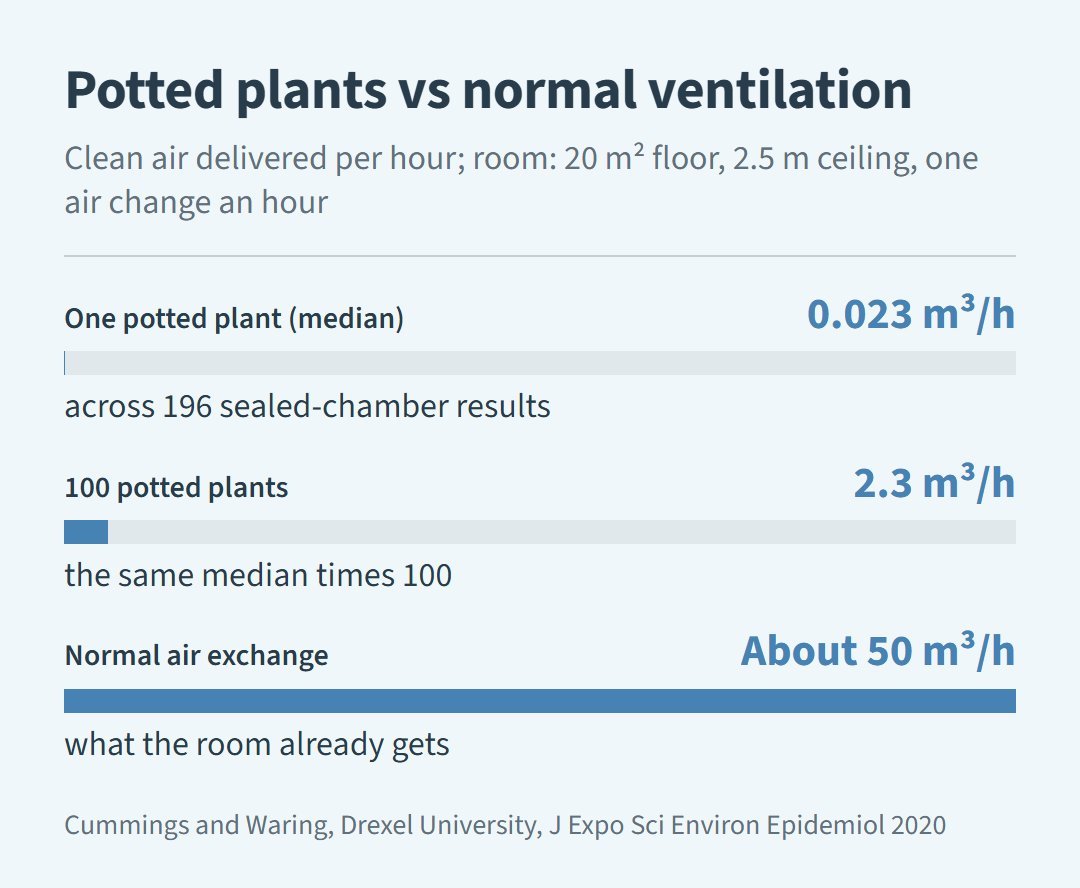
To put that in a room you can picture: a bedroom with 20 square meters of floor and a 2.5-meter ceiling holds 50 cubic meters of air, so one air change an hour moves about 50 cubic meters. At the Drexel median, that’s the work of roughly 2,170 potted plants. Many species sit inside that median, not peace lilies alone, and some plants in the chamber studies did better than others, but even a strong performer sits orders of magnitude short.
The one field test I could find that included peace lilies points the same way: a team at Kasturba Medical College in India placed 7 potted peace lilies in an anatomy storage room for 14 days, found only a weak link with formaldehyde levels, and called the overall effect of plants inconclusive.
Plenty of growers have already made their peace with this. In an r/houseplants thread that opened with “I know plants don’t improve air quality,” a reply with 862 upvotes named what people actually get from them:
“It’s the green. There’s been studies that found surrounding yourself with greenery is good for mental health. There may be other reasons too, but this one is one checked by science.”
– r/houseplants, October 2023 (862 upvotes)
If cleaner air is the goal, an air purifier and an open window do that job, so buy a peace lily for its other strengths.
Can a peace lily help you feel calmer?
Tending a houseplant can lower short-term stress, though the best-known study is small. In a 2015 trial in the Journal of Physiological Anthropology, 24 young men felt more comfortable and soothed after repotting a plant than after a computer task, and their diastolic blood pressure dropped.
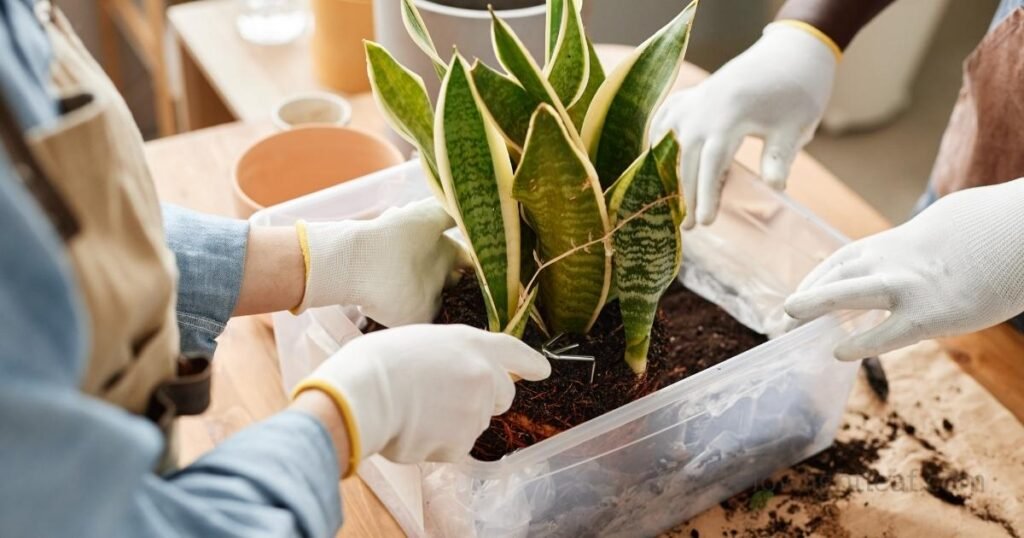
The researchers, Lee and colleagues from Chungnam National University and Chiba University, had each man do both tasks in a randomized crossover, so every participant served as his own comparison. Heart-rate measures of sympathetic nervous activity, the fight-or-flight side, rose during the computer work and fell by the end of the transplanting.
Its limits matter. Hands-on care, repotting, is what got measured, not a plant sitting on a shelf. Participants were 24 men in their mid-twenties, and the abstract describes an indoor plant without naming a peace lily. What it does support is the idea that the routine of looking after a plant, watering, wiping leaves, repotting, can be a small break that your body registers.
Why a peace lily suits a dim room
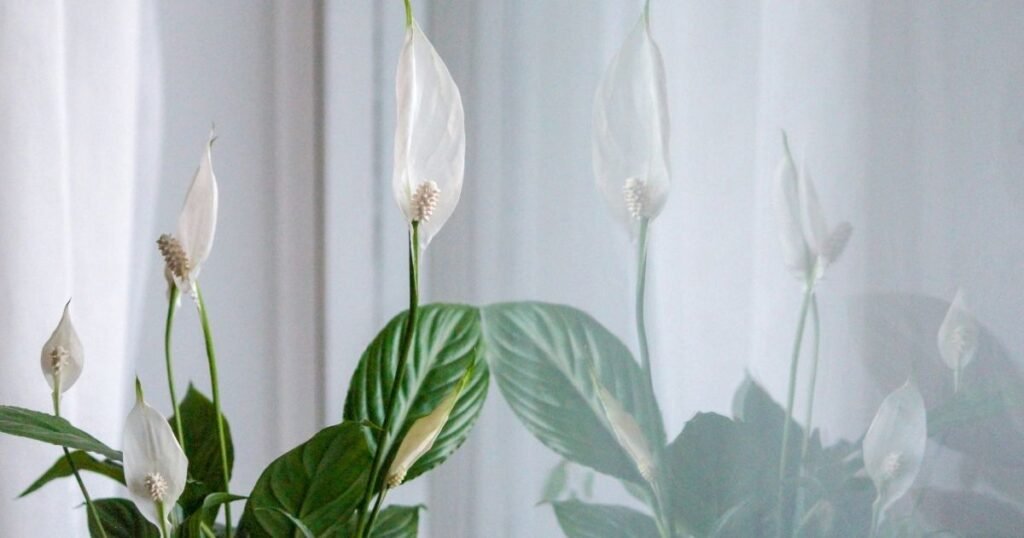
Most flowering houseplants want a sunny window. Peace lilies are the exception that Clemson Extension’s Home & Garden Information Center calls out: one of the few foliage plants that will flower in low light, with white blooms that NC State Extension says fade to pale green after about 10 days and then hang on for at least another month.
“Low light” has limits, though. University of Missouri Extension says peace lilies adapt to low light but need medium light to flower, so a plant in a dark hallway will usually stay green and leafy rather than blooming. An east-facing window, or a spot a few feet back from a brighter one, is where the flowers tend to come; the numbers are in peace lily light requirements. If your room is truly dim, more options are in the low light indoor plants list.
A plant that tells you when it’s thirsty
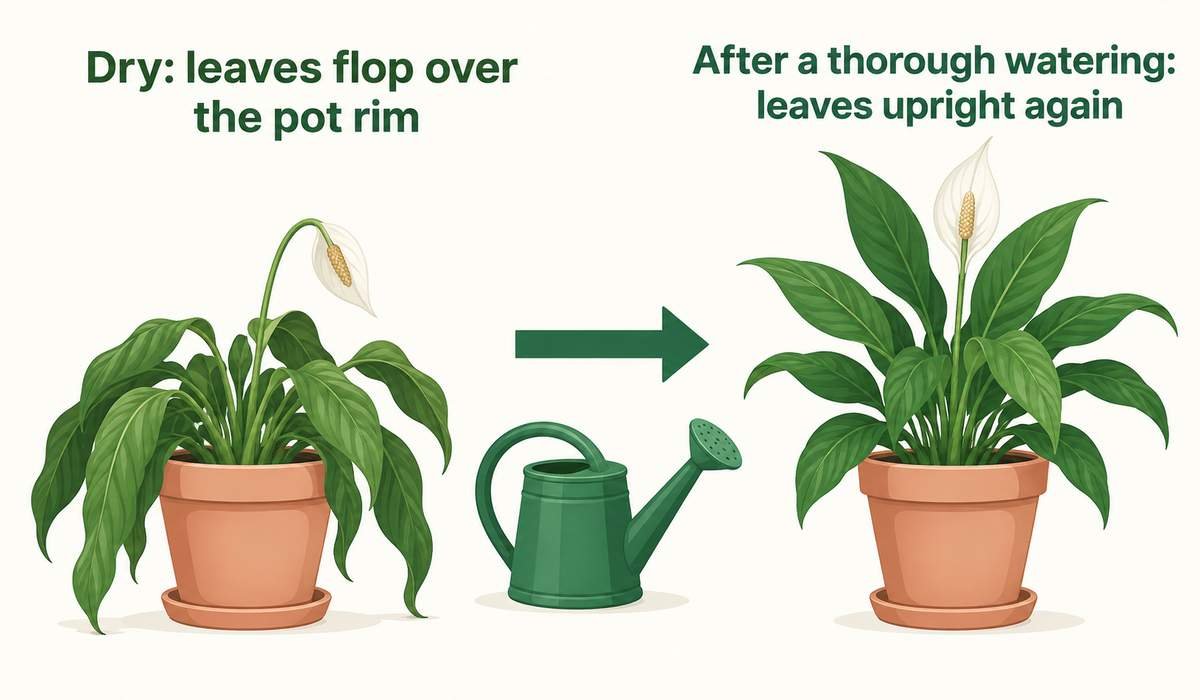
A peace lily slumps when it’s dry, which turns watering from guesswork into something you can see. Clemson Extension notes that if the soil dries out too far, the plant wilts and the leaf edges yellow; a thorough watering usually brings it back upright.
“Has it been watered? Peace lilies are sooooo dramatic but also quite resilient, mine droops like this if it hasn’t been watered in a while”
– r/HouseplantsUK, March 2026 (116 upvotes)
Don’t make a habit of waiting for the collapse. Repeated hard wilting is when the yellow edges Clemson describes start to show, so water when the top of the soil feels dry and treat the droop as a backup alarm. For timing, see the peace lily watering schedule.
Peace lily benefits: quick questions
Is a peace lily good for a bedroom?
A peace lily is a fine bedroom plant if the room gets some daylight and no pets can reach it. It won’t change the air you breathe overnight, per the Drexel review, but it copes with the dimmer light many bedrooms get.
Where should a peace lily go according to Vastu?
Vastu Shastra and feng shui placement rules for a peace lily are tradition that no study has tested, so follow them if they matter to you and make sure the spot also has bright, indirect light with no direct afternoon sun.
The downsides: pets, sap and the drama
Toxicity is the biggest downside. The ASPCA lists the peace lily as toxic to dogs and cats because of insoluble calcium oxalate crystals, which cause intense burning and irritation of the mouth, tongue and lips, drooling, vomiting and trouble swallowing. Clemson Extension notes the same crystals can affect children, most often as a burning mouth and throat.
Miso is the reason I look up every plant on the ASPCA list before it comes into my home, and peace lily is on it for both cats and dogs. Clemson points out it isn’t a true lily at all but a member of the arum family, yet the mouth injury is reason enough to keep it out of reach. Symptoms and next steps are on the peace lily and cats page, and the plant toxicity checker looks up other plants against the ASPCA lists.
Then there’s the drama: a peace lily that misses one watering will look like it has died, which is harmless if you respond and annoying if you travel often.
For a home with a cat or dog that chews plants, the peace lily’s real benefits don’t outweigh that risk; pick a non-toxic plant instead. Without pets, it’s one of the few plants that will put up white flowers in a room that never sees much sun.

Ellie Marsh
Houseplant grower who spent years in a north-facing apartment. Writes practical care guides for low light homes, checked against extension and botanical garden sources.