Monstera deliciosa care is mostly about light. Give a Swiss cheese plant bright, indirect light, water it when the top 1 to 2 inches of soil are dry, keep it between 60 and 85°F with humid air, and give it something sturdy to climb. Those numbers come from Penn State Extension and NC State Extension. Get the light wrong and the rest won’t save it: the plant stretches, and its new leaves come in solid instead of split.
It’s also toxic to cats and dogs, which is covered at the end.
How much light does a monstera need?
A monstera needs more light than its reputation suggests, and the sources don’t fully agree on how much. The University of Minnesota Extension calls it a good plant for medium-light spots.
Penn State Extension says to put it near a sunny window, in bright light but not direct sun, and warns that it gets leggy in lower light. UW-Madison goes further: bright light in summer and direct sun in winter.
NC State lands in between, with moderate brightness and no direct sun, and adds that variegated cultivars need more light than the solid green ones. Put together, a monstera can survive medium light but grows the way it’s supposed to in bright light, and UW-Madison’s advice means winter sun through glass is welcome.
Dim rooms are where most monsteras go wrong. One r/houseplants poster bought a large monstera on Marketplace for an apartment without much natural light, where the plant was too big to move near a window. This reply drew more than 500 upvotes:
“Monsteras need lotsssss of light.”
– r/houseplants, May 2026 (543 upvotes)
The top reply in that thread, with nearly 900 upvotes, was just “it has no light :(“.
In my north-facing apartment, a monstera would have to sit right at the glass, and even then I’d back it up with grow lights. If you have a light meter reading, the DLI calculator turns it into a daily light total and works out grow light hours, and the page on north-facing window plants explains how quickly light drops off across a room.
Why doesn’t my monstera have holes?
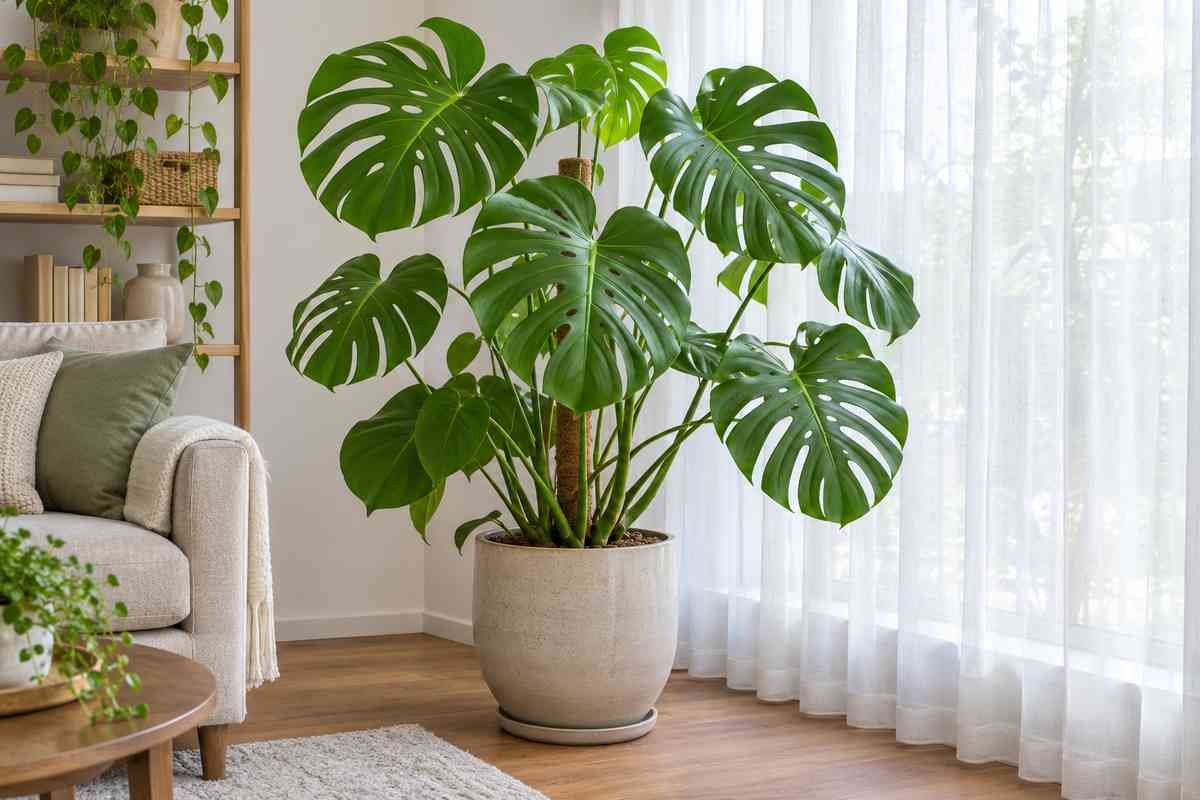
A monstera without holes is either too young or not getting enough light. NC State says only mature leaves have holes, which develop as the leaf grows, and the Missouri Botanical Garden describes juvenile leaves as small and mostly uncut. A young plant or a fresh cutting with solid leaves is normal.
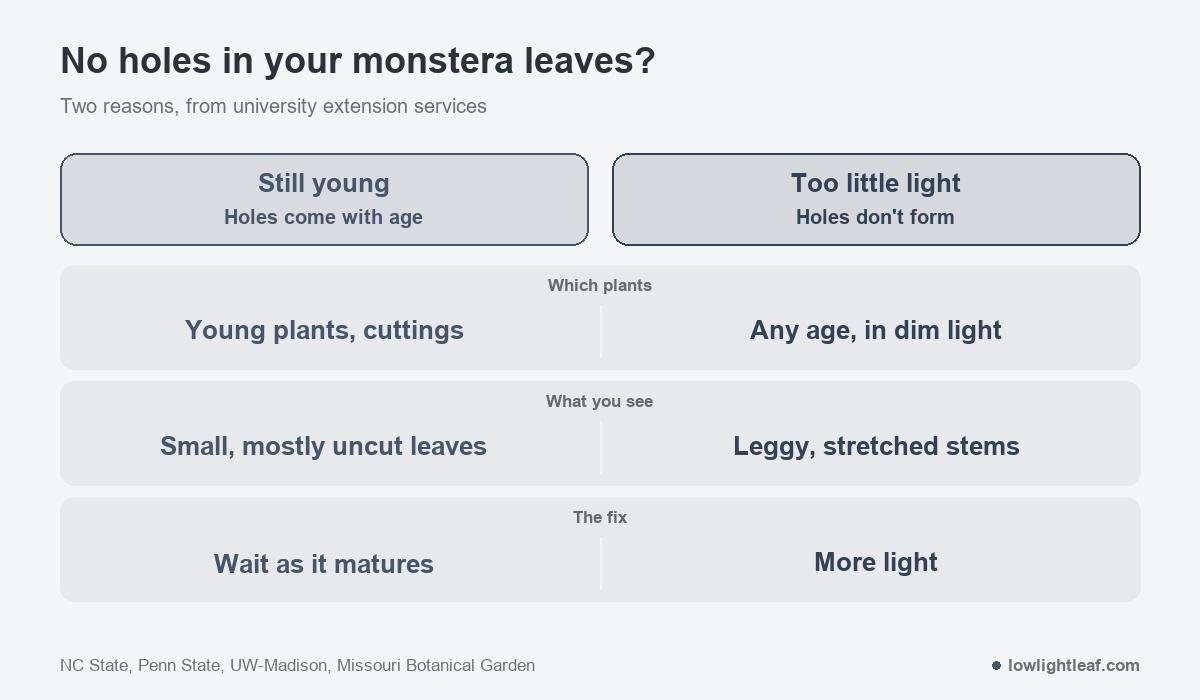
Light is the other half. UW-Madison Extension says a monstera can grow under fluorescent light but won’t develop the leaf perforations when light is inadequate. When an r/Monstera grower asked how to get bigger, more split leaves on a three-year-old plant, the most upvoted answer was about the window:
“More intense light will make it have more fenestrations. Looks great as it is but if that’s your goal then give it more light”
– r/Monstera, February 2026 (61 upvotes)
Holes form while a leaf grows, NC State says, so watch the new ones: if each new leaf comes in larger and more cut than the last, the plant is on track.
One more possibility: you may have a different plant. Minnesota’s extension notes that Thaumatophyllum bipinnatifidum is often sold or labeled as “split-leaf philodendron,” a name also used for monstera. It has deep cuts in its leaves but no holes. A true Monstera deliciosa, also called Swiss cheese plant, Mexican breadfruit or hurricane plant, develops actual holes as it matures.
Watering, the other half of monstera deliciosa care
Water a monstera thoroughly, then wait until the top 1 to 2 inches of soil are dry before watering again. That’s the rule from Penn State and Minnesota, and Minnesota adds that a mature plant often ends up on a weekly schedule. NC State measures it differently, saying to let the top quarter to third of the soil dry, which in a large pot is deeper than 2 inches. Either way, a fixed schedule like the “3 cups once a week” the Marketplace seller recommended can’t account for a dim room, a dry room or the season.
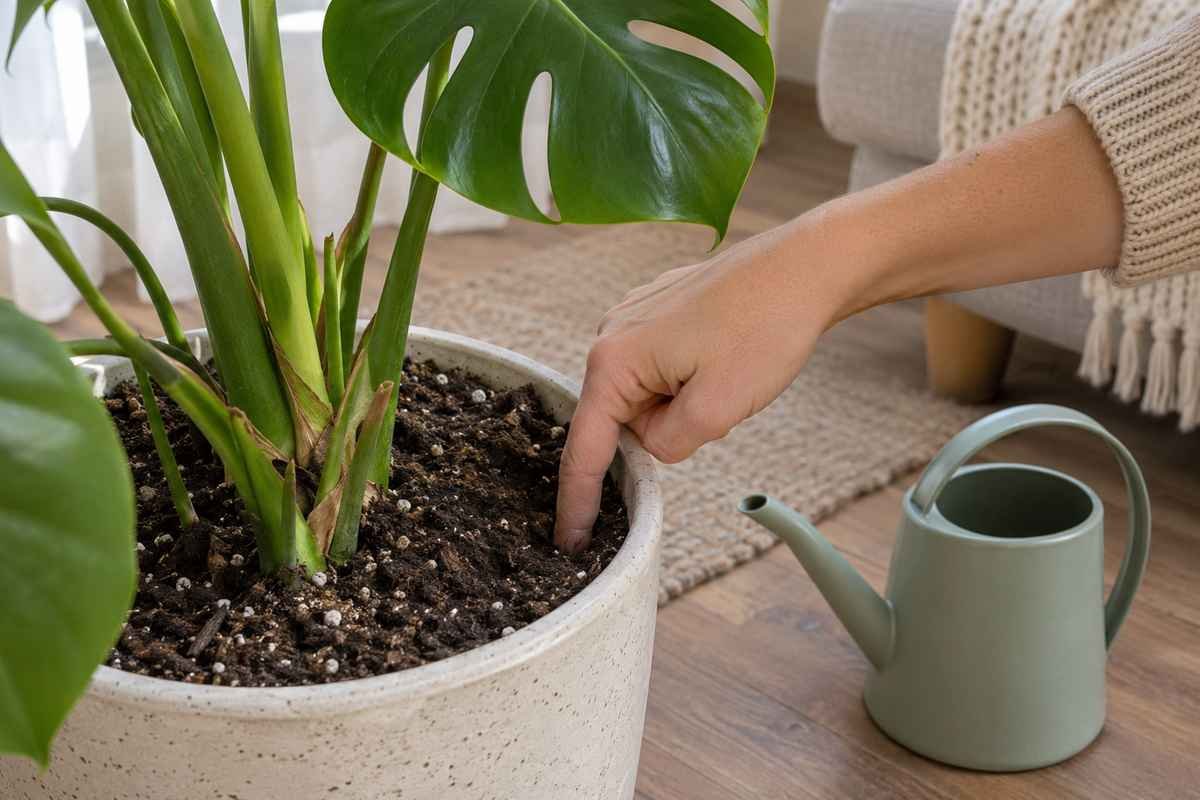
Water less from fall through late winter. The Missouri Botanical Garden and UW-Madison both say to cut back then, when growth slows.
Watch for two warning signs. UW-Madison says the leaves will “sweat” water droplets if the soil stays too moist, and that’s the moment to water less before root rot sets in. Penn State names root rot as the result of overwatering. If leaves are yellowing, the yellow leaves page walks through how to tell overwatering from the other causes.
Brown, crispy leaf edges point the other way. UW-Madison links them to humidity that’s too low.
Humidity, temperature, soil and pot size
A monstera wants warm, humid air. Penn State recommends humidity above 50% and suggests a humidifier if your home is very dry, and NC State adds a tray of wet pebbles as another option. If the leaf edges start browning, see how to raise humidity indoors.
For temperature, NC State and Penn State both give 60 to 85°F, and Penn State says monsteras dislike cold drafts. UW-Madison adds that they stop growing below 50°F and are killed by frost. Outdoors year-round is only possible in USDA zones 10 to 12, per the Missouri Botanical Garden. Elsewhere, a monstera can spend summer outside, but UW-Madison warns that the leaves will sunburn unless you move it into brighter light gradually.
Use a well-draining mix. Penn State suggests a soilless potting mix rich in organic matter with a neutral pH of 6.0 to 8.0, with bark, perlite or charcoal added to a bagged mix.
Do monsteras like small or big pots? Give them room. UW-Madison says ample root room promotes larger leaves and that container-grown plants need frequent repotting. NC State suggests repotting in spring.
On feeding, the two sources that give a schedule differ. Penn State says to fertilize every two weeks during the growing season and monthly through winter with a balanced houseplant fertilizer. UW-Madison says to fertilize regularly from spring until fall, with no winter feeding. If your monstera sits in a dim winter room and has nearly stopped growing, the UW-Madison approach is the more cautious one.
Support, aerial roots and how big it gets
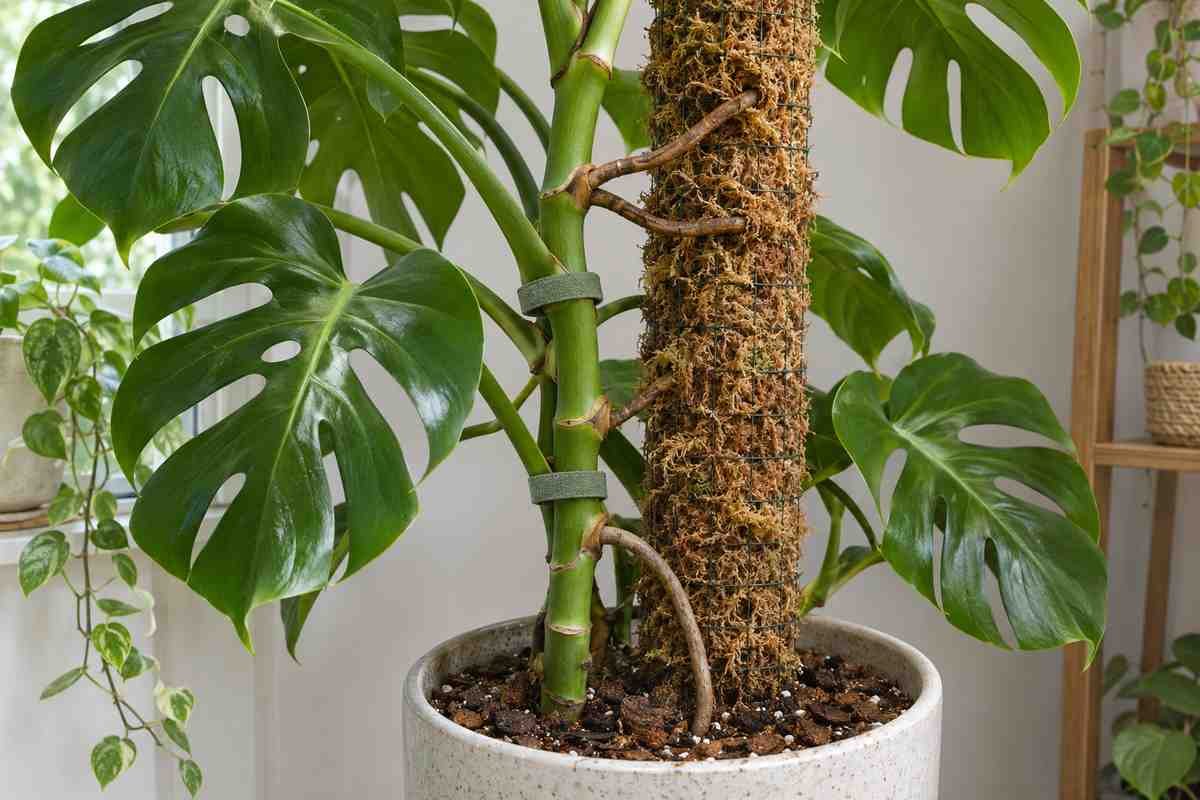
A monstera is a climbing vine, and indoors it still needs something to climb. Penn State and the Missouri Botanical Garden both put indoor plants at 6 to 8 feet tall. NC State lists the growth rate as rapid and says the plant needs sturdy support to keep the stems from breaking, and the Missouri Botanical Garden notes that without support, monsteras tend to grow sideways.
A moss pole, trellis or a board wrapped in sphagnum moss all work. UW-Madison suggests watering the moss-covered support too, so the aerial roots that grab onto it can take up water and nutrients.
Long, cord-like aerial roots are part of the plant, and the Missouri Botanical Garden gives a simple rule for them: aerial roots on the lower part of the plant can be guided into the soil to help feed it, and those higher up can be attached to a moss pole or simply removed.
If the plant outgrows its spot, NC State suggests pruning in spring. Cuttings only root if they include a node, the point on the stem where a leaf grows, according to Minnesota’s extension, which adds that a rooted node can take 2 to 3 months to put out a new leaf. UW-Madison suggests cutting just below an aerial root. Pests are rare, but Penn State lists scale, aphids, mealybugs, spider mites, thrips and fungus gnats as the ones to watch for.
Is a monstera toxic to cats and dogs?
Yes. The ASPCA lists Monstera deliciosa as toxic to cats and dogs because of insoluble calcium oxalate crystals, which cause mouth pain, drooling and vomiting. NC State rates the poison severity as low and also notes that the sap can irritate skin, so Penn State recommends wearing gloves when you prune or repot.
My cat, Miso, is why I look up every plant on the ASPCA list before it comes home. The monstera and cats page covers the signs and when a bite needs a vet, and the plant toxicity checker lets you look up the rest of your plants the same way.
If each new leaf comes in smaller and solid, the plant is telling you about the window, not the watering can.

Ellie Marsh
Houseplant grower who spent years in a north-facing apartment. Writes practical care guides for low light homes, checked against extension and botanical garden sources.