An African violet wants bright, indirect light, room-temperature water given at the soil and never on the leaves, a small pot of fast-draining mix, and temperatures between 60 and 80°F. University of Minnesota Extension says north-facing windows work well, and that the plant needs 14 to 16 hours of light a day to flower. The ASPCA lists African violets as non-toxic to cats and dogs.
That north-window line is why this plant belongs on a site about dim rooms. Few flowering houseplants are happy there. This one can be, as long as its day is long enough.
Do African violets need sun or shade?
African violets need bright light without hot direct sun, and University of Minnesota Extension says north, northwest or northeast windows work well for them.
Not every extension service puts it that way. Clemson’s African violet fact sheet asks for a bright spot that gets no direct afternoon sun, within 3 feet of a large south-, east- or west-facing window, and says a lack of flowers is generally down to too little light. The two agree on the main point: lots of light, no harsh afternoon sun. They differ on how much window you need, and Clemson notes its advice is written for South Carolina conditions.
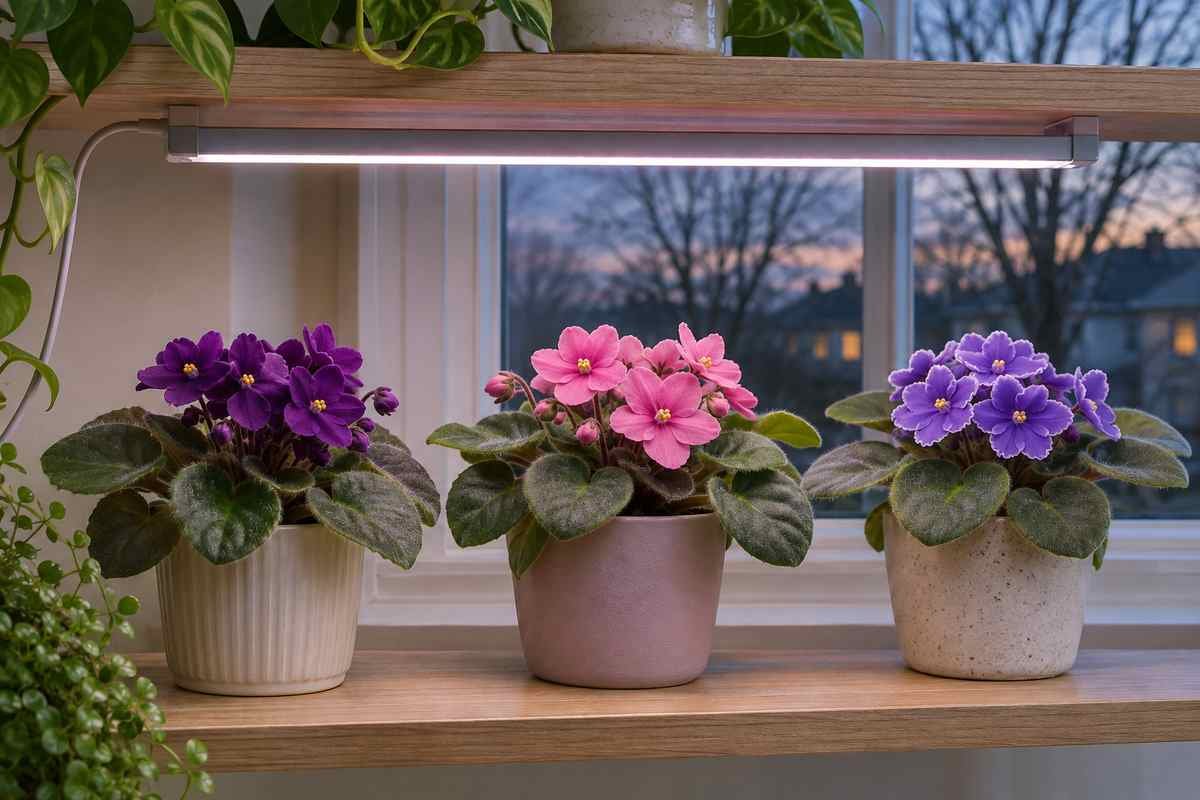
The bigger number is hours. UMN’s African violet guide says the plants need 14 to 16 hours of light and 8 to 10 hours of darkness a day to flower, and that fluorescent or LED grow lights can be used alone or to top up a window. Clemson’s figure for plants grown entirely under fluorescent tubes is 6 to 12 inches below two 40-watt tubes for 15 to 18 hours a day. In winter, daylight alone falls well short of 14 hours. In the north-facing apartment I lived in for years, a violet would have needed a grow light on a timer from fall to spring, and the DLI calculator helps work out how long to run one.
African violet care: watering
Overwatering is the main way these plants die. UMN calls root rot from overwatering one of the most common reasons violets fail, and Clemson says they are very susceptible to crown and root rot. Keep the mix moist but never soggy, and never leave the pot standing in water.
What you water with matters too. UMN says not to use softened or chlorinated water, and to use room-temperature distilled water, rainwater or reverse-osmosis water. Temperature is the part people miss: Clemson says cold water on the leaves causes white blotches and yellow or white ring patterns. UMN adds that water left on the leaves causes spots, so pour onto the mix, not over the plant.
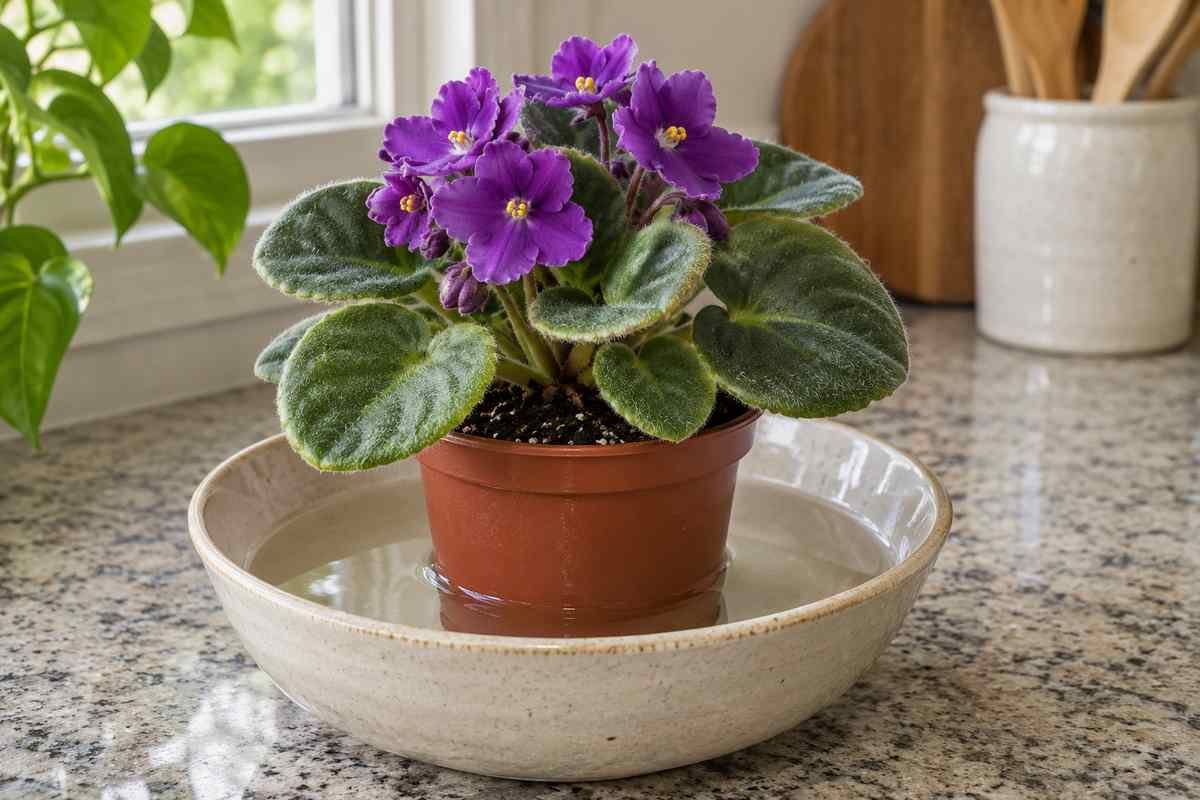
Bottom watering avoids the leaves entirely. UMN’s method:
- Set the pot in a bowl of room-temperature water about 1 inch deep.
- Leave it until the surface of the potting mix feels moist.
- Lift the pot out and let the extra water drain away.
UMN also describes a wick setup: a length of wet nylon or polyester string threaded through the drainage hole when you repot, with the end sitting in a covered reservoir of water and mild fertilizer at about one-eighth strength. It keeps the mix evenly moist, which suits a plant that dislikes both extremes.
Soil, pots, temperature and feeding
Mix. Violets have fine roots, and UMN recommends a well-drained, soilless mix with a pH of about 6.2 to 6.5. Some growers, UMN notes, use half violet mix and half perlite. Clemson suggests equal parts soil, peat and horticultural perlite.
Pot. The pot needs drainage holes. Clemson warns against decorative glazed pots without them, and adds that clay pots dry out faster than plastic, so they need water more often. Salts that build up on a clay rim can kill leaf stems resting on it.
Keep the pot small. On an r/AfricanViolets post about plants that had stopped blooming, one grower explained what they do instead of moving up a size:
“No it’s best to keep them in smaller pots. When I repot mine that have long necks, I just take a serrated knife to cut a couple inches of the bottom rootball or whatever length will make them sit properly again. Then I scrape the neck a bit to promote new roots and add dirt!”
– r/AfricanViolets (9 upvotes)
That’s a grower’s practice, not an extension recommendation, but it fits the advice to keep roots in a snug, well-drained pot.
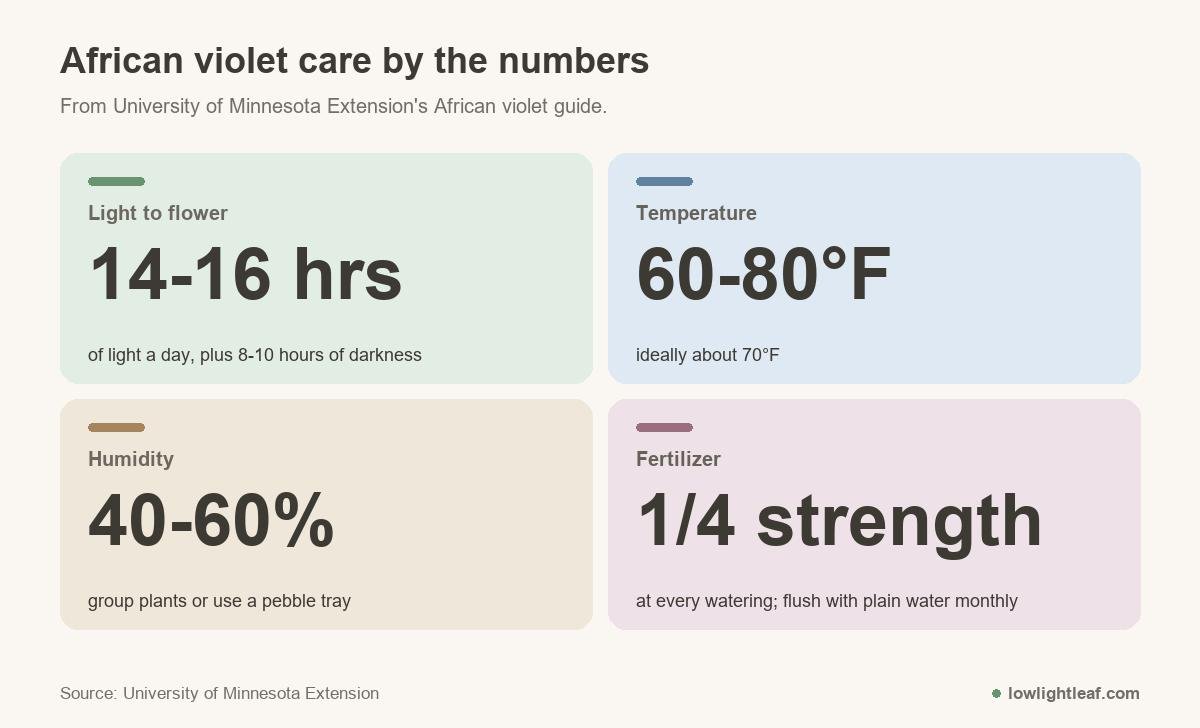
Temperature and humidity. UMN puts the best range at 60 to 80°F, ideally 70°F, with humidity at 40 to 60 percent. Grouping plants or setting them on a tray of wet pebbles helps, as long as the pot sits above the water, not in it. For a dry winter room, raising humidity in the house looks at which methods actually raise the reading.
Feeding. Violets like a little fertilizer, often. UMN says to use a quarter of the recommended amount every time you water, to wet a dry plant with plain water before feeding so the roots don’t burn, and to flush the pot with plain water once a month to clear built-up salts.
Why won’t my African violet bloom?
An African violet that won’t bloom is usually short of light, and UMN says long, narrow leaves with no flowers mean too little light and a room that’s too cool. Clemson adds thin, dark green leaves on long stalks as another low-light sign.
UMN’s troubleshooting list ties the other common symptoms to a cause:
- No flowers, long narrow leaves: too little light and too cool. Move it somewhere brighter or add a grow light, and aim for the 70s by day and 65 to 70°F at night.
- Limp and wilted although the mix is moist: overwatering, poor drainage and root rot. Repot into a container that drains. If the roots are mushy, brown and slimy, the plant probably won’t recover.
- Spots on the leaves: water left sitting on them. Switch to bottom watering.
- Tight centers and rusty-colored leaves: too much fertilizer. Flush with plain water and feed every other watering.
When conditions are right, Clemson says each flower cluster can last three to six weeks, and UMN says the plants bloom several times a year.
Propagating African violets from a leaf
Violets root easily from a single leaf. Iowa State University Extension’s method:
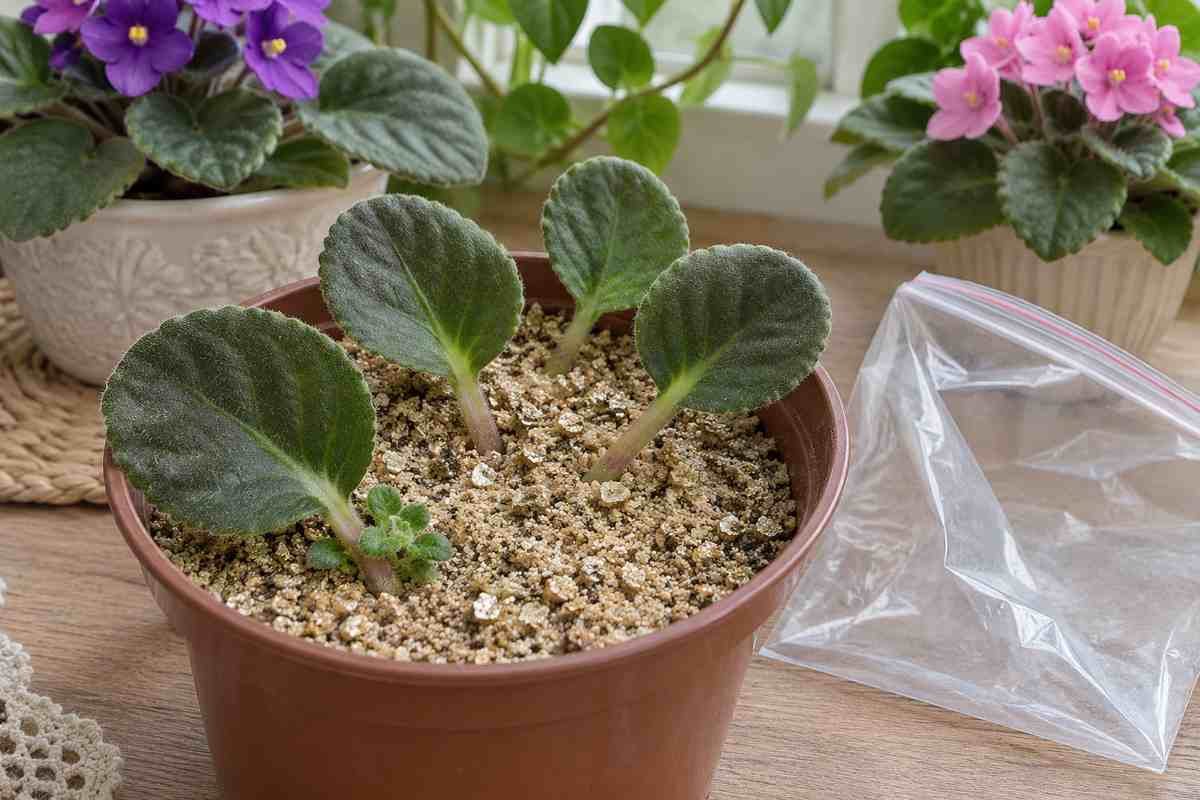
- Cut a firm, healthy leaf with a sharp knife, keeping 1 to 1½ inches of its stalk.
- Push the stalk into a moist 50:50 mix of vermiculite and coarse sand at a 45-degree angle, and firm the mix around it.
- Water, let it drain, then cover the pot with a clear plastic bag held on with a rubber band, and set it somewhere bright.
- Expect roots in three to four weeks and the first new leaves in six to eight weeks.
- Several small plants usually form at the base of each stalk. Pull or cut them apart and pot each one up on its own.
Pests
Clemson says pests and diseases spread very easily from one violet to another, and singles out two. Crinkled, tight crowns can mean cyclamen mites, which it calls incurable. Mealybugs are the other common problem, and getting rid of mealybugs starts with moving the plant away from the rest. I’d keep a new violet apart for a while before it joins a windowsill of others.
Are African violets safe for cats?
Yes. The ASPCA lists the African violet (Saintpaulia) as non-toxic to cats and dogs. I look up every plant on that list before it comes home, and this is one of the flowering plants that passes. The plant toxicity checker has the entry, and pet-friendly indoor plants lists more that pass for a home with a curious cat.
A violet will bloom in a north window if you give it the hours, with a grow light making up the winter shortfall. After that, it comes down to room-temperature water at the soil, a small pot and a light hand with the watering can.

Ellie Marsh
Houseplant grower who spent years in a north-facing apartment. Writes practical care guides for low light homes, checked against extension and botanical garden sources.