Last updated on November 12, 2026
A pink princess philodendron is a slow-growing hybrid with dark purplish-green leaves splashed with pink, and it needs bright, indirect light to keep that pink. Missouri Botanical Garden says too much shade reduces the variegation and makes the plant leggy, so give it evenly moist, rich soil, warmth and something to climb.
That puts it at odds with the family’s easygoing reputation. University of Missouri Extension says the heartleaf philodendron tolerates low light, while most philodendrons prefer medium light for their best growth. The pink princess sits firmly in the second group.
How much light does a pink princess philodendron need?
A pink princess philodendron needs medium to bright, indirect light, roughly 250 to 1,000 foot-candles at the leaves. That’s University of Missouri Extension’s medium-light range for most philodendrons, with the best growth above 750. Missouri Botanical Garden recommends part shade and says to avoid harsh afternoon sun.
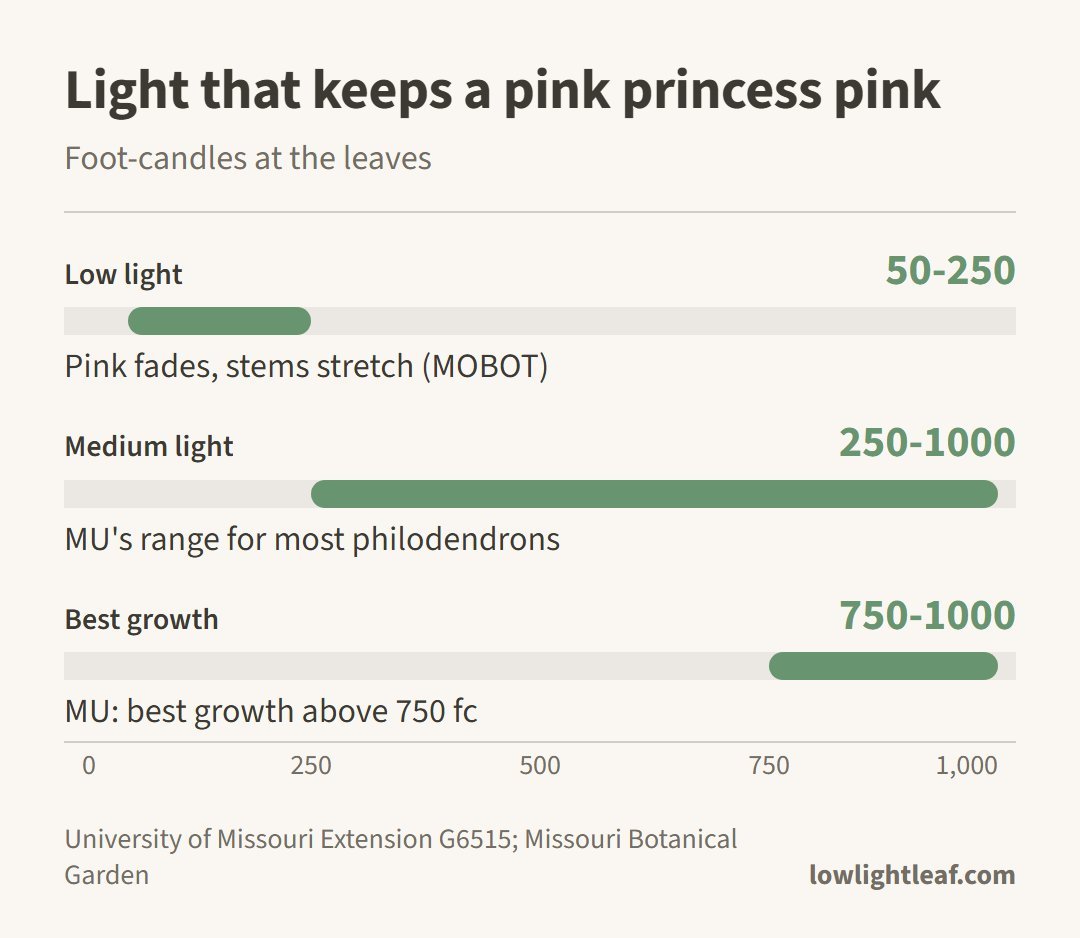
Both ends of that window show up on the leaves. In too little light, Missouri Botanical Garden says the variegation fades and the growth gets leggy, with longer gaps between leaves as the stems reach. In too much, the pink patches take the damage first. The Spruce says those pink areas are prone to burning under harsh light, and growers say much the same:
“A lot of indirect sun, a little direct sun it’s okay but I noticed that he/she had too much, the variations turn orange.”
– r/houseplants (4 upvotes)
In another thread, an owner whose plant sat in a south window was told that full sun there can severely burn the leaves. So a bright east window, or a spot a few feet back from a south or west one, is the kind of place that fits.
North light is the hard case. My apartment faced north for years, and the plants that needed medium light only got it under a grow light. If you aren’t sure where your spot falls, the DLI calculator turns a light reading into something you can compare.
The plant tells you, too. New leaves coming in darker and greener than the old ones are the first sign it wants more light.
Why the pink fades, and which stems to cut
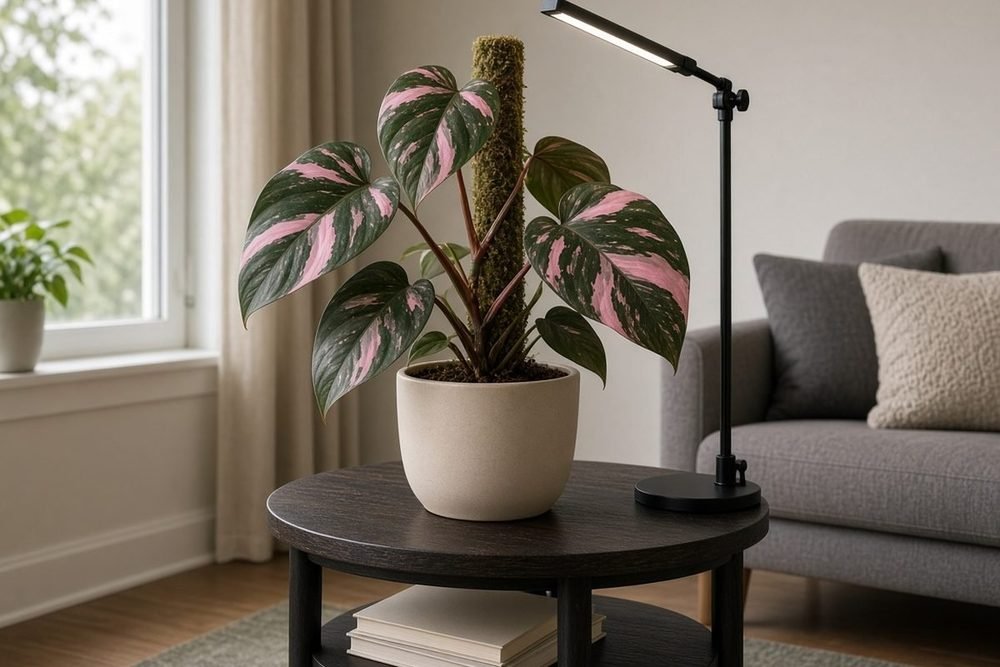
Pink princess variegation is never even. Missouri Botanical Garden describes it as variable, showing up as large splotches, small streaks or occasionally a whole pink leaf, so a run of greener leaves isn’t always a problem. A stem that has gone solid green is a different matter.
Missouri Botanical Garden says to prune out stems that have reverted to solid, non-variegated foliage. Cut them back to a leaf that still shows pink. The Spruce adds that a fully reverted plant can’t recover its variegation, which is why it pays to catch the green early and fix the light at the same time.
One look-alike is worth knowing. The Spruce says the pink congo gets its color from chemicals injected into the leaves and usually turns green within a couple of months of purchase, while the pink princess’s variegation is natural.
Water, potting mix and warmth
Keep the soil evenly moist but never soggy. Missouri Botanical Garden asks for rich, humusy soil, and NC State Extension adds that it should drain well, because overwatering causes root rot. The Spruce lets the top half of the mix dry before watering well, in a blend of one part potting soil, one part perlite and one part orchid bark.
Warmth and humidity matter more than people expect. NC State Extension gives 65 to 85°F and high humidity for Philodendron erubescens, the species behind this hybrid, and says to protect it from cold drafts. It also says to water at the base, since water on the leaves invites leaf spot. In a heated apartment in winter, the humidity page has ways to raise the moisture around it.
Watch for pests when you water. Missouri Botanical Garden lists aphids, mealybugs, scale, thrips and spider mites.
Is pink princess a climber or a crawler?
A pink princess philodendron is a climber. Missouri Botanical Garden describes an upright, vining habit and says the plant requires a trellis or other support, and NC State says Philodendron erubescens can climb a moss pole or trellis indoors or spread outward and take up more room.
Missouri Botanical Garden puts mature plants at 4 feet tall or more with a 2-foot spread, with leaves up to 8 inches long. The roots that grow from the stem are what grip a pole, and the aerial roots page explains what to do with them.
Pruning to keep it compact also gives you cuttings. Both Missouri Botanical Garden and NC State recommend stem cuttings, and The Spruce describes the water method:
- Cut a stem with two or three leaves and two or three nodes below them.
- Strip the lower leaves and stand the cutting in water with the nodes covered, in bright, indirect light.
- Change the water at least once a week; The Spruce says roots usually show in two to three weeks.
- Pot the cutting in well-draining mix once the roots are about an inch long.
Pick a cutting that carries pink on its leaves and stem. A cutting from an all-green stem will grow on as an all-green plant.
Why is pink princess philodendron so expensive?
Pink princess philodendron cost so much because demand outran supply. The Spruce reports that mature plants sold for upwards of $2,000 at the 2021 peak, and says the variegation comes from a mutation, so the plant isn’t easily grown from seed. It adds that mass production has since brought small plants under $50.
When you buy one, look for pink on the leaf stems as well as the leaves, which The Spruce suggests as a sign of steady variegation, and check the leaves for small brown spots. A plant that is already mostly green on its newest leaves is the one most likely to keep going green.
Is pink princess philodendron toxic to cats and dogs?
Yes. NC State Extension lists Philodendron erubescens as poisonous and a problem for cats, dogs and children, because every part contains calcium oxalate crystals. Chewing it irritates the mouth and stomach, and NC State says the sap can irritate skin, so wear gloves when you prune or take cuttings.
With Miso in my apartment, a climbing plant on a pole goes somewhere a cat can’t reach from a shelf or a sofa arm. The plant toxicity checker lists the philodendrons alongside the other common houseplants, and the pothos vs philodendron page helps if you aren’t sure which one you have.
Keep the pink princess where it gets real light, and the newest leaf will tell you whether the spot is working.

Ellie Marsh
Houseplant grower who spent years in a north-facing apartment. Writes practical care guides for low light homes, checked against extension and botanical garden sources.