Last updated on November 12, 2026
Most houseplants do best at 40 to 60 percent relative humidity, the range University of New Hampshire Extension gives for common indoor plants, not including cacti and succulents. That is the ideal humidity for houseplants in a mixed collection. A healthy house usually needs to stay lower.
What the ideal humidity for houseplants actually is
University of New Hampshire Extension puts most houseplants, excluding cacti, succulents, and a few others, at 40 to 60 percent relative humidity. It also says tropical species thrive at 70 to 80 percent.
Iowa State University Extension lands a little lower for many houseplants: 40 to 50 percent. University of Wisconsin Extension in Chippewa County uses the same 40 to 50 percent figure, and notes that the average home often falls short of it in winter. Nebraska Extension in Lancaster County is franker still: requirements vary by species, but 70 to 80 percent is generally best for plants.
Plant numbers sit against a harder limit for the house itself. The U.S. Environmental Protection Agency says to keep indoor humidity below 60 percent, ideally between 30 and 50 percent. Its humidifier guidance is stricter on the way up: do not humidify indoor air past 50 percent, because higher humidity can encourage the growth of biological organisms.
| Range | Who it applies to | Source |
|---|---|---|
| 10 to 20% | Many homes in winter | Iowa State Extension |
| 30 to 50%, and stay under 60% | The house, for moisture control | U.S. EPA |
| Do not humidify past 50% | Whole-house humidifying | U.S. EPA |
| 40 to 50% | Many houseplants | Iowa State; UW Extension Chippewa County |
| 40 to 60% | Most houseplants, not cacti or succulents | UNH Extension |
| 70 to 80% | Tropical species; Nebraska’s general plant figure | UNH Extension; Nebraska Extension |
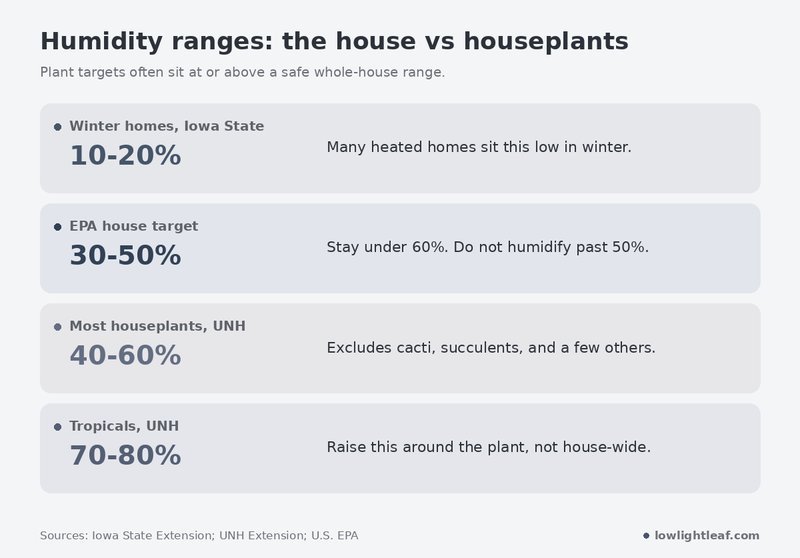
If you only remember one working target, treat 40 to 60 percent as the ideal humidity for houseplants in a typical mixed collection, and keep the rest of the house inside the EPA’s band. When a plant wants more than the house can safely hold, raise humidity around that plant. Don’t try to turn the whole home tropical.
Signs the air is too dry, or too damp
Low humidity shows up on the leaves first. New Hampshire Extension describes foliage that looks dry, brown, and brittle around the leaf margins. Iowa State adds slow growth and dried-up flower buds, and it is blunt about winter indoor air: many homes drop to only 10 to 20 percent relative humidity. Nebraska Extension notes that plants lose water faster when temperatures are high, sunlight is intense, drafts are present, or humidity is low.
Too much moisture is a house problem as much as a plant one. If the room feels sticky, windows stay wet, or a musty smell shows up, the house is probably past a safe range, even if a fern looks happy. The EPA’s ceiling is still 60 percent, with 30 to 50 percent as the ideal band. While you chase a higher reading, don’t compensate by overwatering, which New Hampshire Extension flags as a separate risk.
Raise humidity around the plants, not the whole house
After years in a north-facing apartment, I still raise humidity around the plants instead of trying to humidify the whole place.
- Measure it. The EPA says a small humidity meter, often $10 to $50 at a hardware store, will do. If you use a portable humidifier, New Hampshire Extension recommends pairing it with a digital thermometer and hygrometer so you can see whether the reading actually holds.
- Move plants off the dry spots. New Hampshire and Nebraska both say to keep plants away from heat vents, radiators, and outside doors. A bathroom or kitchen can be a more humid room, New Hampshire notes, if the plant still gets the light it needs.
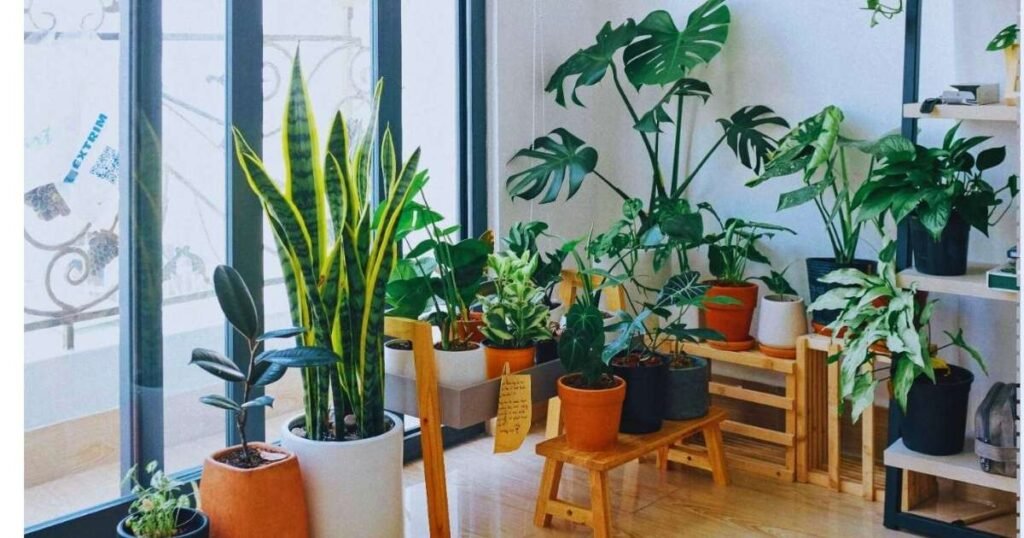
- Group plants together. Water evaporating from the potting mix, plus water leaving the leaves, can raise humidity in the immediate vicinity. New Hampshire says this works best with several plants, or in a small room with low airflow, so the moisture stays around the foliage instead of disappearing into the rest of the house.
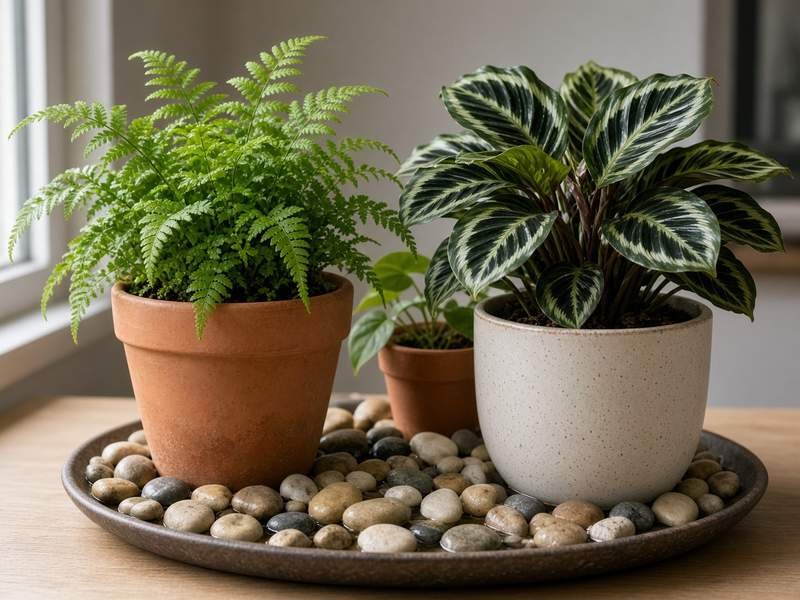
- Use a pebble tray the right way. Iowa State, New Hampshire, Wisconsin, and Nebraska all describe the same setup: a tray of pebbles or gravel, water in the tray, and the pots sitting on the stones above the water line, not in it.
- For plants that need more, put a portable humidifier close to them, or use a terrarium or cloche for smaller plants. New Hampshire says a humidifier near the plants helps most, especially in a larger room, and may need to run for several hours a day. If you also want to raise humidity in the whole house, see how to increase humidity in house, and do not set a humidifier past the EPA’s 50 percent cap.
Skip regular misting as your humidity plan. Iowa State says the level only stays up for a few minutes afterward. Nebraska adds that you would need to mist every few minutes to change the air around the plant, and that keeping leaves wet raises the risk of leaf-spot disease. Wisconsin Extension in Chippewa County agrees: any small gain is quickly lost unless you mist throughout the day.
When the number won’t stay put, look at the roof and attic
If you can’t get the house into the EPA’s range, or the reading swings with the weather, the moisture may not be coming from your plants or a humidifier.
The U.S. Department of Energy’s Guide to Durable Attics calls moisture the number one enemy of an attic. Moisture can enter from above, below, or the side, damage the roof, ruin insulation, and create problems in the main living areas of the house.
DOE lists common routes in: leaks in the roof or poorly installed flashing, and ice dams in the gutters that let water seep under shingles and leak into the house. Warm, humid air from kitchens, bathrooms, and dryers is another threat. DOE is direct about a habit that is more common than it should be: venting that exhaust into the attic is a major source of moisture and a bad practice. Kitchen ranges, bathroom fans, and dryers should vent outdoors, not into the roof space.
ENERGY STAR explains why the attic’s temperature and airflow matter indoors. In winter, outdoor air moving through the attic helps keep it cold, which reduces the chance of ice dams: snow melts off a roof when the attic is too warm, then refreezes at the gutters. Insulation and air sealing also help by blocking heat and moist air from the rooms below. In summer, airflow in a well-vented attic moves super-heated air out and removes moisture, and the insulation resists heat transfer into the house. The most common insulation mistake ENERGY STAR names is blocking airflow at the eaves. Don’t cover soffit vents with insulation. Rafter vents, also called insulation baffles, keep a channel so air can enter at the soffits and leave through a gable or ridge vent.
DOE tells you what water intrusion can look like: wet insulation, especially near the eaves, mold or mildew on attic surfaces, warped or rotting wood, and bubbled paint at fascia boards or soffits. Look from a safe access point. If the space is unsafe, don’t walk the joists or disturb the insulation.
Stains, a stuck-high reading, or a damp attic usually mean a few new shingles will not be enough. The cause may be a ventilation problem, a leak, or moist air dumping into the attic. If the roof or attic may be involved, a roofing company in Twinsburg can inspect ventilation, leaks, and ice-dam risk. Ask whether exhaust fans vent outdoors, whether soffit vents are clear, and whether moisture in the attic has a clear source. I’m a plant grower, not a roofer or an HVAC technician. A building-envelope problem needs a qualified inspection, not a bigger humidifier.
Humidity questions
Is 70 percent humidity too high for plants?
Not necessarily for the plant. New Hampshire Extension says tropical species thrive at 70 to 80 percent. It is too high for the house as a whole. The EPA says not to humidify indoor air past 50 percent, and to keep the house below 60 percent, ideally between 30 and 50 percent. Keep that higher reading in a terrarium, under a cloche, or next to the plants that need it, not as a whole-house setting.
Which houseplants tolerate dry air well?
Nebraska Extension lists cacti, succulents, cast iron plant (Aspidistra), Chinese evergreen (Aglaonema), devil’s ivy or pothos (Scindapsus aureus), philodendrons, and dracaenas as plants that tolerate low humidity well. You don’t have to push a room to 40 to 60 percent for a shelf of those. New Hampshire also excludes cacti, succulents, and a few others from its 40 to 60 percent preference.
Should I raise humidity the same way in summer and winter?
Usually not. Iowa State points to winter, when many homes fall to 10 to 20 percent, as the stretch when brown tips and stalled growth show up. Nebraska notes that air conditioning can also circulate dry air in summer. If the house already sits in the EPA’s 30 to 50 percent band, you may only need a local pocket for humidity-loving plants. If the house is already damp, don’t add a humidifier.

Ellie Marsh
Houseplant grower who spent years in a north-facing apartment. Writes practical care guides for low light homes, checked against extension and botanical garden sources.