Last updated on November 3, 2026
To get a moth orchid to rebloom, keep it healthy, give it enough light to build up energy, and then let it feel a few weeks of cooler nights in the fall. The American Orchid Society says most Phalaenopsis start new flower spikes in October and November, once nights drop into the 50s and 60s °F. If yours hasn’t bloomed since spring, now is the time to act.
If your orchid looks healthy and gets decent light, the missing piece is probably the signal. A room that stays the same temperature day and night never gives it one.
Why won’t my orchid rebloom?
An orchid won’t rebloom unless three things line up. The American Orchid Society’s rebloom article lists them in order: the plant has to be healthy, it has to have made and stored enough carbohydrates while it was growing, and its blooming cue has to be met.
Health comes first because a plant fighting rot, pests or a dying root system won’t spend energy on flowers. Stored energy comes from light. For a Phalaenopsis, the cue is temperature, and light and temperature are the two you can change at home.
Give your orchid enough light
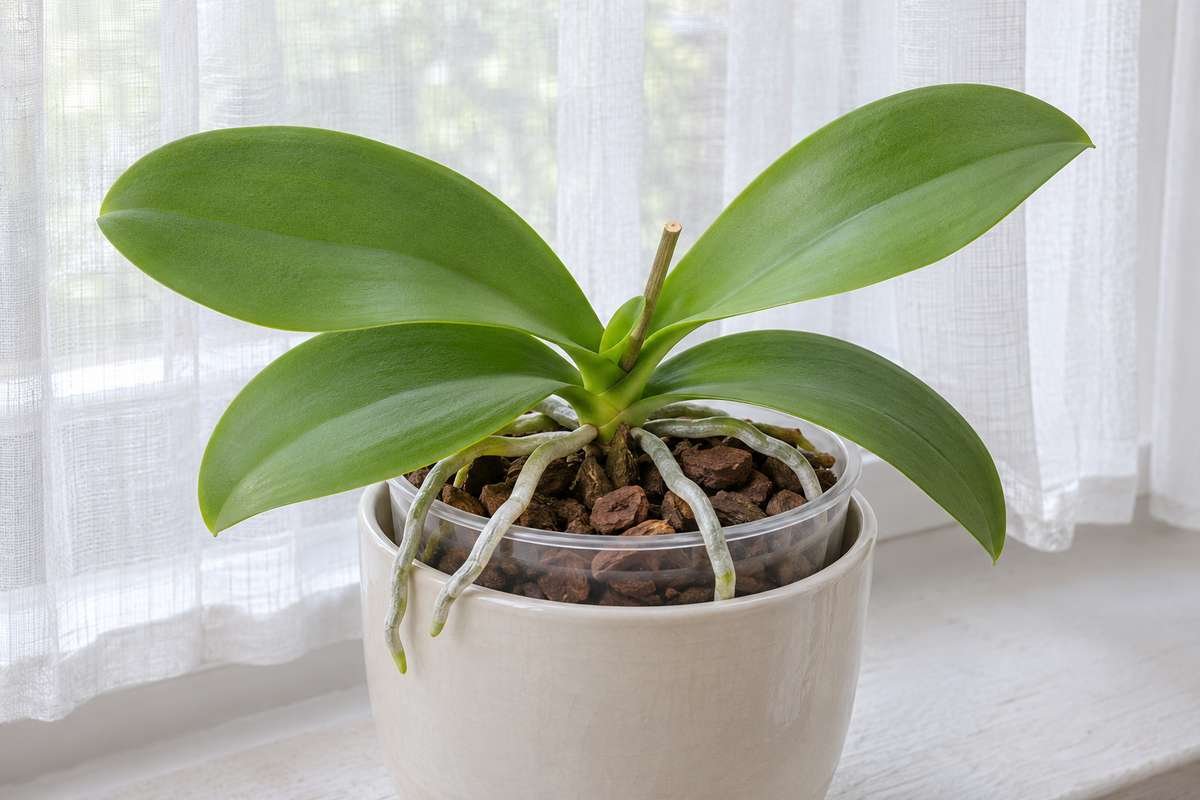
The leaves tell you whether your orchid gets enough light. University of Maryland Extension says a moth orchid in the right light has light green leaves, while low light makes them dark green and stiff. Iowa State’s extension goes further: dark green leaves mean too little light, and the plant won’t flower.
When a beginner on r/orchids posted photos and asked why their orchid hadn’t rebloomed, one answer was blunt:
“Prob needs more light. Your leaves are really dark.”
– r/orchids, April 2026 (5 upvotes)
Too much light shows too. Maryland’s extension says very high light turns the leaves yellow-green with pink or reddish edges. You’re aiming between the two, a medium, grassy green.
Phalaenopsis don’t need a sunny window. According to the AOS, they’re low-to-medium light orchids that do well in a north, east or west window, or a shaded south one. Maryland adds that a south window can work in winter. In my north-facing apartment, that means a phal can sit right at the window, with grow lights for backup. If you use lights, Iowa State suggests keeping the leaves 6 to 12 inches below them for about 14 hours a day. Our north-facing window plants page explains how fast light fades as you move back from the glass.
How to get orchid to rebloom: start with cool nights
A Phalaenopsis reblooms when it feels a bigger gap between day and night temperatures. According to the AOS, that happens naturally in fall, when nights drop into the 50s and 60s °F (10 to 16°C), and its culture sheet says nights down to 55°F for several weeks in autumn start the flower spikes.
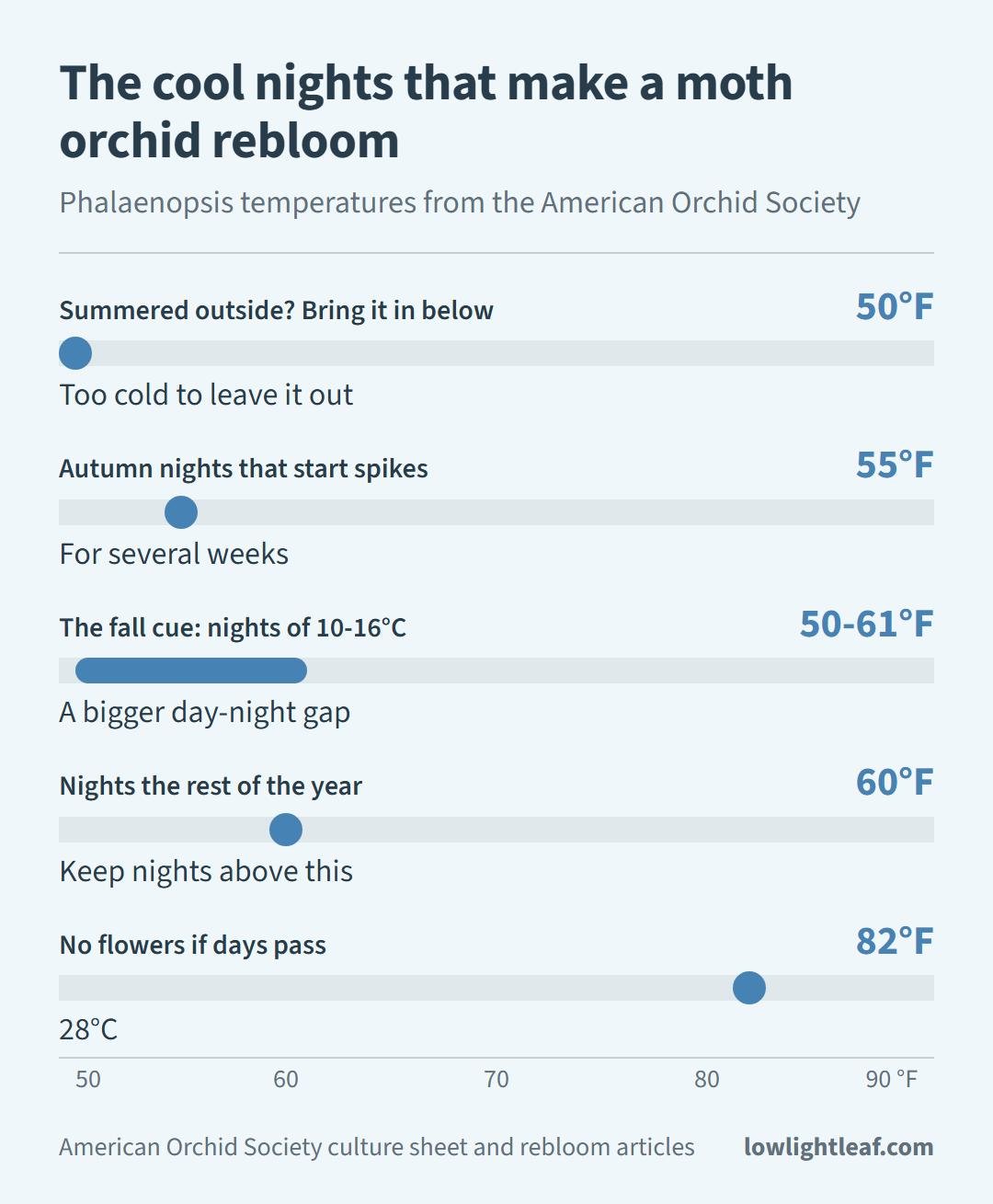
Heat works against you too. Phalaenopsis won’t flower, the AOS notes, if daytime temperatures go above 82°F (28°C). The society also warns that an orchid kept in a room at one constant temperature may never sense the seasonal change. A heated apartment, with the thermostat set the same around the clock, is exactly that room.
One r/orchids grower described the routine that works for them:
“Other than nutrients and water, the biggest factor to get it to rebloom is a nightly temperature drop of over 10°f and into the lower 60’s. Over a few weeks. Mine will usually flower late fall and hold over the winter. It needs to recognize the colder night temps/season change. Air conditioning and heating can affect it as well if the vents are close by.”
– r/orchids, May 2026 (6 upvotes)
Here’s how to arrange it indoors:
- Find the coolest bright spot you have. A windowsill away from the radiator, or a room you keep cooler at night. Keep it clear of heating and cooling vents.
- Aim for nights around 55 to 60°F for several weeks. AOS guidance puts spike-starting nights in that range. The RHS offers a simpler version: move a large, healthy plant that hasn’t flowered in a while to a spot about 5°C (8°F) cooler for a month or so.
- Don’t let it get too cold. Outside autumn, the AOS keeps Phalaenopsis nights above 60°F, and the RHS says to keep them above 16°C (60°F). The autumn chill is a few weeks, not the whole winter.
- Keep days below 82°F. A sunny sill can heat up fast at midday.
If your orchid spends summer outdoors, the AOS describes an even easier route. Leave it outside in fall as nights cool, as long as they stay above 50 to 55°F, for two or three weeks. Once nights fall below 50°F, bring it in.
What to do after the blooms fall off
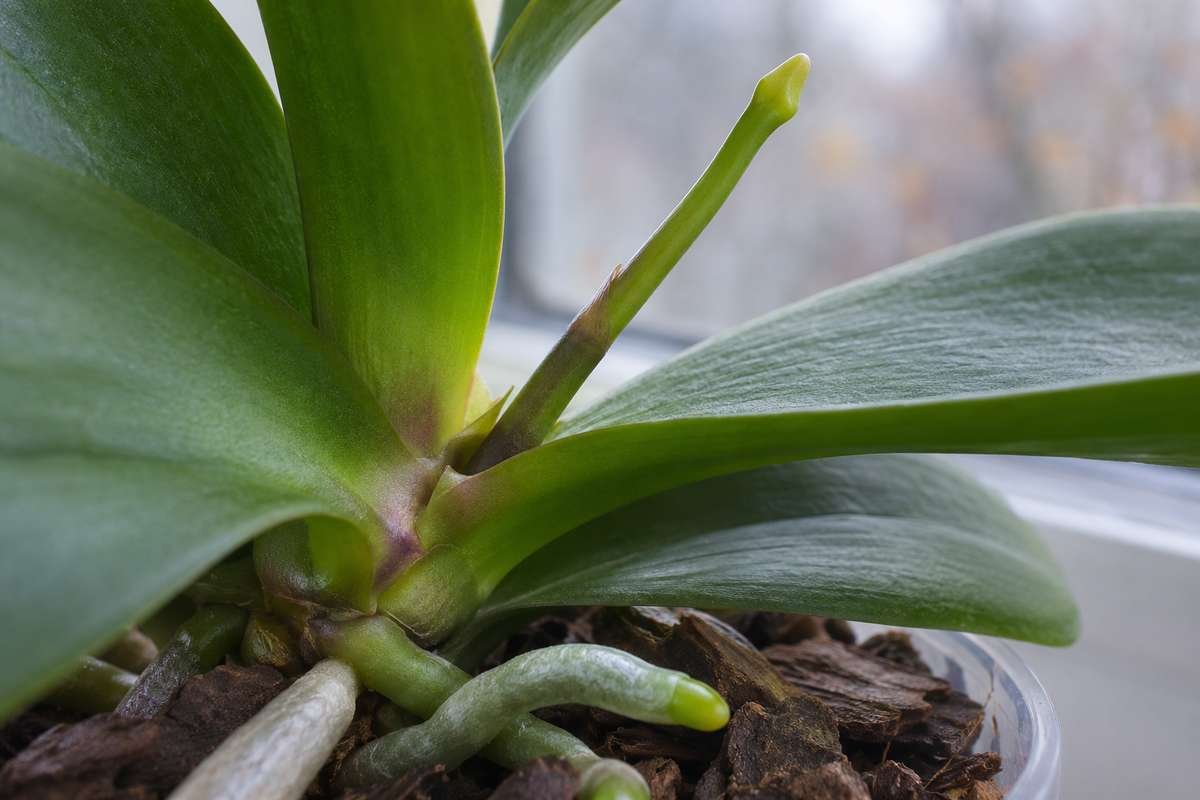
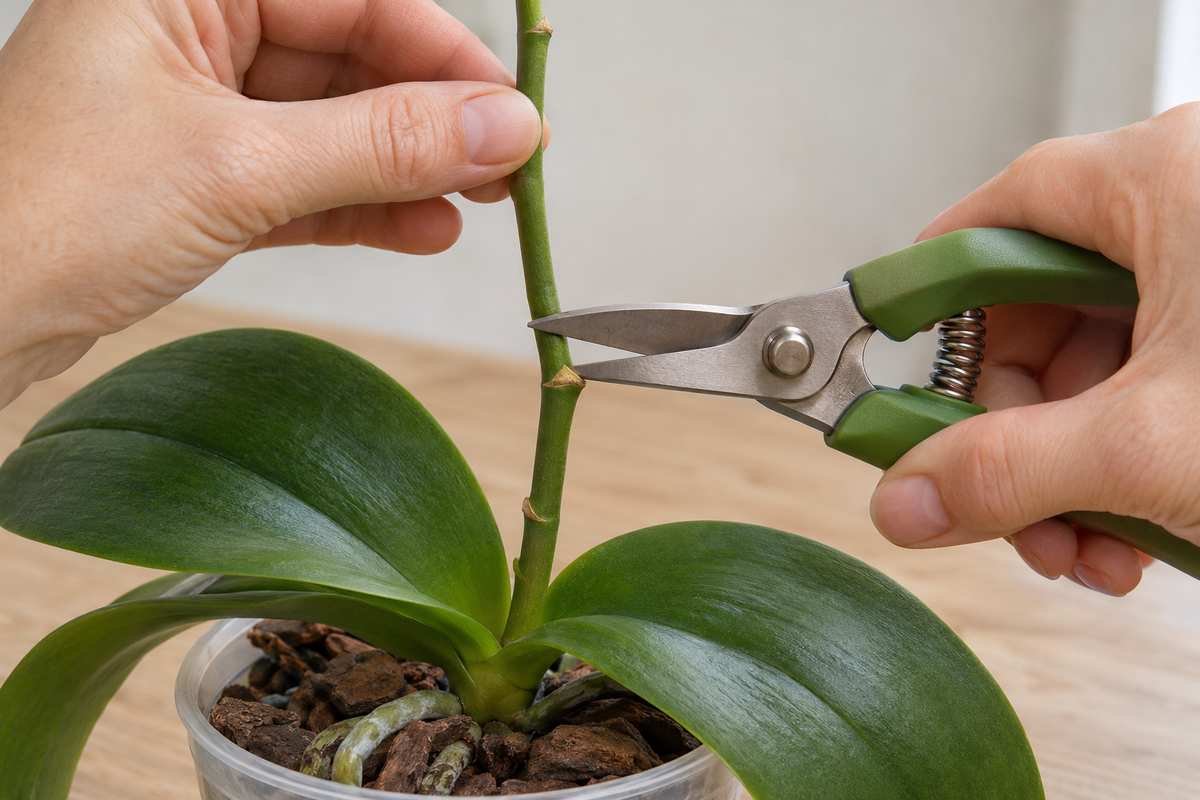
After the flowers drop, look at the spike. If it’s still green and has unused nodes (the small bumps along the stem), the AOS says you can cut it just above the second node below where the lowest flower was, and below any brown section. The RHS gives the same advice: cut back to just above the second node.
You may get a second round of flowers from it. Expect a cost, though, according to the AOS: a bloom from the old spike is usually smaller, and it takes energy from the plant. If there are no unused nodes, or the plant looks weak, cut the spike as low as possible so the plant can put its energy into new growth.
A spike that turns brown and dries on its own is nothing to worry about. As one r/orchids reply explained, spikes are temporary and it’s normal for them to die off completely while the plant grows new ones. One exception the AOS notes: some novelty and star-shaped types rebloom from the same spike, so don’t cut those while they’re green.
Watering and feeding while you wait
Water thoroughly, then let the mix get nearly dry before watering again, as the AOS culture sheet advises. University of Maryland Extension says that under normal home temperatures, a moth orchid shouldn’t need water more than once a week. The roots help you judge: Maryland says they turn from silvery white to pale green when they’ve had enough water.
Water in the morning. According to the AOS, watering late on a day when the night turns cool can cause edema, blister-like spots on the leaves, which matters more once you’re chilling the plant on purpose. Tip out any water that collects in the crown, where it can cause rot.
For feeding, the AOS recommends fertilizing regularly, and the RHS warns that overfeeding does more harm than good, so follow the label. As for the baking soda trick that comes up in searches, the only use the AOS gives baking soda is as a home fungicide spray for Botrytis spots on flowers. None of the sources here recommends it to make an orchid bloom.
How long does it take an orchid to rebloom?
A few months, if it follows the natural schedule. In the AOS’s seasonal routine, a plant chilled outdoors in fall and brought in should show flower spikes by Christmas and flowers by Valentine’s Day. That’s why November matters: a cool few weeks now are what you see in February.
Not every hybrid sticks to the calendar. According to the RHS, moth orchid flower stems can appear at any time of year, and the AOS says novelty types seem to flower at almost any time if they get enough light. A plant that misses this fall can still bloom later.
Once the flowers are done, look at the potting mix. Orchid bark usually breaks down in about two years, the AOS says, and most plants need repotting every year or two, since roots rot in decomposed mix. Moth orchids are also on the ASPCA’s non-toxic list, which our page on whether orchids are toxic to cats goes through in detail.
Your orchid isn’t waiting for fertilizer or a trick. It’s waiting for a few chilly weeks that a warm apartment never gives it, and you’re the one who has to arrange them.

Ellie Marsh
Houseplant grower who spent years in a north-facing apartment. Writes practical care guides for low light homes, checked against extension and botanical garden sources.