Last updated on November 7, 2026
Peperomia care comes down to four things: filtered light from an east or south window, water only after the mix has dried, a small pot of fast-draining mix, and a warm room away from cold drafts. Clemson Extension says peperomia can even tolerate somewhat low light near a large north-facing window. The usual way to lose one is overwatering.
That makes it one of the fairer bets for a dim room, with one condition attached. In low light the plant uses water slowly, so good peperomia care in a darker spot means watering less often and keeping the pot small.
Does peperomia need sunlight?
Peperomia needs light but not hot sun: Clemson Extension recommends indirect light from an east- or south-facing window and says direct sun may scorch the foliage. NC State Extension describes it as a plant for bright, filtered light that will tolerate low light.
The useful line for a darker home is Clemson’s peperomia fact sheet note that peperomia “can even tolerate somewhat low light near a large north-facing window.” The word large is doing work there. A small north window across the room is a different situation, and so is a spot six feet back from any glass. The University of Arkansas Extension puts peperomia in the medium-light group of houseplants, which fits: it copes with less than most flowering plants want, but it does not grow in the dark.
For years I lived in a north-facing apartment, and plants in that kind of light grow slowly and stretch toward the window. If yours is leaning hard or the stems are getting long between leaves, move it closer to the glass or add a grow light for the corner. The north-facing window plants list covers what else tends to manage in that light.
How often should you water a peperomia?
Water a peperomia only when the potting mix has dried out, not on a calendar. Clemson Extension says peperomia prefers to dry out between waterings and drops its foliage when overwatered, and the University of Florida’s IFAS Extension advises erring on the dry side.
Why so much caution? Many peperomias store water in thick, fleshy leaves, as the NC State Extension plant toolbox notes, and most grow as epiphytes in the wild, perched on trees with very little soil around their roots. The University of Arkansas Extension says that small root system is easily overwatered, especially in winter when growth slows. A plant in a dim room is in a version of winter all year, so the gap between waterings stretches further there.
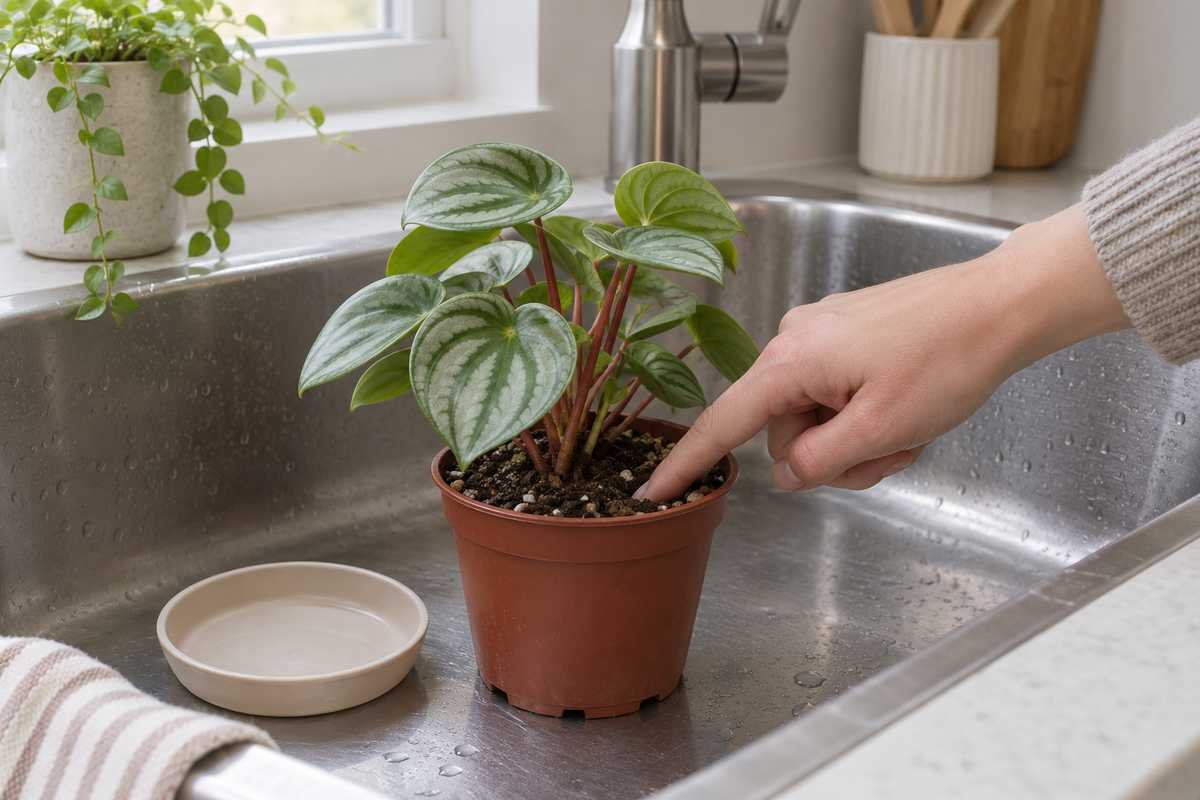
How do you tell it is time? Push a finger into the mix. If it feels damp, wait. Soft, slightly wrinkled leaves on a plant in dry mix mean it is thirsty. Yellowing or curling leaves on a plant in wet mix point the other way: NC State lists both as signs of overwatering, along with root rot.
One reply on an r/peperomia thread from a new owner summed up the rhythm well:
“They prefer snug pots so it doesn’t need to be repotted anytime soon. Naturally they are epiphytes meaning they grow on trees or as ground covers, so they don’t like overly compact soil. Their water schedule is “when the soil seems dry and the leaves are squishy” They hold water in their leaves and have delicate roots so it is very easy to over water.”
– r/peperomia, December 2025 (12 upvotes)
When you do water, water fully and let it drain. Clemson’s advice is to let the pot drain before putting it back in its saucer, so the roots never sit in a puddle.
Soil, pot size and repotting
Use a well-drained houseplant mix or a cactus mix, which is what Clemson recommends. NC State suggests a moist but well-drained blend of loam and sand. Either way, the mix should dry within days, not stay wet for a week.
Keep the pot small. Arkansas Extension says peperomias are best grown in relatively small pots, and Clemson says a new pot only needs to be slightly larger than the grower’s pot. A big pot holds a lot of wet mix around a small root ball, and that wet mix is where rot starts. Peperomia grows slowly, NC State notes, so it rarely needs repotting, and Clemson says one can stay in the same pot for several years.
When it does need a new pot, do it in spring. Arkansas advises waiting for spring before cutting back or repotting, when the plant is growing again and can replace any roots you disturb.
Peperomia care for warmth, humidity and feeding
Warmth. One common name for peperomia is radiator plant, which NC State says comes from its liking for warm conditions. Keep it away from cold drafts, doors that open onto winter air, and air conditioning vents. Clemson says plants can go outdoors for the summer once nights stay at 60°F or higher, in deep shade at first and then a bright spot with no direct sun.
Humidity. Ordinary home humidity is fine. NC State says peperomia handles the humidity of most homes and suggests a humidifier only if the air is very dry, while Clemson says it benefits from one in winter, when heating dries the air. The guide to raising humidity in the house covers the cheap ways to do that.
Fertilizer. Feed only while it is actively growing in spring and summer. Clemson suggests a low-strength liquid fertilizer now and then during that season, or a slow-release granular product once a year. Nothing in winter.
Common peperomia types and how they differ
Clemson counts more than 1,000 peperomia species, and the ones sold as houseplants differ mainly in leaf shape and habit. Most stay small: Clemson gives 8 to 15 inches tall and wide as the typical size, and NC State puts the species it covers at 6 to 12 inches.
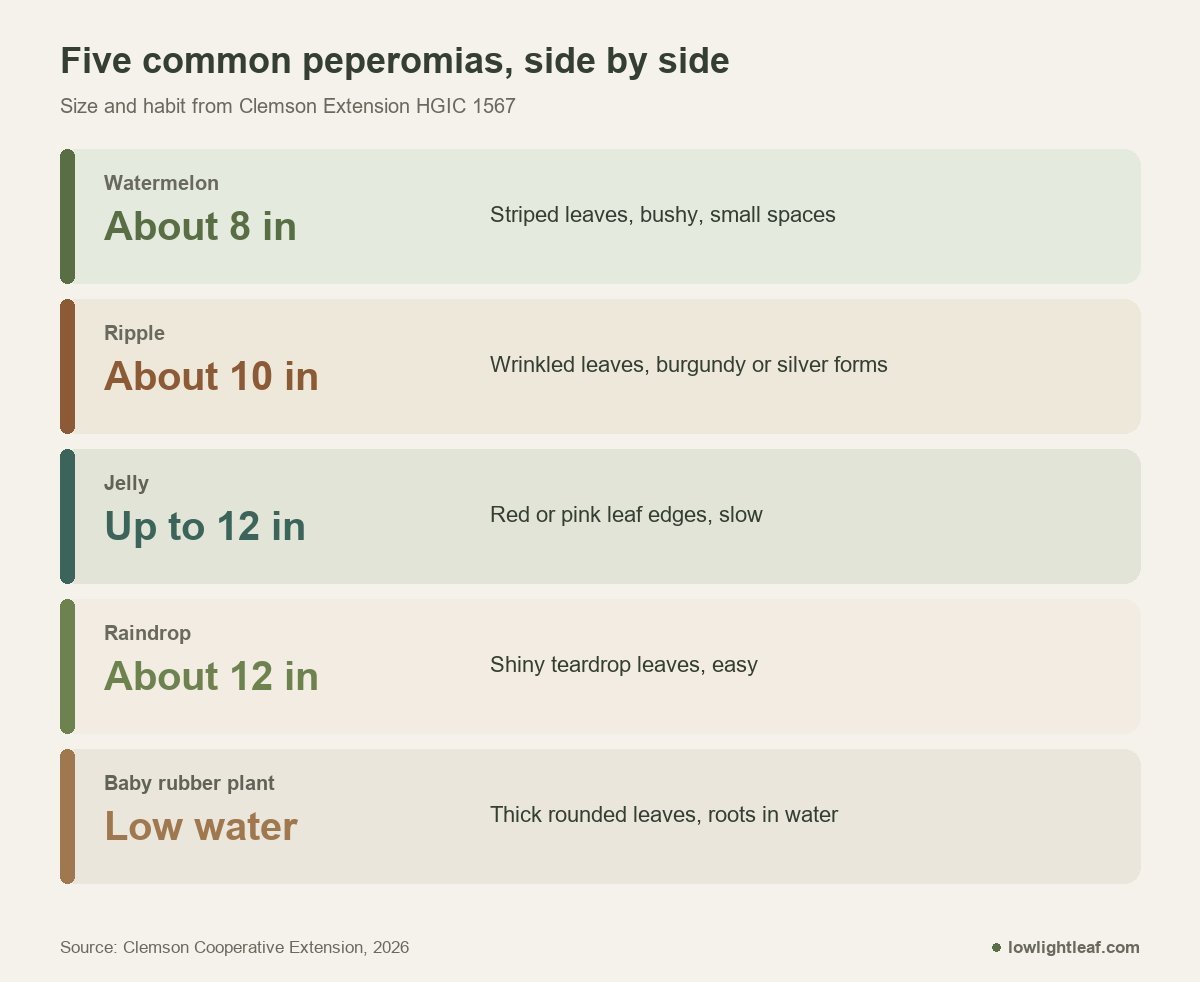
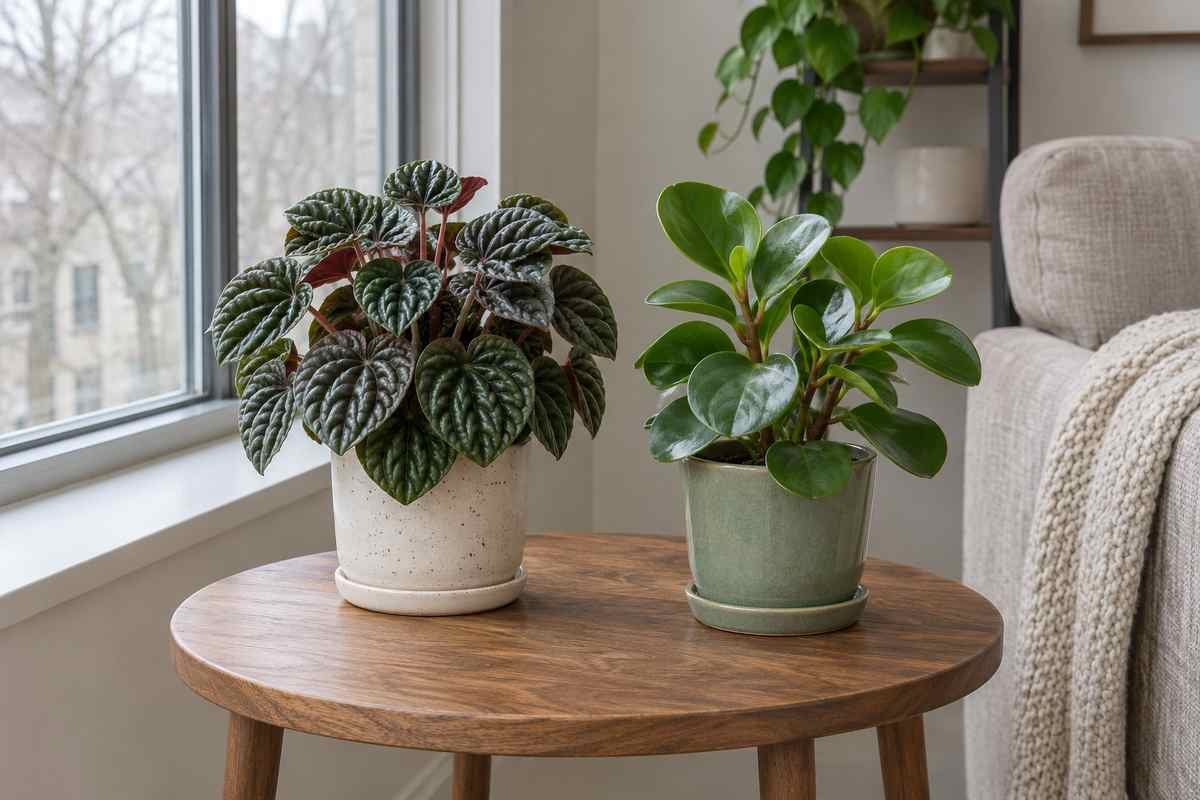
Two names cause most of the mix-ups. The raindrop peperomia (Peperomia polybotrya) is often mistaken for the Chinese money plant, Pilea peperomioides, and Clemson says the peperomia is the easier of the two to grow. The baby rubber plant (Peperomia obtusifolia) has nothing to do with the rubber tree, which is a Ficus with its own care needs and its own pet warning.
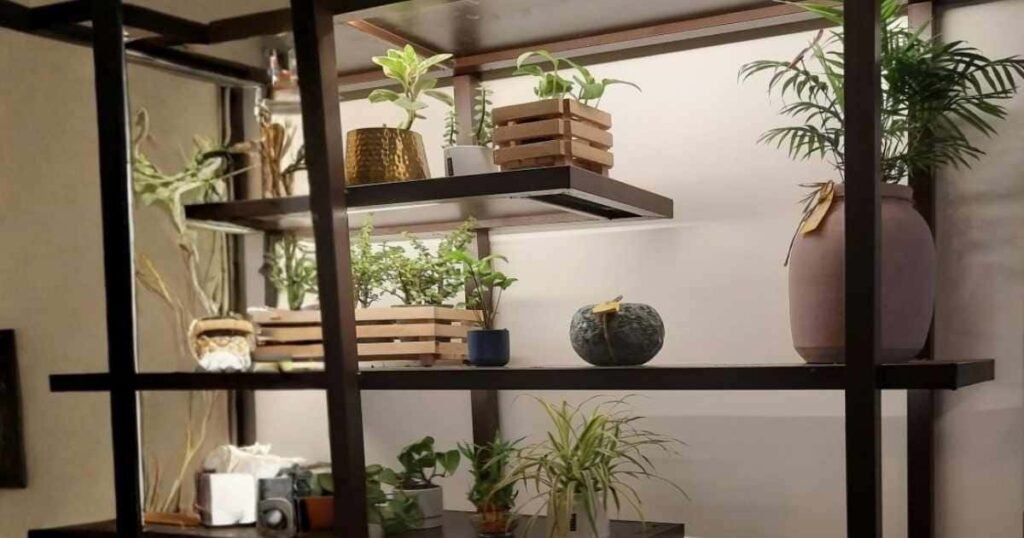
Trailing types such as string of turtles (Peperomia prostrata) and cupid peperomia (Peperomia serpens) suit hanging pots and shelves. Clemson flags string of turtles as sensitive to overwatering, so it needs the driest hand of the group.
Three ways to root a peperomia cutting
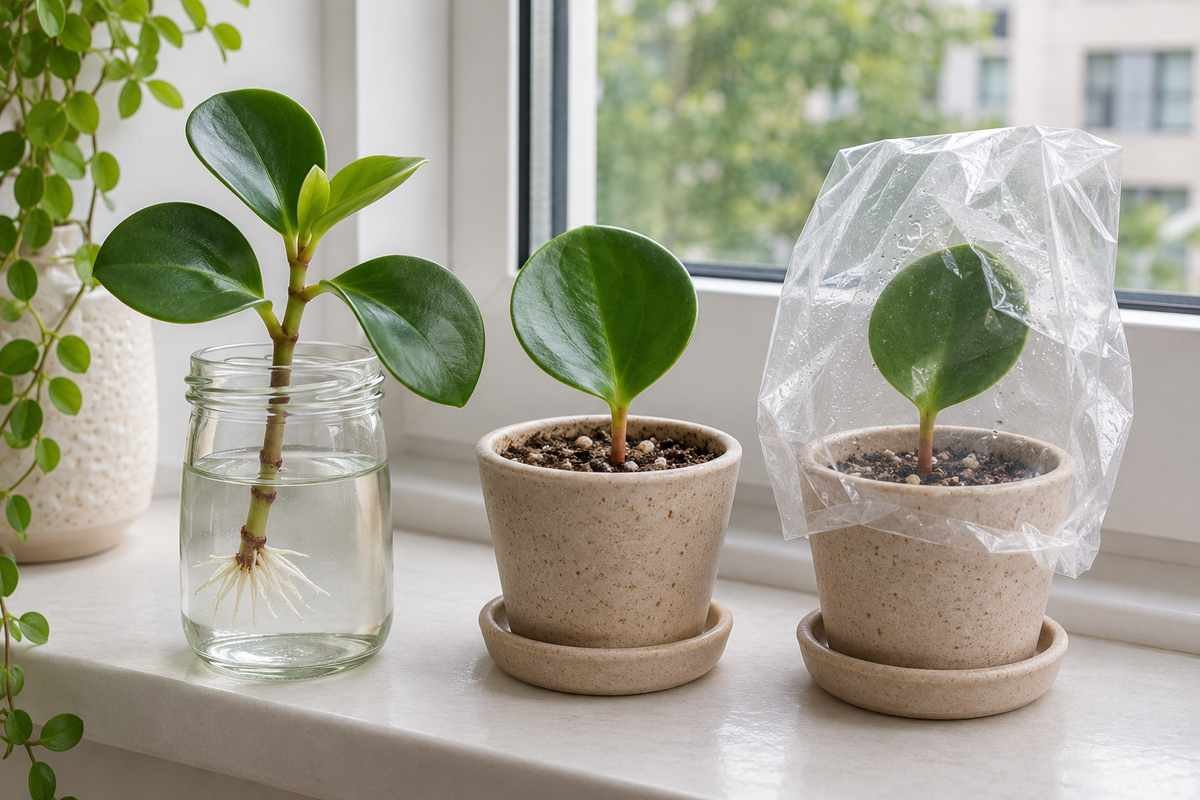
Peperomia roots easily from stem cuttings, leaf cuttings or, for some types, cuttings in water. Clemson Extension describes all three:
- Stem cutting. Cut a 3- to 5-inch piece of stem, strip the leaves from the lower third, dip the end in rooting hormone and set it in potting mix or rooting medium. Cover with clear plastic and keep it out of direct sun.
- Leaf cutting. Take a leaf with at least an inch of its leaf stalk attached and insert the stalk into rooting medium. New plants form at the base of the stalk and can be potted on once they have roots.
- Water rooting. Baby rubber plant roots readily in water. Take a 4- to 6-inch cutting, cut just below a leaf node, remove the lower leaves and keep the jar in bright, filtered light. Pot it once roots and new leaves appear.
A cutting is also cheap insurance. If the parent plant rots, you still have the plant.
Leaf drop, root rot, pests and those odd flower spikes
Root rot. Clemson calls root rot, caused by overwatering, the most common disease of peperomia. Leaves dropping from a plant in wet mix is the early warning. Let the pot dry out, and if the stems are soft at the base, take cuttings from the healthy top growth.
Leaf spots. Fungal spots are prevented by keeping the foliage dry when you water, says Clemson. NC State also recommends good air movement.
Pests. The usual ones are mealybugs, spider mites, fungus gnats and whiteflies, according to Clemson, and NC State adds aphids and scale. Fungus gnats in particular follow wet mix, which is one more reason to let it dry.
Flower spikes. Thin spikes appear in spring and summer on some plants. Clemson describes them as unattractive and said to resemble a rat’s tail, and says removing them lets the plant put its energy into leaves. NC State notes that as houseplants they typically will not flower at all, so a plant with no spikes is not a problem.
Is peperomia safe for cats and dogs?
The ASPCA lists the baby rubber plant (Peperomia obtusifolia) and the emerald ripple peperomia (Peperomia caperata) as non-toxic to cats and dogs, and Clemson Extension says most peperomia are considered safe for pets.
Any plant can still upset a pet’s stomach if it eats enough, so a cat that chews leaves is still worth discouraging. Miso, my cat, is the reason I look up every plant before it comes home. The plant toxicity checker covers the ASPCA status of common houseplants, and the pet-friendly indoor plants list includes peperomia with other safe low-light picks.
If you are unsure whether a peperomia needs water, wait a few more days. A dry one recovers after a drink; a rotted one usually does not.

Ellie Marsh
Houseplant grower who spent years in a north-facing apartment. Writes practical care guides for low light homes, checked against extension and botanical garden sources.