Last updated on November 7, 2026
Staghorn fern care means strong, filtered light, a thorough soak whenever the moss or mix has dried a little, warmth above 55°F, and leaving the brown shield fronds alone. Staghorns (Platycerium) are epiphytes that grow on trees rather than in soil, so most are grown mounted on a board or in a basket. The ASPCA lists the common staghorn, Platycerium bifurcatum, as non-toxic to cats and dogs.
Most losses come from too much water or too little light. Good staghorn fern care is mostly about giving it the brightest spot you have and letting it dry slightly between soaks.
How much light does a staghorn fern need?
A staghorn fern needs strong, indirect light: the New York Botanical Garden’s plant guide says staghorns grow high in the tree canopy, are used to more light than ferns of the forest floor, and do best in strong indirect light. Direct sun on the fronds, NYBG warns, can bleach them and leave blotchy marks.
That puts the staghorn in a different group from the ferns people tuck into dim corners. UF/IFAS Gardening Solutions says the plant thrives in shade and part shade outdoors, but that very low light is likely to encourage disease and pests. Indoors, shade means the bright side of a room, not the far wall.
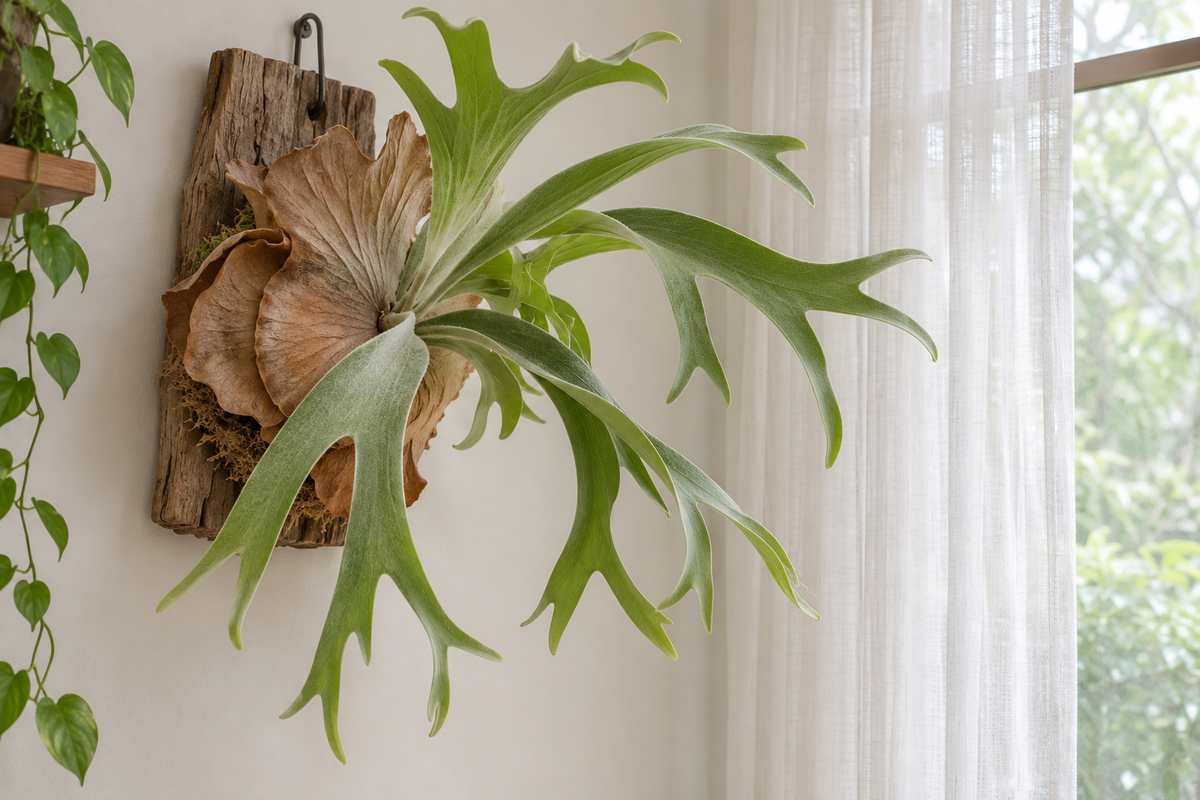
In the north-facing apartment where I lived for years, a staghorn would have needed the window itself or a grow light overhead. If your brightest window is small or north-facing, plan on the light. Wisconsin Extension adds that staghorns tolerate more direct sun when humidity and temperatures are high, but need more water in that position, so a sunny summer porch is a different job from a living room wall.
Soak watering a mounted staghorn
Water a staghorn fern by soaking the root ball, then letting it dry a little before the next soak. Staghorns take in water through their fronds as well as their roots, and UW-Madison Extension says they rot easily if overwatered.
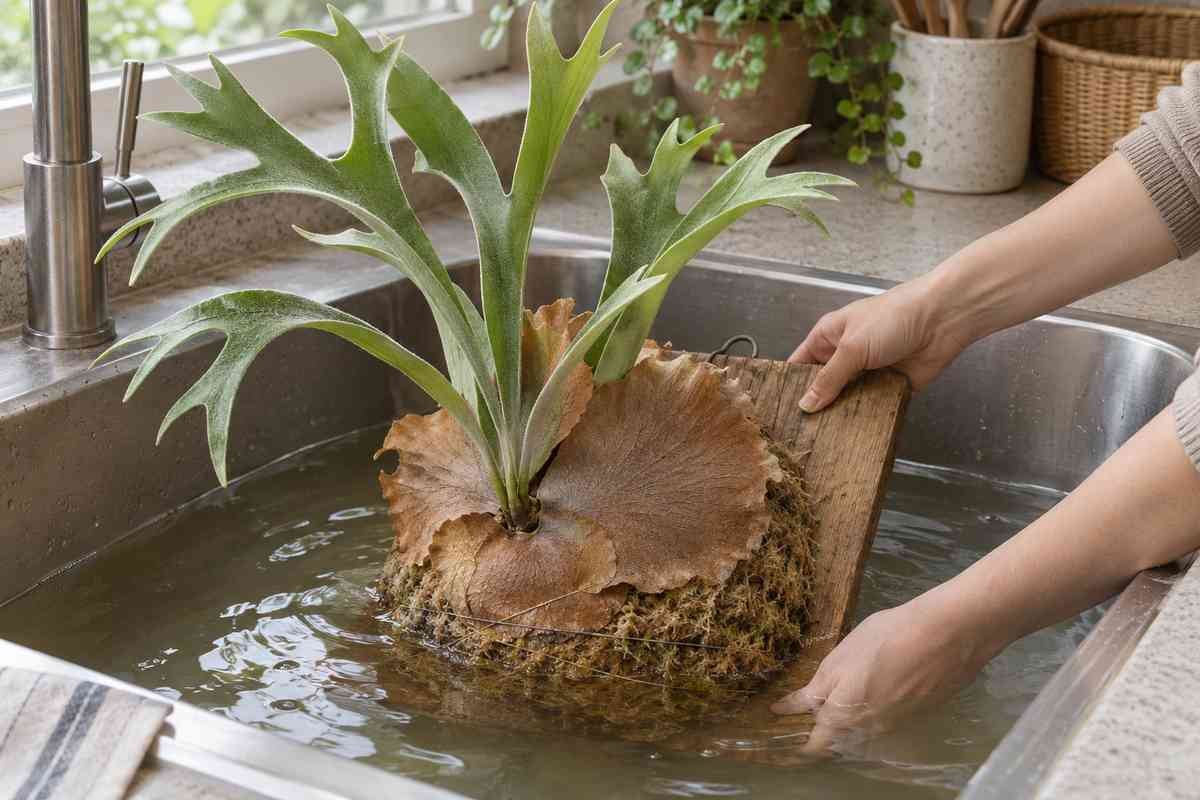
For a mounted fern, NYBG’s method is to take it down and immerse the brown base in a large container of water:
- Lift the board or basket off its hook and set it in a sink, tub or bucket of water.
- Hold the brown shield fronds and the moss under until the medium is saturated.
- Let it drain fully before you hang it back up, so it does not drip down the wall.

Illustration: soak the base until the moss is saturated, then let it drain before re-hanging.
How do you know when to soak again? Moss on a board is hard to read by touch, so UF/IFAS suggests waiting until the fern wilts slightly. A fern that wilted recovers quickly once watered; one that was overwatered rots and dies. As a rough guide, UF/IFAS says once a week in warm, dry weather and less often when it is cool or cloudy. NYBG and Wisconsin both say to cut back in winter, when growth slows and the medium dries more slowly. Wisconsin prefers rainwater where you can collect it.
A reply on an r/ferns thread about a struggling potted staghorn explained the balance:
“It doesn’t look great, but I wouldn’t panic. Their ideal culture would provide frequent moisture with an opportunity to mostly dry out again soon afterwards. Persistent moisture can really only be tolerated if their roots have very good airflow and light is quite bright.”
– r/ferns, July 2026 (4 upvotes)
That lines up with the extension advice. In a dim, still room the medium stays wet longer, which is exactly the setup that leads to rot.
Mounting, baskets and pots
Mounting suits a staghorn best because it gives the roots the drainage and airflow they would have on a tree. Wisconsin Extension says indoor staghorns are typically grown on wooden boards, bark slabs or wire baskets, and that small plants can grow in a container of rich, very well-drained mix. NYBG prefers board or basket over a pot.
To mount one, UF/IFAS describes shaping a few handfuls of sphagnum moss into a mound on a slab of wood, tree fern fiber or even a rock, then setting the fern so its basal fronds touch the moss. Fasten it with plastic strips, nylon hose or wire, but not copper wire. Wisconsin adds a detail that saves the plant: wrap the line over or through the dead brown basal fronds, never across the soft green ones, which it says can be badly damaged or killed. New shield fronds grow over the fastening and hide it.
A wire basket hung on its side works too, and UF/IFAS notes that pups will grow out of the back and sides until they cover it. When the shield fronds reach the edges of the board, it is time to remount on something larger. Staghorns tolerate crowding, so there is no rush.
Staghorn fern care for temperature, humidity and feeding
Temperature. Keep the room above 55°F. Wisconsin gives that figure for household temperatures, and UF/IFAS says most staghorn species cannot take anything colder. The common P. bifurcatum and P. veitchii are hardier, surviving down to 30°F according to UF/IFAS, but that is a brief outdoor limit, not a goal. NYBG puts the comfortable range at up to 75°F, with about 70°F in summer.

A fern that spends summer outside should come in before fall nights drop into the 40s, Wisconsin says, and should be moved gradually so it is not shocked by the change in light.
Humidity. Moderate humidity is enough, per Wisconsin, though dry winter air may call for frequent misting. NYBG suggests misting once a day in warm rooms. Wisconsin also names a bathroom as an ideal spot because of the steam from the shower, but only if the light and air movement are right, and many bathrooms are too dark for this plant. The guide to raising indoor humidity covers other options.
Feeding. UF/IFAS recommends a balanced 1:1:1 fertilizer: monthly for young plants in warm months and every other month when growth slows, and once or twice a year for mature ferns. Wisconsin suggests diluted liquid fertilizer monthly in the warmer months, or slow-release pellets tucked into the medium. For a mounted fern, NYBG says to feed by dipping the base in water mixed with dilute fertilizer.
The brown shields and the fuzz: leave them
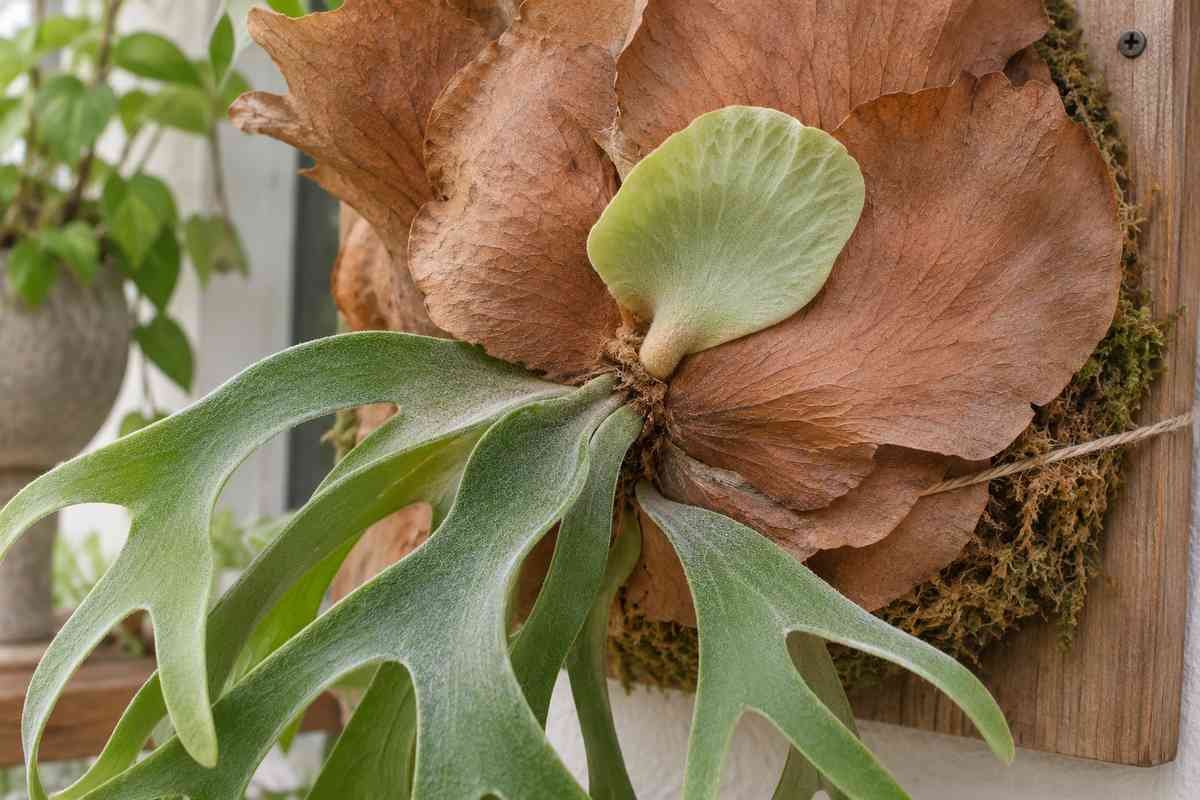
The brown, papery fronds at the base are supposed to look like that. Wisconsin Extension explains that these sterile basal fronds start green, turn tan to cinnamon-brown with age, and protect the rhizome and roots. It says not to remove them even when they look dead, until they fall off naturally.
The green, forked antler fronds carry two more things that worry new owners. A fine whitish-grey fuzz makes them look dusty; Wisconsin says not to wipe it off, because it helps slow water loss. Brown felt on the underside of the tips is the spore-bearing tissue, and UF/IFAS calls it normal. Only withered fertile fronds should be trimmed.
Dividing pups
A mature staghorn is a cluster of smaller plants, called pups, packed together. Wisconsin says division is the usual way to propagate: cut a pup away with a sharp knife, making sure it has some green fronds, some shield fronds and roots, then keep it warm and moist. Expect it to take a long time to establish. Growing staghorns from spores is possible but slow.
Problems and pet safety
Rot from overwatering is the main threat, and very low light makes disease and pests more likely, according to UF/IFAS. Wisconsin lists scale insects and mealybugs as the pests to watch, and NYBG says scale tends to settle on the underside of the fronds. Look there when a frond yellows without an obvious cause.
For pet owners, the ASPCA lists Platycerium bifurcatum as non-toxic to cats and dogs. Miso, my cat, is why every new plant gets looked up first, and the plant toxicity checker carries the staghorn’s ASPCA status. A mounted fern on a wall is also out of chewing range. For related ferns and their pet status, the page on whether ferns are toxic to dogs covers the true ferns and the look-alikes, and Boston fern care covers the easier fern for lower light.
When you are unsure whether it needs water, wait for the fronds to soften slightly. A thirsty staghorn bounces back after a soak.

Ellie Marsh
Houseplant grower who spent years in a north-facing apartment. Writes practical care guides for low light homes, checked against extension and botanical garden sources.