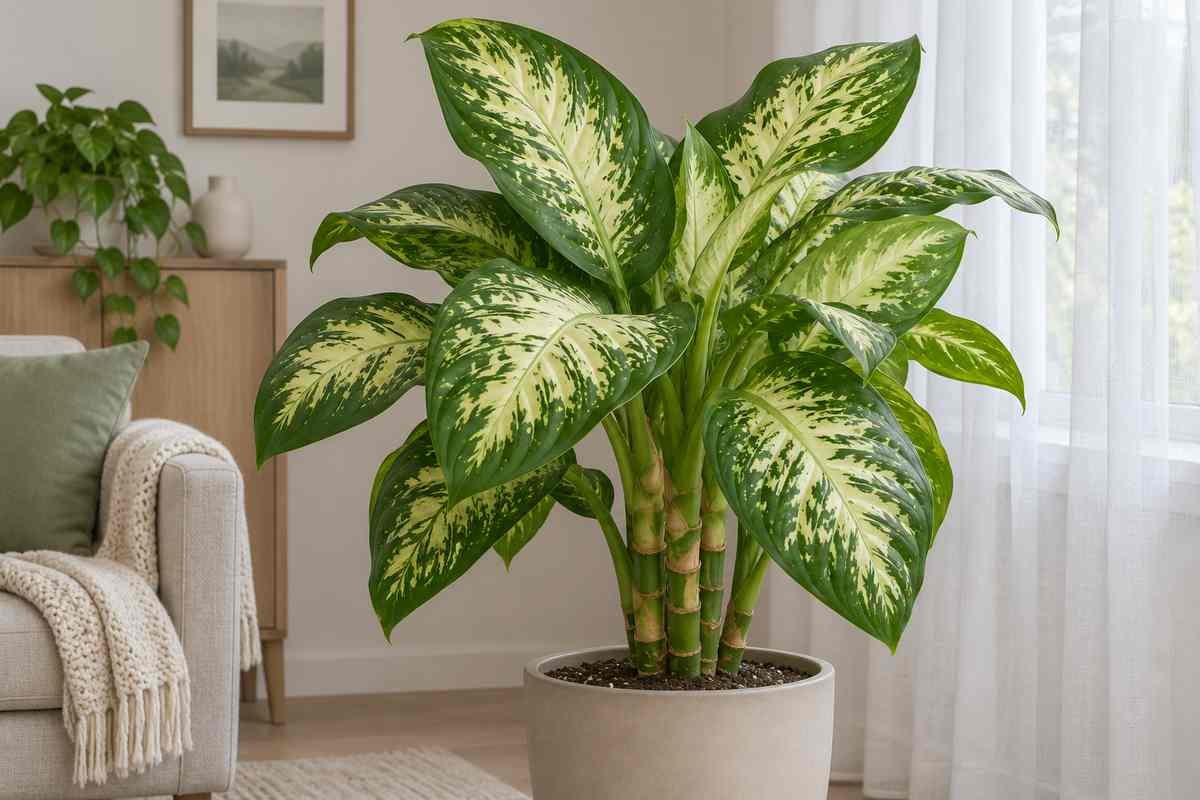
Dieffenbachia grows best in bright, indirect light, but it will keep going in a shady room, just more slowly. Water it thoroughly, let the surface of the soil dry, and keep it between 65 and 75°F. That’s most of it. The catch is safety: the ASPCA lists dieffenbachia as toxic to cats and dogs, and the sap irritates skin.
So is dieffenbachia a good indoor plant? For a dim room without a chewing pet, it’s one of the better ones.
Do dieffenbachia plants like sun or shade?
Dieffenbachia prefers bright, indirect light and no direct sun, but it tolerates shade. The UConn Home and Garden Education Office says it will grow in heavy shade and dark areas of the home, though growth slows, and that its best growth comes in bright indirect light.
The NC State Extension plant toolbox adds that it needs protection from direct sunlight and cold drafts, and describes it as a plant that will brighten the dark corners of a home.
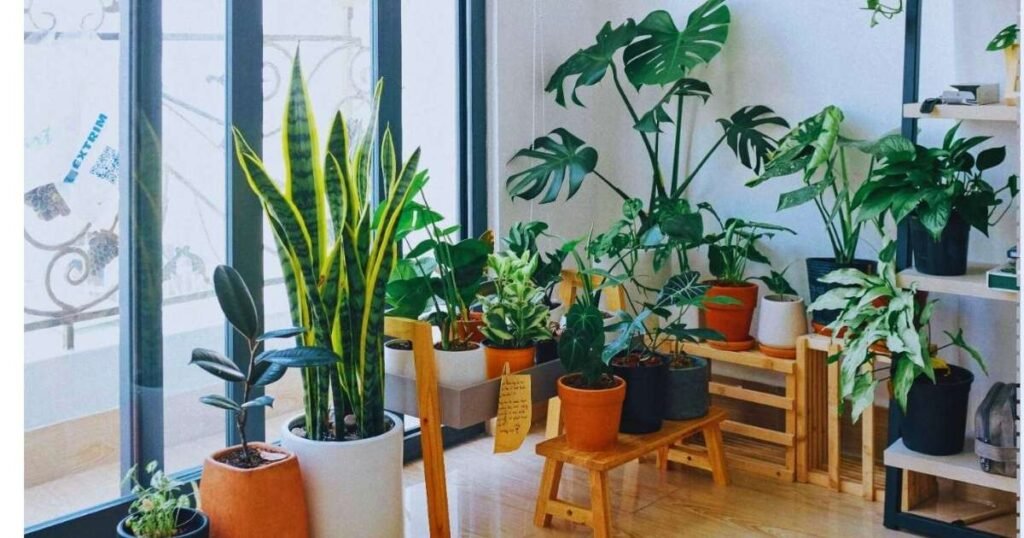
Where should I put dieffenbachia in my house? Near a bright window but out of direct sun, and away from radiators and cold drafts, which NC State and UConn both flag. In a north-facing apartment like the one I lived in for years, that means right by the window rather than across the room. If you’re working with the same kind of light, the guide to north facing window plants shows what else fits.
Dieffenbachia care at a glance
Water. Water thoroughly, then not again until the surface of the mix is dry to the touch, per UConn. NC State puts the line at the top 1 inch of soil drying completely, and says this helps prevent root rot. UConn is blunt that dieffenbachia won’t tolerate constant overwatering.
Water by the soil, not the calendar. In an r/houseplants thread about a struggling plant, one reply named both problems at once:
“The issue here is not the amount of water, but lack of light and watering on schedule. It needs to be on a window and be watered thoroughly when it needs it.”
– r/houseplants (6 upvotes)
Soil. UConn recommends a loose, fertile, high-organic mix that holds water but drains well. It lists several that work: peat and perlite at 1:1, soil and peat at 1:1, or soil, peat and perlite or vermiculite at 1:1:1. NC State describes the same kind of loose, fertile, organic soil.
Temperature and humidity. UConn gives 65 to 75°F as the range for best growth and says the plant shouldn’t drop below 50°F. Heat is a problem too. In a hot, dry room those large leaves can dry up, so UConn suggests grouping plants together or setting the pot on a pebble tray, well away from any radiator. The guide on raising humidity in the house covers which other methods actually help.
Feeding. UConn calls dieffenbachia a heavy feeder and suggests a complete fertilizer such as 20-20-20 every 4 to 6 weeks, only during active growth. In limited light, it needs feeding less often.
Dieffenbachia problems: what the leaves are telling you
Most dieffenbachia problems show up in the leaves first, and UConn’s factsheet links each symptom to a cause.
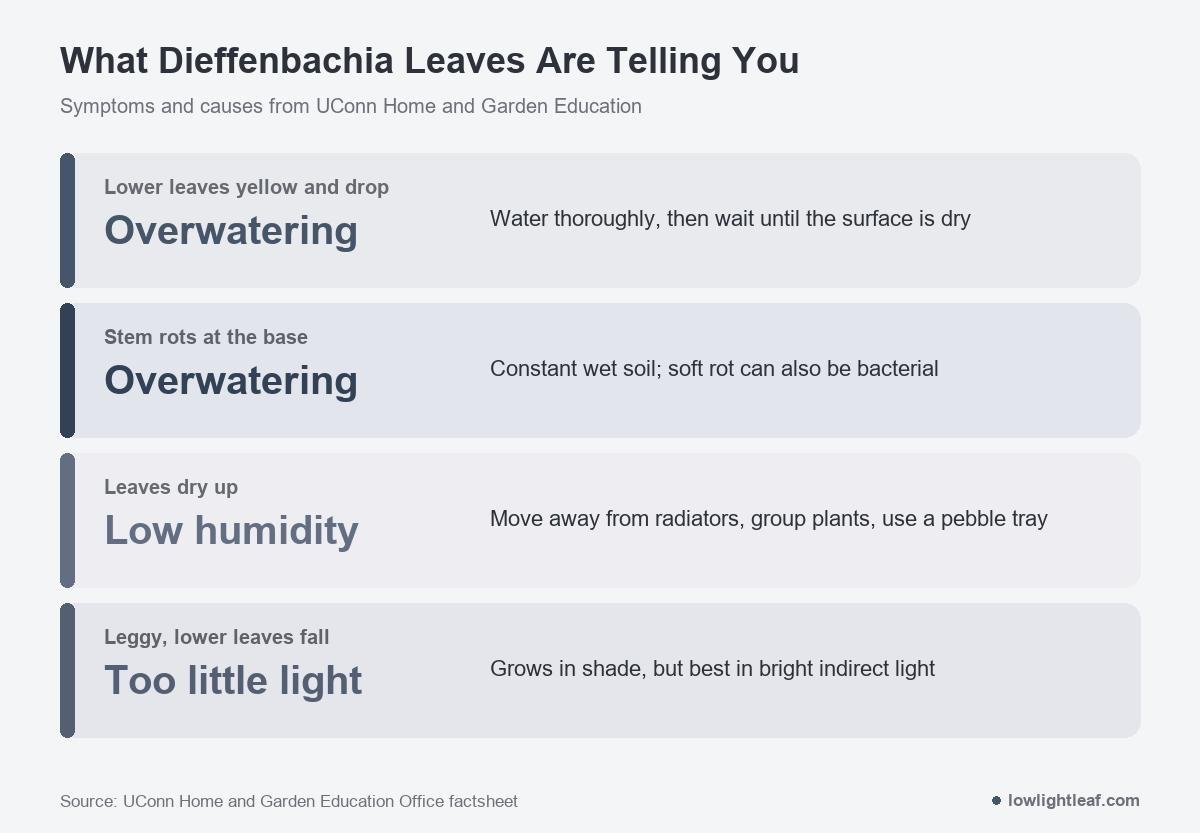
- Lower leaves turning yellow and dropping: overwatering.
- The plant rotting off at the base: overwatering, or bacterial soft rot (Dickeya dieffenbachiae).
- Leaves drying up: low humidity.
- Lower leaves falling and the plant getting leggy: not enough light.
Two of those four trace back to water, which is why the watering rule above matters so much. If yellowing doesn’t fit the pattern, the general guide to yellow leaves walks through other causes.
Pests. NC State lists spider mites, scale, whiteflies, fungus gnats and aphids, plus fungal leaf spot, root rot and blight. UConn singles out mealybugs. For the two most common, see getting rid of mealybugs and getting rid of fungus gnats.
Is it a dieffenbachia or a Chinese evergreen? NC State’s tip is to count the main side veins on a leaf: dieffenbachia usually has 20 to 30, while Aglaonema usually has 5 to 8. If yours turns out to be the second, the Chinese evergreen care guide is the one you want.
Propagating dieffenbachia from cane and tip cuttings
Dieffenbachia roots from stem cuttings, and NC State also lists division. UConn’s method is useful for a plant that has gone leggy, because even bare stem works:
- Put on gloves; the sap irritates skin.
- Take a tip cutting from the top of the plant, or cut a bare stem into 2-inch pieces, each with at least one bud.
- Let the cuttings dry for a day.
- Set them in a rooting medium such as peat, sand, perlite or vermiculite. UConn says they root faster in sphagnum moss than in sand.
UConn adds that cuttings from the top root faster than sections from the base, and thicker stems faster than thin ones. Dieffenbachia can also be rooted and grown in water, and the guide to plants that grow in water covers that setup. Even a damaged plant can come back this way:
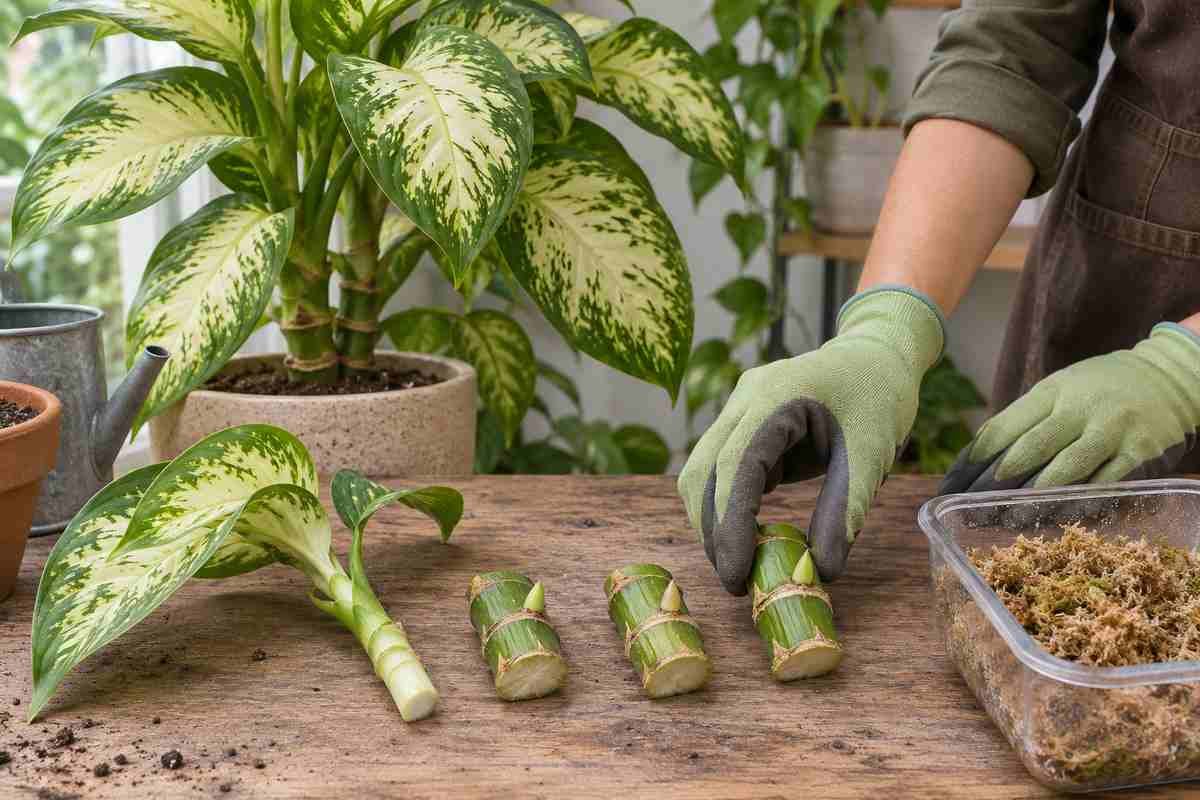
“On May 30th I had to undertake major surgery on my 185cm tall dieffenbachia, after it suffered a stem trauma during transportation. I tried various propagation methods and they’re all showing very promising signs, I am so pleased!”
– r/propagation (134 upvotes)
As for flowers: UConn says dieffenbachia seldom flowers indoors, and when it does, the green spathe and off-white spadix aren’t showy.
Is dieffenbachia poisonous to the touch?
The sap is the problem when you touch dieffenbachia. NC State recommends gloves to prevent skin irritation or contact dermatitis, and washing your hands after handling it. UConn warns that getting the sap in your eyes is particularly painful.
UConn explains why: every part of the plant contains raphides, needle-like crystals that are released when cells are damaged. Cutting, pruning and taking cuttings are the moments to be careful, and the moment to keep your hands away from your face.
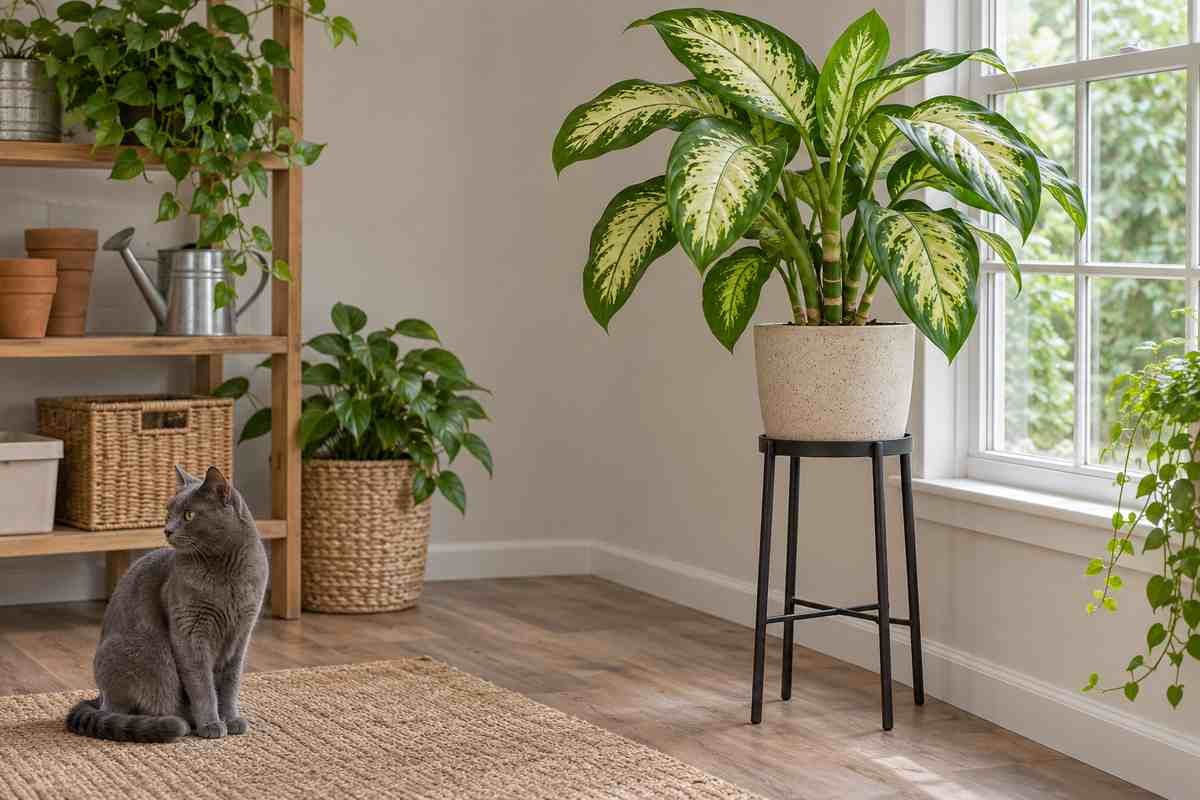
Is dieffenbachia toxic to cats and dogs?
Yes. The ASPCA dieffenbachia entry lists it as toxic to dogs and cats because of insoluble calcium oxalates and a proteolytic enzyme. Signs include intense burning and irritation of the mouth, tongue and lips, excessive drooling, vomiting and difficulty swallowing.
The name dumb cane comes from that reaction. UConn says chewing the plant causes stinging and burning in the mouth and throat that can last up to two weeks and can disable speech. NC State tags it as a problem for cats, dogs, horses and children.
If your pet chewed it, call your vet, the ASPCA Animal Poison Control Center at (888) 426-4435 or Pet Poison Helpline at (855) 764-7661. The ASPCA entry covers the plant under its other names too, including Tropic Snow, Exotica and spotted dumb cane.
My cat, Miso, is why I check every plant against the ASPCA list before it comes home, and dieffenbachia doesn’t pass. The plant toxicity checker lists it alongside more than a hundred other houseplants, if you want a dim-room plant that does.
Dieffenbachia is easy in low light as long as you water by the soil and keep it warm. It’s not a plant to leave where a cat, dog or toddler can chew it.

Ellie Marsh
Houseplant grower who spent years in a north-facing apartment. Writes practical care guides for low light homes, checked against extension and botanical garden sources.