Last updated on October 31, 2026
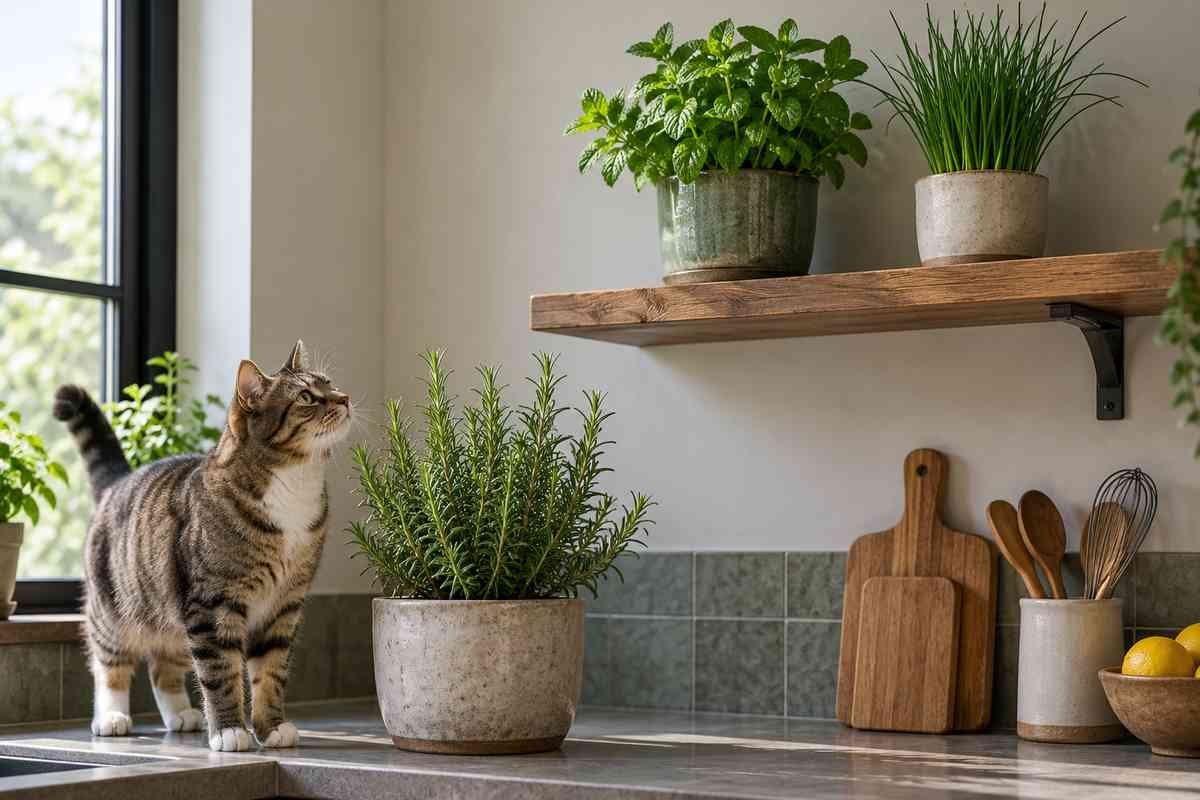
Is rosemary safe for cats? Yes. The ASPCA lists rosemary (Rosmarinus officinalis) as non-toxic to cats, dogs and horses, so a cat that chews a sprig or a leaf off a potted rosemary is not at risk of poisoning. Concentrated rosemary essential oil is a separate question, and so are the other herbs that often sit next to rosemary on a windowsill.
I share my apartment with a cat named Miso, and every plant that comes through the door gets looked up on the ASPCA list first. Rosemary passes, the same way orchids do. What follows is everything around it that doesn’t always pass: the oil, the diffuser, the foil-wrapped Christmas tree version and the herb pots beside it.
What happens if a cat eats rosemary?
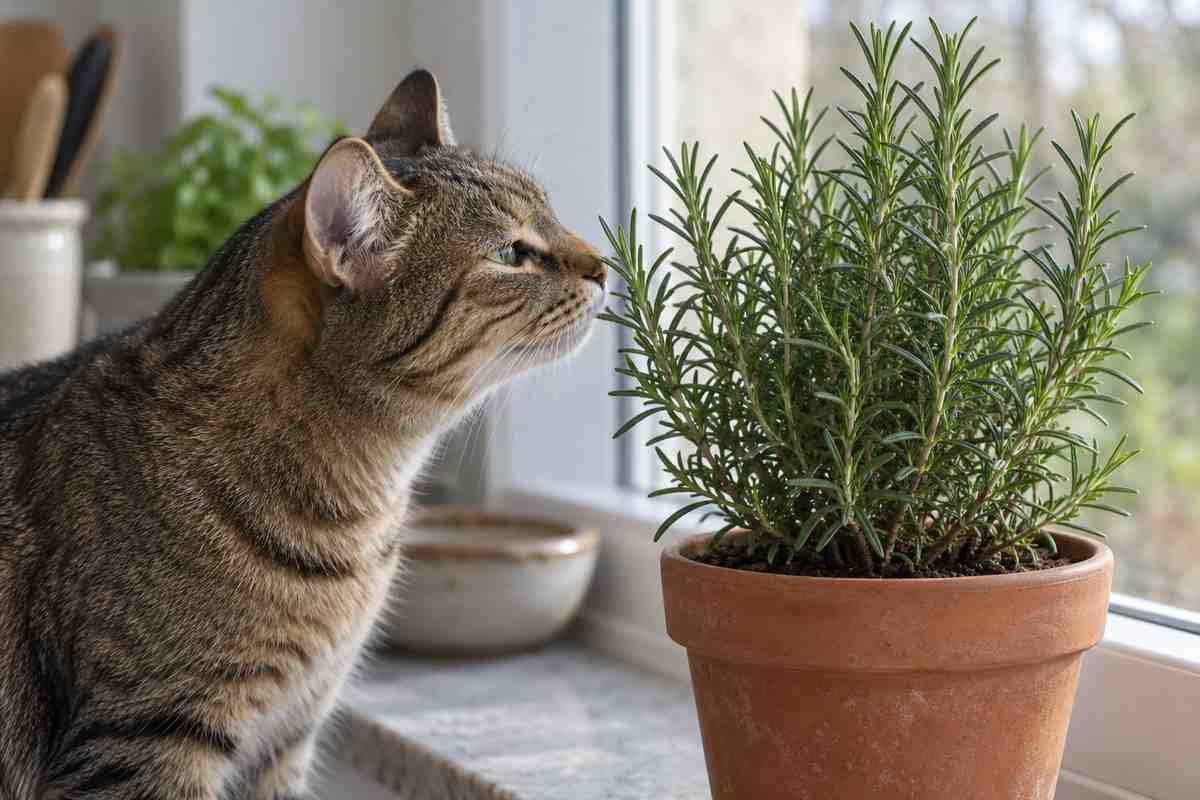
Most of the time, nothing. A cat that nibbles rosemary has eaten a plant the ASPCA rosemary entry classes as non-toxic, and UF/IFAS Extension says the same about holiday rosemary topiaries: if a bit ends up eaten, it’s no problem at all.
The limit is quantity. The ASPCA’s own plant list notes that eating any plant material can cause vomiting and stomach upset in cats. Rosemary leaves are stiff and needle-shaped, and a cat that eats a lot of them may throw some back up. That is a stomach reacting to roughage, not poisoning, and it should pass on its own.
Call your vet if vomiting keeps going past a day, if your cat stops eating, or if you aren’t sure the plant was rosemary in the first place. A plant label that says “herb” is not an ID, and several look-alike herbs are on the toxic list (the table further down has them).
Rosemary oil, diffusers and scented products are a different question
Rosemary essential oil should not be used on or near a cat the way the plant can be. The Merck Veterinary Manual says concentrated essential oils should never be applied directly to pets, and that cats are more sensitive than dogs because they are deficient in the liver enzyme glucuronyl transferase.
To be precise about what Merck does and doesn’t say: rosemary oil is not on its list of oils that damage the liver (birch tar, cassia, cinnamon, pennyroyal, tea tree) or its list of oils linked to seizures. The warning is about concentration and exposure. Merck notes that the higher the concentration, the greater the risk, and that oils are absorbed through the gut, skin and lungs.
How the oil reaches the cat matters as much as which oil it is:
- Fresh or dried rosemary. The plant the ASPCA lists as non-toxic.
- A drop of oil on fur or a bed. Direct contact with a concentrated oil, the exposure Merck says to avoid entirely.
- Ultrasonic or nebulizing diffusers. Merck says these send out microdroplets that land on fur, and a cat swallows them while grooming.
- Reed diffusers and candles. They don’t emit droplets, so Merck’s main concern is irritation from breathing the scent, unless the bottle gets knocked over.
Rosemary hair products come up a lot. One cat owner asked on r/CatAdvice about a rosemary and rice water hair spray:
“he generally doesn’t rub or lick my hair but on occasion he does lay on my pillow”
– r/CatAdvice, 2026 (1 upvote)
The reply drew the same line Merck does, between pure oil and a diluted product:
“I’ve stopped using pure essential oils because they can be dangerous for pets. But stuff that’s already mixed into a hair product. Etc should always be fine unless you are applying it too close to the cat or letting them lick it right off of you.”
– r/CatAdvice, 2026 (1 upvote)
That matches the exposure logic, though no source I found tests rosemary hair sprays on cats. Let the product dry before the cat gets near your hair or pillow, and don’t use anything on your hands right before handling the cat. The same plant-versus-oil split applies to lavender, covered in is lavender safe for cats, except that the lavender plant itself is on the ASPCA’s toxic list.
Rosemary Christmas trees and cats
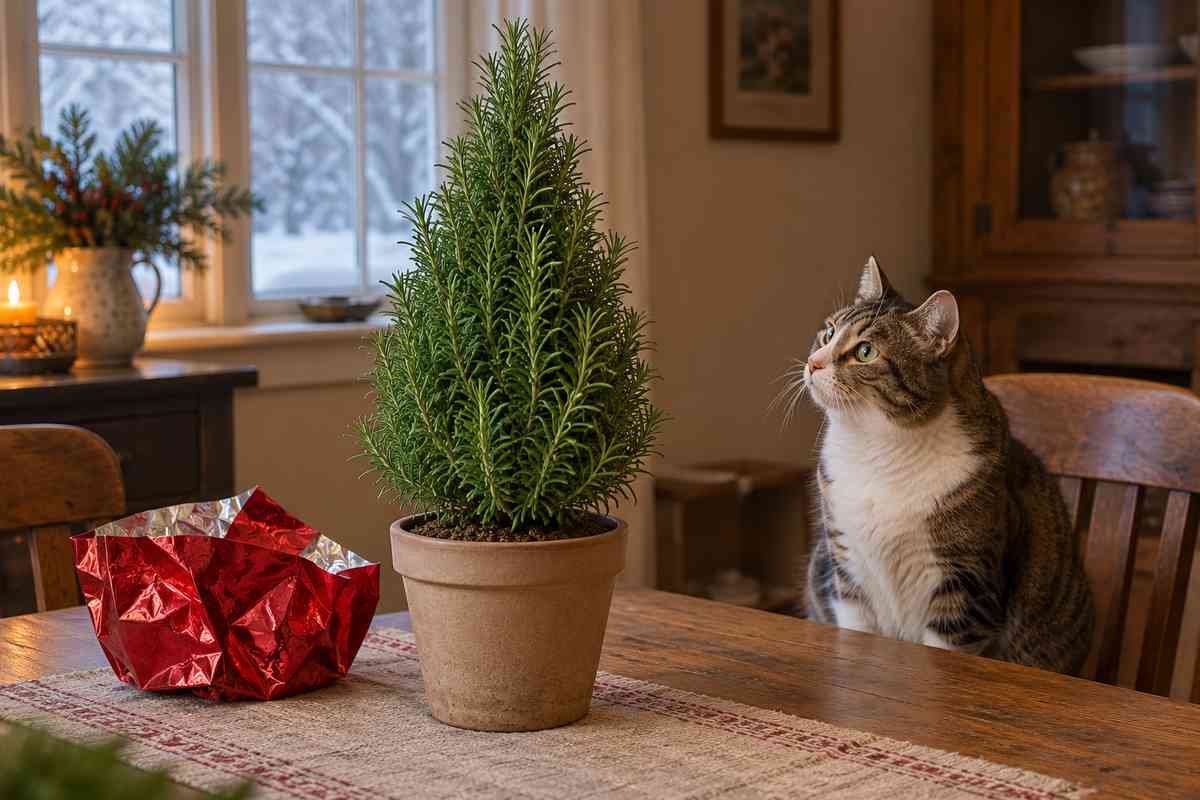
A rosemary Christmas tree is safe to keep where a cat can reach it, as far as toxicity goes. These are ordinary rosemary plants: UGA Extension says holiday rosemary is often sheared into topiaries or Christmas tree shapes, and UMass Extension describes the same plant grown as tabletop trees and living wreaths.
The risks with the holiday version are about the decorations and the pot:
- The foil sleeve. UF/IFAS warns that festive foil around the container can hold in more water than rosemary likes. Take it off, or at least tip out what collects in it. A cat drinking from standing pot water is a separate habit worth discouraging.
- Ornaments and tinsel. Small glass balls and tinsel on a tabletop tree are at cat height. Tinsel is the bigger hazard on any tree; are Christmas trees toxic to cats goes through what to leave off.
- Tipping. A top-heavy topiary on a narrow pot goes over easily when a cat jumps onto the table.
Keeping it alive is the other challenge. UGA says most holiday rosemary is greenhouse grown and struggles with the dry heat of a heated home, and UF/IFAS says indoors it should get full sun and water only when the soil is dry to the touch. If you want a cat-safe living tree that copes better with indoor light, a Norfolk Island pine is the other common choice. A full-size cut tree is a different job; how to keep a Christmas tree alive covers the cut, the stand and the water.
Which kitchen herbs are safe for cats, and which are not
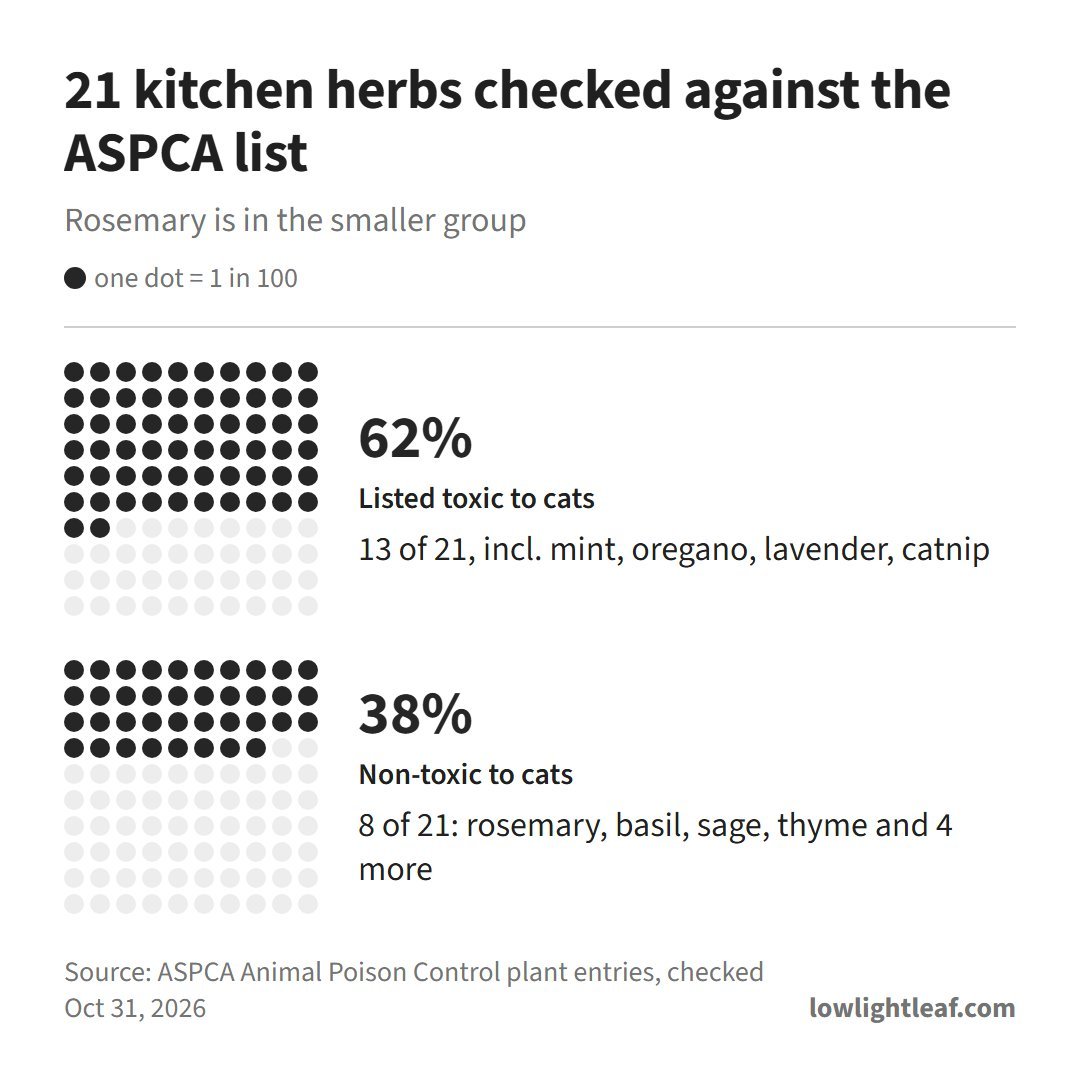
Rosemary is in the minority. I looked up 21 common kitchen herbs on the ASPCA list, and 13 of them are listed as toxic to cats, including some that get planted right next to rosemary. The signs the ASPCA gives for most of them are mild stomach upset; the onion family is the exception.
| Herb | ASPCA listing for cats | Signs the ASPCA lists |
|---|---|---|
| Rosemary | Non-toxic | None listed |
| Basil, sage, thyme | Non-toxic | None listed |
| Cilantro, fennel, lemon balm | Non-toxic | None listed |
| Dill | Non-toxic | Skin irritation with prolonged contact |
| Mint | Toxic | Vomiting and diarrhea with large amounts |
| Oregano, marjoram, tarragon | Toxic | Vomiting and diarrhea, mild |
| Lavender | Toxic | Nausea, vomiting, loss of appetite |
| Bay laurel | Toxic | Vomiting, diarrhea; whole leaves can cause a blockage |
| Parsley | Toxic | Sun sensitivity, only after large amounts |
| Chamomile | Toxic | Vomiting, diarrhea, skin irritation |
| Lemongrass | Toxic | Stomach upset |
| Chives, garlic, onion | Toxic | Vomiting and damage to red blood cells (anemia) |
| Catnip | Toxic | Vomiting and diarrhea; sedation or excitement |
Two entries surprise people. Catnip is on the toxic list: the ASPCA says many cats love it but it can cause vomiting and diarrhea, so it’s a treat in small amounts, not a plant to leave out for grazing. And chives belong to the onion family, the one group in this table where the ASPCA lists blood damage rather than a stomach reaction. Keep chives, garlic and onions well out of reach.
For anything not in the table, the site’s plant toxicity checker looks up a plant by common or botanical name.
Growing rosemary where a cat can reach it
Rosemary is a sun plant, which is the real problem for most indoor growers. UF/IFAS says indoor rosemary should be kept in full sun and turned weekly so every side gets light. I spent years in a north-facing apartment, and a north windowsill gives far less than full sun, so indoors in a room like that, rosemary needs a grow light. If that’s your situation, grow lights for indoor plants covers distance and hours.
For a cat household, the practical setup is simple. Keep rosemary in a heavy pot that won’t tip, and let the soil dry between waterings as UF/IFAS advises; wet soil is what kills potted rosemary indoors. Don’t put the toxic herbs from the table in the same windowsill box, because a cat that’s allowed to chew the rosemary won’t stop to read labels.
Signs to watch and who to call
After a cat eats fresh rosemary, a single vomit is the most you’d expect. After contact with rosemary essential oil, Merck lists the common signs as vomiting, drooling, lethargy, wobbliness and loss of appetite, and after breathing a diffused oil, watery eyes and nose, coughing or wheezing. Those signs from oil exposure are a reason to call a vet the same day.
If oil got on the coat, keep the cat from grooming it off and call. You can also reach ASPCA Animal Poison Control at (888) 426-4435. Have the product name and, if you can, the bottle with you when you call.
Is rosemary safe for cats? FAQ
Is dried rosemary safe for cats?
Dried rosemary is the same plant the ASPCA lists as non-toxic, so a pinch in food or a few dried needles on the floor is not a poisoning risk. Cooked dishes are a different matter: a recipe with rosemary often also has garlic or onion, which are toxic to cats.
Is rosemary safe for cats to smell?
A rosemary plant in the room is safe for cats to smell. The scent of a living or dried plant is not concentrated oil. Diffused rosemary oil is different: Merck says active diffusers leave oil droplets on fur and inhaled oils can irritate airways, especially in cats with asthma.
Is rosemary safe for dogs?
Yes. The ASPCA lists rosemary as non-toxic to dogs as well as cats and horses. The same caution about concentrated essential oils applies to dogs, according to Merck, though dogs don’t share the cat’s liver enzyme gap.
So keep the rosemary, and keep the oil bottle in a cupboard. The herb a cat is more likely to get in trouble with is the one in the next pot over.

Ellie Marsh
Houseplant grower who spent years in a north-facing apartment. Writes practical care guides for low light homes, checked against extension and botanical garden sources.