Last updated on November 6, 2026
No. The ASPCA’s poison control entry for the money tree, Pachira aquatica, marks it non-toxic to cats, dogs and horses and names no toxic principle. The same entry still mentions nausea, vomiting and loose stool, so a cat that eats a lot of leaf can get a sore stomach.
So is money tree toxic to cats in your house? Which plant came home with the label decides it. The money name also gets used for jade and for pothos, and ASPCA counts both of those as toxic to cats. A botanical name on the tag settles it faster than the common name does.
Is money tree toxic to cats? It depends which plant you have
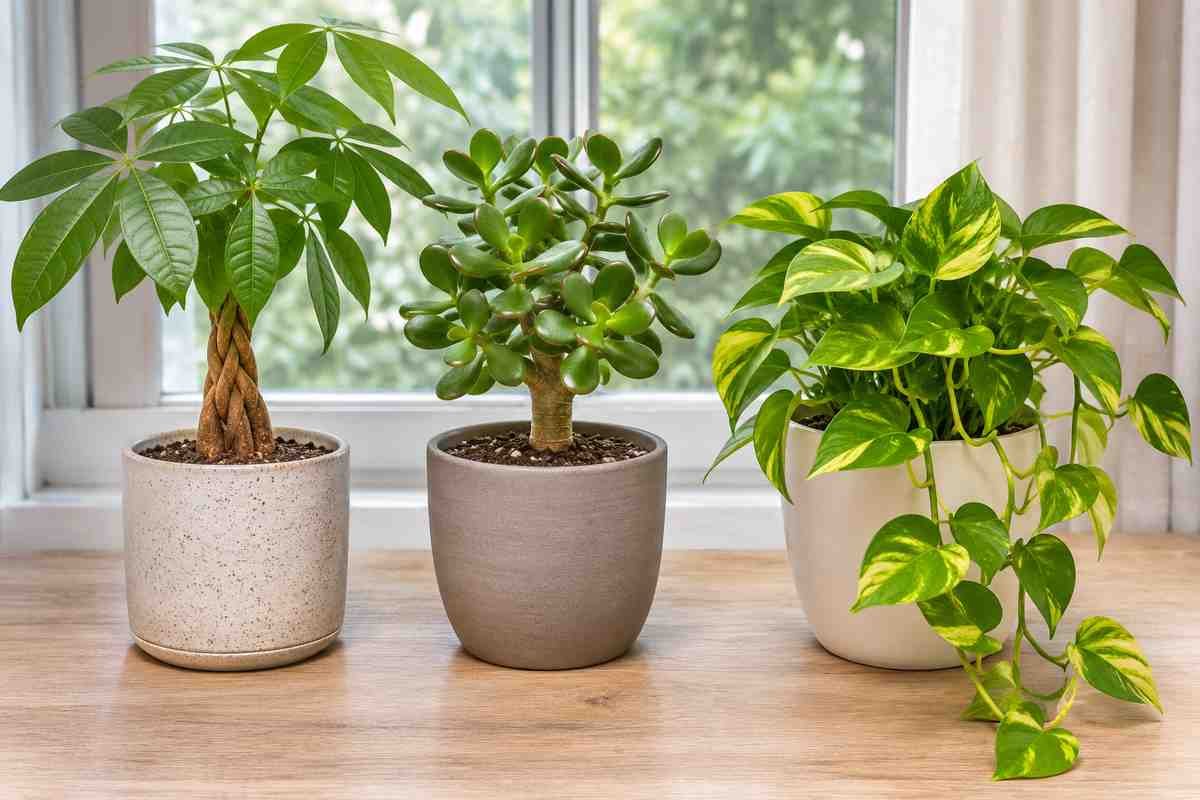
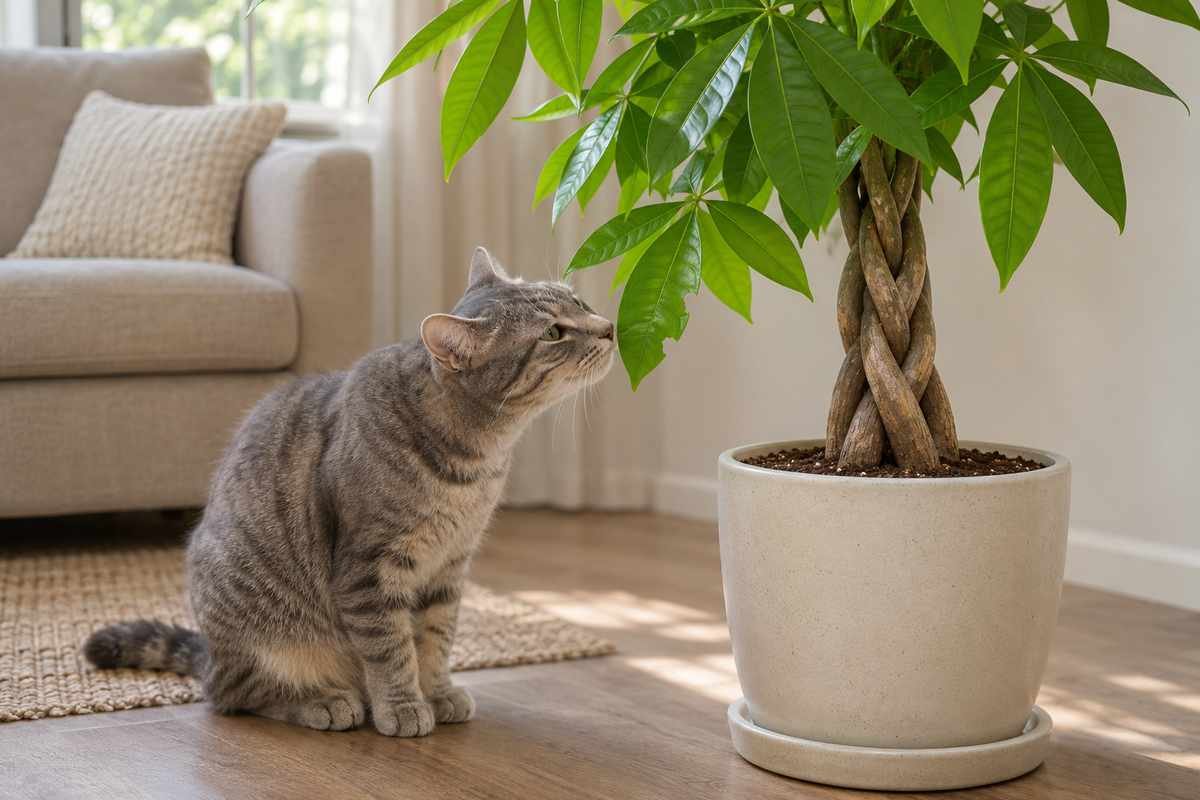
A true money tree is Pachira aquatica, the one usually sold with several trunks braided together and glossy leaves spread like an open hand. If the tag says Pachira, you have the plant the ASPCA rates as non-toxic for cats.
A braided trunk is a hint, not proof. One r/houseplants reply put it plainly: “They don’t naturally braid. A human has spent time braiding the ones you see in a store.” NC State Extension traces the braiding of seedling stems back to Taiwan, where the plant became popular in the 1980s as a luck and prosperity plant.
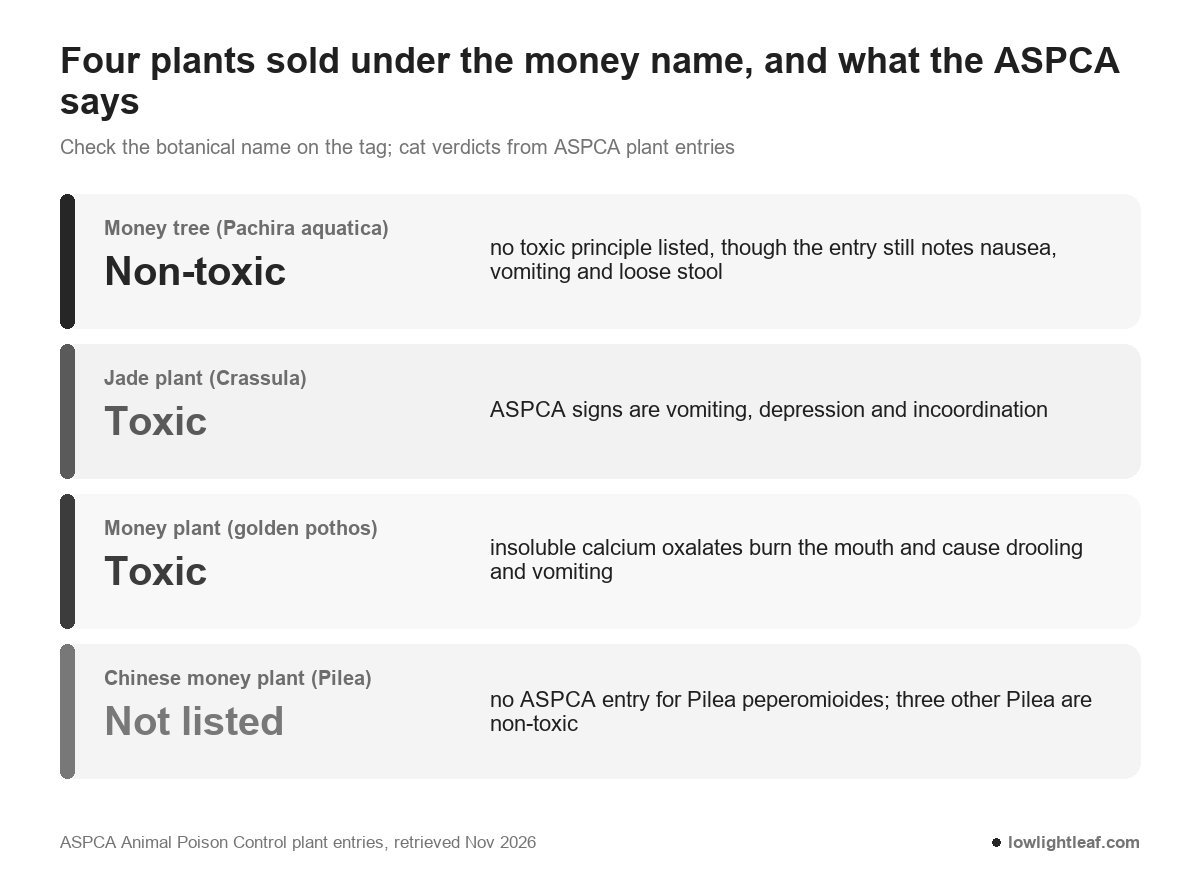
Here is how the four usual suspects compare, going by ASPCA entries:
- Money tree, Pachira aquatica: non-toxic. Toxic principle listed as none. Possible signs are mild: nausea, vomiting, loose stool.
- Jade plant, Crassula: toxic to cats. ASPCA files it under names like jade tree and Chinese rubber plant, and NC State Extension adds “Money Plant” and “Lucky Plant” to its common names. Signs are vomiting, depression and incoordination, and the toxic principle is listed as unknown.
- Golden pothos, Epipremnum aureum: toxic to cats. Some plant shops sell this trailing vine as a money plant. It contains insoluble calcium oxalates, which cause intense burning of the mouth, tongue and lips, heavy drooling, vomiting and trouble swallowing.
- Chinese money plant, Pilea peperomioides: not on the ASPCA list at all.
Jade has thick, rounded, fleshy leaves on a woody little trunk, so it looks nothing like a Pachira once you see them side by side. My page on succulents and cats has more on jade and its relatives. Pothos grows as a vine with heart-shaped leaves, and the full breakdown is on pothos and cats.
Is a Chinese money plant safe for cats?
ASPCA has no entry for the Chinese money plant, Pilea peperomioides, so there is no official cat verdict for that exact species. Three of its relatives are on the list as non-toxic to cats: the aluminum or watermelon plant (Pilea cadierei), the artillery plant (Pilea microphylla) and the friendship plant (Pilea involucrata).
Those entries point in a reassuring direction, but a relative’s entry is not the plant’s own entry. If your cat chews a pilea and seems off, call a poison line rather than assuming it’s covered.
What happens if a cat chews a real money tree?
A cat that chews a real money tree will most likely be fine, or have a mild stomach upset. ASPCA lists no toxic compound in Pachira aquatica, and the signs its entry mentions are nausea, vomiting and loose stool.
Leaf damage is usually the bigger casualty. In one r/houseplants thread, a new owner described the plant a friend handed over:
“My friend gave me this money tree that seems healthy but kind of out of control. Any tips for care?? Her cats chewed it which is why some of its leaves look rough. Despite the photo I do not plan on allowing my cats to continue that habit.”
– r/houseplants, May 2026 (99 upvotes)
NC State Extension adds one wrinkle. Its plant toolbox, a separate source from the ASPCA, gives Pachira “low severity poison characteristics” and notes that some sources consider the seeds potentially toxic because they contain cyclopropenoid fatty acids. Those seeds sit inside a large woody capsule. NC State also says the tree will not flower indoors or if braided, so a braided living-room plant isn’t going to drop nuts for a cat to bat around. Leaves are what a house cat can actually reach.
When to call a vet or a poison line
Call when you aren’t sure the plant is a Pachira, when the cat ate a large amount, or when vomiting or diarrhea keeps going instead of settling. Drooling, pawing at the mouth or trouble swallowing points away from a money tree and toward a pothos, since those are the calcium oxalate signs.
ASPCA Animal Poison Control answers at (888) 426-4435. Have the plant or a photo of the tag in front of you when you call, because the first thing they need is the name.
Is a money tree safe for dogs too?
Yes. ASPCA marks Pachira aquatica as non-toxic to dogs as well as cats and horses, with the same mild caveat about nausea, vomiting and loose stool if a dog eats a lot of it.
Dogs run into the same naming problem. Jade and golden pothos are both on the ASPCA list as toxic to dogs too, so a dog household needs the same look at the tag.
Keeping a money tree where a cat can’t wreck it
Because it is safe, a money tree is one of the easier tall plants to keep in a cat home. Most of the work goes into protecting the plant from the cat rather than the other way around. My cat Miso is the reason I look every plant up on the ASPCA list before it comes home, and Pachira is one I don’t have to move out of reach for her sake.
A few things help the plant survive a curious cat:
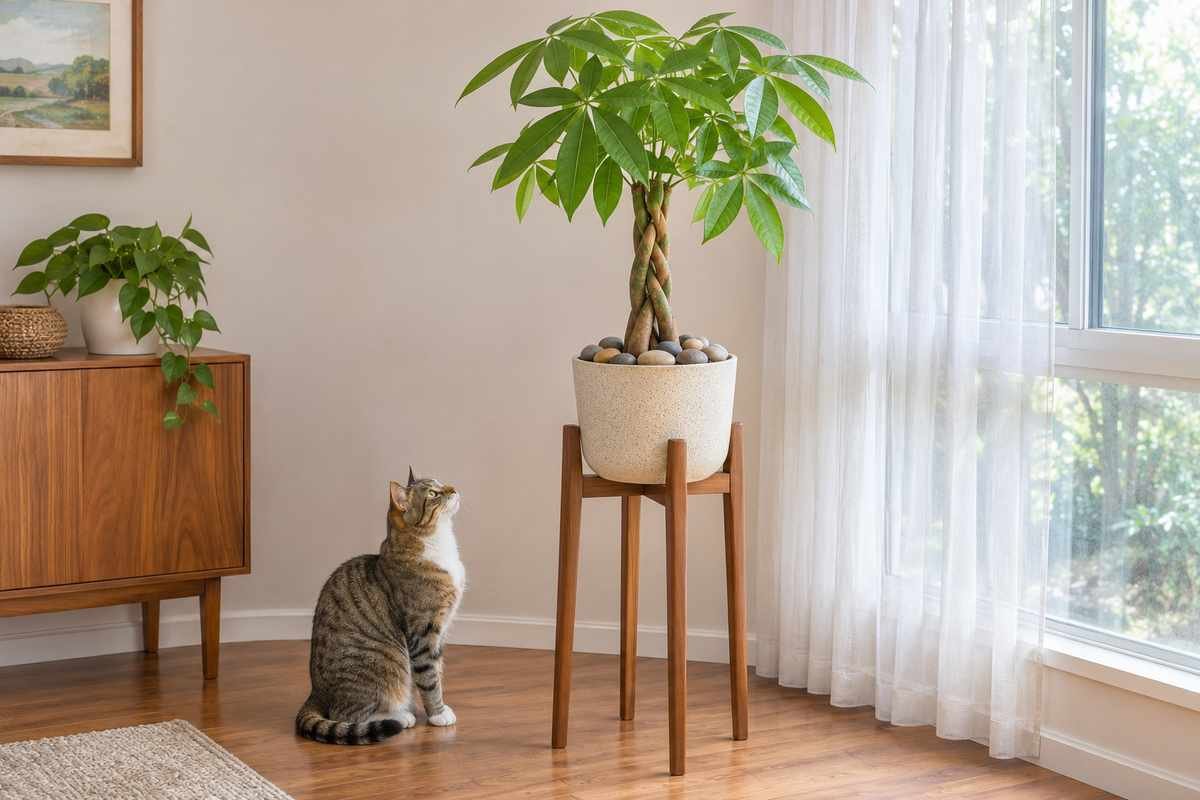
- Put it on a stand or a sill the cat can’t use as a launch pad, close to a window. NC State says a money tree prefers indirect sun or a mix of sun and shade, and direct sun can scorch the leaves.
- Trim chewed or torn leaves back to healthy growth. They won’t repair themselves.
- Give the cat its own chewing option, such as a pot of cat grass, in a spot that is easier to reach than the tree.
- Water when the top of the soil dries, and empty the saucer. NC State says Pachira does not tolerate standing water and can get root rot, while soil that stays too dry causes leaf drop.
A cat digging in the pot is a separate nuisance from chewing. A layer of large stones over the soil, or a cover that fits around the trunks, keeps paws out and keeps the soil from ending up on the floor.
If you are building a whole shelf of cat-safe plants, the plant toxicity checker lets you look up each one by common or botanical name before you buy. Pachira is in there, and so are the jade and pothos that borrow its name.
If there’s no tag at all, compare the leaves before deciding the plant is safe: hand-shaped leaves on braided trunks mean Pachira, fleshy round leaves mean jade, and a vine with heart-shaped leaves means pothos. If it is a Pachira, the money tree plant care guide covers light, water and the root-band check.

Ellie Marsh
Houseplant grower who spent years in a north-facing apartment. Writes practical care guides for low light homes, checked against extension and botanical garden sources.