Last updated on November 6, 2026
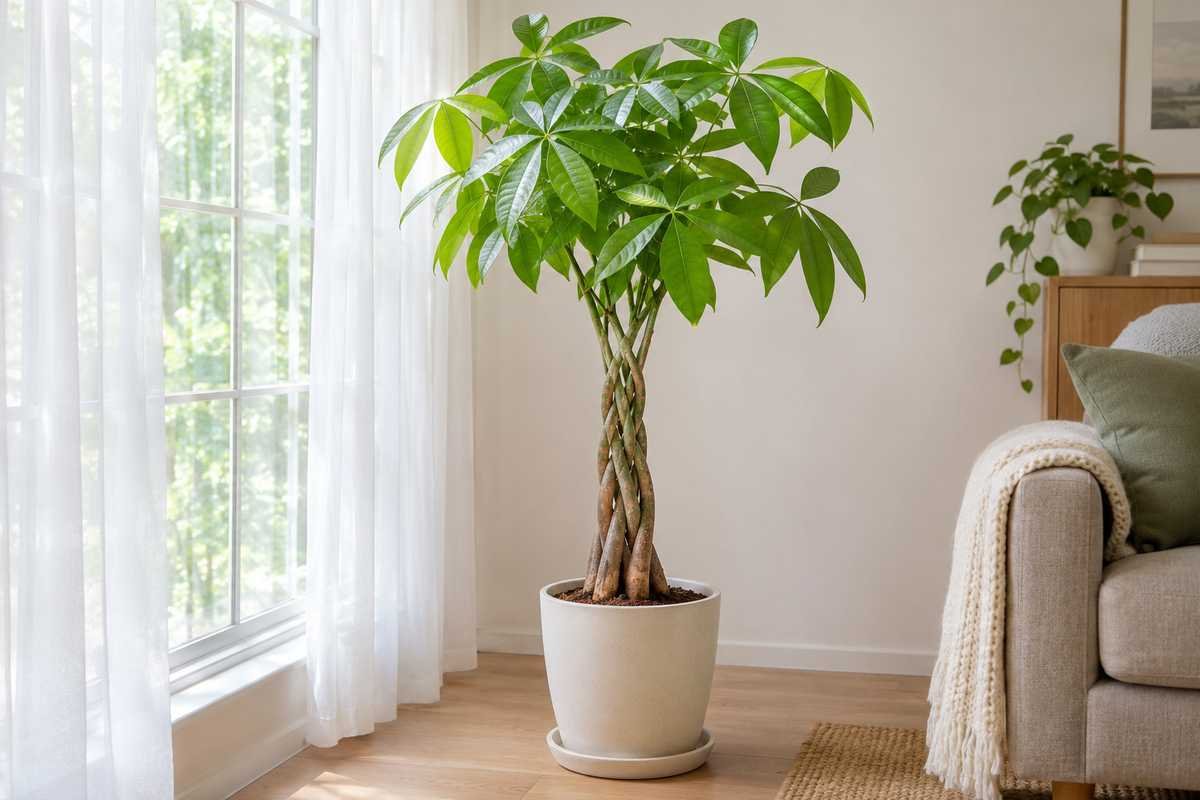
A money tree plant (Pachira aquatica) does best in indirect light or a mix of sun and shade, in a moist but well-drained pot that never sits in water, at 65-75°F with some humidity. It’s forgiving, it tells you what’s wrong through its leaves, and the ASPCA lists it as non-toxic to cats and dogs.
Many money trees are sold with braided trunks. A few checks in the first week save a lot of guessing later.
What is a money tree plant?
The money tree is Pachira aquatica, a tropical tree in the mallow family that NC State Extension says is native from southern Mexico to Bolivia and northern Brazil, where it grows in freshwater swamps and along riverbanks. It can reach 60 feet in the wild but usually stays at 6 to 8 feet as a houseplant.
Is the money tree a money plant? Both the ASPCA and NC State list “money plant” as another common name for Pachira aquatica. Other plants get sold as money plants too, so the scientific name on the tag is the one to trust.
Why is it called a money tree? According to the NC State Extension plant toolbox, the tree became popular in Taiwan in the 1980s and was valued in feng shui for bringing prosperity. The name comes from a tale about a poor man who got rich selling its nuts. Braiding the young stems also started in Taiwan, as a way of “locking in” luck.
The good-luck benefits are a belief, not something a plant guide can measure. What the braid does do is shape care, which comes up below.
Money tree plant care at a glance
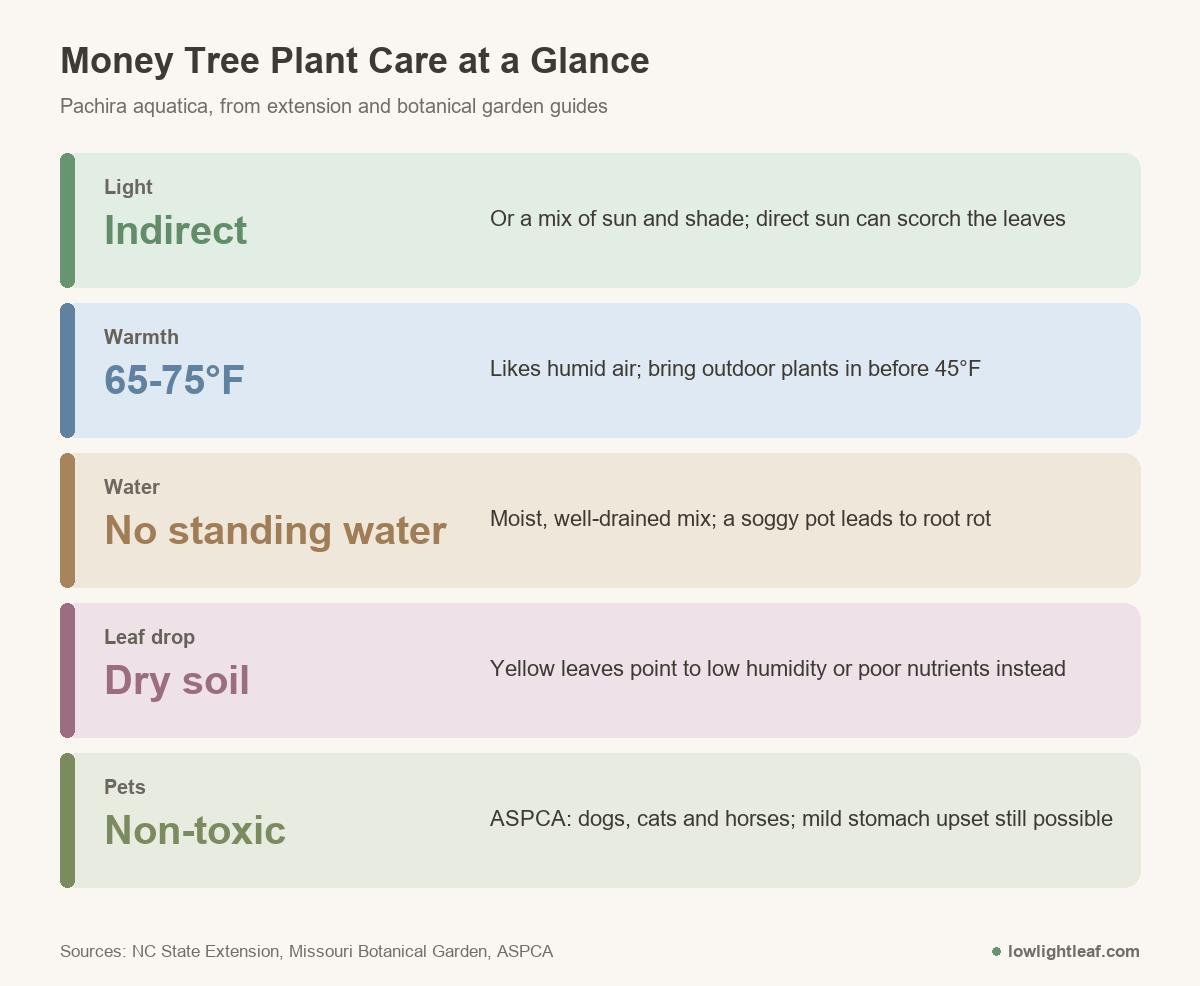
Light. NC State says the money tree prefers indirect sunlight or a mix of sun and shade, and that direct sun can scorch the leaves. The Missouri Botanical Garden recommends bright light indoors. NC State also tags it as shade tolerant, which is why it shows up on so many low-light lists.
Shade tolerant doesn’t mean dark-corner tolerant. In my north-facing apartment I’d give it the brightest spot available, and a grow light if that spot is across the room from the window. The DLI calculator can tell you whether a spot gets enough light before you move the plant.
Water. Keep the mix evenly moist but never soggy. NC State says standing water isn’t tolerated and causes root rot, and both NC State and MBG say leaves drop when the soil dries out too far. That narrow band is the whole trick: keep it evenly moist, as MBG puts it, and always empty the saucer.
Soil. NC State suggests a moist, well-drained potting mix of peat moss, perlite, loam or sand. A pot with drainage holes matters more than the exact recipe.
Temperature and humidity. It thrives at 65 to 75°F in humid air, per NC State, and it’s hardy only in USDA zones 10 to 12. If yours spends summer outside, bring it in before nights drop to 45°F. Low humidity is one of the two causes NC State gives for yellow leaves, and the guide to raising humidity in the house covers what actually helps.
Check the roots in the first week
The braid isn’t always the only thing holding the trunks together. In an r/houseplants thread from a first-time owner, the top reply was short:
“Remove the rubber bands at the roots!”
– r/houseplants (317 upvotes)
Another reply in the same thread explained why:
“If you take your money tree out of the nursery pot there may be a band, or mesh, around the roots from commercial propagation. If so, you want to remove this because it restricts root expansion which can eventually harm your plant”
– r/houseplants (173 upvotes)
I didn’t find an extension source on root bands, so treat this as grower experience rather than a rule. It’s a cheap check, though:
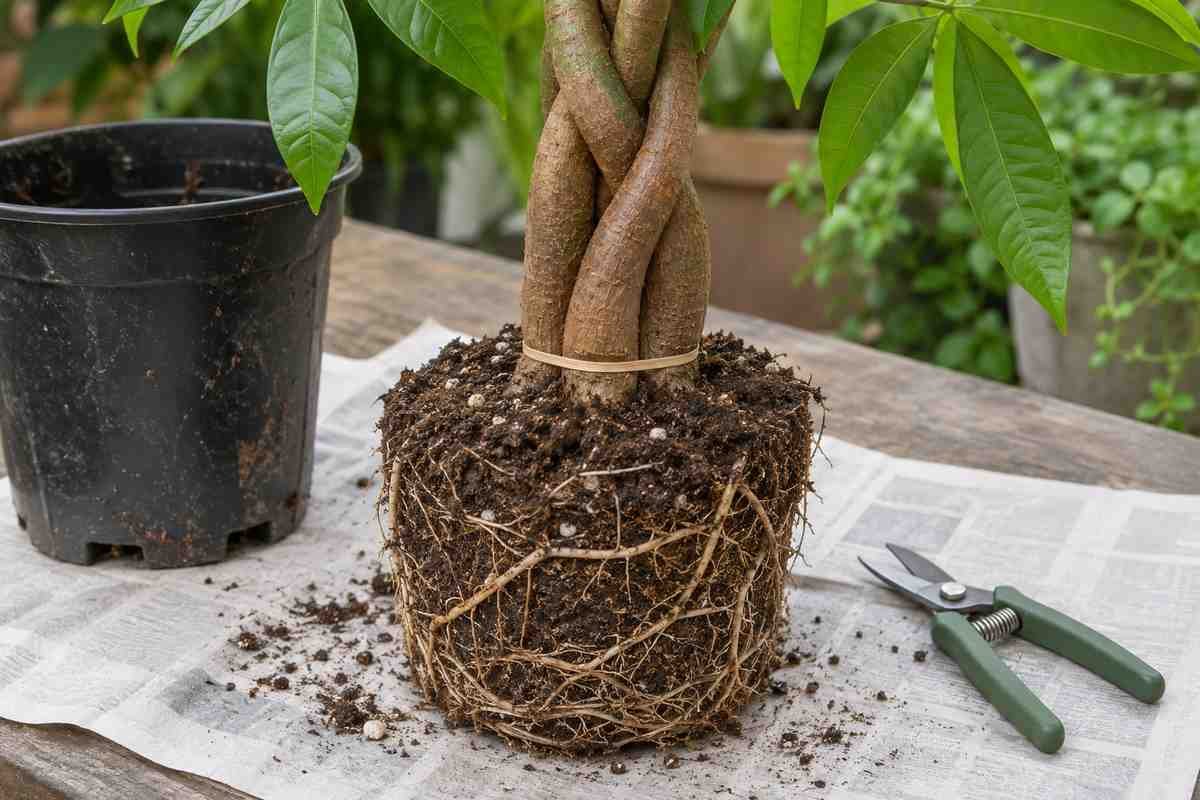
- Slide the plant out of the nursery pot.
- Look just under the soil line and around the root ball for a rubber band, tie or mesh sleeve.
- Cut it away carefully without nicking the roots.
- Pot it back into fresh, well-drained mix in a pot with drainage holes.
Why is my money tree dropping leaves?
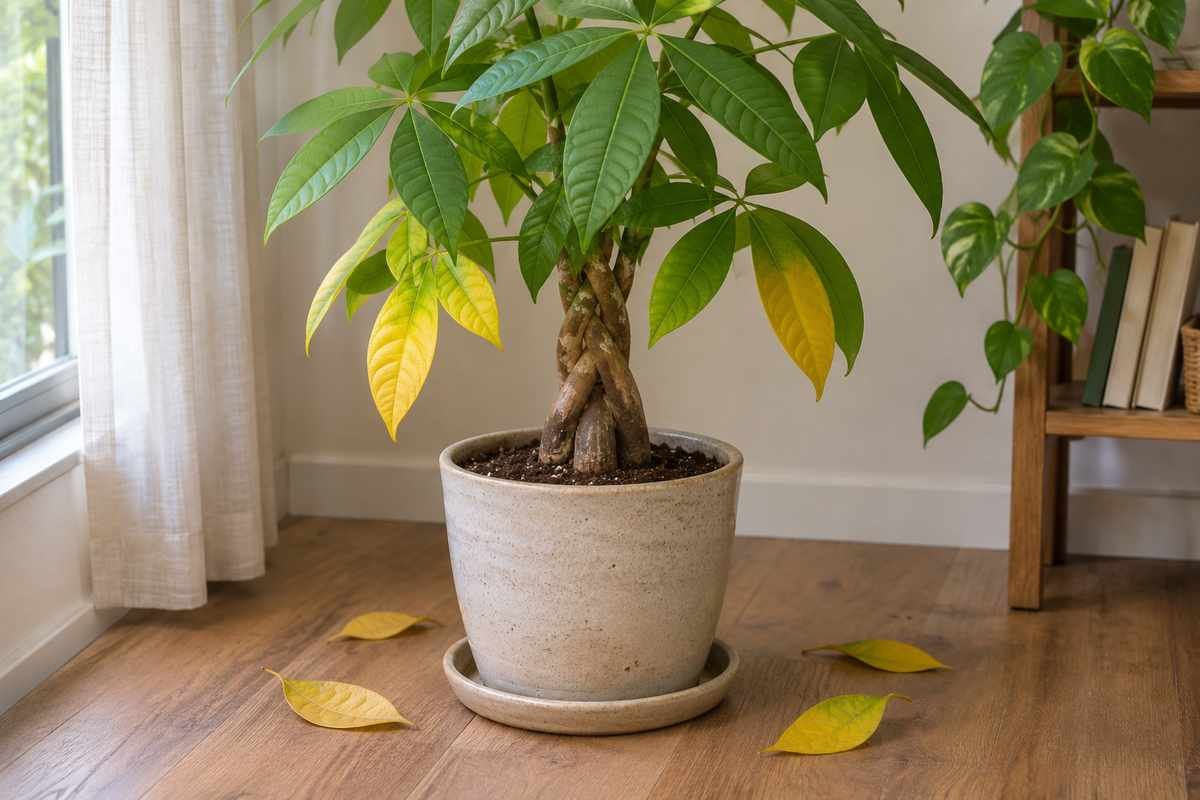
A money tree usually drops leaves because the soil dried out too far, according to both NC State and the Missouri Botanical Garden. Yellow leaves point to a different cause: NC State links them to low humidity or a lack of nutrients in the soil. If the pot has been sitting in water, root rot is the third suspect.
It’s a common complaint on r/houseplants, including from one owner whose tree loses a branch every time a new one grows.
If the drop is steady rather than occasional, check the three causes in order: how dry the mix gets between waterings, how dry the air is, and whether the pot drains. The guide to why plant leaves turn yellow goes through the same checks in more detail.
Pests and disease. NC State lists aphids, mealybugs, scale and fungus gnats, plus anthracnose, powdery mildew and root rot. MBG says it has no serious insect or disease problems. If gnats show up, the guide to getting rid of fungus gnats walks through them.
Braids, flowers and propagation
The braid is decoration, and it has a cost. NC State says money trees grown outdoors flower in 4 to 5 years, but that they won’t flower indoors or if braided. I couldn’t find a source on keeping a braid going as the trunks thicken, so I won’t guess at it.
For new plants, NC State lists softwood cuttings, layering and seed. Cuttings are the route most indoor growers have access to, since an indoor tree won’t produce seed.
Is a money tree safe for cats and dogs?
Yes. The ASPCA money tree entry lists Pachira aquatica as non-toxic to dogs, cats and horses, with no toxic principle. Its entry still mentions nausea, vomiting and loose stool, so a pet that eats a lot of leaves may get an upset stomach.
NC State adds a narrower note: some sources say the seeds may be toxic, and it gives the plant a low-severity poison rating. Indoor trees rarely flower, so seeds aren’t usually around. Not every plant sold under the money name is this safe, and is money tree toxic to cats sorts them by botanical name.
My cat, Miso, is the reason every plant gets checked against the ASPCA list before it comes inside, and the money tree passes. If you’re filling a dim room with pets in mind, the plant toxicity checker covers more than a hundred houseplants with the same ASPCA verdicts.
Give a money tree bright, indirect light, a pot that drains, steady warmth and humid air. When something’s off, the leaves will usually tell you which of those slipped.

Ellie Marsh
Houseplant grower who spent years in a north-facing apartment. Writes practical care guides for low light homes, checked against extension and botanical garden sources.