Chinese evergreen care is mostly about matching the plant to your light: the solid green kinds grow in low light, while red, pink and heavily variegated ones need low to moderate light, according to Clemson Extension. Water when the top inch or two of soil is dry, and keep it above 55°F.
That makes Chinese evergreen care easy in a dim room, with one catch worth knowing before you buy. The often-quoted claim that Aglaonema survives on 10 foot-candles comes from a guide about growing plants under lamps, and the conditions behind that number matter more than the number.
How much light does a Chinese evergreen need?
A Chinese evergreen needs low to moderate indirect light and no direct sun on its leaves, which is how Clemson’s Chinese evergreen fact sheet puts it. Clemson defines low light as indirect or heavily shaded indoor areas, and moderate light as bright and indirect.
The number you’ll see repeated is 10 foot-candles. University of Missouri Extension’s guide to lighting indoor houseplants does say aglaonemas “can tolerate light as low as 10 foot-candles,” but the sentence sits in its list of plants for growing under artificial light. The same guide says plants that get no outdoor light should be lit 16 to 18 hours a day, and that low-light plants generally should receive 50 to 250 foot-candles. Ten is a floor under lamps that run most of the day, not a target for a corner six feet from a north window.
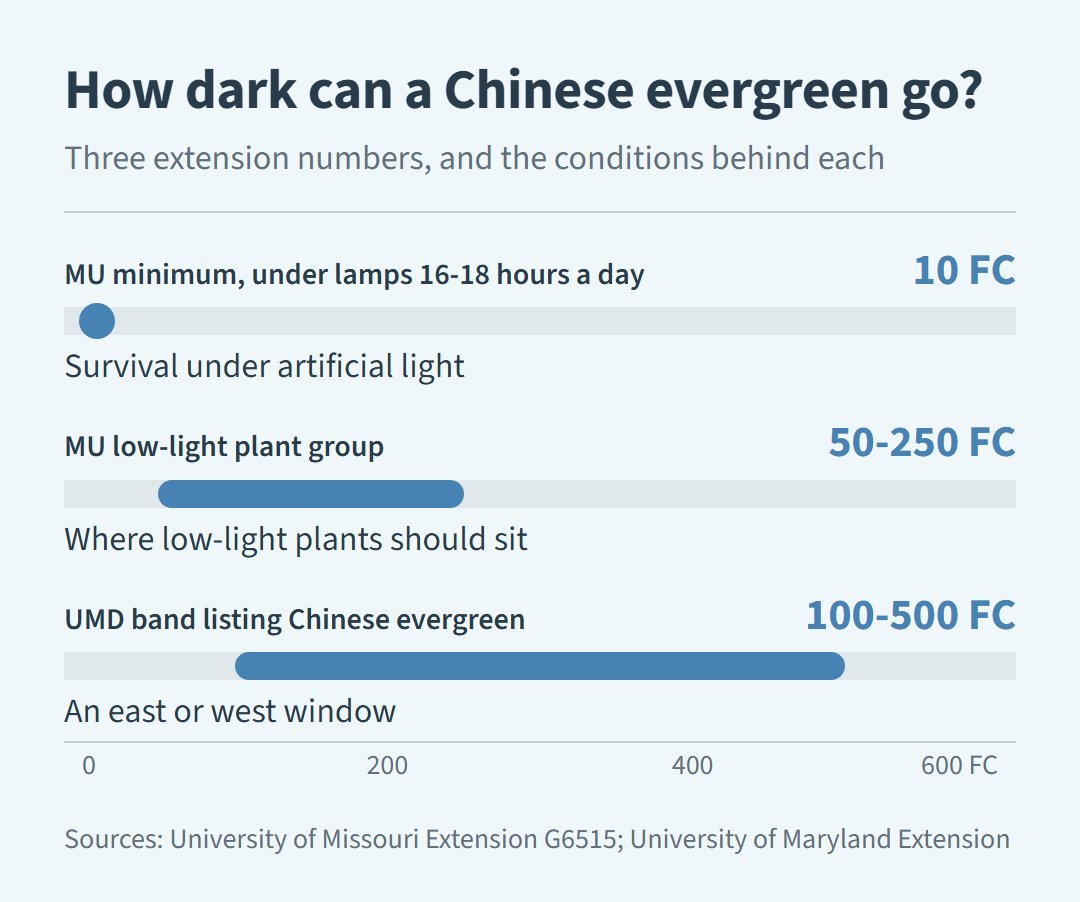
University of Maryland Extension goes the other way. Its footcandle table lists Chinese evergreen in the medium-bright band, 100 to 500 foot-candles, the light of an east or west window. NC State Extension calls it an excellent plant for low-light indoor spots but adds two costs: houseplants may not flower when light is low, and the plant tends to get leggy with age as the stem grows.
So a dim room is fine for survival, and a brighter one is better for growth. If you want to know where your spot falls, take a reading at leaf height with a phone light meter and run it through the DLI calculator. I spent years in a north-facing apartment, which is exactly the kind of room where a reading is worth taking before you buy.
Which Chinese evergreen handles the least light?
The green and silver Chinese evergreens handle the least light, and the red, pink and white ones need more. Clemson draws that line by leaf color.
Two plant guides agree. Proven Winners, which sells a line of them, notes that variegated cultivars do best in medium indirect light to keep their color, and The Green Mad House writes that colorful varieties live in lower light but can lose some color definition.
Sorted by leaf color, here is how I’d place them. The three groups are my reading of Clemson’s green-versus-variegated split, not a scale Clemson publishes.
- Darkest rooms: solid green or silver-marked types. Clemson singles out pewter plant (Aglaonema crispum), a 3- to 4-foot species with silvery markings, as tolerating very low light.
- Low to moderate light: patterned green leaves. Ribbon aglaonema (A. commutatum), with gray markings along the veins, is variegated, so Clemson’s low-to-moderate range applies.
- Brighter spots: red, pink and white leaves. Clemson’s list includes ‘Cherry’, whose leaves turn pink as they mature, and red-edged hybrids such as ‘Red Edge’ and ‘Red Emerald’. Give these an east window or a grow light.
For other plants that handle the same dim corner, low light indoor plants compares the darkest-room options, and cast iron plant care covers the one Missouri calls among the best where only low light exists.

Watering and soil
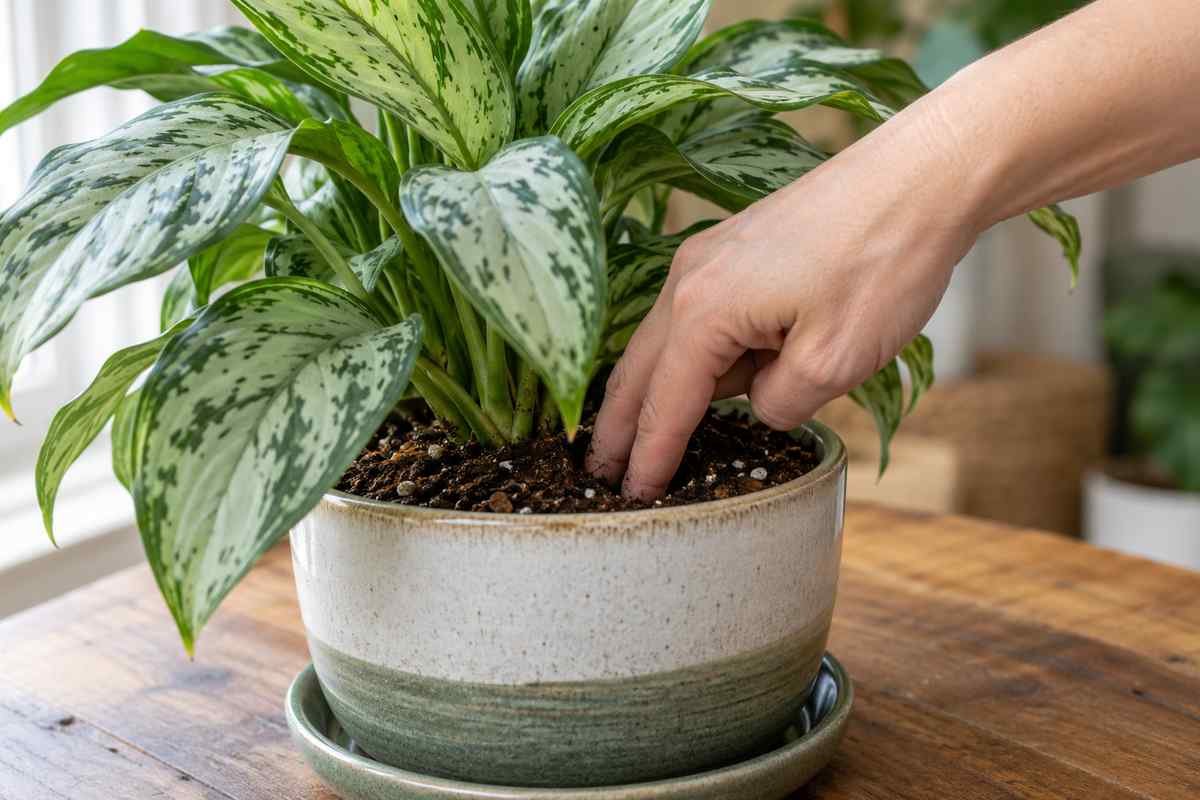
Water a Chinese evergreen when the top 1 to 2 inches of soil are dry. Clemson’s test is to push two fingers into the soil: dry means it’s time to water, and cold and damp means wait. Clemson asks for room-temperature water, and NC State warns against cold water specifically.
NC State says to keep the mix moist from spring to fall and water less in winter; the plant needs no dormancy period. Clemson recommends a standard soilless mix with extra humus in a pot with drainage holes, because root rot usually comes from a mix that drains slowly or from overwatering. In a dim room the soil dries more slowly, so the finger test matters more than any schedule.
Temperature, humidity and feeding
Chinese evergreens prefer 68 to 80°F and tolerate as low as 55°F, Clemson says. Below 50°F, they chill. NC State adds that the leaves may turn brown in very dry air or a drafty spot, so a pot right beside an exterior door that opens all winter, or blasted by a heating vent, is in the wrong place. Average household humidity is enough, per Clemson; if winter air gets very dry, how to increase humidity in the house covers what helps.
On feeding, neither extension sheet gives a schedule, and Clemson’s only warning is that excessive fertilizer burns the leaf edges. Proven Winners suggests an all-purpose liquid fertilizer once a month in spring and summer and none in fall and winter.
Common Chinese evergreen problems
Most Chinese evergreen problems trace back to light, water or cold, and the symptom usually tells you which. The extension sources sort them this way:
- New leaves smaller than the old ones: usually too little light. A reply in r/plants made that call for an owner whose plant kept shrinking (quoted below).
- Long bare stem with leaves only at the top: NC State says the plant gets leggy with age as the stem grows. The fix is in the next section.
- Yellow, soft leaves and wet soil: overwatering and root rot (Clemson, NC State). Let the mix dry and check that the pot drains.
- Brown, crispy edges: too much fertilizer (Clemson), or dry air and drafts (NC State).
- Sticky residue, cottony clumps or fine webbing: pests. Clemson names mealybugs, aphids, scales and mites; how to get rid of mealybugs covers the most common one.
- White powder on leaves: powdery mildew, which Clemson says can show up in high humidity.
“That happens when they aren’t getting enough light, which is usually why the new leaves come in so tiny. The curling and crispy bits also seem like low humidity, inconsistent watering, or being rootbound. I’d check the roots, move it closer to a brighter window, and make sure it’s getting a regular drink.”
– r/plants, September 2026 (2 upvotes)
If yours flowers, NC State suggests removing the flowers and the red berries that follow, so the plant puts its energy into leaves.
Propagating and fixing a leggy Chinese evergreen
The simplest fix for a leggy Chinese evergreen is to root its top. Clemson notes that when the bottom leaves have shed and the lower stem is bare, the top can be removed and rooted. That gives you a compact plant again, and the old stem can stay in the pot.
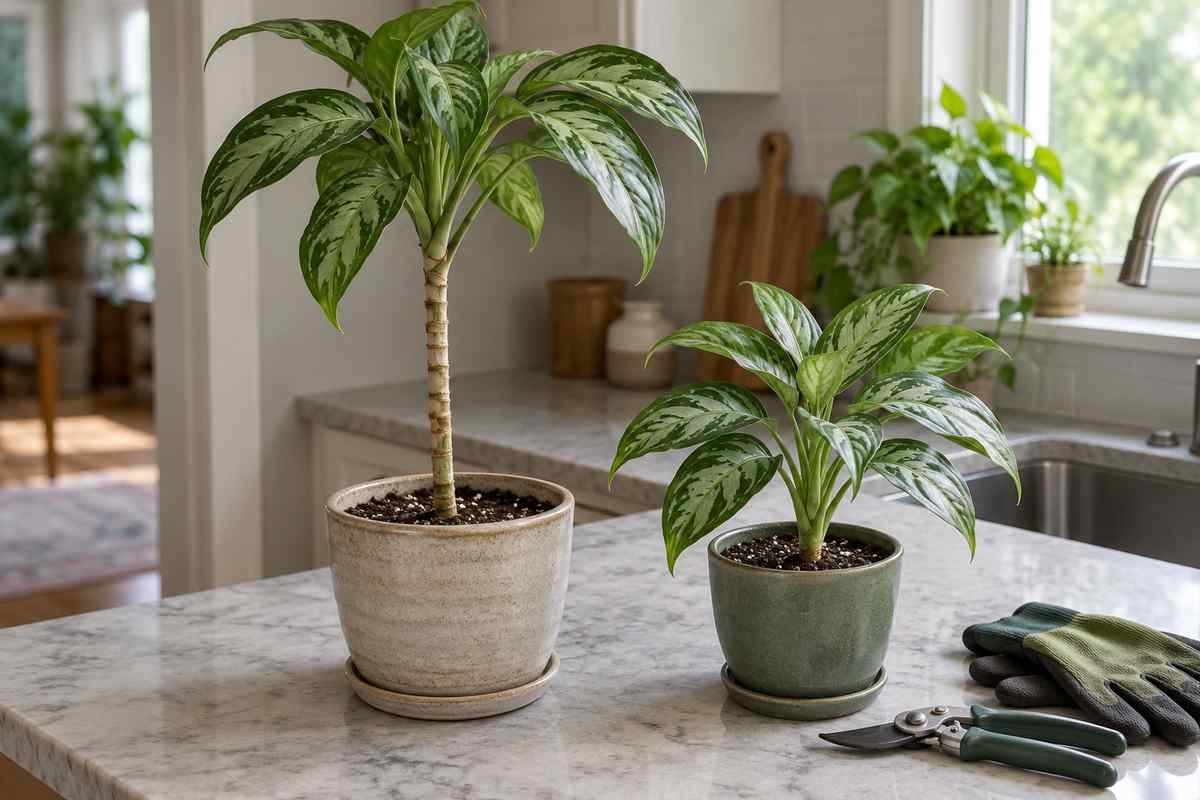
Clemson lists division, stem cuttings, tip cuttings, air layering and seed as ways to propagate it. The Green Mad House calls division the best way to propagate it, and one r/houseplants reply described how it goes:
“If you take it out of the dirt, you’ll be able to see where there are separate root systems. I cut the solid ones with heavy duty branch trimmers last time to split them, everyone recovered fine. They are hardier than you’d think.”
– r/houseplants, April 2026 (2 upvotes)
Proven Winners says the sap can irritate skin, so wear gloves when you cut.
Is Chinese evergreen toxic to cats and dogs?
Chinese evergreen is toxic to cats, dogs and horses, according to the ASPCA, because it contains insoluble calcium oxalates. The signs the ASPCA lists are oral irritation, pain and swelling of the mouth, tongue and lips, heavy drooling, vomiting and difficulty swallowing.
NC State rates its poison severity as low, but I still keep plants like this out of my cat Miso’s reach. If a pet chews one, call your vet or the ASPCA Animal Poison Control Center at (888) 426-4435; a consultation fee may apply. The plant toxicity checker lists safer options.
Can Chinese evergreen grow outside?
Chinese evergreen grows outside year-round only in very warm climates: NC State’s entry for ribbon aglaonema gives USDA zones 10b to 11b. Elsewhere, keep it indoors, since Clemson says it is sensitive to chilling below 50°F.
Chinese evergreen care FAQ
Where should I put my Chinese evergreen?
Put a green Chinese evergreen within a few feet of a north or east window, and a red or pink one at an east window or under a grow light. Missouri says north windows suit only low-light plants and east and west windows suit medium-light plants; north-facing window plants covers how close to set it.
Are Chinese evergreens hard to take care of?
Chinese evergreens are not hard to take care of, which is why Chinese evergreen care is a common first step for beginners. Clemson calls it one of the most durable houseplants, tolerant of poor light, dry air, air conditioning and drought; overwatering and cold are what usually kill it.

Ellie Marsh
Houseplant grower who spent years in a north-facing apartment. Writes practical care guides for low light homes, checked against extension and botanical garden sources.