Last updated on October 31, 2026
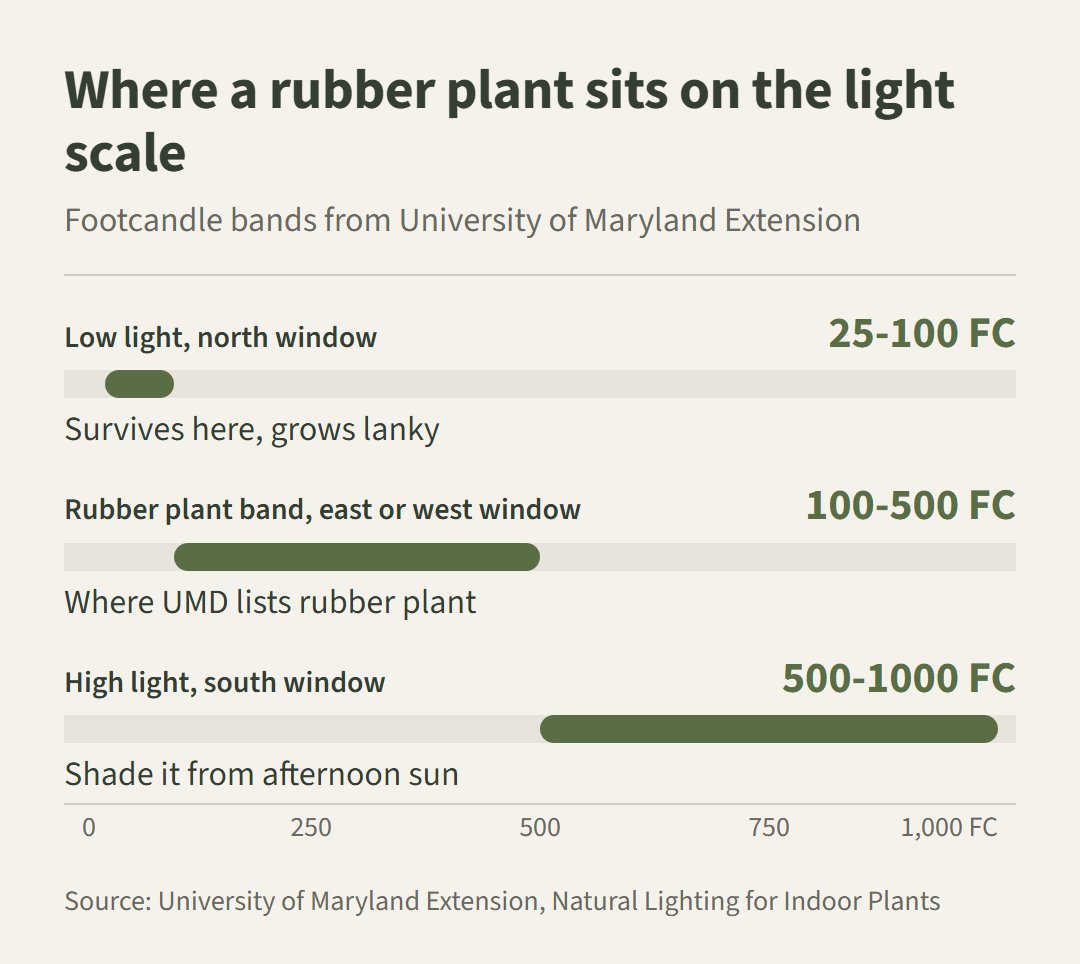
Rubber plant care comes down to medium-bright light, soil that dries slightly between deep waterings, and temperatures above 55°F. University of Maryland Extension places the rubber plant (Ficus elastica) in its 100 to 500 footcandle band, the light of an east or west window, and Clemson Extension says it grows best in morning light from an east window.
For a dim home, the part of rubber plant care that matters most is how far from that window it can go. Sources disagree on that. The light numbers and what a darker spot costs come first below, then water, pruning for a bushier shape, leaf drop, and pets.
How much light does a rubber plant need?
A rubber plant needs medium-bright light, which University of Maryland Extension puts at 100 to 500 footcandles, the range an east- or west-facing window gives. Maryland lists the rubber plant in that band, next to Chinese evergreen and dracaena, and puts true low light at 25 to 100 footcandles, the light of a north window or an artificially lit room.
Here is where the sources split. Clemson’s rubber plant fact sheet says rubber plants prefer bright light but adapt to low light, and NC State Extension’s plant toolbox says the species does best in partial shade or low light, with bright indirect light indoors. Joy Us Garden, written by a former interior plant professional, says the opposite: don’t try it in lower light at all.
They are closer than they sound. Clemson’s own fact sheet lists what low light costs: rubber plants may grow tall and lanky indoors, and too little light is one of the causes of leaf loss. So “adaptable” means it survives in a dim room, not that it keeps the full, glossy shape it had at the nursery. I lived for years in a north-facing apartment, and a plant from the medium band would have sat in the low band in every room I had.
If your spot is dimmer than you’d like, three things help:
- Measure first. A light meter app reading in footcandles, run through the DLI calculator, tells you which band your spot is really in. Under about 100 footcandles you are in Maryland’s low band.
- Pick the cultivar. Clemson singles out ‘Robusta’, with leaves up to 18 inches long, as good in low light. Gardener’s Supply notes that variegated rubber plants may lose their coloring if left in the dark too long.
- Add light rather than fight it. A plant on a timer under grow lights moves a dim corner up a band, and grow lights are what I lean on in my own dim rooms.
At the bright end, NC State recommends protection from afternoon sun indoors, so keep it back from a hot south or west window rather than pressed to the glass. If your only window faces north, north-facing window plants covers what grows there and how close to set it.
Watering, soil and feeding
Water a rubber plant thoroughly, then let the soil dry slightly to the touch before watering again, which is Clemson’s rule. The pot needs drainage holes, and Clemson says to empty the saucer after watering, because root rot usually comes from a mix that drains slowly or from watering too often.
NC State adds the seasonal part: water regularly but avoid overwatering, and cut back when the plant is dormant, from fall to late winter. Use a well-drained houseplant mix. Rubber plants prefer humid air, Clemson says, but they tolerate the dry air most homes have.
For feeding, Clemson recommends a water-soluble houseplant fertilizer every two weeks during active growth in spring and summer. Clemson’s next sentence matters more for a dim home: plants in lower light should be fertilized less often. A rubber plant in a dim spot grows slowly, so it uses less, and the full schedule only fits a plant in the 100 to 500 footcandle band.
Temperature, humidity and dusty leaves
Rubber plants like 60 to 65°F at night and 75 to 80°F by day, according to Clemson, which also says to avoid temperatures below 55°F, sudden drops, and cold drafts. NC State says they don’t do well with drafts or cold, so a spot by an exterior door or under an air conditioning vent is a poor one. If your air is very dry in winter, how to increase humidity in the house covers what helps.
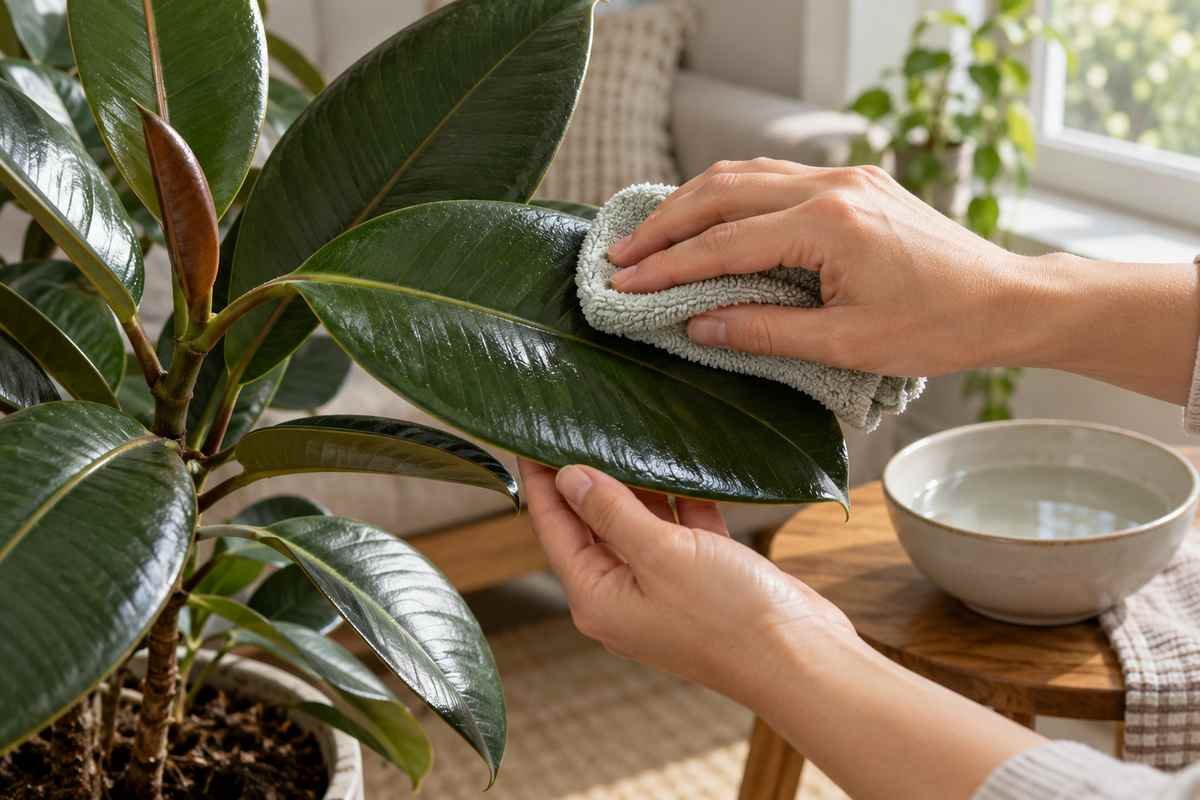
Those big leaves collect dust. NC State suggests wiping them with a damp soft cloth or sponge, and Clemson says washing them keeps the plant healthier as well as better looking. The top reply in an r/houseplants thread from a new rubber plant owner put the routine in three lines:
“Keep the leaves clean. Look for pests. Spider mites like them. Milky sap from leaves or cut stems will stain surfaces. Talk to it frequently and tell it how good looking it is.”
– r/houseplants, December 2025 (158 upvotes)
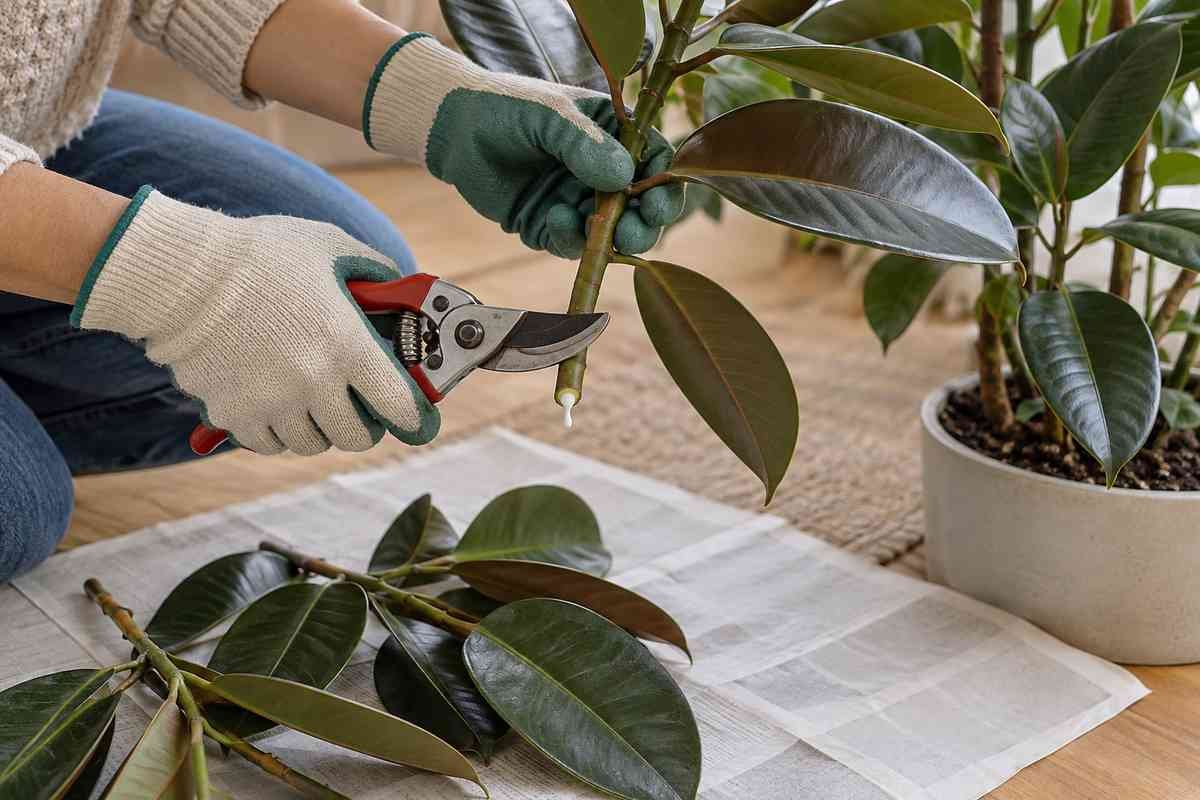
The sap warning is worth taking literally. Put down newspaper before you cut anything, and wipe your pruners afterward.
Pruning a rubber plant into a bushier shape
To make a rubber plant bushy, prune the main branches, which NC State says encourages a bushier habit; left unpruned, it grows into a tall, narrow, tree-like form. Clemson says spring is the time to prune, so the cut has the growing season to push new shoots.
- Wait until spring, and until a newly bought plant has settled in.
- Choose the stems that have grown too long. One r/houseplants reply quoted below suggests taking long branches down by about two-thirds.
- Cut each stem cleanly, with newspaper underneath for the dripping sap.
- Watch for side shoots below the cut during the growing season. Those are the branching NC State describes, and the sign the pruning worked.
“Take those long branches down by 2/3rds so they can branch and have good strong scaffolding. Then the next time take them 10” from the last cut, then you can keep the shape at a size you like but you’ll have 15 branches instead of 3.”
– r/houseplants, December 2025 (82 upvotes)
That is one grower’s method, not an extension rule, but it matches NC State’s point that pruning main branches is what makes it branch. If you’d rather not cut, the sources don’t offer another way to make it bushier. The alternative Clemson gives for a tall, lanky plant is a stake, which keeps the single-trunk shape upright.
Propagating a rubber plant
Clemson lists three ways to propagate a rubber plant: stem cuttings, tip cuttings, and air layering. Spring pruning gives you the cuttings, so the two jobs go together. Air layering grows roots on a stem while it is still attached to the plant; Joy Us Garden recommends it for substantial stems and says it takes about two months.
Why are my rubber plant leaves falling off?
Rubber plant leaves fall off for one normal reason and several problem ones. NC State says it is normal for some bottom leaves to turn yellow and drop. A reply in r/plantclinic said the same about an owner’s five-year-old plant:
“Some plants sacrifice a leaf when they’re growing. The plant drains all the nutrients from the leaf and then it will fall off. It’s normal.”
– r/plantclinic, December 2025 (33 upvotes)
More than the odd lower leaf points to a cause. Here is how the extension sources sort it:
- Yellow leaves, then drop: soil staying too wet (Clemson). Check drainage and the saucer.
- Sudden drop of green leaves: cold drafts or a temperature drop (Clemson, NC State).
- Slow loss with long bare stems: too little light (Clemson). See the light section above.
- Drop after a move: NC State says rubber plants prefer to remain in one location, so a plant just brought home or moved to a new room may shed some leaves.
- Sticky residue, cottony spots or fine webbing: pests. NC State names mealybugs, scale and spider mites; how to get rid of mealybugs covers the first.
Is a rubber plant toxic to cats and dogs?
Treat a rubber plant as toxic to cats and dogs. The ASPCA lists its “Indian Rubber Plant” as toxic to both, and Clemson warns that the sap irritates skin and the stomach.
The ASPCA listing is muddled, though. That “Indian Rubber Plant” entry gives the scientific name as Ficus benjamina, which is the weeping fig. There is no entry under Ficus elastica at all, and the weeping fig entry, which covers Ficus species broadly, lists gastrointestinal and skin irritation as the signs.
Clemson’s advice is plain: keep the plant away from pets and young children that chew plants. I check every plant against the ASPCA list because of my cat, Miso, and this one goes out of reach. Don’t confuse it with the baby rubber plant, Peperomia obtusifolia, which the ASPCA lists as non-toxic. The plant toxicity checker shows the ASPCA rows for both.
Can a rubber plant live outside?
A rubber plant can live outside year-round only in USDA zones 9a through 12b, the range NC State gives. Elsewhere it can spend summer outdoors in shade, but bring it in before nights drop below 55°F, Clemson’s floor, and expect some leaf drop from the move.
Rubber plant care FAQ
How hard is it to keep a rubber plant alive?
Keeping a rubber plant alive is easy; keeping it full is the harder part of rubber plant care. In a dim room it survives but grows lanky, so the plant that thrives is the one in 100 to 500 footcandles with soil allowed to dry slightly between waterings.
What are the downsides of having a rubber plant?
The downsides of a rubber plant are size, sap and leaf drop. Clemson says it can grow 6 to 10 feet tall indoors, the milky sap from cuts stains surfaces and can irritate skin, it tends to drop leaves after a move or a cold draft, and it belongs out of reach of pets.

Ellie Marsh
Houseplant grower who spent years in a north-facing apartment. Writes practical care guides for low light homes, checked against extension and botanical garden sources.