Last updated on August 21, 2026
Getting spider plant light requirements right sounds simple until you have to choose an actual spot in your home. Is the light near your window bright enough? Can the plant handle a few hours of direct sun? And does “low-light tolerant” really mean it will grow well in a dim room?
The answer is more practical than following a single rule. Spider plants respond differently to filtered window light, harsh afternoon sun, and artificial lighting, so both the amount and type of light matter. This guide explains how much light a spider plant needs, where to place it indoors, when a grow light helps, and how to recognize whether your current spot is actually working.
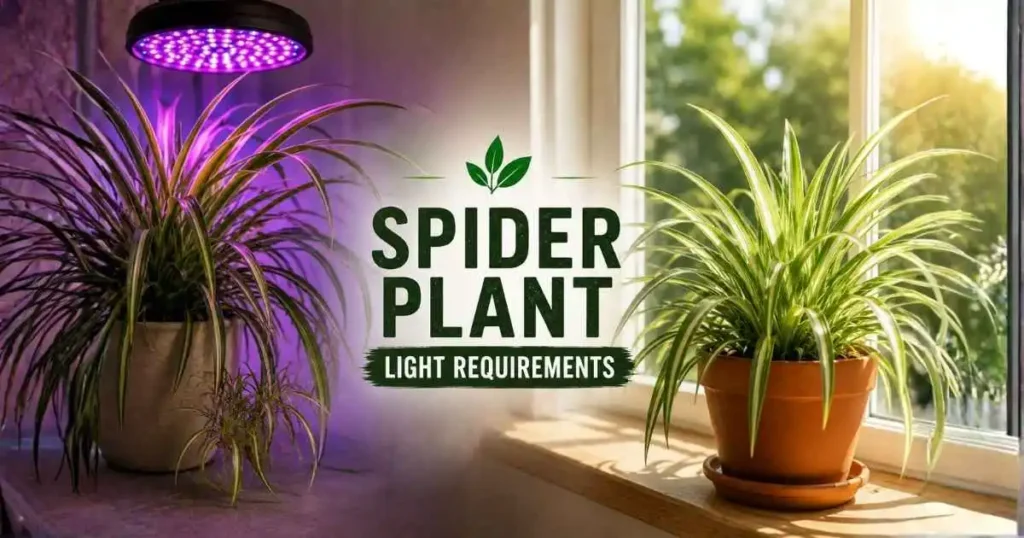
How Much Light Does a Spider Plant Need? Spider plants need 4 to 8 hours of bright, indirect light daily to grow well and help variegated varieties maintain their white-and-green striping. An east- or west-facing window works best. They can tolerate low light, but growth slows and variegation may fade in dimmer spots. Avoid harsh direct sunlight in the afternoon, which can scorch the leaves. If natural light is limited, a grow light can provide supplemental light.
Ideal Daily Light Requirements
Spider plant light requirements aren’t just about light intensity; the number of hours matters because longer, consistent light exposure can influence how quickly and fully your spider plant grows.
Here’s how different light durations can affect growth:
- Less than 4 hours: Slower growth and fewer new leaves
- 4–8 hours: Steady, healthy growth
- Closer to 10 hours during spring and summer: May support fuller foliage, stronger variegation, and more spiderettes
Pro Tip: If you want a heavier crop of baby spiderettes, aim toward 10 hours of consistent light during spring and summer. Adequate light supports the energy needed for active growth and flowering runners, where new plantlets develop. Once those plantlets are mature enough, you can learn how to propagate spider plant babies from runners.
Does a Spider Plant Need a Lot of Light?
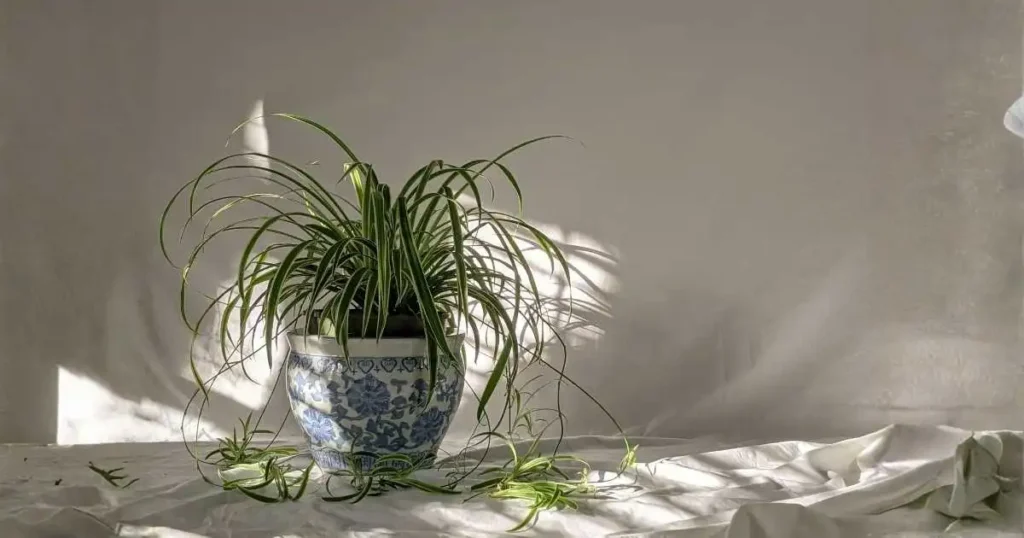
Not as much as you might think. Spider plants need consistent bright light rather than intense light. Unlike succulents or sun-loving flowering plants, they don’t need hours of harsh direct sun to grow well.
That softer, diffused brightness is closer to the light spider plants receive naturally beneath taller vegetation.
What Type of Light Is Best for a Spider Plant?
Bright, indirect light is best for spider plants. Chlorophytum comosum grows wild on the forest floor in South Africa, under the dappled shade of taller trees. Your plant evolved for filtered, broken light, not open sky. That natural habitat explains why bright, indirect light works so well indoors.
Bright Indirect Light, Explained Simply
Quick test: Hold your hand a foot above the soil.
- Sharp-edged shadow → direct sun
- Soft, fuzzy-edged shadow → bright indirect light
- No visible shadow at all → the spot may be too dim
This five-second check gives you a quick read on the light reaching your spider plant. For the best picture, repeat it at different times of day.
Can Spider Plants Handle Direct Sunlight? Morning sun is usually fine. Afternoon sun is the real risk. Gentle morning sun (a few hours) → usually well tolerated Harsh afternoon sun through unfiltered glass, especially in summer → the heat-and-intensity combo that can scorch leaves and bleach color
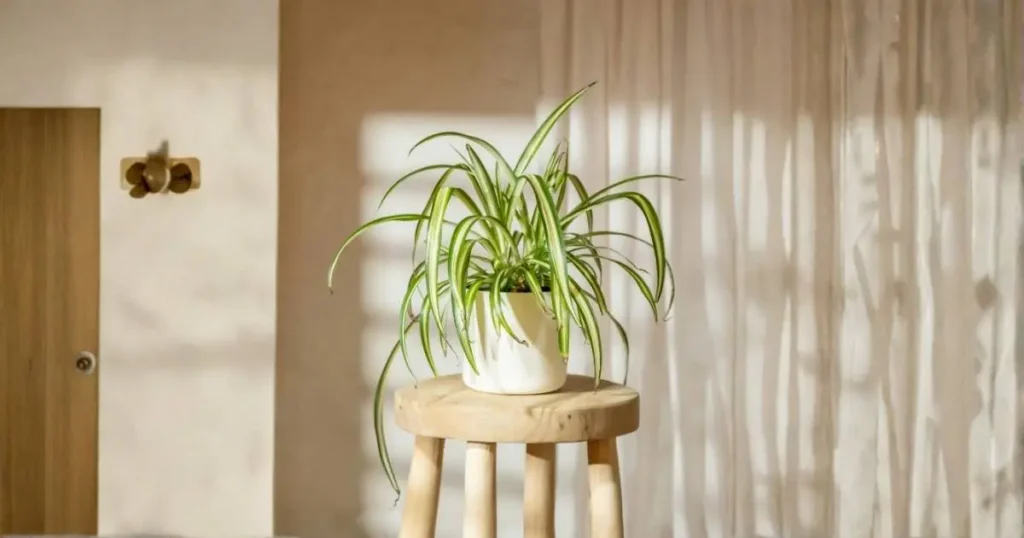
So, if your plant gets midday or afternoon sun through a south- or west-facing window, that’s the exposure to manage, not direct light in general.
Best Window Direction for Spider Plants
Window direction matters because the strength and timing of sunlight change throughout the day. Here’s what each exposure usually means for a spider plant:
| Window Direction | What to Expect | Recommendation |
|---|---|---|
| East-facing | Gentle morning sun, indirect rest of day | Ideal, usually needs no filtering |
| West-facing | Soft light most of day, stronger afternoon light | Good, watch intense summer afternoons |
| South-facing | Brightest, most direct exposure | Filter harsh direct rays or move the plant farther back |
| North-facing | Consistently dim, no direct sun | May work, but add a grow light if growth slows |
Note: A north-facing spot isn’t a death sentence, it’s just where spider plants are more likely to look “fine, but not great.” Expect slower growth, fewer pups, and weaker stripe contrast unless you add supplemental light. If this is the kind of exposure your room gets, A beginner’s approach to low-light plant care can help you make better use of those dimmer conditions.
How Far Should a Spider Plant Be From a Window? There is no fixed distance that works for every window. A spider plant can sit close to a gentle east-facing window but may need more space from a bright south- or west-facing window. If direct rays hit the leaves for hours, use a sheer curtain or move the plant farther back.
Measuring Spider Plant Light: PPFD and Lux
Want to put a number on your spider plant’s light? A practical target is around 200–400 µmol/m²/s PPFD under a grow light. For natural light, roughly 10,000–20,000 lux can be used as a bright-light reference rather than a strict requirement.
PPFD measures the photosynthetically active light reaching the leaves, while lux measures brightness as the human eye perceives it. That is why the two numbers should not be treated as interchangeable.
How to check your spider plant’s light
For everyday spider plant care, you don’t need laboratory equipment. A smartphone light-meter app can give you a rough lux or foot-candle reading and help compare brighter and dimmer spots around your home.
- Take a rough lux or foot-candle reading with a light-meter app.
- Take the reading at leaf level, not beside the pot.
- Check the same spot at different times of day.
If you use a grow light, check the manufacturer’s PPFD chart when available. For natural window light, repeated light-meter readings at different times of day are usually more practical than chasing one exact number.
Keep in mind: Lux-to-PPFD calculators only give estimates because the relationship changes with the light source and spectrum.
Can Spider Plants Grow in Low Light?
Will a Spider Plant Survive in Low Light? Yes—but “tolerant” doesn’t mean “thriving.” A spider plant can stay alive with limited light, but prolonged exposure eventually shows in the way it grows. If the plant still grows slowly after you improve its lighting, check what’s stopping your spider plant from growing normally.
How Low Light Affects Growth
In consistently dim conditions, you may notice:
- Slower growth and smaller new leaves
- Fading variegation, as white or cream stripes become less distinct
- Fewer spiderettes, especially on mature plants
One more nuance: Solid green spider plants generally handle lower light better than variegated varieties. White and cream sections of variegated leaves contain less chlorophyll, which reduces their photosynthetic capacity. As a result, variegated spider plants benefit from brighter conditions to maintain strong growth and distinct striping.
Low-light tolerance is useful, but it doesn’t remove every limitation of keeping this plant indoors. You can also explore other drawbacks to consider before growing a spider plant.
Do Spider Plants Grow Well Under Grow Lights?
Are LED Grow Lights Good for Spider Plants? Yes. They’re an easy, practical fix if your home lacks a bright window. Full-spectrum LEDs provide broad-spectrum light while running cooler than many older grow-light options, making them easier to use near spider plant foliage when positioned at the recommended distance.
Fluorescent vs. LED Grow Lights
Both can work. Spider plants aren’t especially picky about the fixture when light intensity and duration are adequate.
How Long Should Grow Lights Stay On?
As a practical starting point, run a grow light for about 8 to 10 hours a day, then adjust based on the natural light your spider plant already receives.
Already getting several hours of bright window light? Use the grow light as a supplement rather than treating it as the plant’s only light source. A plug-in timer makes the schedule easier to keep consistent.
Best Placement for Grow Lights
For many small LED grow lights, 12 to 18 inches above the foliage is a practical starting point. Move closer only if the manufacturer recommends it; stronger fixtures may need more distance. Light intensity drops quickly as the lamp moves farther away, so a light placed too high may provide little useful supplemental light.
If available, check the manufacturer’s hanging-height or PPFD chart and adjust from there. Watch the plant as well. Bleaching or scorched-looking patches can signal excessive intensity, while weak growth may mean the light is too dim or too far away.
Signs Your Spider Plant Is Getting the Wrong Amount of Light
Not every discolored or droopy leaf points to a light problem. Light stress often develops gradually, but the pattern of damage matters. Watering and water-quality issues can look similar, which is why good moisture management for spider plants can help prevent confusion between moisture stress and light problems.
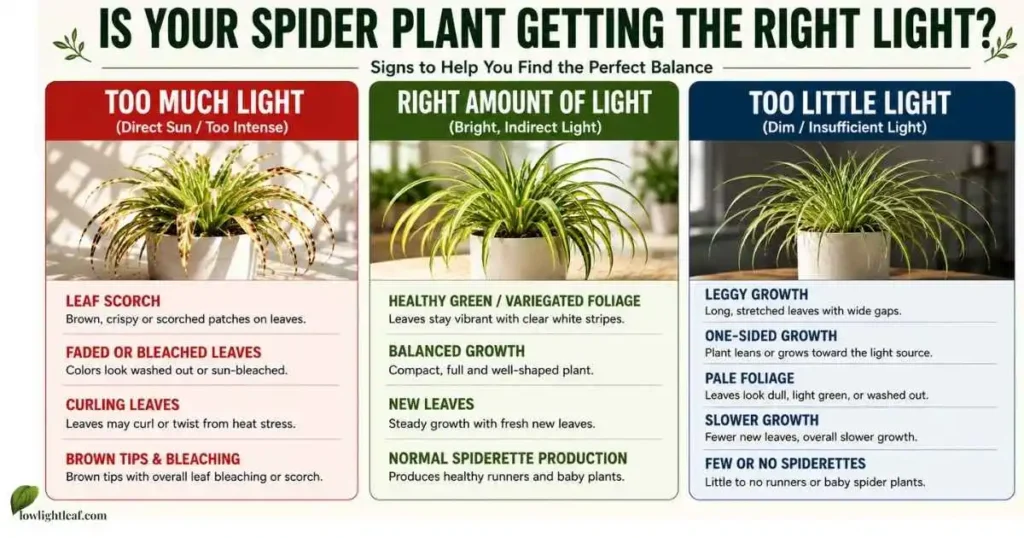
Warning: Brown tips alone usually aren’t enough to diagnose a light problem. Tap-water minerals, low humidity, fertilizer buildup, and watering stress can also cause them. If this is the main symptom you’re seeing, our guide to diagnosing brown tips on spider plant leaves can help narrow down the cause. Light is more likely when the browning appears alongside bleaching or fading across the leaf.
Is It Really a Light Problem? Quick Diagnostic Table
Use the symptom pattern, not a single damaged leaf to narrow down whether light is actually the problem.
| Symptom | Light-Related? | More Likely Cause | Check First |
|---|---|---|---|
| Brown tips only | Less likely | Fluoride/chlorine in tap water, low humidity | Water source, humidity |
| Pale + droopy | Sometimes | Underwatering | Soil moisture |
| Whole leaf bleached/white | Likely | Too much direct sun | Window distance |
| Solid green, losing stripes | Likely | Low light | Time in current spot |
| Yellow from the base up | Less likely | Overwatering / root rot | Soil dampness, drainage |
| Leggy, reaching one direction | Yes | Low light or one-sided exposure | Distance from light source |
If overwatering has already damaged the roots, learning when to repot an overwatered spider plant can help prevent further decline and give the plant a better chance to recover.
How to Fix Spider Plant Light Problems
If too much sun is the issue:
- Move the plant a few feet back, or filter harsh direct rays with a sheer curtain.
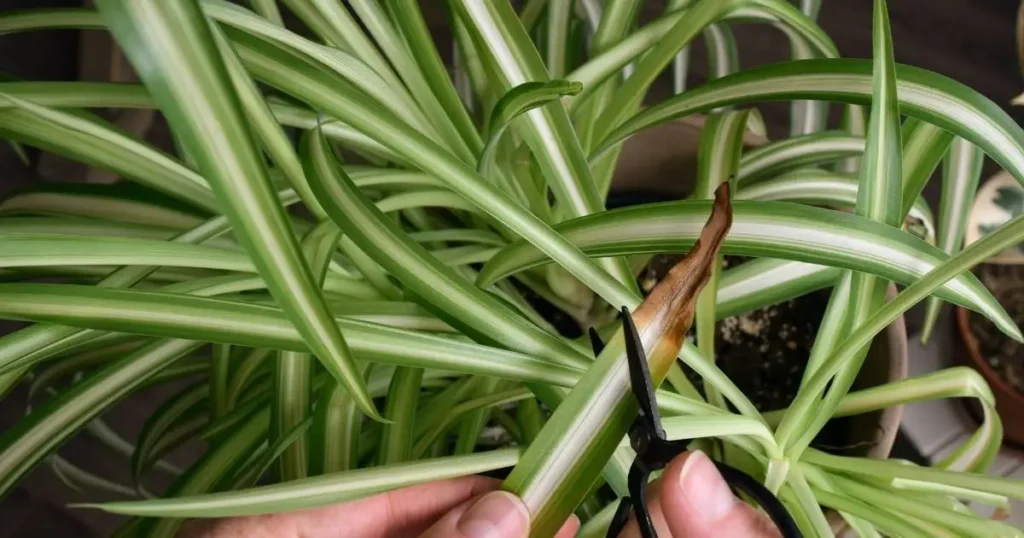
- Trim damaged leaves if you want to improve the plant’s appearance; scorched tissue won’t turn green again.
- When trimming damaged areas, leave a thin margin of brown tissue rather than cutting into healthy green tissue.
If too little light is the issue:
- Move the plant closer to a brighter window
- Add a grow light on a timer if natural light is limited.
- Increase exposure gradually rather than moving it suddenly from a dim spot into strong direct light.
What recovery looks like: Existing scorch or bleached tissue won’t repair itself. Look for healthier new growth after correcting the light rather than expecting damaged leaves to regain their original color.
Seasonal Spider Plant Light Requirements
Spring & summer: Your spider plant is actively growing while days are longer and natural light is stronger. Watch for intensifying afternoon sun through south- and west-facing windows. What felt safe in March can become too intense by July.
Fall & winter: Days shorten, and the angle and duration of sunlight change.
Did you know? A south- or west-facing window that felt too intense in summer can become genuinely useful in winter, when the sun remains lower in the sky and daylight conditions change. Moving your spider plant closer to that same window in December, rather than farther away as you might in July, can make a real difference, especially when yellowing spider plant leaves appear alongside changing light conditions.
If you have the flexibility, shift the plant slightly closer to windows in winter and slightly farther back, or add filtering, during peak summer. That small adjustment helps keep light levels more consistent year-round.
Indoor vs. Outdoor Spider Plant Light Requirements
Indoors: Spider plant light requirements can vary even between windows facing the same direction. Check what’s actually blocking that window. Trees, roof overhangs, tinted glass, curtains, and nearby buildings can dramatically reduce the light that actually reaches your spider plant. Check the conditions at leaf level rather than assuming every east-, west-, or south-facing window provides the same exposure.
Outdoors: Give spider plants partial shade or filtered light rather than prolonged, intense sun. A covered porch or a position beneath taller plants can provide protection while still allowing plenty of ambient light.
Note: Spider plants can only stay outside year-round in USDA zones 9–11, with temperatures between roughly 45°F and 90°F. Outside that range, treat your plant as a summer outdoor guest and bring it back indoors before the first frost.
Spider Plant Light Tips for Different Varieties
Bonnie (Curly Spider Plant): Bonnie’s curled, twisting leaves don’t change its basic light requirements. Give it bright, indirect light and watch the compact growth carefully for stretching or loss of vigor in a dim location.
Variegated types (Vittatum, Variegatum): Need more light than solid-green types. The white or cream stripes contain less chlorophyll, so the plant relies more heavily on its green tissue for photosynthesis.
Solid-green types: Their greater proportion of green, chlorophyll-containing tissue makes them generally more tolerant of lower-light conditions, although they still grow better with adequate indirect light. If you’re choosing one for your home, it also helps to know the benefits of growing a spider plant indoors and what makes it such a popular houseplant.
Common Spider Plant Lighting Mistakes to Avoid
- Leaving it in harsh afternoon sun: Unfiltered direct sun can scorch or bleach the leaves.
- Treating “low-light tolerant” as “no light needed”: Survival in a dim spot doesn’t mean the plant will grow well there.
- Placing it too far from the available light: Light intensity can drop substantially as you move farther from a window or grow light.
- Never rotating the plant: One-sided exposure can encourage uneven growth toward the light source.
- Ignoring seasonal light shifts: A spot that works well in June may provide very different conditions in December.
- Blaming every symptom on light: Brown tips, yellowing, and drooping can also point to watering, water quality, or other care problems.
If your plant is struggling even when its light looks right, use our complete guide to spider plant care to assess its overall growing conditions.
Spider Plant Light Requirements at a Glance
| Situation | Recommended Light |
|---|---|
| Daily light | About 4–8 hours of bright, indirect light |
| Best window | East-facing is often easiest; west-facing can also work with protection from intense afternoon sun |
| Direct sunlight | Gentle morning sun is usually tolerated; avoid prolonged harsh afternoon sun |
| Low light | Tolerated, but growth may slow and variegation can become less distinct |
| Grow lights | Full-spectrum LED; around 8–10 hours as a starting schedule, adjusted for natural light |
| Grow-light distance | Around 12–18 inches can be a starting point for many small LEDs; follow the fixture’s recommendations |
| Outdoor placement | Partial shade or filtered light |
| PPFD | Around 200–400 µmol/m²/s as a practical grow-light target, not a universal requirement |
| Spiderette production | Longer, consistent light during active growth may support flowering runners and plantlet production |
Spider Plant Light Requirements FAQs
Are spider plants low-light plants?
Not exactly. Spider plants can survive in low light, but “tolerate” is a better word than “thrive.” They can stay alive and green in dimmer spots, but growth tends to be slower, the plant may look less full, and variegation can become less distinct.
What happens if my spider plant gets too much sun?
Too much direct sun can bleach or scorch spider plant leaves, leaving pale, dry, or crispy patches, especially on the side facing the window. Move the plant farther from harsh sunlight or filter it with a sheer curtain. Existing damage won’t recover, so look for healthier new growth after correcting the light.
Can I keep a spider plant in an office without windows?
Yes, with adequate artificial light. A grow light running roughly 8 to 10 hours a day is a practical starting point. Without a natural or artificial light source, a spider plant will eventually decline.
Why is my spider plant losing its variegation?
Insufficient light is one possible reason a variegated spider plant may lose some of its stripe contrast. White or cream areas contain less chlorophyll than green tissue, so variegated plants generally benefit from brighter indirect light. If new growth is becoming noticeably greener, check whether the plant has been sitting in a dim location.
Should I rotate my spider plant for even growth?
Yes. Rotating your spider plant a quarter turn every week or two can help encourage more even growth. Without occasional rotation, the plant may lean or grow more heavily toward its main light source.
Key Takeaway
Spider plants do best with 4 to 8 hours of bright, indirect light, but the right spot ultimately depends on the light in your home. Protect them from harsh afternoon sun, and consider a grow light when natural light is limited. Rather than relying on one fixed rule, watch the leaves and new growth, then adjust the plant’s position as light conditions change through the year.
Explore more:

Muddsir Munir
Houseplant enthusiast researching and writing about indoor plants, helping beginners grow spider plants, snake plants, and more with confidence.