Last updated on November 7, 2026
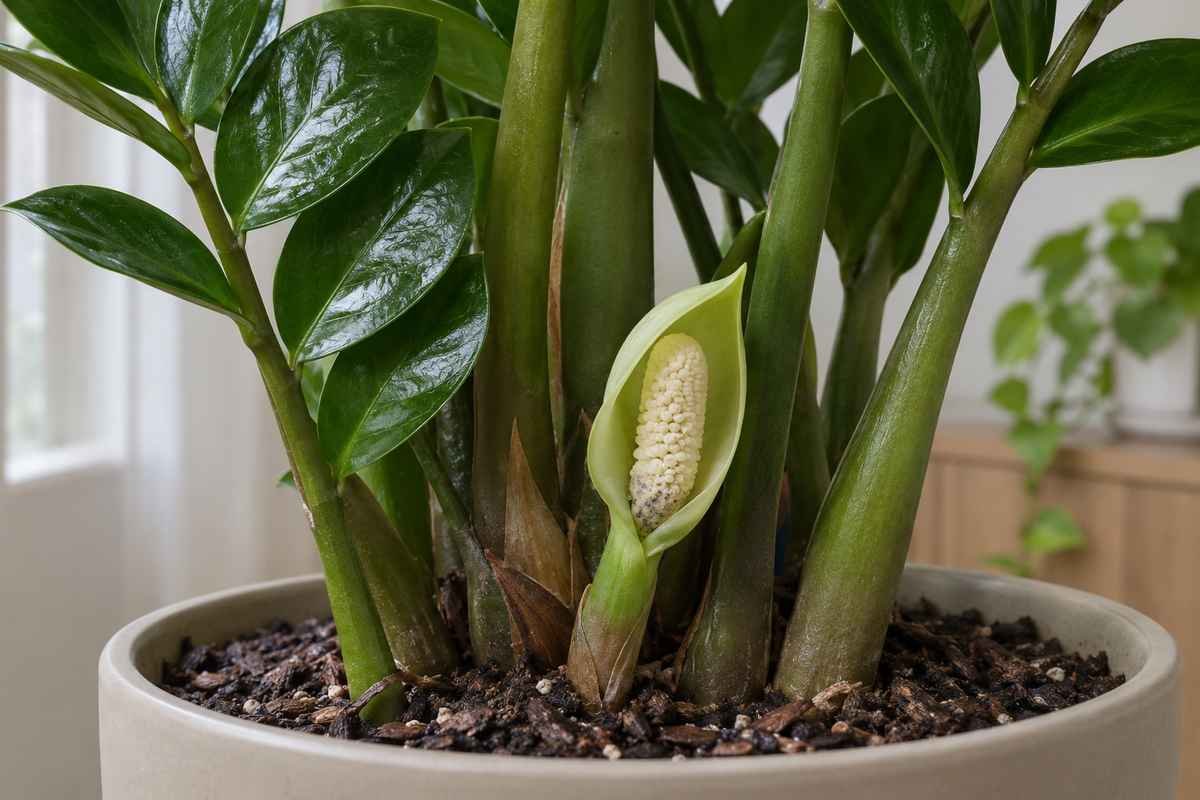
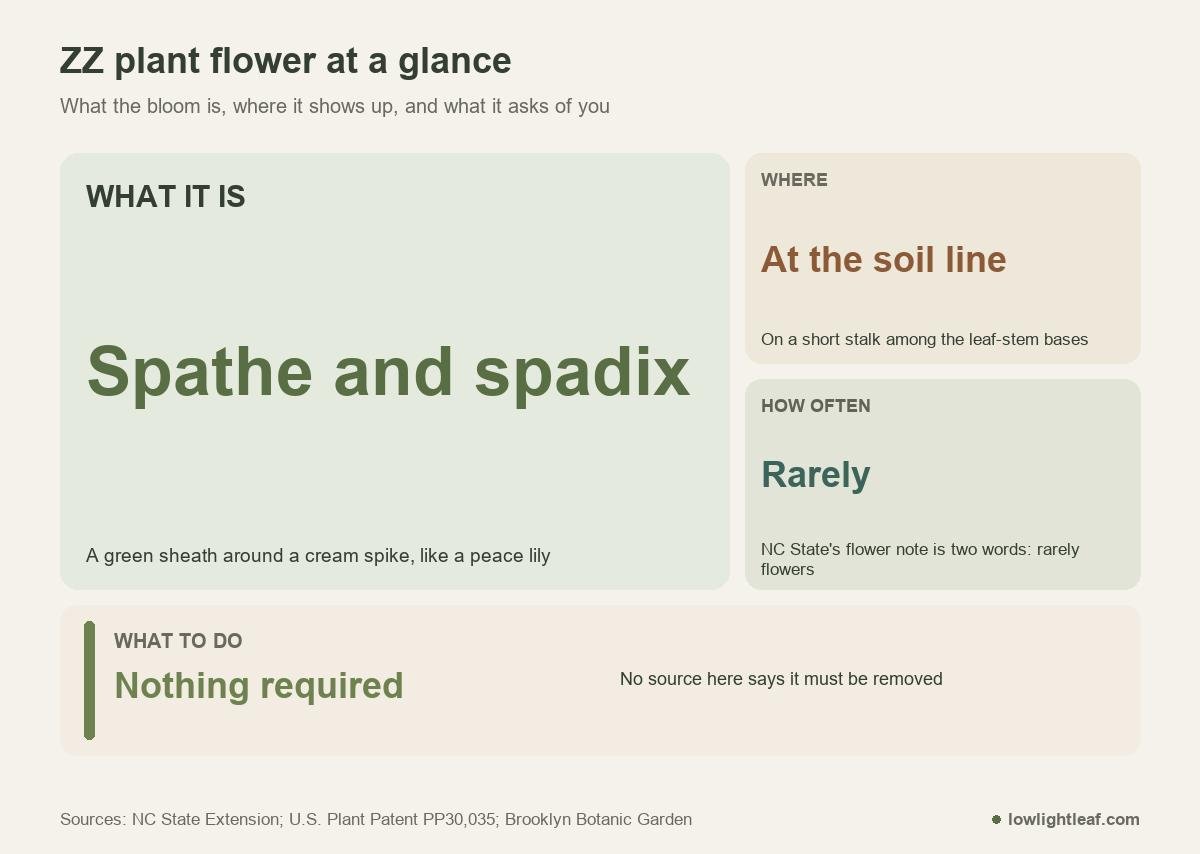
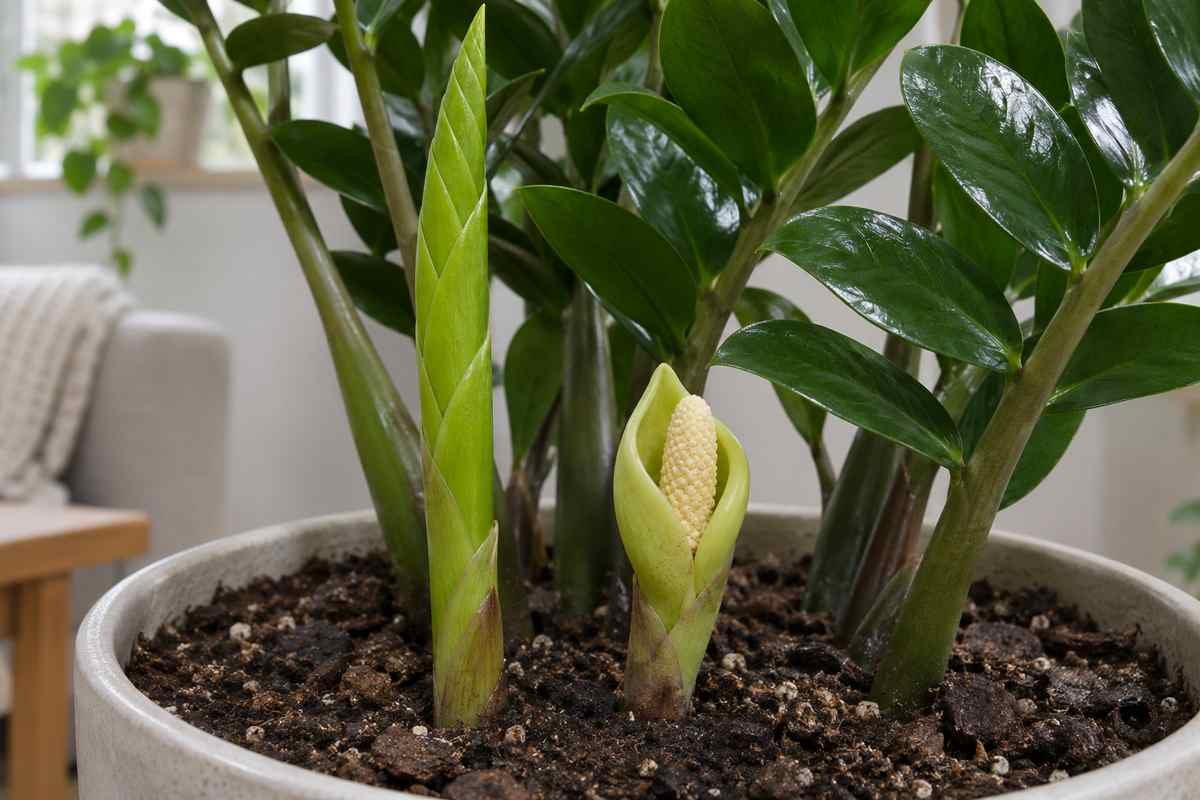
A ZZ plant flower is a pale green spathe wrapped around a cream-white spadix, and it appears down at the soil line on a short stalk among the leaf stems. NC State Extension’s description of the ZZ plant sums up its flowering in two words, “rarely flowers,” so most owners never see one. When one does show up, the plant doesn’t need anything different from you.
If you’ve just found a pale, corn-like shoot pushing up beside the stems, that’s almost certainly it. Here’s what it is, why it’s rare, and the few decisions it leaves you with.
What does a ZZ plant flower look like?
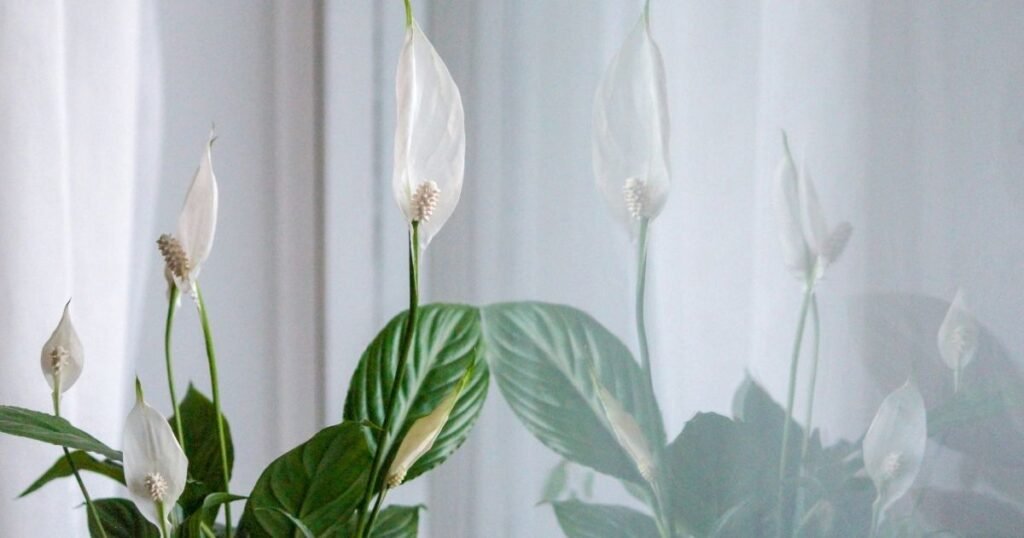
The ZZ plant flower looks like a small, green version of a peace lily bloom, because the ZZ plant (Zamioculcas zamiifolia) belongs to the same aroid family, Araceae. The NC State Extension profile of the ZZ plant describes a sheath-like green spathe around a white spadix, which it defines as an upright spike of creamy white flowers.
So the “flower” is really two parts:
- The spathe is the hood. It’s green, not white like a peace lily’s, which is a big reason a ZZ flower is easy to miss.
- The spadix is the spike inside. NC State’s photo captions note that the tiny true flowers sit on it, packed so tightly that the spike looks bumpy rather than flowered.
Position is the other giveaway. NC State’s photos show the spathe and spadix on a short stalk among the bases of the leaf stems, and in one picture the stalk has tipped over the edge of the pot. The U.S. plant patent for the Raven ZZ (‘Dowon’, PP30,035) describes the same structure at ground level: pale green spathe, cream-white spadix. Brooklyn Botanic Garden’s ZZ profile makes the peace lily comparison too, and adds that the ZZ’s version is harder to see.
Because it sits so low, a ZZ flower is often spotted only when you’re watering or turning the pot. A new leaf shoot comes up as a tight, pointed spear; a flower is shorter and stubbier, and it opens into a hood rather than unrolling into leaflets.
How rare is it for a ZZ plant to flower?
It’s rare indoors. NC State lists the ZZ as a plant that rarely flowers, and no extension source I found puts an age or a frequency on it.
The owners who report one tend to have had the plant a long time. One r/IndoorGarden member replied to a post about a two-flower ZZ with their own:
“Congrats! Our ZZ popped out 2 flowers this spring for the first time as well. I was so intrigued when the first started sprouting, I didn’t even know that they flowered. So cool to see after growing it for 5+ years. Even more so after I learned how rare it is to happen indoors.”
– r/IndoorGarden, May 2026 (8 upvotes)
That’s one grower’s experience, not a rule, but it fits what NC State says: this is a slow plant, and flowering is the exception.
What does it mean when a ZZ plant flowers?
Botanically, it means the plant is doing what flowering plants do: making a structure that could, if pollinated, set seed. Many owners take it as a sign of a settled, healthy plant. That’s a fair guess, but no source here measures it. What it doesn’t mean is anything you need to fix. None of the sources here link flowering to a problem, and the spiritual or feng shui meanings that come up in searches have no source behind them, so I’ll leave those alone.
What to do when your ZZ plant flowers
You can leave it. Nothing in NC State’s profile or the Raven patent describes the flower as a drain on the plant or something to remove. The most common question after a ZZ blooms is the one this r/IndoorGarden poster asked:
“My ZZ plant flowered again! It now has two! I’m wondering what to do once the flower dies off. I read you can leave them or cut them off.”
– r/IndoorGarden, May 2026 (415 upvotes)
Both choices are open. Once the spathe browns and shrivels, cutting the stalk off near the soil is a tidiness call, and I’d do it simply so the dead tissue isn’t sitting against damp potting mix. Use clean snips and gloves.
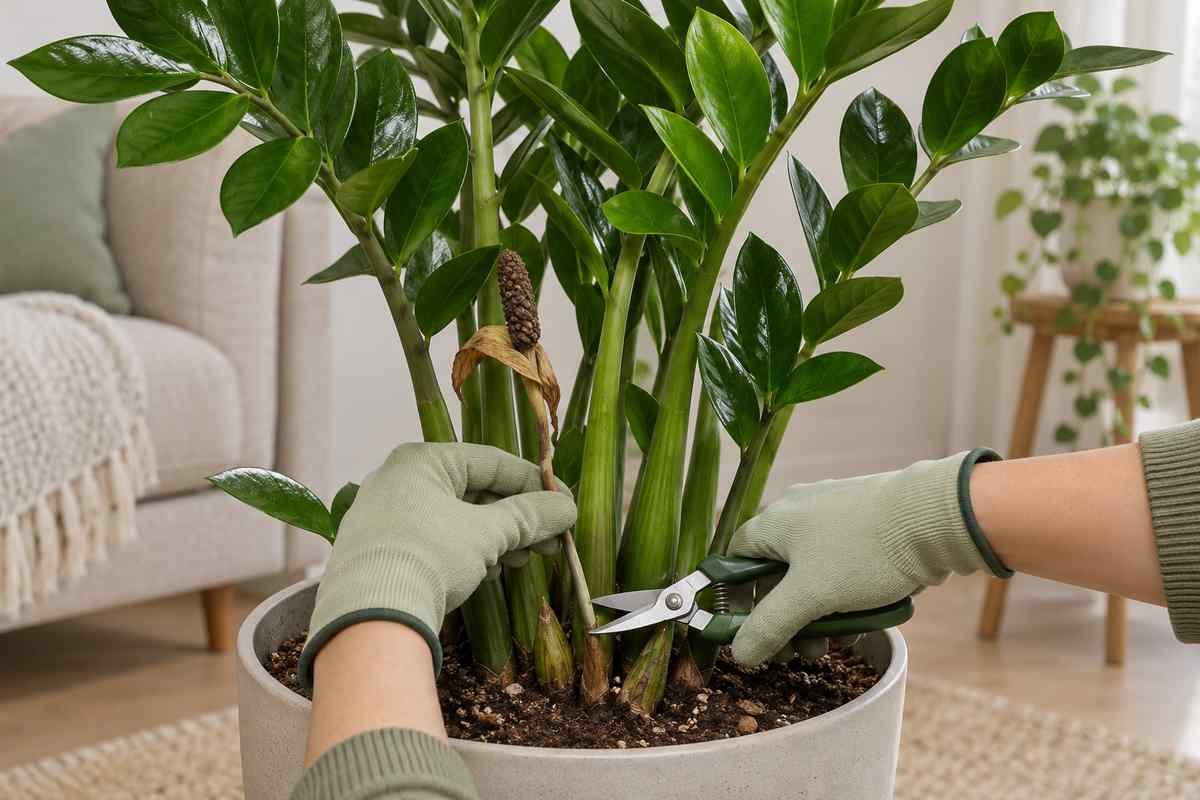
Gloves matter because the flower is part of the same plant NC State rates as medium toxicity for cats and dogs. The ASPCA list has no ZZ entry at all, which our page on ZZ plants and cats explains, so a low flower at nose height deserves the same caution as the leaves. Keep the cuttings away from pets, too.
Don’t change the watering because of the bloom. The plant’s needs haven’t changed.
Can you make a ZZ plant flower?
Not reliably. None of the extension or botanical sources I read name a trigger for ZZ flowering: no temperature drop, no dark period, no fertilizer formula. Anyone promising a method is guessing.
What you can do is grow the plant well and let flowering happen if it’s going to. NC State says the ZZ survives very low light, even fluorescent only, but does best in bright indirect light, and that direct sun scalds the leaves. In other words, a ZZ in a dim corner can live for years without the vigor a flower would need. The ZZ plant light requirements page sets out how much brighter is worth aiming for, and a grow light is the honest fix when the window can’t provide it.
The rest is the usual ZZ routine from NC State: let the soil dry out completely between waterings (about once a month in winter, twice a month in summer only if it’s dry), and a balanced liquid fertilizer once or twice a year. ZZ plant watering has the details. NC State says wet feet aren’t tolerated, and a ZZ that’s losing its rhizomes to soggy soil isn’t going to flower.
ZZ plant flower seeds, and why some ZZs can’t be propagated freely
Don’t plan on seed. A houseplant ZZ rarely flowers, and a flower needs pollination to set seed. NC State’s propagation methods are division and leaf cuttings, and Brooklyn Botanic Garden notes that even a fallen leaflet can root. Those are the routes that actually work at home; ZZ plant propagation runs through both.
The “illegal to propagate” question that shows up in searches is about patents, not the species. The plain green ZZ isn’t patented. Some named cultivars are: Raven is protected by U.S. Plant Patent PP30,035, and under 35 U.S.C. 163 a plant patent lets the holder exclude others from asexually reproducing the plant and selling the results. Dividing or rooting leaflets from a patented cultivar is exactly that kind of reproduction, which is why it’s restricted. The Raven ZZ plant page has more on that cultivar.
If your ZZ flowers, enjoy the oddity and change nothing. It’s the same tough plant it was the day before the hood came up.

Ellie Marsh
Houseplant grower who spent years in a north-facing apartment. Writes practical care guides for low light homes, checked against extension and botanical garden sources.