Last updated on November 4, 2026
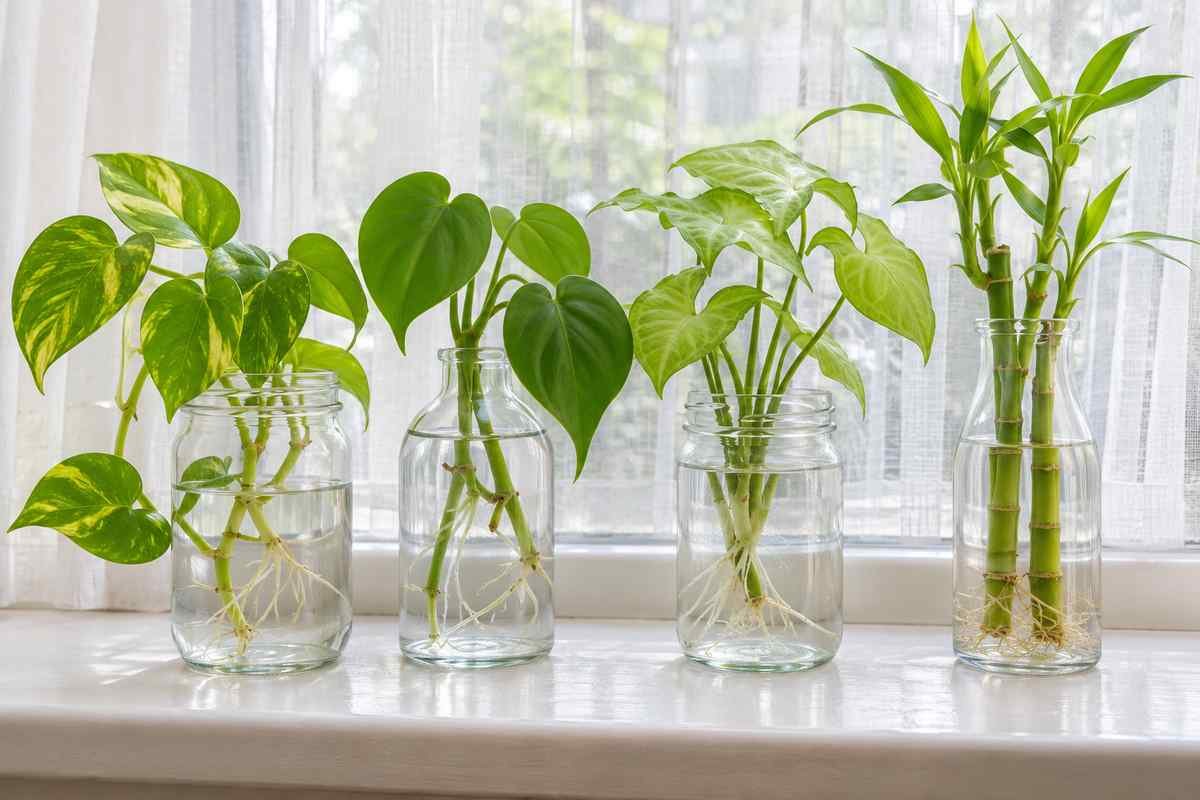
Golden pothos, heartleaf philodendron, arrowhead vine, Swedish ivy and coleus all root easily in plain tap water, according to University of Maryland Extension, and NC State Extension says lucky bamboo can be grown in chlorine-free water. Those are the plants that grow in water most reliably indoors. Most of them start in a jar and are meant to move into soil once they have roots.
Lucky bamboo is the exception that lives in water for good, and it has its own rules about what water to use.
Six plants that grow in water
These six plants that grow in water are each named by an extension service, with the ASPCA’s pet rating alongside.
| If you want | Plant | What the source says | Cats and dogs (ASPCA) |
|---|---|---|---|
| A trailing vine in a jar | Golden pothos (Epipremnum aureum) | Roots easily in tap water (Maryland, Ohio State) | Toxic |
| Smaller heart-shaped leaves | Heartleaf philodendron (Philodendron hederaceum) | Roots easily in tap water (Maryland) | Toxic |
| Arrow-shaped leaves | Arrowhead vine (Syngonium podophyllum) | Roots easily in tap water (Maryland) | Toxic |
| A pet-safe trailing plant | Swedish ivy (Plectranthus) | Roots easily in tap water (Maryland) | Non-toxic |
| Colorful leaves | Coleus (Plectranthus scutellarioides) | Roots easily in tap water (Maryland) | Not listed for ornamental coleus |
| A plant that stays in water | Lucky bamboo (Dracaena sanderiana) | Grows in chlorine-free water, changed weekly (NC State) | Toxic (NC State) |
The ASPCA’s coleus entry is for Coleus amboinicus, a different plant also sold as Cuban oregano, so it doesn’t settle the question for the ornamental kind.
The site has care pages for heartleaf philodendron and arrowhead plants once the cuttings move to a pot.
How to root a cutting in water
Cut a 3 to 5 inch stem with at least one node, the point where a leaf grows from the stem, and stand it in a clean container of fresh tap water with no leaves below the waterline. University of Maryland Extension says roots form over several weeks.
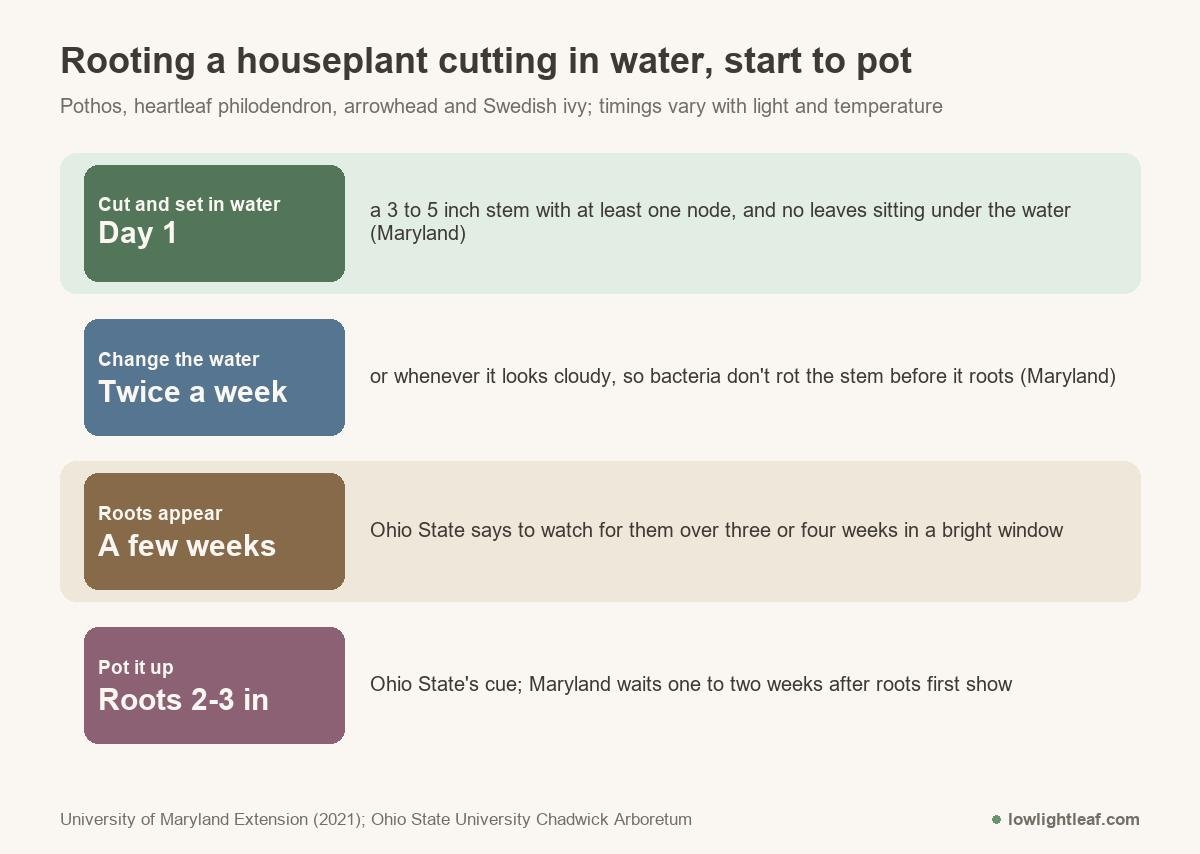
Change the water at least twice a week, or whenever it turns cloudy. Maryland says bacteria in old water can rot the stem before roots form, and that leaves left under the surface make the water dirty faster, a point Ohio State’s Chadwick Arboretum makes too.
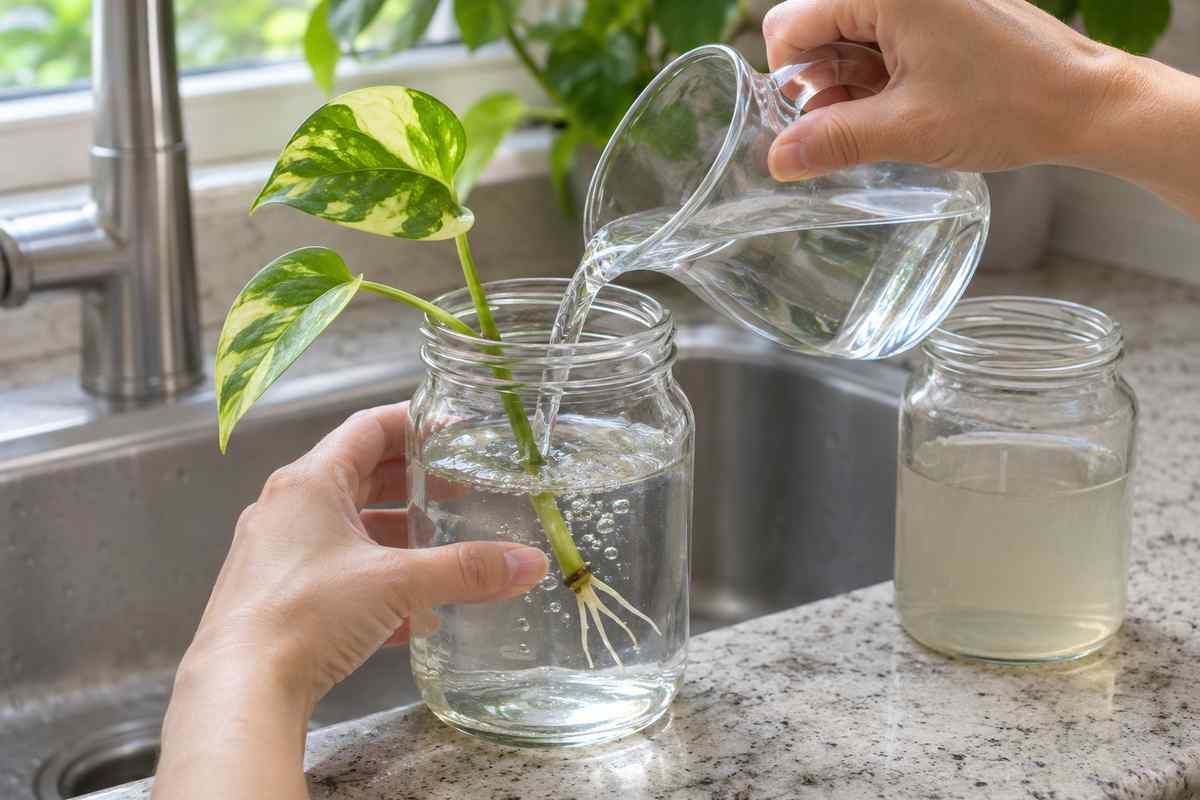
Pick a thin stem. Maryland notes thick stems take longer to root and may rot first, and if a large-leaved cutting wilts, pinching off a few of the bigger leaves cuts down the water it loses while it has no roots.
Light matters as much as water. Maryland recommends bright light without direct sun, around 70°F and away from cold drafts. In a north-facing apartment like the one I lived in for years, that means a jar right at the glass or under grow lights, not a shelf across the room.
The two sources disagree on timing. Ohio State says roots should show after a few weeks and to plant the cutting once they are 2 to 3 inches long; Maryland says to let roots grow another one to two weeks after they first appear, then pot it in a small, well-draining container and keep the mix moist until new leaves form.
Can plants grow in water permanently?
Some can, but of these six, only lucky bamboo is grown long-term in water by the extension sources. NC State says it can grow in chlorine-free water changed weekly, and a Michigan State University Extension Master Gardener adds that it is sensitive to fluoride as well, so rain or distilled water is the safer choice.
The same Michigan State answer recommends a water-based fertilizer once a month for lucky bamboo kept in water, without overdoing it, and notes that growing it in soil is less work because there’s no water to change.
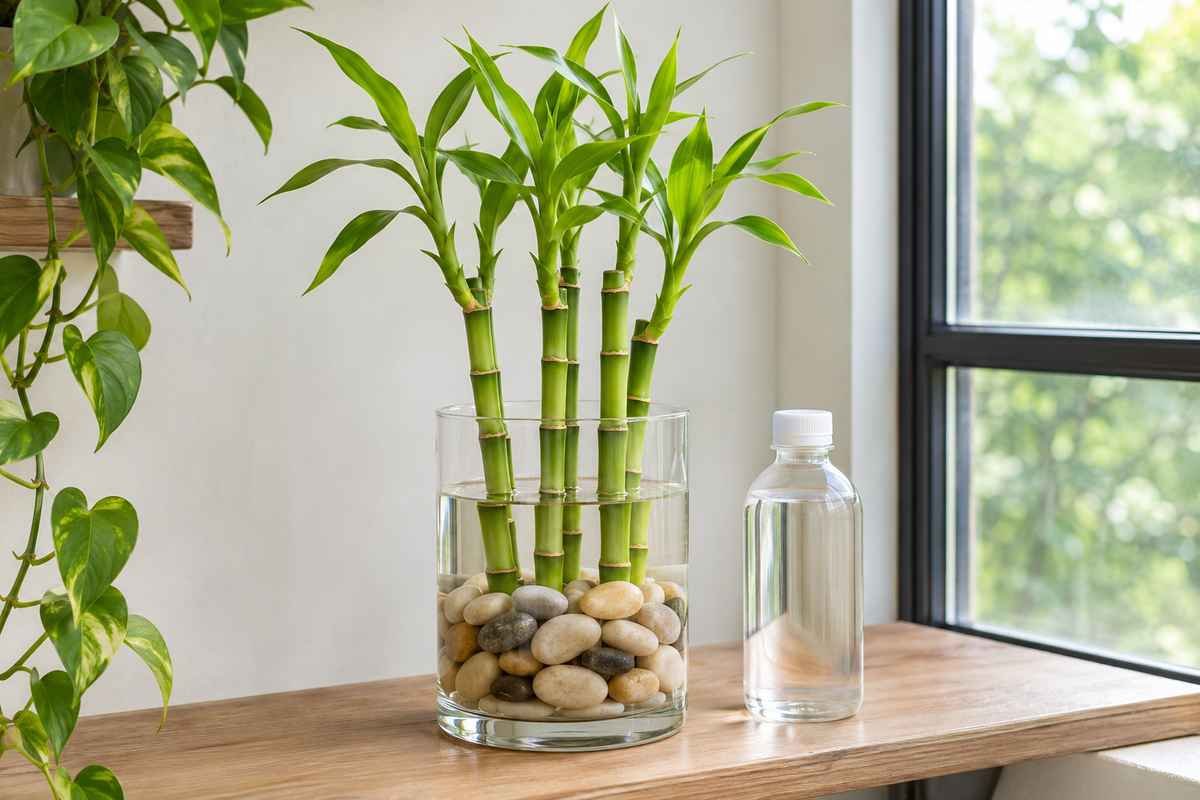
The rest are treated as cuttings on their way to soil. Christa Carignan, who wrote the Maryland piece, replied to a reader that a pothos left in water for years survived but did not thrive. Some growers go further with feeding and aeration:
“Virtually all plants could be kept in hydroculture if they are fertilized correctly and the roots are aerated properly.”
– r/houseplants (5 upvotes)
Another grower in the same thread has had pothos and spider plants growing in an aquarium “for ten years or so.” A plain jar of tap water has no nutrients of its own, which is why Michigan State’s monthly, go-easy feeding for lucky bamboo is the closest published rule for a vase.
Water-grown plants and cats
Swedish ivy is the only plant in the table that the ASPCA lists as non-toxic to cats and dogs. Pothos, philodendron and arrowhead vine all contain insoluble calcium oxalates, and NC State lists lucky bamboo as toxic to cats and dogs, with vomiting and dilated pupils in cats.
Spider plants are another non-toxic option, and the page on spider plant propagation goes through rooting their plantlets. My cat, Miso, is the reason I look up a plant before it joins the windowsill, and the plant toxicity checker does that lookup for anything else you’re thinking of putting in a jar. A toxic cutting in a jar belongs up high, where a curious cat can’t knock it over or chew it.
Once a jar cutting has 2 to 3 inches of roots and you want a fuller plant, soil is the next step.

Ellie Marsh
Houseplant grower who spent years in a north-facing apartment. Writes practical care guides for low light homes, checked against extension and botanical garden sources.