Last updated on November 26, 2026
Neon pothos is the chartreuse form of Epipremnum aureum, the vine sold as golden pothos. It takes ordinary room light and the same care as the green version. The difference is that its color follows the light. NC State Extension lists ‘Neon’ as a yellow-leaved cultivar of the species.
Two things trip up new owners. The first is light: a Neon that sits too far from a window keeps its shape but loses the glow, and the vines space out. The second is identity: Lemon Lime philodendron is sold beside it, looks close in a photo, and grows a little differently. Both are worth sorting out early, because the fixes are simple once you know which plant you have.
What a Neon pothos is, and what it is not
A Neon pothos is a cultivar of Epipremnum aureum with solid yellow-green leaves, not a variegated plant with cream or white streaks. Every leaf carries the same pigment, so there is no second color to lose. That single fact explains most of what owners see when the glow fades.
- Botanical name: Epipremnum aureum ‘Neon’
- Leaf color: solid chartreuse to yellow-green, no cream or white
- Growth: vining; climbs a pole or trails from a shelf
- Toxicity: insoluble calcium oxalates; toxic to cats and dogs
The cultivar sits inside the same species as golden pothos, marble queen and Manjula, and it inherits the family’s tolerance for dim corners. NC State’s listing gives the leaf color simply as yellow, which is the whole point of the plant: one flat color across the blade, no sectors, no speckles. A Manjula or Marble Queen is variegated, and its cream patches can revert or brown. A Neon has no second color to lose, so its changes are about brightness, not pattern.
Nurseries sell it widely, and it is not rare, though it often costs a little more than a golden pothos of the same size. In parts of South Asia the whole species is called money plant, so a shop label may use that name for a Neon too. The pothos variety list puts it beside the other named forms if you want the full set.
Neon pothos vs Lemon Lime philodendron
The two plants share a color and a habit, and the differences sit in the stalk and the newest node rather than the leaf face.
| Feature | Neon pothos | Lemon Lime philodendron |
|---|---|---|
| Leaf shape | Broad heart, uneven shoulders, short tip | Narrower heart with a longer, drawn-out tip |
| Petiole | Shallow groove along the top | Smooth and round, no groove |
| New growth | Leaf pushes out of the sheath of the previous leaf; nothing papery left behind | A separate stipule wraps the new leaf, then dries and sheds in flakes at the node |
| Leaf surface | Waxy, soft sheen | Glossier, reflects a window |
NC State’s description of Philodendron hederaceum names the giveaway directly: conspicuous stipules on new growth, messy falling stipules on older stems, and petioles without a groove. Check the node where the newest leaf joins the vine. Brown papery flakes caught there point to philodendron. A clean sheath with no debris points to pothos.
Color is the weakest test. Both run yellow-green, and a Lemon Lime in shade can pass for a Neon in good light. Leaf texture and the node settle it. Both are toxic to pets, so the distinction is about care, not safety.
Light and leaf color: why the glow fades
The glow is a report on light, and it changes on a scale you can watch.
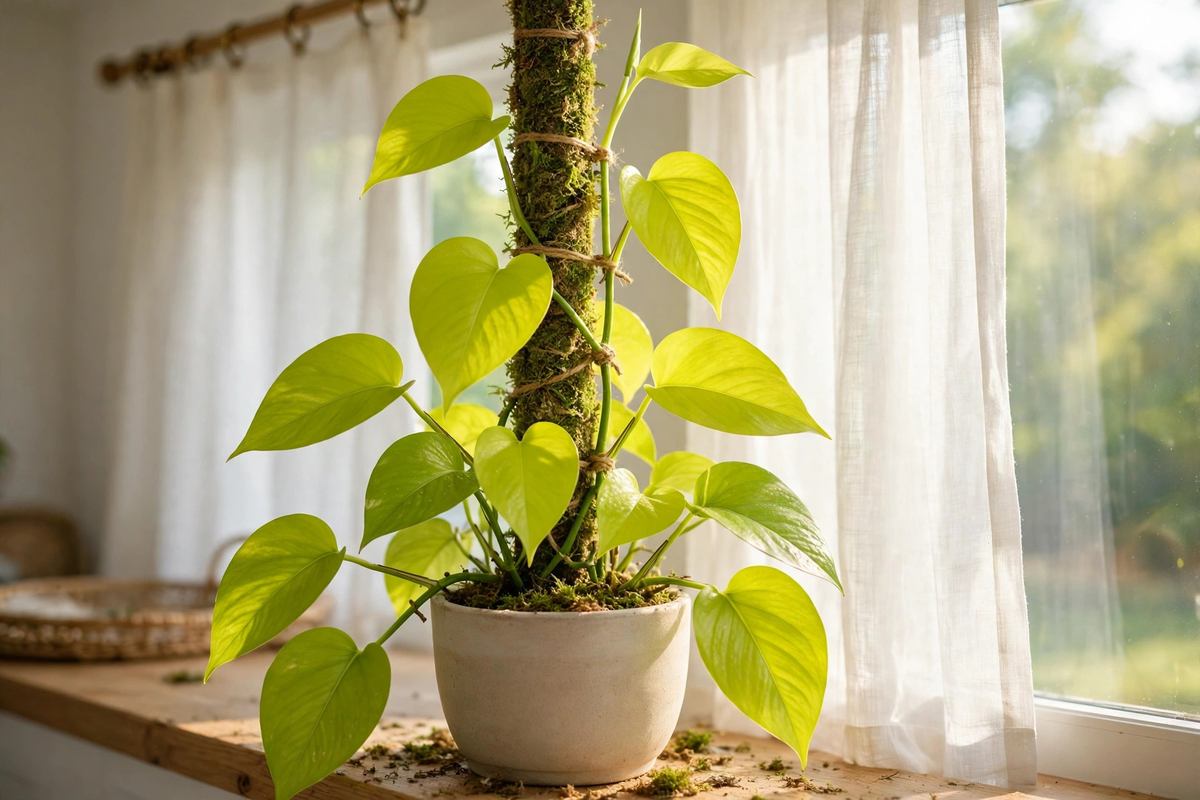
A leaf that opens in bright, filtered light comes in saturated chartreuse. Move the same vine to a dim corner and the new leaves open smaller, duller, and further apart. The color does not switch to the deep green of a golden pothos, and the gaps between leaves lengthen. In my last north-facing apartment the only usable spot was the sill, and the vine grew there for years without matching the color it had in the shop.
Put a Neon one to three feet from an east window, or three to five feet back from a south or west window where the sun never lands on the leaves. A north window works if the sill is wide and the room is pale. Under a grow light, roughly eight to twelve hours a day with the lamp a foot or so above the vine keeps color without scorching.
Direct afternoon sun is the one placement to avoid. Pale leaves scorch faster than a golden pothos, and the burn shows as a bleached patch with a brown edge that never colors back. I have burned a leaf this way more than once.
What owners call a neon pothos turning green is usually two things: older leaves deepening to olive before they drop, and new leaves opening in less light than the last batch. Move the pot closer to the window and the next two or three leaves come in brighter. If one vine pushes solid dark green leaves while the rest stays chartreuse, that vine has changed; take cuttings from the bright stems and remove the dark one if you want an even color.
For a lamp setup, guesswork is the weak point. The DLI calculator converts a light’s output and hours into a daily light integral, the figure that describes how much light a plant receives in a day. The pothos light requirements page covers the room-by-room version if you would rather work from window distance.
Water and soil for a Neon pothos
Water a Neon the way you water a golden pothos: soak the pot, then let the top inch or two of mix dry before the next round. In a six-inch pot in a bright room that is often about a week in summer and two to three weeks in winter. A cool, dim room stretches both, and a terracotta pot shortens them. I water mine when the top inch feels dry, not on a calendar.
Yellow leaves that start at the base and work up, soft stems, and soil that smells sour are the overwatered picture. The fix is drainage and a lighter mix rather than less water at the top.
A chunky mix protects the roots. One part ordinary potting soil, one part perlite, one part orchid bark gives the roots air while holding enough moisture. The pothos soil guide has the ratios and the store-bought shortcuts.
Cuttings root easily in water, and a Neon that has grown leggy can be cut back and restarted from its own vines. Change the water weekly and pot the cutting when the roots are an inch or two long. The propagation guide covers node placement and the soil transition.
Problems: yellow leaves, small leaves, leggy vines
Most Neon problems are light or water, and the leaf pattern says which one.
Yellow leaves
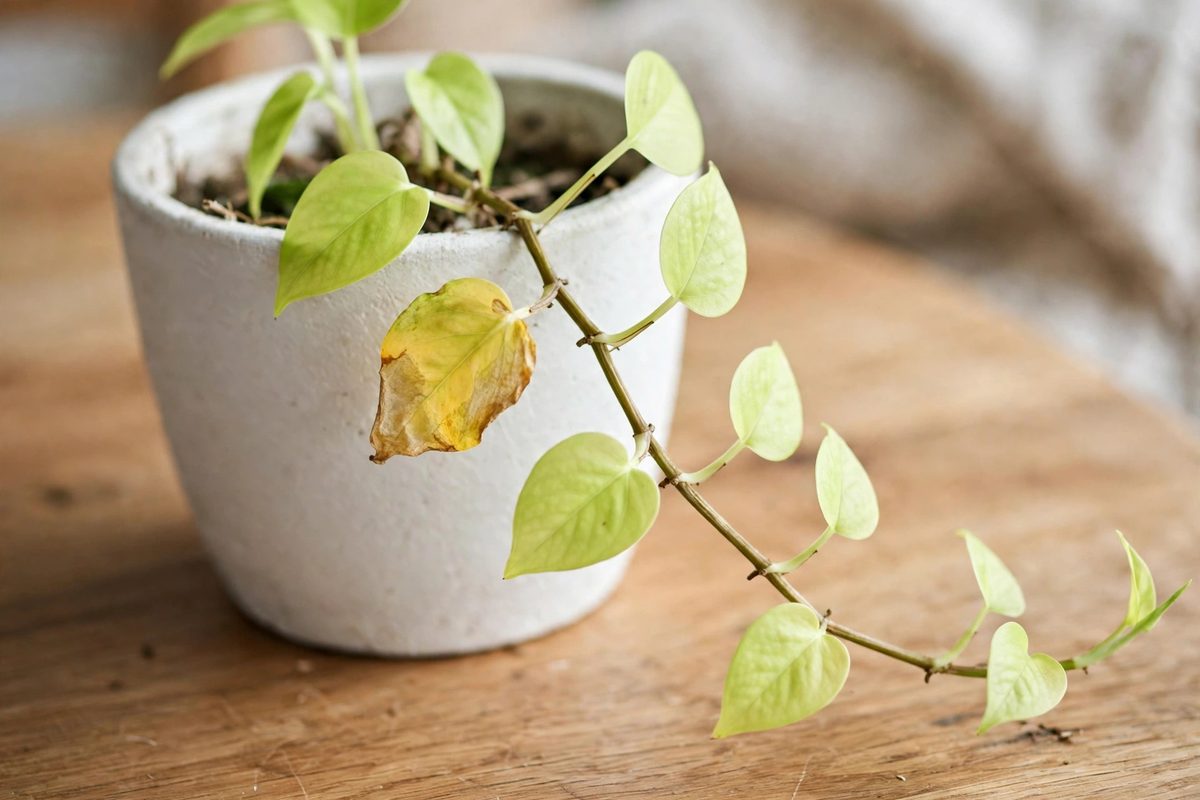
Lower leaves yellowing one at a time is ordinary aging. Several at once, especially with soft stems, points to wet soil. Pale new leaves with green veins usually mean the mix is spent or the roots are damaged, and fresh mix at the next watering is the place to start. The yellow leaf checklist sorts those symptoms by cause.
Small leaves and long gaps
Small leaves and long gaps are one problem, not two: the vine is reaching for light. Move it closer to a window or add a lamp. Pruning alone regrows the same small leaves in the same spot.
What an overwatered Neon pothos looks like
An overwatered Neon pothos looks limp rather than crisp: yellow lower leaves, stems that feel soft at the soil line, and a sour smell when you lift the pot. Brown tips point elsewhere, usually dry air or a missed watering.
Fungus gnats come with wet mix, and letting the surface dry between waterings thins them out. Mealybugs show as white cotton at the nodes; wipe them off with alcohol and repeat weekly until they stop coming back.
Moss poles, fenestration, and bigger leaves
A Neon allowed to climb makes bigger leaves than the same plant hanging. The vine grips a pole, the internodes shorten, and the blades widen. Fenestration, the splits along the leaf edge, can follow on a mature vine; it is not a feature of young cuttings.
“Second pic was taken in June 2025 which was a few weeks after I put it on a moss pole”
– r/houseplants, November 2026 (4,246 upvotes)
That timeline is fast, and it is one grower’s report rather than a guarantee. The mechanism is ordinary: a climbing vine invests in support before it invests in leaf area. Keep the pole damp, tie the vine at two or three points, and give the top of the pole the brightest spot in the room.
Hanging is still fine. A trailing Neon stays compact and is easier to move; it keeps the smaller juvenile leaves, which is often why people buy it.
Neon pothos and cats
Neon pothos is toxic to cats and dogs. The ASPCA lists the species under the common name devil’s ivy as containing insoluble calcium oxalate crystals. Chewing releases the crystals, which cause oral irritation, burning, drooling, vomiting, and trouble swallowing.
I keep mine on a shelf Miso cannot reach, and I check every new plant against the ASPCA list before it comes inside. A trailing vine is the risky shape: cats bat at hanging ends, and one chewed leaf is enough to set off the mouth irritation.
The reaction is mechanical rather than damage to the organs. If a cat chews a leaf, rinse the mouth and call a vet or poison control, especially with vomiting or swelling. The pothos toxicity page covers the full symptom list and the plants that are safe to keep beside it.
Move the pot a foot closer to the window this week and watch the next two leaves. If they come in larger and brighter, the spot is right. If they come in smaller and further apart, move it again.

Ellie Marsh
Houseplant grower who spent years in a north-facing apartment. Writes practical care guides for low light homes, checked against extension and botanical garden sources.