Last updated on November 8, 2026
The Raven ZZ plant is a black ZZ plant: a black-leaved form of the ordinary ZZ plant, Zamioculcas zamiifolia ‘Dowon’, sold in North America by Costa Farms under the Raven name. Its new leaves come in green and darken to black as they age. Care is the same as any ZZ: bright, indirect light if you can give it, very little water, and no direct sun. NC State Extension rates it as medium toxicity for cats and dogs. If one ever sends up a hooded bloom at the soil line, ZZ plant flower explains what it is.
If you just bought one and the newest leaves are bright green, nothing is wrong. That’s how this plant grows.
What is a Raven ZZ plant?
A Raven ZZ is a natural mutation of the regular ZZ plant, discovered in 2006 at a nursery in Seoul, South Korea.
According to U.S. Plant Patent PP30,035, the grower noticed that one leaf on a normal green ZZ had leaflets that were unusually dark and kept darkening as they expanded. The inventor rooted those black leaflets, and the plants they produced turned black too.
The patent covers the variety under the name ‘Dowon’. Costa Farms says it has exclusive permission from the patent holder to grow it in North America, and Raven is the trade name you’ll see on the tag.
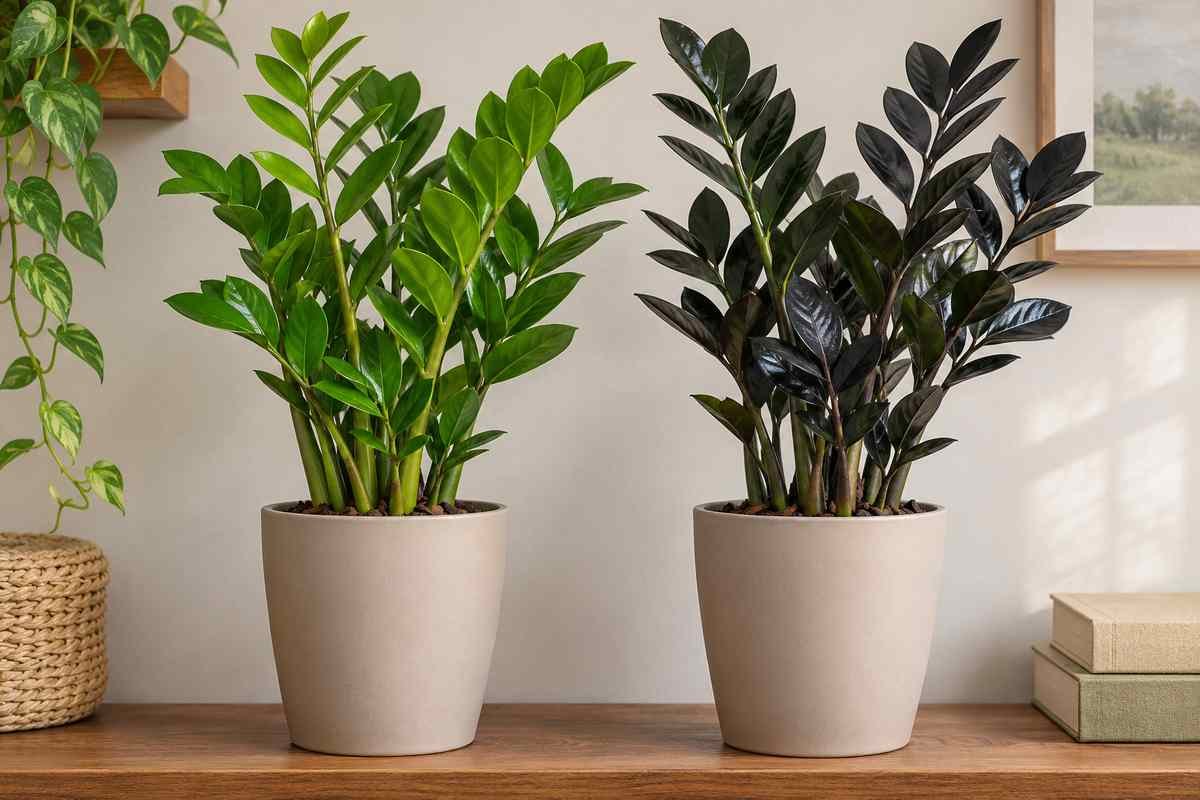
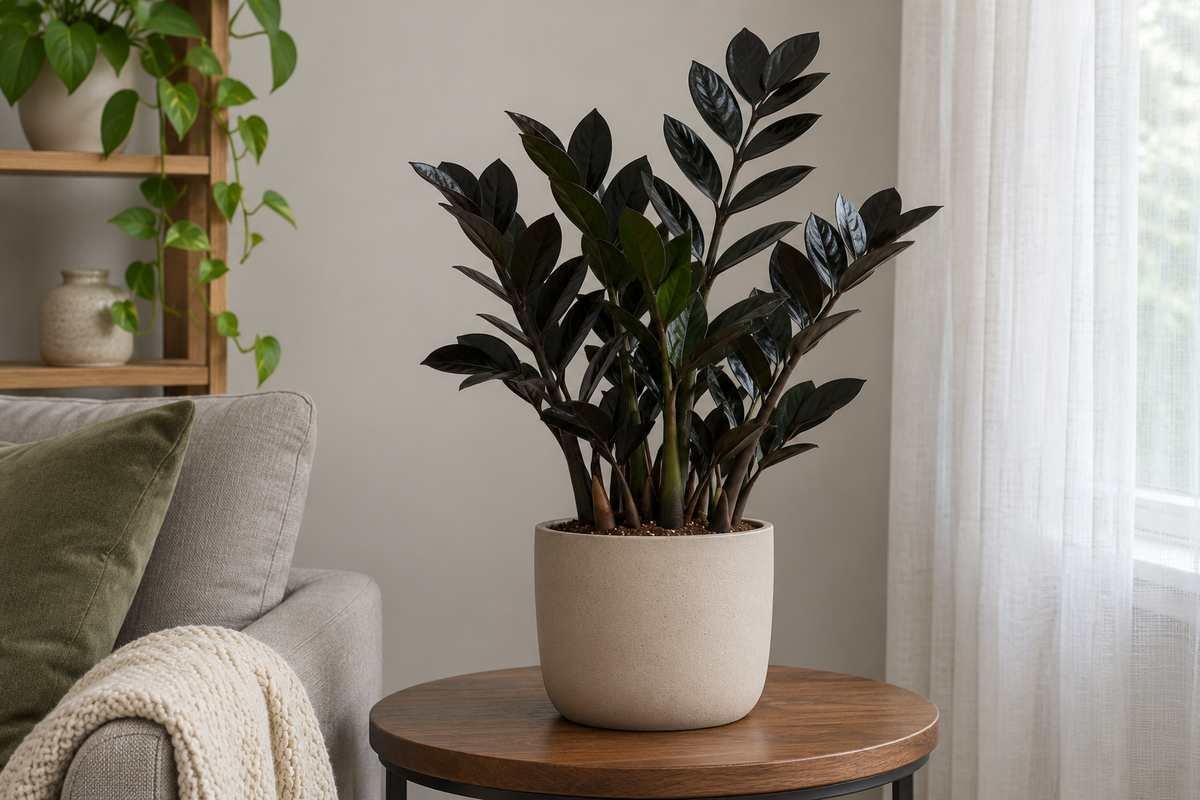
Raven ZZ vs a regular ZZ. Botanically, it’s the same species, so the difference is color, not care. NC State Extension gives the Raven the same light, watering and feeding advice as the green ZZ, and the Missouri Botanical Garden describes it simply as a dark-leaved selection. Costa Farms puts its size at about 30 inches tall and wide; NC State says up to 3 feet, with slow growth.
Why are my Raven ZZ’s new leaves green?
A Raven ZZ’s new leaves are supposed to be green. The patent describes each new leaf emerging glossy mid-green, then darkening through dark olive, then developing streaks of very dark green, until the leaflets, the central rib and the leaf stalk are entirely black.
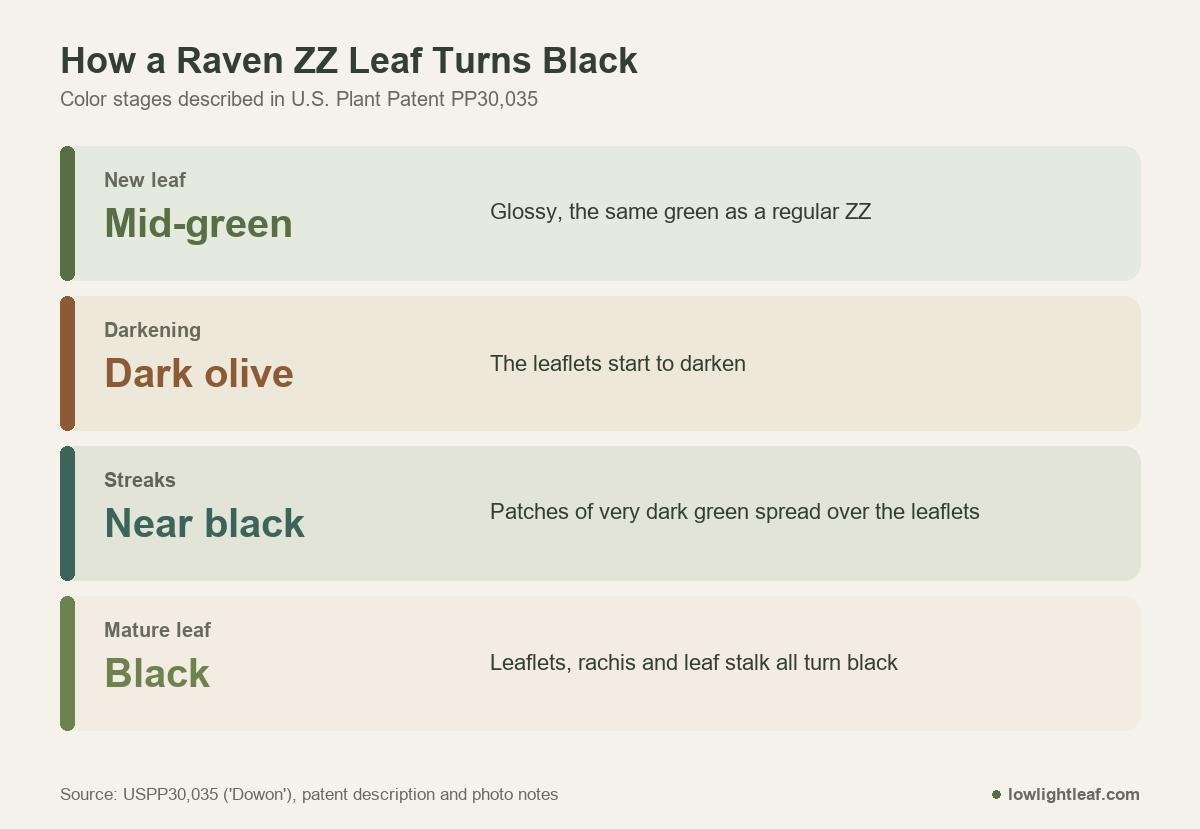
How long that takes is less clear, even in the patent. Its summary says a new leaf darkens over 1 to 2 months. Its photo notes describe leaflets starting to darken around 6 months and a leaf becoming entirely black around 12 months after it appears. Both describe the inventor’s own plants in Seoul, so expect your timing to vary, and don’t worry about a green leaf that’s only a few weeks old.
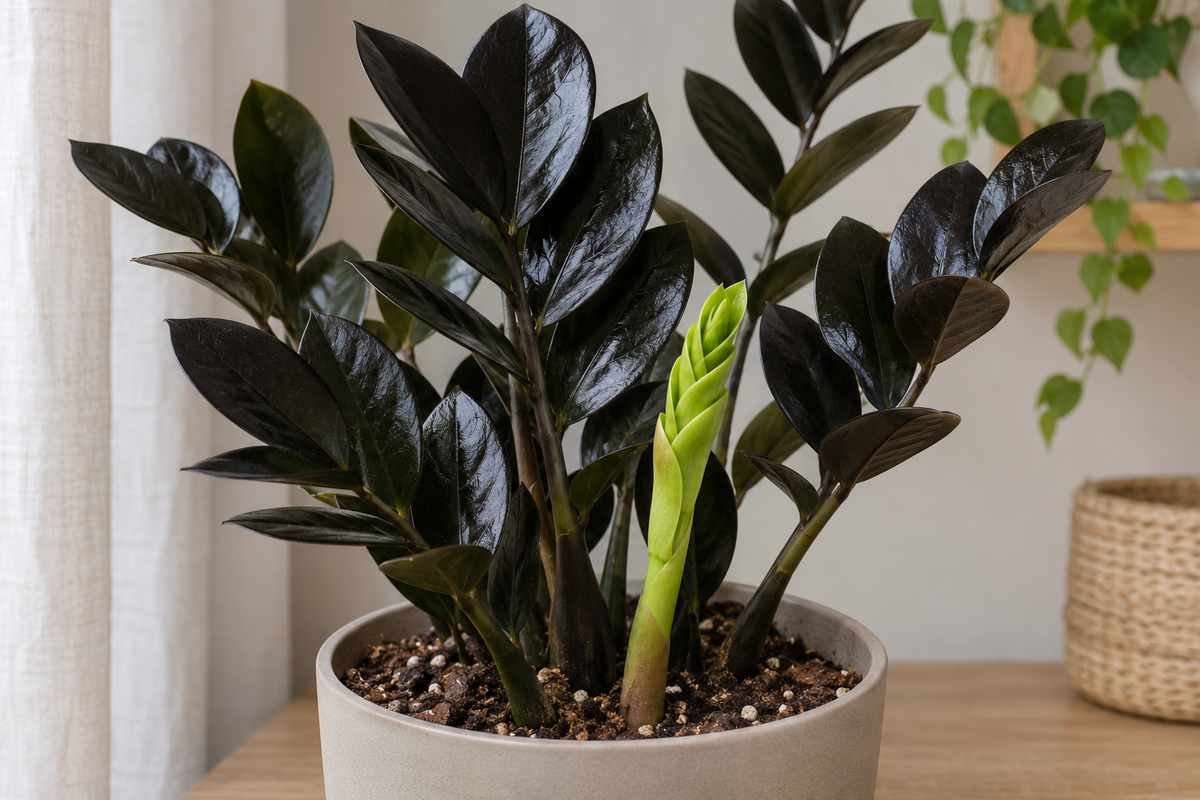
NC State and the Missouri Botanical Garden say the same in plainer terms: new growth emerges lime or bright green and matures to near black.
Raven ZZ plant care
Light. NC State’s Raven entry says it will grow in very low light, even with only fluorescent lighting, but does best in bright indirect sunlight. Direct sun can scald and brown the leaves. That makes it the kind of plant that would have suited the north-facing apartment I lived in for years; for slow growth in a dark spot, see why a ZZ plant isn’t growing.
Water. This is where most ZZs get into trouble. NC State says to let the soil dry between waterings because it won’t tolerate wet feet: about twice a month in summer, only if the soil has dried out completely, and once a month in winter. The thick leaf stalks and the rhizome under the soil store water, so it handles neglect far better than overwatering. One r/houseplants owner found theirs at a big-box store sitting in mud:
“This was almost like a rescue from HD. It was in mud from overwatering. Luckily the roots were fine. I put it in a self-watering pot with a chunky aroid mix and didn’t even both to water it.”
– r/houseplants (190 upvotes)
The full schedule, and how to tell when the soil is dry enough, is in how often to water a ZZ plant.
Soil and feeding. NC State recommends a well-drained potting soil and says to treat the plant much like a cactus or succulent. A balanced liquid houseplant fertilizer once or twice a year is enough. The guide to the best soil for ZZ plants covers mixes.
Temperature. If it summers outdoors in a container, NC State and MBG both say to bring it in once temperatures fall below 60°F.
Problems. NC State lists no significant problems, but says to watch for scale insects.
Is it illegal to propagate Raven ZZ?
Propagating a Raven ZZ without the patent holder’s permission infringes its plant patent, because a U.S. plant patent covers asexual reproduction. Under 35 U.S.C. § 163, the patent owner has the right to exclude others from asexually reproducing the plant, and from using, offering for sale or selling plants reproduced that way. Cuttings and division are asexual reproduction.
That’s why Costa Farms can describe its rights as exclusive in North America. The patent itself notes that the variety reproduces true to type from leaflet cuttings, which is exactly what the protection is there to control. I’m not a lawyer, so treat this as what the statute says rather than legal advice, and don’t sell or trade cuttings from one.
Is a Raven ZZ rare or expensive?
It isn’t hard to find. Costa Farms is the only licensed grower in North America, but Reddit owners report picking it up at Costco and Home Depot. One owner, who titled the post “Raven ZZ: best $19.99 I’ve spent for a plant,” bought theirs at Costco a year earlier:
“She’s flourished and grown a ton in the past year and has gone from my window’s centerpiece to almost cover piece!”
– r/houseplants (220 upvotes)
Is a Raven ZZ toxic to cats and dogs?
Treat it as toxic. NC State Extension gives the Raven ZZ medium toxicity for cats and dogs, the same rating as the green ZZ. The ASPCA list has no entry for ZZ plants at all, which is why a quick check comes back empty.
My cat, Miso, is why I check every plant against the ASPCA list, and the ZZ is one where the list doesn’t settle it. The page on whether a ZZ plant is toxic to cats explains the gap and what to do if your cat chews one.
A Raven ZZ is a regular ZZ in black. Let the green new leaves darken on their own schedule, water far less than you think, and keep it where pets can’t chew it.

Ellie Marsh
Houseplant grower who spent years in a north-facing apartment. Writes practical care guides for low light homes, checked against extension and botanical garden sources.