Last updated on November 4, 2026
Orchid leaves turning yellow can be normal or a warning, and the difference is how many leaves and where. The American Orchid Society says one lower leaf on a moth orchid that turns a clear, even yellow is often natural aging, as the plant pulls nutrients back to feed new growth. Several leaves yellowing at once, or yellow leaves that are soft, wet or limp, point to roots, cold or rot.
So start by counting what you see. One old leaf at the bottom is a schedule. Three at a time is a symptom.
Is it normal for orchid leaves to turn yellow?
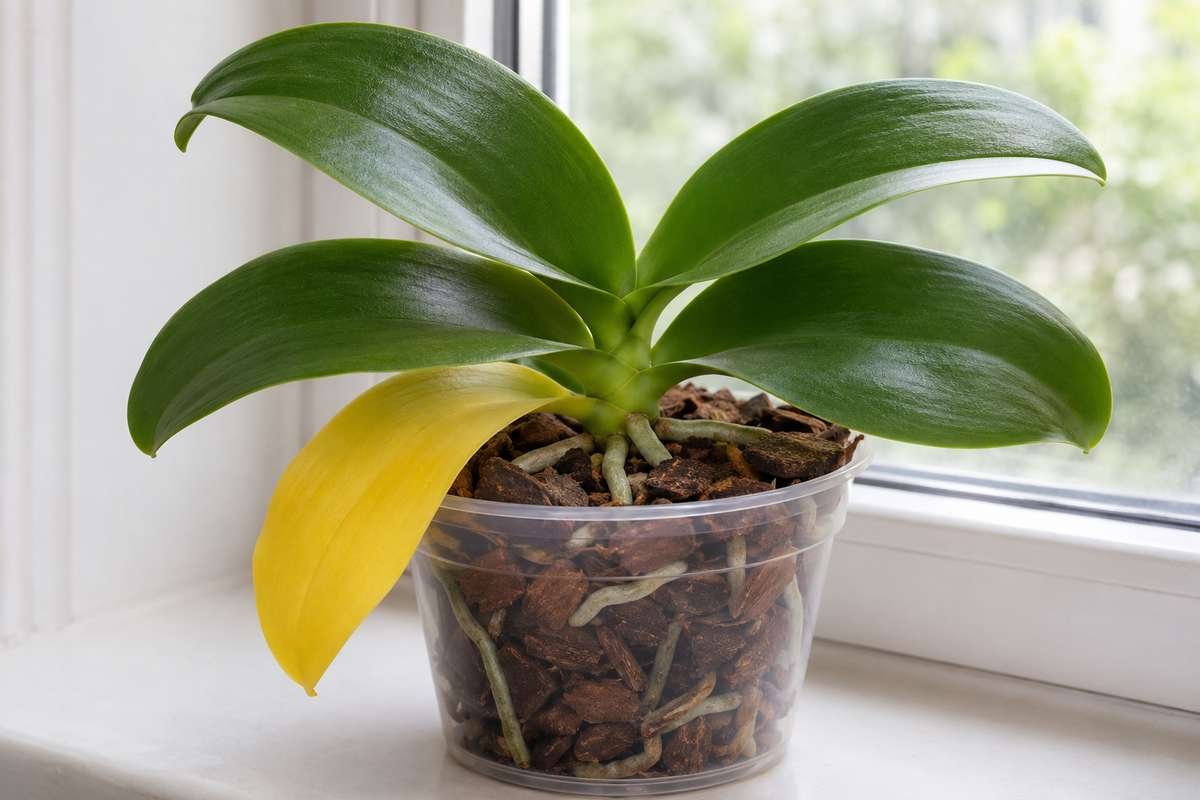
Yes, for one lower leaf at a time. In the AOS article on leaf yellowing, Sue Bottom describes a lower Phalaenopsis leaf turning clear yellow and slowly losing color as the plant reabsorbs its nutrients for new growth. It often happens in spring, when new leaves are coming in.
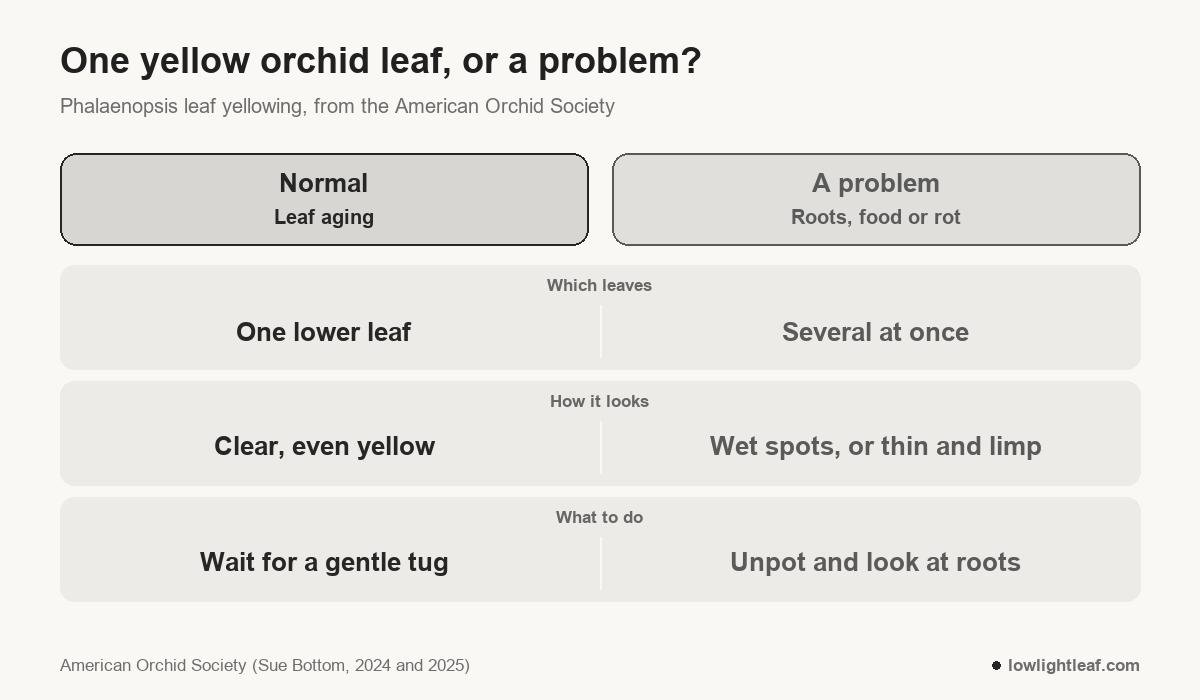
Should you remove a yellow orchid leaf? Not right away. The AOS advice is to leave it until the plant has taken back what it can, then remove it once it comes away with a gentle tug. Cutting a half-green leaf early takes those nutrients with it. The exception is a leaf that’s soft or rotting, which is covered further down.
If the yellowing has spread past one leaf, the page on yellow leaves across houseplants explains how the pattern of yellowing points to a cause. For an orchid, the roots come next.
Look at the roots first
When more than one orchid leaf yellows, the roots are the first thing to look at. The AOS says roots rot either because the plant is watered too often or because the potting mix is breaking down, and once roots rot they can’t take up water. An overwatered orchid ends up looking thirsty: the AOS describes leaves that turn thin and droopy instead of plump and firm.
Old mix is a common culprit. The AOS culture sheet says orchid bark usually starts to decompose in about two years, and a decaying mix smothers the roots. A new orchid from a store can already be sitting in tired or overly wet mix. When someone on r/plantclinic posted a week-old nursery orchid with yellowing leaves, the most upvoted practical answer was short:
“You are not killing it, the store did. Change soil ASAP”
– r/plantclinic, July 2026 (91 upvotes)
To look at the roots:
- Slide the plant out of its pot. The AOS says to knock it out and find out why if the plant starts to look dehydrated.
- Sort the roots by color and feel. Healthy roots are silvery white when dry and turn pale green after watering, per University of Maryland Extension. Roots that look nothing like that are the ones to worry about.
- Look at the mix itself. Bark that is breaking down, or white, thread-like mold growing through it (the AOS calls it snow mold), means the mix is decaying.
- Repot in fresh mix. The AOS suggests fresh potting mix and light watering until the plant reestablishes.
Roots climbing out over the pot rim aren’t a problem. Maryland’s extension says these aerial roots are normal for moth orchids and shouldn’t be cut off.

Wrinkled yellow leaves deserve a closer look too. Maryland links wrinkled leaves to low humidity or too little water, but the AOS points out that a plant with rotted roots looks dehydrated even in wet mix. Only the roots tell you which one you have.
Orchid leaves turning yellow from cold, drafts or cold water
Cold can turn orchid leaves yellow. The AOS says some orchids yellow and drop leaves when nights fall below about 55 to 60°F, and its culture sheet keeps Phalaenopsis nights above 60°F outside the autumn chill that sets flower spikes. The RHS gives the same floor: keep moth orchids above 16°C (60°F).
The water you use matters as well. The AOS lists low temperatures, cold water and ice cubes as causes of cold damage, which shows as sunken, discolored or water-soaked patches, and recommends room-temperature water.
A north-facing windowsill in winter is both cold and dim. One UK grower on r/orchids had exactly that setup, with the heating rarely on, and was losing one low leaf after another. A reply put the temperature first:
“9C indoors is pushing it, and id recommend not fertilizing based on season but on what you see. If the orchid is growing new leafs or roots, fertilize. If it’s starting a flower spike, hold off. It definitely could use more light, though. The old leaves falling off are larger than your new growth.”
– r/orchids, January 2026 (9 upvotes)
Nine degrees Celsius is about 48°F, well under the AOS minimum. In a north-facing apartment like mine, a thermometer on the sill overnight settles the question faster than guessing.
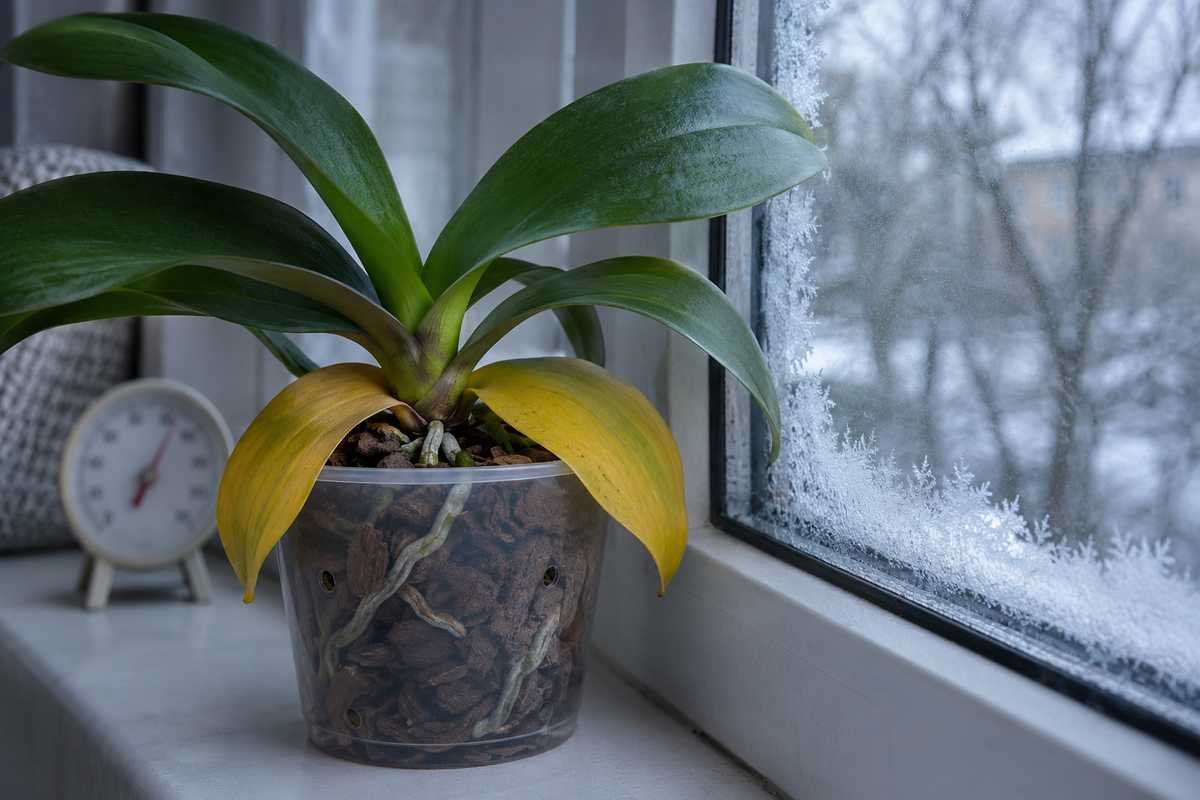
If leaves are yellowing and buds or flowers are dropping at the same time, temperature swings are a likely link. The AOS culture sheet says fluctuating temperatures can cause bud drop on plants with buds ready to open.
Too much light or sunburn
If your orchid sits in strong light, the yellowing looks distinctive. University of Maryland Extension says very high light turns the leaves yellow-green or almost yellow, with pink or reddish color along the edges. The AOS describes sunburn as a whitish or yellowish scar that fades to tan or black, on the part of the leaf that gets the most sun.
A burn scar won’t turn green again, but the AOS says a lightly burned leaf still photosynthesizes. Move the plant back to bright, indirect light, which the AOS culture sheet puts at an east window ideally.
Too little light looks different. Maryland says low light gives dark green, stiff leaves, not yellow ones. A dim plant can still shed old leaves faster than it grows new ones, which is what the Reddit reply above noticed.
Yellow spots, soft patches and pests
Yellow that comes with soft, wet spots needs fast action. The AOS describes bacterial soft rot as small water-soaked spots often surrounded by yellow halos, spreading so quickly that a plant can rot completely in two to three days. Bacterial brown spot, the most common Phalaenopsis disease, starts as a soft, water-soaked blister with a yellowish or pale green halo, and kills the plant if it reaches the crown.
For a fast-moving soft rot, the AOS says to cut away the infected tissue with a sterile tool, going about an inch below the damage, then pour hydrogen peroxide over the wound. The AOS also suggests treating nearby plants.
Water sitting in the crown, where the leaves meet in the center, causes rot too. The AOS suggests tilting the plant so the crown drains, and watering early in the day.
Pests can also yellow leaves. Spider mites leave a pale, stippled pattern and sometimes webbing under the leaf, according to the AOS, and soft brown scale forms light yellowish to dark brown shells on leaves and spikes. For a few scale insects, the AOS suggests a cotton swab dipped in isopropyl alcohol.
Feeding, watering and dry winters
If several leaves yellow and you find healthy roots, look at feeding. Sue Bottom’s AOS article says that a plant sacrificing older leaves for new growth may not have had enough nutrition in previous months, and that magnesium is often overlooked, since many fertilizers contain none. Use a fertilizer that lists it and follow the label.
The opposite mistake causes yellowing too. The AOS notes that keeping orchids too dry in winter can turn leaves yellow, and the culture sheet recommends watering thoroughly and then waiting until the mix is nearly dry. How often should you water an orchid? Maryland’s extension says that under normal home temperatures, it shouldn’t need water more than once a week.
Baking soda comes up a lot in searches about orchids. The AOS mentions it only as a home fungicide spray for Botrytis, the fungus that spots flowers, not as a fix for yellow leaves.
If a cat has been chewing those leaves, moth orchids are on the ASPCA’s non-toxic list, and my cat, Miso, is why I check that list for every plant. Our page on whether orchids are toxic to cats has the details.
Count the yellow leaves, then touch them. One firm yellow leaf at the bottom can wait for its tug. A soft one can’t wait at all.

Ellie Marsh
Houseplant grower who spent years in a north-facing apartment. Writes practical care guides for low light homes, checked against extension and botanical garden sources.