Last updated on November 2, 2026
Good polka dot plant care comes down to bright, filtered light, evenly moist soil and regular pinching. NC State Extension lists Hypoestes phyllostachya for partial shade and says too little light fades the leaves and stretches the stems, while too much direct sun makes them crinkle and curl.
Get the light right first, because nothing else in polka dot plant care makes up for a dark spot. After that, the plant asks for steady water, a pinch every so often, and a fresh start from cuttings once it gets old and bare.
How much light does a polka dot plant need?
A polka dot plant needs bright, filtered light to hold its spots. UW-Madison Extension says it grows best that way and tolerates some sun, and that color is better in partial shade than in full sun, but the leaves fade out in very low light.
So this isn’t a dim-room plant, whatever the label says. In my old north-facing apartment it would have been a grow-light plant, and it sits in the bright-room section of our low light indoor plants list for that reason. If you’re not sure how bright a spot is, take a light-meter reading and run it through the DLI calculator.
The leaves tell you which way you’ve missed:
- Too dim: the pink or white spots fade toward green and the stems stretch, with more bare stem between each pair of leaves. UW-Madison notes the plants get leggy as they age, particularly in lower than ideal light.
- About right: strong color and short gaps between leaf pairs. NC State Extension puts its range at dappled sun or partial shade, meaning 2 to 6 hours of direct sun.
- Too much: the leaves crinkle and curl, per NC State.
Moving straight from a dim corner to a hot sill can swap one problem for the other. One owner on r/plantclinic did just that on a shop worker’s advice:
“It started off in a spot about two feel away from a south facing window but recently as of two weeks ago got moved to a window sill per the plant shop worker’s advice but the leaves are still browning.”
– r/plantclinic, September 2026 (4 upvotes)
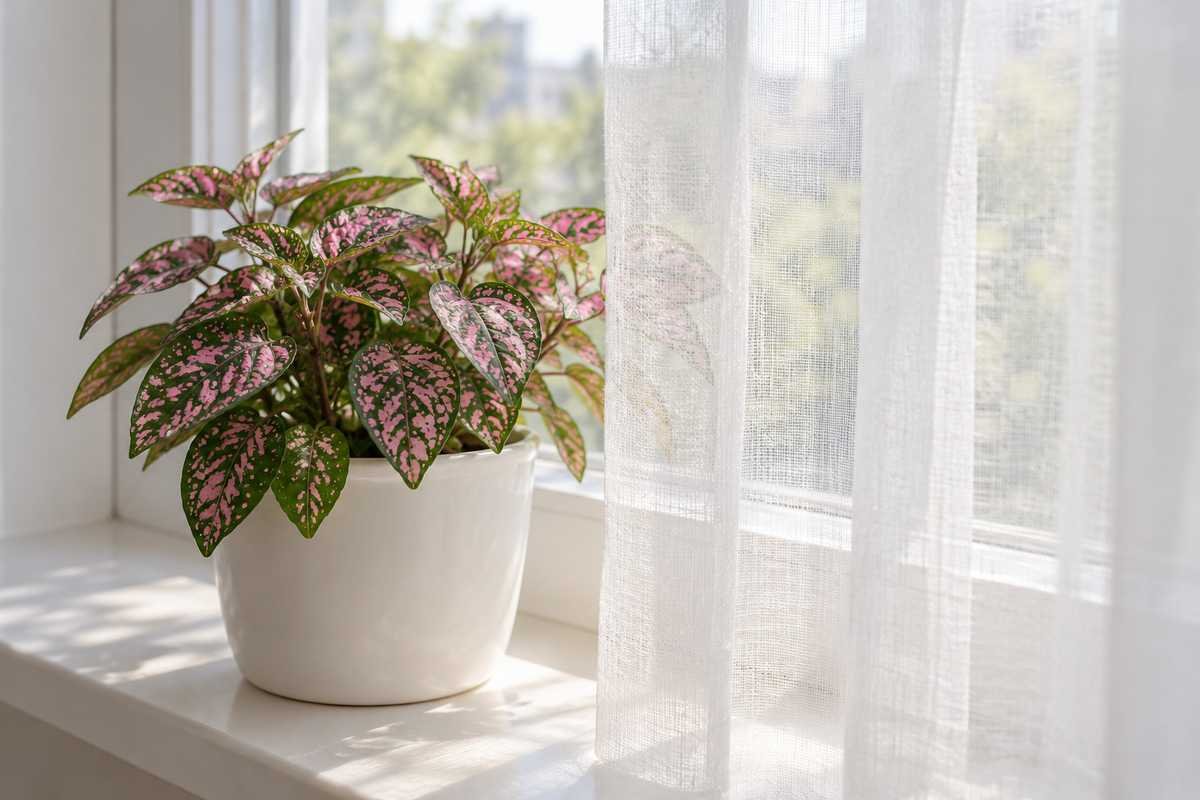
A sheer curtain between the plant and a south or west window gives the filtered light both extensions describe. With no bright window at all, UW-Madison says polka dot plants can also be grown under artificial light, and grow lights for indoor plants covers distance and hours.
Watering and humidity
Water when the top of the soil has dried slightly. Don’t wait for the whole pot to dry. UW-Madison puts it plainly: let the soil dry slightly between waterings, because the plant is only somewhat drought tolerant and grows better with plenty of water. NC State tags it drought intolerant.
A dry pot shows fast, because the whole plant flops, and a drink usually stands it back up. Its relative the nerve plant, also in the acanthus family, faints the same way. The opposite mistake is just as real: both NC State and UW-Madison list root rot among its problems, so the pot needs a drainage hole and the saucer shouldn’t hold water.
The RHS says to water generously in growth and sparingly in winter. For humidity, UW-Madison says it prefers a humid environment and may need misting indoors in winter, when heating dries the air. If your air runs dry, how to increase humidity in house air has options that do more than a spray bottle.
How do you make a polka dot plant bushier?
You make a polka dot plant bushier by pinching off the growing tips, again and again. The RHS says to pinch out the growing tips to promote a bushy habit, and UW-Madison says regular pinching back keeps the plants compact. Each pinched stem branches below the cut.
The catch is that it never stops. One r/houseplants reply sums up the routine:
“If I kept pinching off the new growth, the bushiness was perfect but the second I let it go for a second, it was awkwardly leggy.”
– r/houseplants, September 2026 (30 upvotes)
Pinching shapes a plant that already has enough light. It can’t fix one that’s stretching because the spot is too dark, so if the gaps between leaf pairs keep growing after every trim, move the plant before you cut again.
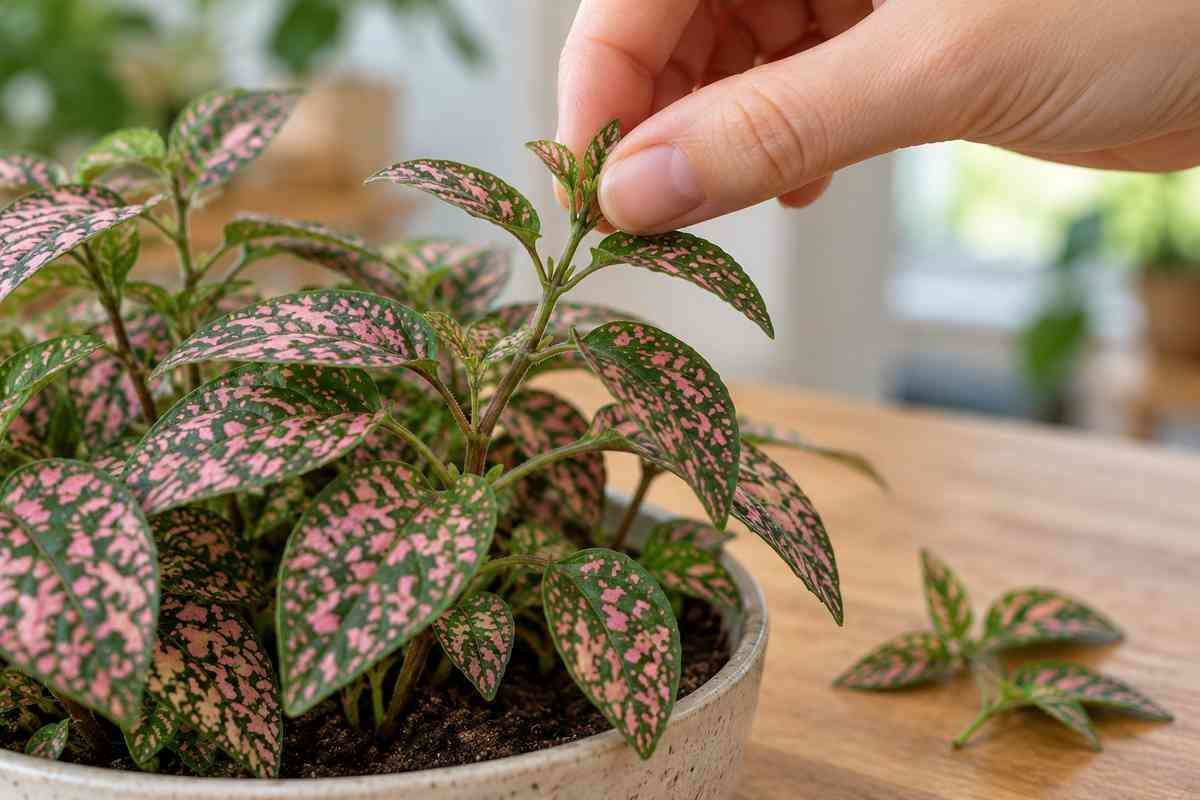
Flower spikes are the other thing to snip, since NC State says the small lilac flowers aren’t the main attraction and that removing them lets the plant put more energy into its leaves. UW-Madison adds that houseplants flower in late summer or fall, if at all.
Rooting cuttings, the easy part of polka dot plant care
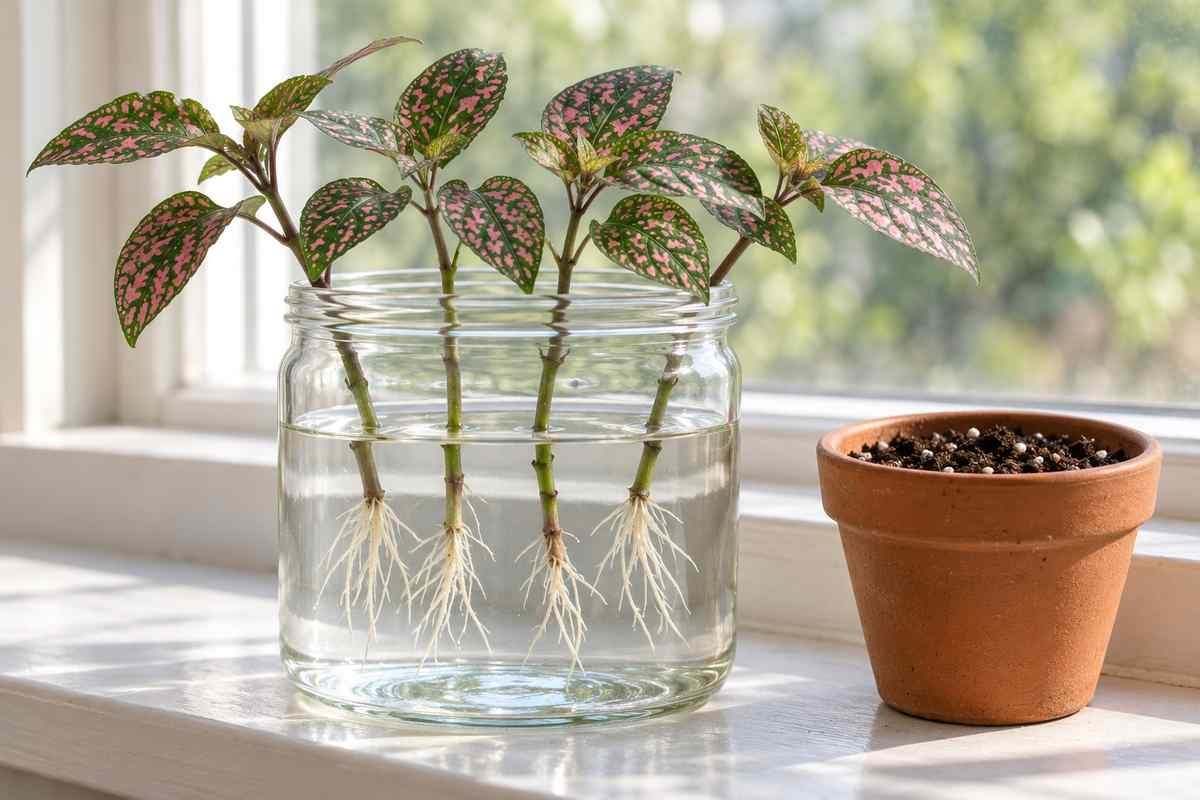
Polka dot plant cuttings root quickly in plain water, so every pinch can become a new plant, and UW-Madison Extension gives a simple method:
- Cut a stem tip about 4 inches long.
- Strip the leaves from the lower part of the stem.
- Stand it in water in a bright spot (NC State notes roots form there), or push it straight into moist potting mix, sand or vermiculite.
- Pot it up once roots show, in a porous mix high in organic matter.
- Pinch the new plant early so it branches from the start.
UW-Madison also suggests a way to carry a garden plant through winter: pot it up from the garden in late summer and bring it inside.
Temperature, soil and feeding
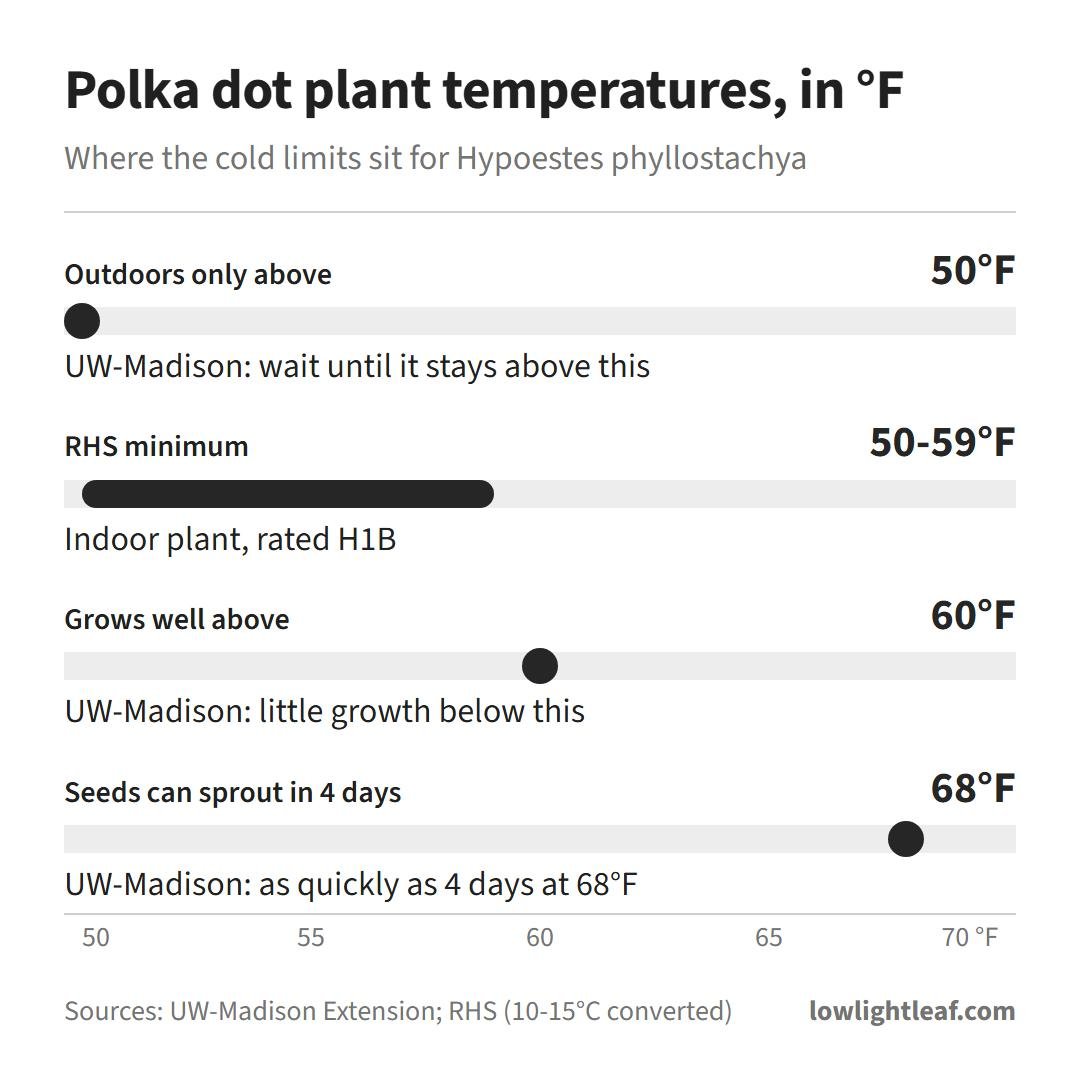
Keep a polka dot plant warm. UW-Madison says it doesn’t grow well until temperatures are over 60°F and shouldn’t go outdoors until it stays above 50°F. The RHS gives a minimum of 10 to 15°C, roughly 50 to 59°F. NC State tags it frost tender and hardy only in zones 10 and 11. Seed needs the same warmth: UW-Madison says it can germinate in as little as 4 days at 68°F.
For soil, NC State lists a well-drained mix high in organic matter. The RHS suggests a balanced liquid fertilizer every 2 to 3 weeks in summer, and UW-Madison says to feed periodically with a dilute one once the plant is established.
Is a polka dot plant safe for cats and dogs?
Yes. The ASPCA lists the polka dot plant, Hypoestes phyllostachya, as non-toxic to dogs, cats and horses, though its entry still notes mild vomiting and diarrhea as possible signs if a pet eats some. It also appears under the names freckle face, measles plant and pink splash.
Check the label for the word begonia. The polka dot begonia, Begonia maculata, shares the nickname but is a different, much bigger plant: one owner on r/begonias asked what to do with a polka dot begonia that had grown past 3 1/2 feet. The ASPCA lists begonias as toxic to dogs and cats, with soluble calcium oxalates and the underground parts most toxic. Our plant toxicity checker covers both, and there are more options in pet friendly indoor plants.
Why polka dot plants crash, and when to start over
Most polka dot plants decline through the problems above: a dry pot, a wet one, a dark corner or a hot sill. NC State and UW-Madison also list powdery mildew, plus aphids, mealybugs and whiteflies, so check the undersides of the leaves when a plant goes downhill for no clear reason.
Some decline is just age. UW-Madison says plainly that houseplants eventually need to be replaced, and they get leggier as they get older. When a plant is mostly bare stem with a tuft of leaves at the top, root the best tips and start the next pot.

Ellie Marsh
Houseplant grower who spent years in a north-facing apartment. Writes practical care guides for low light homes, checked against extension and botanical garden sources.