Last updated on October 22, 2026
Give a Christmas cactus bright, indirect light, water it when the top inch of soil is dry, keep it in a fast-draining mix in a snug pot, and let fall nights run cool and dark. That is Christmas cactus care in one breath, and University of Minnesota Extension lists root rot from soggy soil as one of the most common ways these plants die.
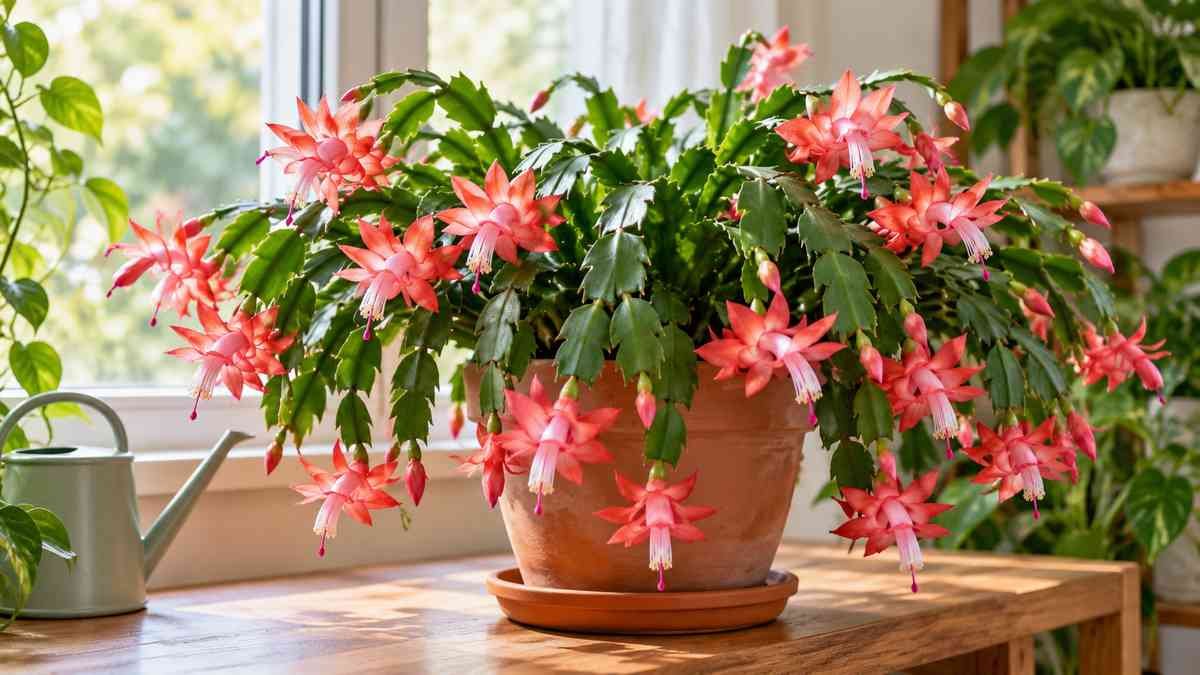
So treat it like a forest plant that happens to be a cactus. It grows on tree branches in the wild, where rain drains away fast, which is why Purdue calls it less drought tolerant than its desert relatives and why Wisconsin stresses perfect drainage. Most of the year-round work follows from that one fact, starting with where the plant sits.
How much light does a Christmas cactus need?
A Christmas cactus needs bright, indirect light, and it tolerates less. Purdue University’s consumer horticulture team says the plant adapts to low light but produces more flowers with more light, and University of Florida IFAS suggests a spot within six feet of a south-, east- or west-facing window.
Notice which window is missing from that list. After years in a north-facing apartment, I’d call a north window the bare minimum for a plant like this, and Purdue’s point about fewer flowers in low light applies in full. If that’s all you have, put it right at the glass, or give it a grow light during the day and switch it off at night, because evening light in fall is what stops buds from forming. Other plants that handle that window better are in north-facing window plants.
Too much sun is the other mistake. Purdue says the segments may turn a bit red under excessive light, and that strong direct sun can burn them or make them limp. University of Wisconsin-Madison Extension puts the line at no more than a few hours of direct morning sun, and Clemson Extension notes that bright summer sun turns plants pale and yellow, while full sun is beneficial in fall and winter.
Summer outdoors suits it, in the right spot. Minnesota recommends part shade with 3 to 6 hours of sun, ideally filtered light under a tree, and Wisconsin warns against the deep shade of a big maple. Bring it in before nights drop into the low 50s°F, Illinois Extension says, and Purdue suggests easing it back in by lengthening the hours it spends inside a little each day.
Temperature, drafts and humidity
Room temperature suits it most of the year. Iowa State keeps holiday cacti at 60 to 70°F indoors, Clemson says 70 to 80°F is ideal for spring and summer growth, and Wisconsin puts the floor at 55 to 60°F, with no tolerance for frost. Keep the pot away from heat vents, fireplaces and other sources of hot air; Purdue says drafts and temperature extremes make buds fall before they open. If the only bright spot is above a radiator, I’d take a slightly dimmer one that stays steady.
Humidity is the part of Christmas cactus care that sets it apart from desert cacti. Minnesota lists high humidity among its needs, Penn State says the plants enjoy a light daily misting, and Illinois names low humidity as one cause of bud drop.
How often to water a Christmas cactus
Water a Christmas cactus when the top inch of soil feels dry, the trigger Purdue and UF both use, and never let the pot stand in water. No fixed number of days fits every home.
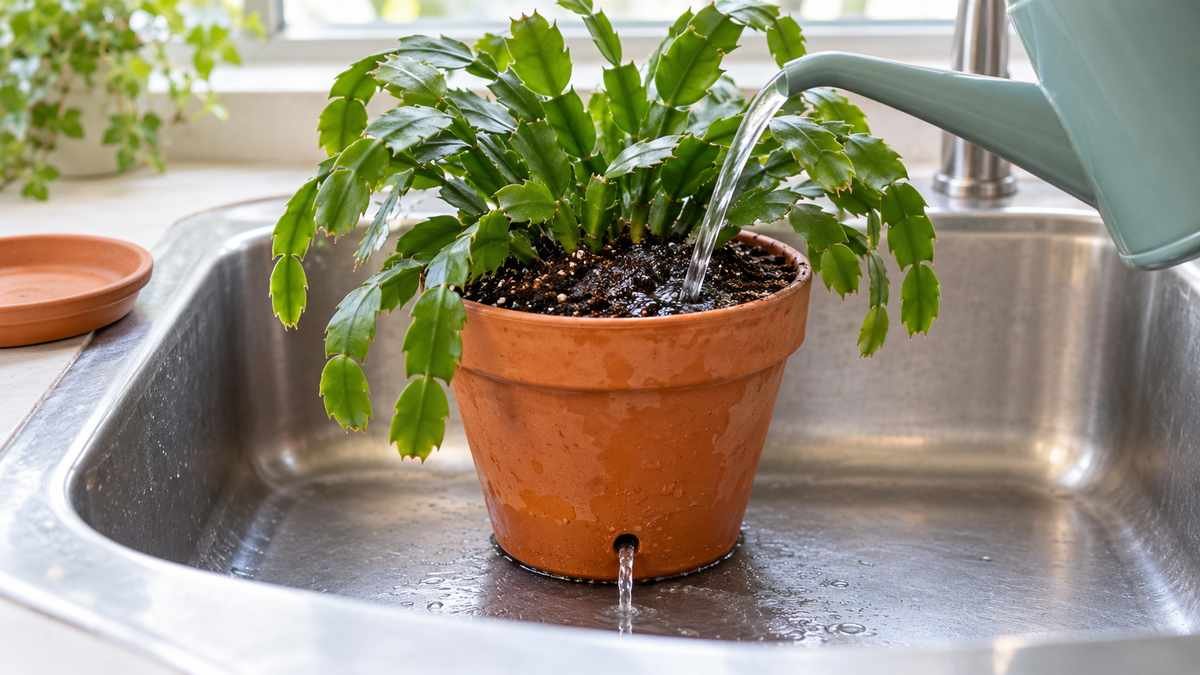
Purdue says the interval changes with temperature, light, growth and humidity, and one UC Master Gardener column offers every 1 to 3 weeks only as a loose rule of thumb.
Where the extension services split is how far to let it dry. Iowa State says to let the soil dry completely between waterings when the plant isn’t flowering. Clemson says not to let it dry out completely. Purdue’s own pages disagree with each other: its FAQ says water when the top inch is dry, while its after-the-holidays article says the top half. What the plant is doing at the moment settles most of it:
| What the plant is doing | Watering | Who says so |
|---|---|---|
| Growing, spring and summer | Water thoroughly when the top inch is dry; it handles being slightly underwatered | UF, Purdue, Clemson |
| Late summer, before buds | Some growers cut back a little to harden the stems, then water normally once buds swell | Wisconsin |
| In bud and in bloom | Keep the soil evenly moist; dry soil drops buds | Iowa State, Clemson, Illinois, Purdue |
| After flowering, until new growth | Water less often, then return to normal in spring | Minnesota, Iowa State, Illinois, Penn State |
| Dark winter months | Never waterlogged, but not bone dry either | Clemson |
The mix decides the rest. Wisconsin says frequent watering is fine in a very well-drained mix, and that a heavier mix should dry somewhat between waterings. In practice, I’d lean toward Iowa State’s “dry completely” in a dense, slow-draining soil, and toward Clemson’s “never completely dry” in a gritty one.
Water in the sink and let it drain, Minnesota suggests, and tip out whatever collects in the saucer or a decorative outer pot. Minnesota says excess water left there can lead to wilting, dropped buds and root rot.
Christmas cactus soil, pot size and repotting
Good Christmas cactus care starts below the soil line: an airy, fast-draining mix in a pot that looks slightly too small. Minnesota, Clemson, Iowa State and UF all say these plants do best a little pot-bound, and Minnesota calls drainage holes critical.
The potting mix
Each extension service has its own recipe, and they share one idea: ordinary potting soil opened up with something coarse. I’d use whichever one matches what you can buy locally; the drainage is what counts.
- Clemson and Illinois: 60 to 80% potting soil with 20 to 40% perlite.
- Purdue: two parts potting soil to one part clean sand or vermiculite, or a packaged succulent mix.
- Minnesota: one part sterile potting soil, two parts peat moss and one part sharp sand or perlite.
- Iowa State: all-purpose potting soil works if it drains well; a special cactus mix isn’t required.
Wisconsin adds a reason to refresh the mix even when the pot isn’t crowded: peat breaks down over a few years, and the soil starts holding water around the roots.
When to repot, and how
The schedules differ more than you’d expect. Minnesota says a healthy plant may only need repotting every three years, Clemson says about every three years, Penn State Extension says every three to four, Wisconsin says at least every four to five, and Iowa State says only when it has completely outgrown the pot. The signs matter more than the calendar: roots coming out of the drainage holes (Penn State), or a plant that dries out and wilts often between waterings (Purdue).
Repot after flowering, never while it’s in bloom. Penn State prefers late winter or early spring, and Iowa State says spring or early summer.
- Ease the plant out and loosen the roots. Wisconsin suggests shaking off most of the old soil so you can see whether the roots are firm and healthy.
- Move up only one pot size. Penn State’s method sets the top of the root ball about an inch below the rim.
- Fill with fresh mix, press out air pockets and water moderately.
- Keep it out of strong light for two to three days, Penn State says, then go back to normal care.
- Water a little less than usual for about a month, which Wisconsin says lets new feeder roots grow.
A year of Christmas cactus care: feeding, pruning and rest
Year-round Christmas cactus care follows the plant’s own cycle: rest after flowering, steady growth and feeding through summer, then less food and longer nights in fall. The months shift with your plant’s bloom date, so read this as an order of jobs rather than a fixed calendar.
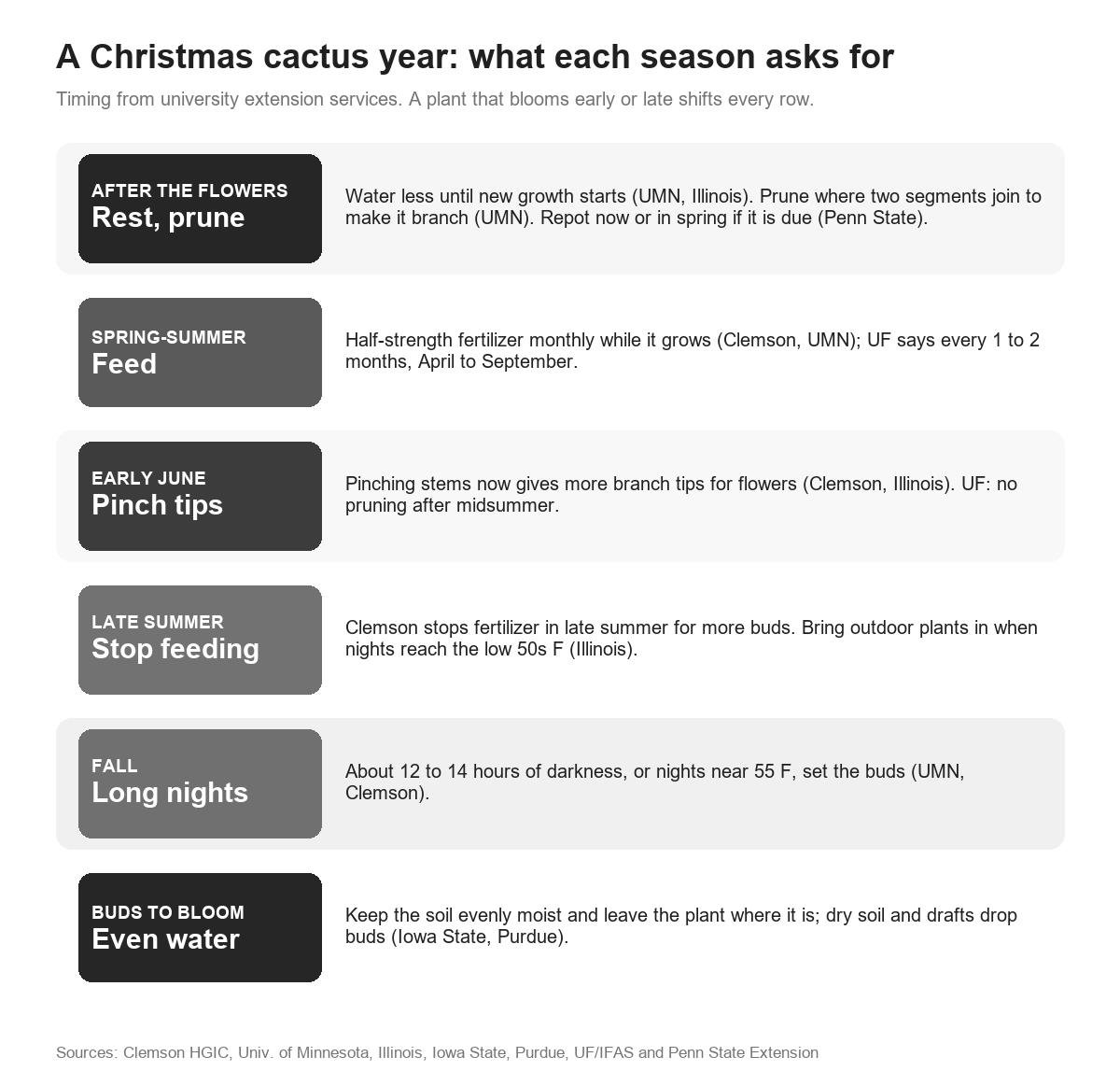
Feeding is where the schedules vary most. Clemson Extension feeds monthly at half strength from late winter or early spring through summer, then stops in late summer for better bud set. Minnesota feeds monthly from June through August at half strength, then switches to a low-nitrogen, high-phosphorus and potassium formula such as 0-15-10 in fall. UF says every one to two months from April to September. Purdue says no fertilizer is needed while it blooms.
Clemson is the one source that brings up magnesium. It says holiday cacti need more of it than many plants and suggests Epsom salt at 1 teaspoon per gallon of water once a month in the growing season, in a different week from the regular fertilizer. That’s a nutrient recommendation for growth, not a trick for flowers.
Pruning comes in two moments. After flowering, Minnesota says to cut where two segments join, and the plant grows one or two new segments from that point. In early June, Clemson and Illinois pinch stem tips so the plant branches and carries more flowers. UF says not to prune after midsummer. Clemson also “levels” plants at the end of September, removing new segments shorter than about 0.4 inch, because those immature tips won’t bud.
The pieces you remove will root. Clemson lets cuttings of three to five segments callus for a day or two before planting them about an inch deep, and says roots form in three to eight weeks.
Fall is when the buds are set, and that routine of long nights or cool nights has its own page: how to get Christmas cactus to bloom.
Why are Christmas cactus segments limp, red or dropping?
Limp Christmas cactus segments usually mean the roots can’t supply water, either because soggy soil has rotted them or because the soil stayed too dry. Red or purple segments usually mean too much light. Illinois Extension says overwatering is the more common cause of limp, wrinkled stems, because it kills the roots.
I’d push a finger into the soil before doing anything else, because the two main causes of limpness call for opposite fixes.
- Limp segments, wet soil. Minnesota’s diagnosis is too much water rotting the roots: let the plant dry out and make sure the pot drains freely. Gray-green, wilting growth with dark, mushy roots is fungal root and stem rot.
- Limp segments, dry soil. Purdue says the plant wilts under drought stress. Water thoroughly, then go back to watering whenever the top inch dries.
- Limp in a hot, sunny window. Purdue lists strong direct sun as a cause of limp segments too. Move it back from the glass.
- Red, purple or pink tint. Purdue links reddening to excessive light, and the UC Master Gardeners of Tulare and Kings Counties add soil left too dry for a long stretch.
- Young stems shriveling even though you water. Wisconsin treats this as a sign of root loss, along with soil that stays wet for days and tiny hair-like roots at the bases of the segments. Unpot it and look at the roots.
- Segments falling off. Wisconsin calls the dropping of young segments a stress sign. Minnesota notes that a very large plant can also shed branches it can no longer hold up, which pruning and a slightly bigger pot fix.
- Brown, corky base. Normal aging, Minnesota says, as long as it isn’t scale insects.
- Black, slimy patches climbing from the soil line. Minnesota identifies bacterial soft rot and says to discard the plant.
Root rot is the one Clemson calls the major disease of these plants, and it’s the reason drainage keeps coming up in Christmas cactus care. For buds falling off rather than segments, the causes are different and are in the bloom page linked above. Pests are less common, but Clemson lists mealybugs, scale, spider mites, aphids and fungus gnats; white cottony tufts in the joints are worth treating early, as described in how to get rid of mealybugs.
Thanksgiving cactus care: is it any different?
Thanksgiving cactus care is the same as Christmas cactus care. Iowa State Extension says all the holiday cacti need similar growing conditions, and it notes that most plants sold as “Christmas cactus” are actually Thanksgiving cacti or hybrids, so many owners are already growing one.
The segment edges tell you which you have. Clemson describes two to four saw-toothed points on each segment of a Thanksgiving cactus (Schlumbergera truncata), and rounder edges on a Christmas cactus (Schlumbergera x buckleyi, also known by the older name S. bridgesii, Iowa State notes); the flower anthers are yellow on the first and purplish-brown on the second. The practical difference is timing: Clemson says a Thanksgiving cactus normally flowers about a month before a Christmas cactus.
With Miso in the house, I looked up the ASPCA listing before anything else: it lists Christmas cactus as non-toxic to cats, dogs and horses. How it compares with other holiday plants is in is Christmas cactus toxic to cats. A potted Norfolk Island pine is on the ASPCA’s non-toxic list too, under the name Australian pine, though it needs a brighter window; see Norfolk Island pine care.
More Christmas cactus questions
How big can a Christmas cactus get?
An old Christmas cactus can fill a 12- to 15-inch pot and spread nearly three feet across, according to University of Wisconsin-Madison Extension. Plants that size can be decades old, and the stems thicken and turn woody at the base to carry the weight.
How many times a year does a Christmas cactus flower?
Penn State Extension says Thanksgiving and Christmas cacti can bloom more than once a year with the right care. Clemson says one flowering can last 7 to 8 weeks at about 68°F.
How long do Christmas cacti live?
Christmas cacti can live more than 100 years, University of Minnesota Extension says, which is why so many are passed down in families. Wisconsin’s insurance policy for an old plant is simple: root a few cuttings every three to five years, so a healthy young copy is waiting if the original declines.

Ellie Marsh
Houseplant grower who spent years in a north-facing apartment. Writes practical care guides for low light homes, checked against extension and botanical garden sources.