Last updated on November 17, 2026
A spider plant flower is a small white bloom, about the size of a dime, that opens on a long, wiry stalk. It isn’t a warning sign or a prize. It’s a normal stage, and the real payoff is the baby plantlets that grow where the flowers were.
If you just spotted one, you’re probably wondering what it means and whether to cut it off. Short version: leave it alone for now, then decide what to do with the plantlets. Below: what the bloom looks like, what sets it off, and what to do once it fades.
What do spider plant flowers look like?
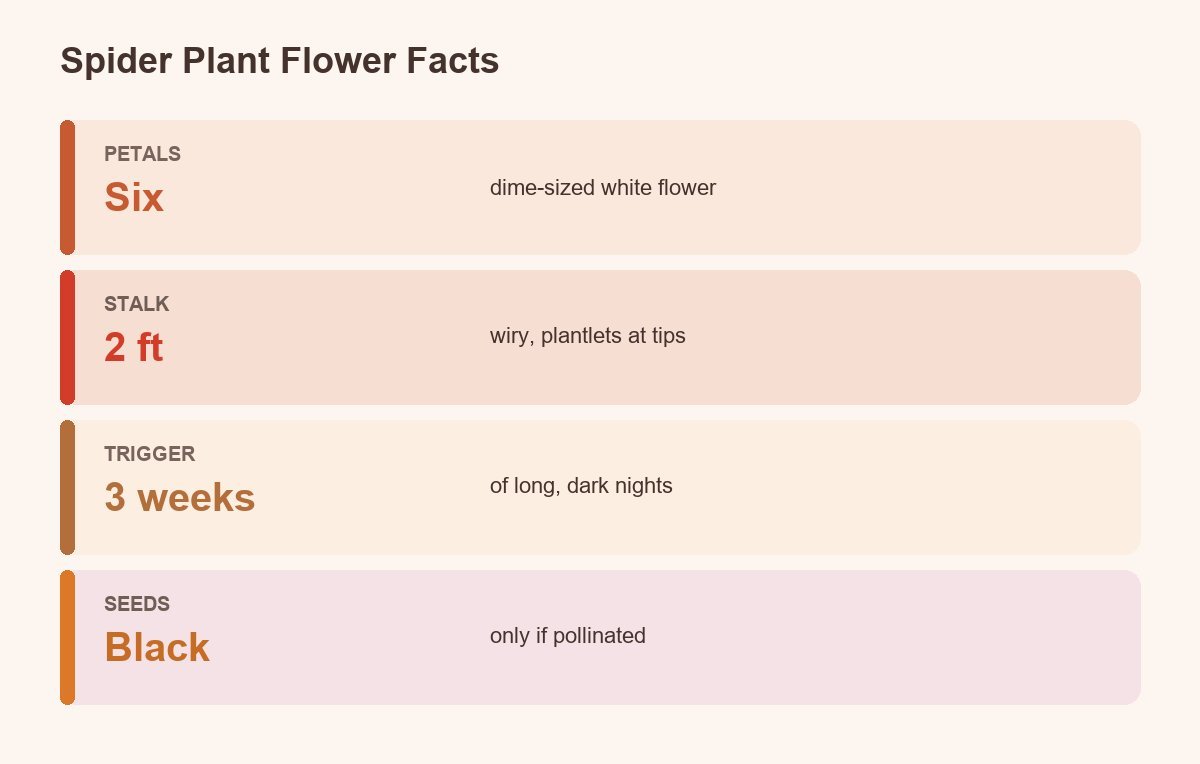
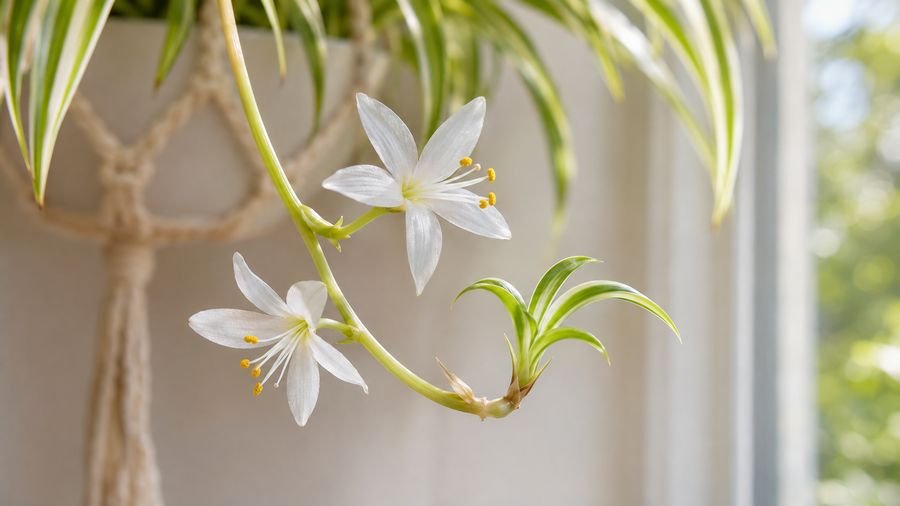
Spider plant flowers are small, white and star-shaped. The University of Arkansas Division of Agriculture describes them as dime-sized with six petals, borne on branching stalks that can reach 2 feet long. It calls the flowers interesting but insignificant, which is fair.
The stalks are the bigger show. They arch out from the center of the plant, thin and wiry, with the flowers at the ends. University of Wisconsin-Madison Extension notes the stems can carry a few small leaves along the way.
If you see a cream or yellowish stalk instead of a green one, that isn’t a problem. The same Wisconsin page says the ‘White Stripe’ cultivar has cream to yellowish flower stalks, so the color can simply come from the variety. You can compare leaf patterns on our spider plant varieties page to see which one you have.
Why is my spider plant flowering?
Wisconsin Extension says the stalks typically form in response to short days and long, uninterrupted nights lasting at least three weeks. Indoors, though, they can show up at any time of year. So the trigger is mostly about day length, not about anything you did right this week.
That matters because plenty of articles treat a bloom as a report card for your care. I haven’t found an extension source that does. Neither Wisconsin nor Arkansas says a flowering plant is healthier than one that isn’t, so I’d read the bloom as a sign of a mature plant and nothing more.
Timing in the Arkansas write-up lines up with that. Flower stalks appear in summer, and the plantlets form on them as the days get shorter in the fall. Your plant may follow a different calendar indoors, since a lamp or a bright window changes how long its nights really are.
Can you make a spider plant flower on purpose?
Only nudge it. Wisconsin Extension says spider plants grow and produce plantlets best when slightly pot bound, and that heavily fertilized plants may not form as many plantlets. So the only sourced advice is to stay out of the way: a snug pot, light feeding, and a regular dark night.
Here is how that looks in practice.
- Keep the pot snug. Wisconsin lists slightly pot bound as the best state for plantlet production, so skip the oversized upgrade.
- Feed lightly. The same page suggests fertilizing every 3 to 4 months, or more often at half strength.
- Give it real darkness at night. A lamp left on in the same room cuts into the long nights the plant seems to respond to, though no source tells us how much light it takes.
- Give it medium to bright light during the day. For the full routine, our spider plant care guide covers watering and light in more detail.
One gap: I couldn’t find a number for how often indoor spider plants bloom, so I won’t tell you it’s rare or common. One r/spiderplants poster wrote that they had never even seen one until last week, which tells you only that it surprises some owners.
Do spider plant flowers turn into babies?
Yes. After the flowers finish, small leaf tufts form at the ends of the stems, and those are the plantlets. Wisconsin Extension says more leaves are produced at the stem ends after flowering, forming small plantlets, and Arkansas says they hang below the parent like spiders on a web.
“Every flower will be a new baby spider plant. It’s beautiful when they start to flower because you know you’ll have baby spider pups. Congratulations”
– r/houseplants comment (26 upvotes)
That commenter is describing the usual pattern. Seeds are possible too, but plantlets are the quick route to a second and third plant.
What to do after the flowers fade
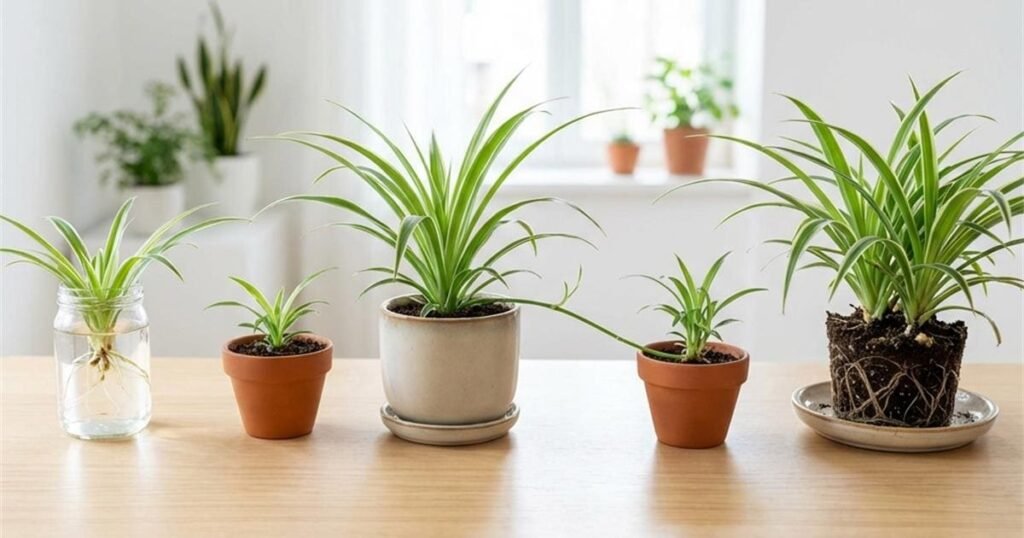
Nothing is required. You can leave the stalk in place, root a plantlet while it’s still attached, or pot up one that already has roots. Pick based on what you want from the plant, using the table below.
| If you want to | Do this | Why |
|---|---|---|
| Make a new plant with the least effort | Set the plantlet, still attached, on the surface of a pot of soilless mix and hold it down with a bent paper clip. Cut the stem once it roots. | This is the method Wisconsin Extension describes. The mother keeps feeding it while roots form. |
| Pot up a plantlet quickly | Remove one that has already started growing roots and plant it. | Wisconsin lists this as the other common method. |
| Keep the plant looking tidy | Trim the stalk once it browns or looks messy. | No source I found says trimming helps or harms, so treat it as housekeeping, not care. |
| Do nothing | Leave the stalk and plantlets hanging. | Spider plants are a hanging basket plant by habit, per Arkansas, so the stalks usually trail on their own. |
Brown tips on the leaves are a separate issue from a browning flower stalk. Wisconsin Extension ties leaf tip burn to low humidity, very dry soil, salt build-up, and fluoride or chlorine in tap water, and our spider plant brown tips guide goes through those causes one by one.
Can spider plant flowers make seeds?
Yes, if the flower is pollinated. Wisconsin Extension says a pollinated flower produces a leathery, three-angled capsule holding flat black seeds. Plants grown from seed won’t necessarily match the parent’s leaf coloring, so plantlets are the safer route for a copy.
Seeds are a project. Most owners never see a capsule.
Are spider plant flowers and plantlets safe for cats?
The ASPCA lists the spider plant as non-toxic to both cats and dogs. That’s reassuring, since dangling plantlets are exactly what a bored cat goes for. My cat, Miso, is why I check every plant against that list.
Non-toxic doesn’t mean the plant survives the attention, though. One commenter on a widely shared spider plant thread wrote:
“Catnip is like weed and spider plants are like LSD to a cat.”
– r/houseplants comment (46 upvotes)
If you share a home with a chewer, hang the plant out of reach so the plantlets get a chance to root. To check another plant, use our plants poisonous to cats and dogs checker, which covers 115 houseplants from the ASPCA list.
Spider plant flower FAQ
Should you let spider plants flower?
Yes, there’s no reason to stop it. Neither Wisconsin Extension nor the University of Arkansas describes flowering as harmful, and the flowers lead to plantlets you can root. If you don’t want the stalks, trimming them is a matter of looks.
What does it mean if my spider plant is flowering?
It means the plant has matured to the point of sending out flower stalks, usually after a stretch of long nights. It doesn’t mean something is wrong, and no source I found says it means you are doing everything right either.
Is it rare for spider plants to flower?
I can’t give you a rate, because none of the sources publish one. Arkansas describes summer flowering as part of the plant’s normal habit, and indoor plants can bloom at any time of year per Wisconsin.
The short version
A spider plant flower is optional and harmless, and nobody has shown it’s a health score. Wait for the plantlets, root a couple with a paper clip, and keep the cat from the rest. For details on propagation and care, the Wisconsin Extension article is worth the five-minute read, and the ASPCA spider plant entry is the source for pet safety.

Ellie Marsh
Houseplant grower who spent years in a north-facing apartment. Writes practical care guides for low light homes, checked against extension and botanical garden sources.