An anthurium will keep growing leaves in a dim room, but it usually won’t flower there. The New York Botanical Garden’s plant guide says that if sunlight is too limited, an anthurium will fail to produce flowers, so good anthurium care starts with bright indirect light close to a window. The rest of the routine is soil kept lightly damp but never soggy, warmth above 60°F, and humid air.
The red or pink “flowers” are waxy bracts called spathes, and they’re what a low-light room costs you. Anthuriums are also toxic to cats and dogs, which matters if you have a pet that chews leaves.
Anthurium care starts with the window
An anthurium needs bright indirect light, which indoors means close to a window and out of strong direct sun. UF/IFAS Gardening Solutions puts it plainly: outdoors in Florida anthuriums do best in low light, but as a houseplant they require bright indirect light to thrive.
That difference trips up a lot of owners. Shade outdoors is still far more light than a living room gets, and University of Missouri Extension notes that even low-light plants usually don’t get enough light more than 10 feet from an average window.
The NYBG Mertz Library guide gives a placement plan that changes with the seasons. In summer, an unobstructed north-facing window is ideal because it keeps the plant away from strong direct sun. In fall and winter, NYBG moves the plant to a slightly shaded east-facing window to make up for the shorter days, then back to more protection as winter ends. It also says to keep the plant close to the window so the leaves don’t stretch.
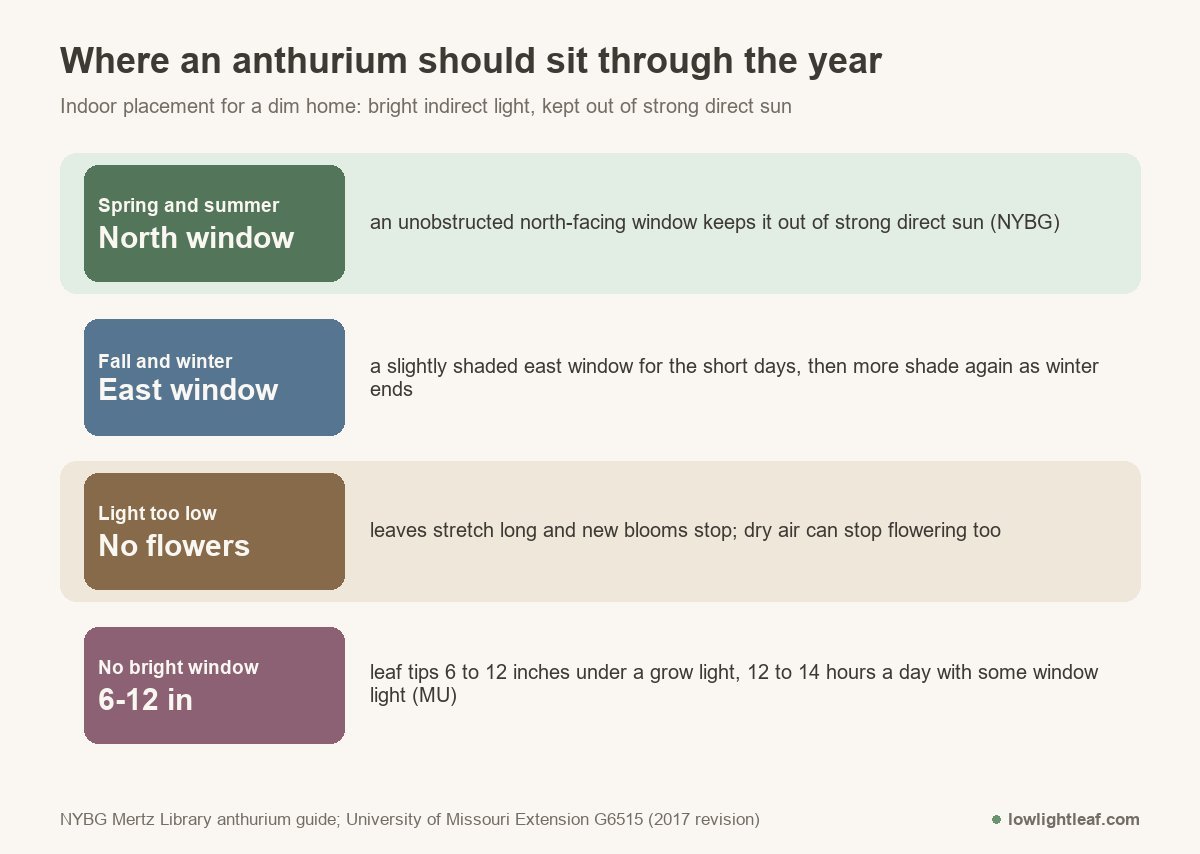
I lived for years in a north-facing apartment, and that is exactly where the winter half of this plan breaks. If your only windows face north and something outside shades them, winter light won’t be enough for blooms, and a grow light is the realistic fix. University of Missouri Extension (publication G6515, 2017 revision) says to keep plant tips 6 to 12 inches from the light source and to run lights 12 to 14 hours a day when the plant also gets some window light, or 16 to 18 hours when it gets none.
If you like numbers, MU Extension sorts houseplants into light groups by foot-candles. Medium-light plants prefer 250 to 1,000 foot-candles and grow best above 750, while low-light plants sit at 50 to 250. One anthurium grower on Reddit described where their plants live:
“They don’t love have super high light, but enough to promote growth. Mine stay around 700-1000 fc. The exception being the variegated ones, which are more like 1300 fc.”
– r/Anthurium, September 2026 (5 upvotes)
That is one person’s setup, not a rule, but it lands at the top of MU’s medium-light range rather than in the low-light group. A light meter or a phone lux app will tell you where your window actually sits, and the DLI calculator turns that reading into a daily total.
How do you know the light is too low? MU Extension lists the general signs: long gaps between leaves, leaves smaller than normal, pale stems and foliage, and lower leaves that yellow and drop. On an anthurium the first sign is usually simpler. New flowers stop coming.
Direct sun is the opposite problem. NC State Extension warns that it can scorch the leaves, and NYBG says bleached areas on the leaves come from sun scorch. For a south window, MU Extension’s advice for plants that don’t want hard sun is to set them to the side of the glass rather than right in it.
Watering without rotting the roots
Water an anthurium thoroughly when the top inch of soil feels dry, then let the extra drain away. NC State Extension uses the top-inch test, and NYBG describes the plant as sensitive to the slightest dryness at the roots but able to rot if the soil stays too wet.
NYBG’s method is specific. Water in the morning with room-temperature distilled water or rainwater, since cold water and the minerals in tap water can damage the plant. Water until it runs out of the bottom, then empty the saucer about 15 minutes later so the roots never sit in run-off.
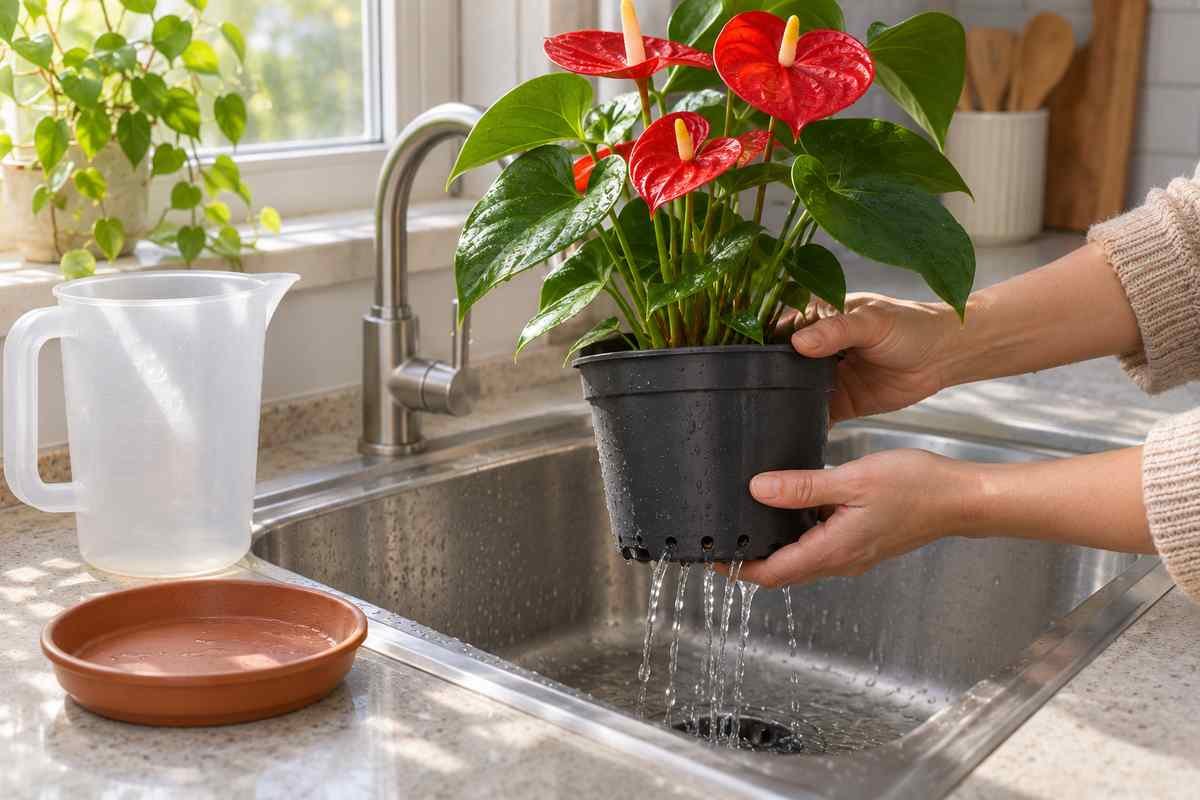
From roughly March through October, keep the soil lightly damp. In the winter rest, NYBG lets the top half inch dry between waterings. Don’t let it swing to bone dry, though: NYBG notes that flower buds may drop if the roots approach dryness even once.
Top or bottom watering both work if the whole root ball gets wet and the pot drains. NYBG waters from the top until it drains; Proven Winners suggests setting the pot in a bowl of room-temperature water for 15 to 20 minutes instead. Either way, a pot with drainage holes matters more than the method.
Warmth and humidity
Keep an anthurium between about 65 and 80°F and never let it drop below 60°F. NC State Extension gives 65 to 80°F with humidity of 60 to 80%, and NYBG says the plant grows best between 65 and 75°F and can become stressed and die below 60°F.
Cold drafts and sudden swings are the other risk. Keep it away from heat vents, air conditioning and a window that leaks cold air in January.
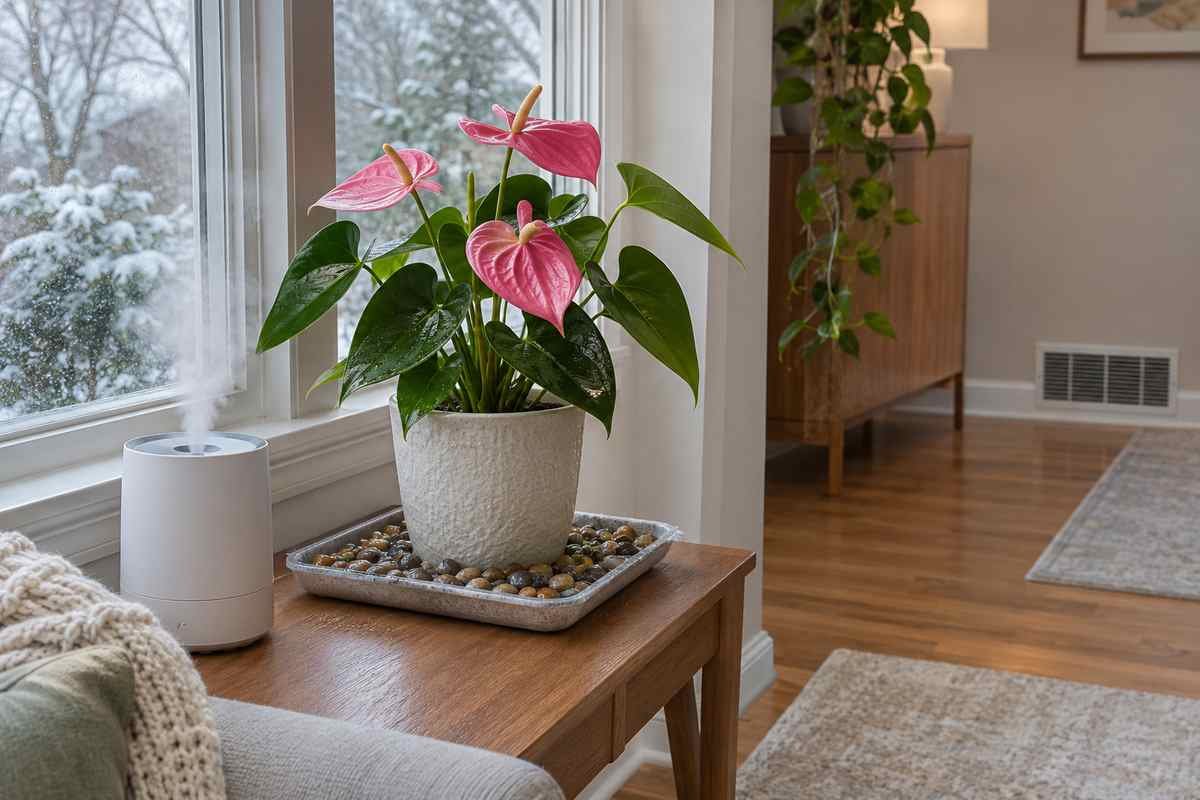
Proven Winners points out that 60% humidity is more than the average indoor environment provides. A tray of moist gravel under the pot is the fix both UF/IFAS and NYBG suggest, and a small humidifier nearby does more. There are more options in the guide to raising humidity in the house. NYBG ties dry air to two visible problems: leaves that curl and turn brown along the edges, and a plant that won’t flower or makes stunted flowers.
Soil, repotting and feeding
Anthuriums grow on trees in the wild, so they want a loose, airy mix rather than dense potting soil. NYBG suggests equal parts neutral to acid houseplant potting soil and peat moss (or a peat alternative), with coarse sand or perlite added for drainage. If the mix contains coir, NYBG advises a well-processed brand, because the plant is sensitive to the salt in poorly washed coir.
The sources disagree a little on timing. NYBG repots every one to two years in spring, one pot size up, while NC State says every two to three years or when the plant looks rootbound. Go by the roots. Set the plant so the roots sit just at the surface, and if aerial roots creep above the mix, NYBG says to cover them with damp sphagnum moss.
Feeding varies too. NYBG uses a dilute fertilizer with a higher middle number (phosphorus) once a month from March through October, then a balanced houseplant fertilizer every eight weeks in fall and winter. NC State recommends liquid fertilizer weekly in the growing season. In a dim room the plant grows slowly, so the gentler monthly schedule makes more sense. NYBG also rinses the soil thoroughly once a quarter to clear mineral salts.
When it stops flowering or the leaves change
Most anthurium problems trace back to light, water or dry air. Match the symptom first, then change one thing at a time:
- No new flowers: usually too little light. NYBG also blames low humidity, and NC State adds nutrient deficiency. Move it closer to the window before you change anything else.
- Bleached or pale patches: sun scorch, according to NYBG. Pull it back from direct sun.
- Brown edges and tips, curling leaves: dry air, per NYBG.
- Yellow, wilting leaves with brown patches: NYBG lists underwatering, but the same look comes from roots rotting in soggy soil or run-off. Feel the soil before you water again. NC State adds poor drainage and lack of nutrients as causes of yellowing.
- Flowers flopping over: stake them with soft twine, as NYBG suggests.
For pests, NC State lists aphids, spider mites, mealybugs and scale. Wet leaves and poor air movement can lead to leaf spots, so water the soil rather than the foliage.
Anthuriums around cats and dogs
The ASPCA lists the flamingo flower (anthurium) as toxic to dogs, cats and horses because it contains insoluble calcium oxalates. Chewing it can cause mouth pain and swelling, heavy drooling, vomiting and trouble swallowing.
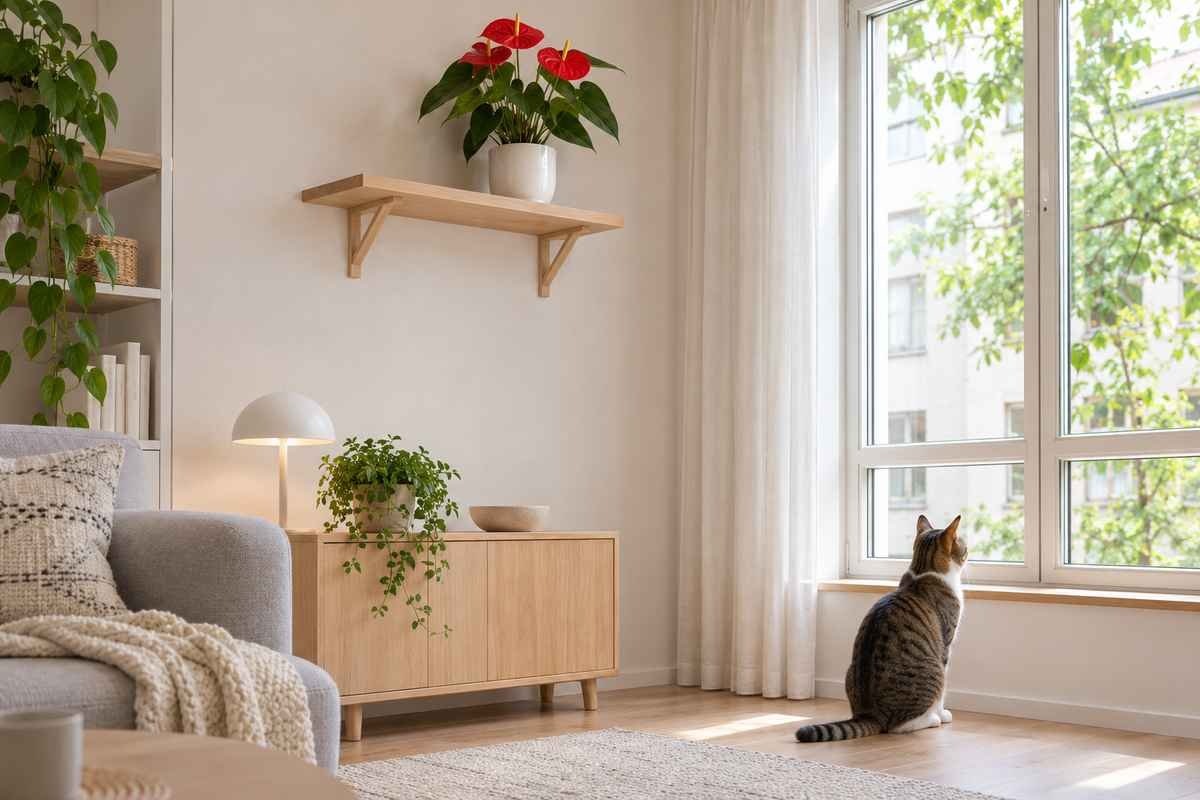
My cat Miso is why I look up every plant before it comes home. If your pet chews leaves, an anthurium belongs on a shelf it can’t reach, and the plant toxicity table lists pet-safe choices that also handle lower light. NYBG suggests gloves and eye protection when you repot, because the sap is irritating.
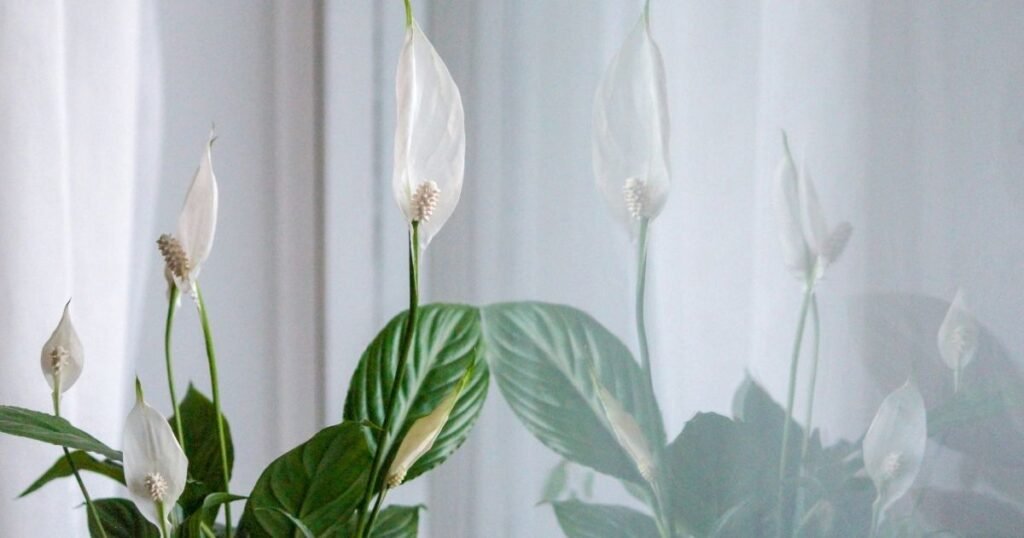
If you like the anthurium’s spathe-and-spike flower but your room is dimmer, peace lily care is the closer match. MU Extension describes peace lily flowers as anthurium-like and says the plant adapts to low light, though it still needs medium light to flower, and the ASPCA lists them as toxic to pets as well.
Anthurium questions
How long does an anthurium flower last?
An anthurium flower lasts several weeks to two months, depending on the source and the plant. UF/IFAS says about six weeks on the plant, NYBG says as long as two months, and NC State says up to four weeks, with repeat blooms through the year when conditions are right.
Can an anthurium live in a room with no window?
An anthurium can live in a windowless room only under a grow light. MU Extension says plants that receive no outdoor light need 16 to 18 hours of light a day, with the plant tips 6 to 12 inches from the source. Without that, expect slow leaves and no flowers.

Ellie Marsh
Houseplant grower who spent years in a north-facing apartment. Writes practical care guides for low light homes, checked against extension and botanical garden sources.