Last updated on November 3, 2026
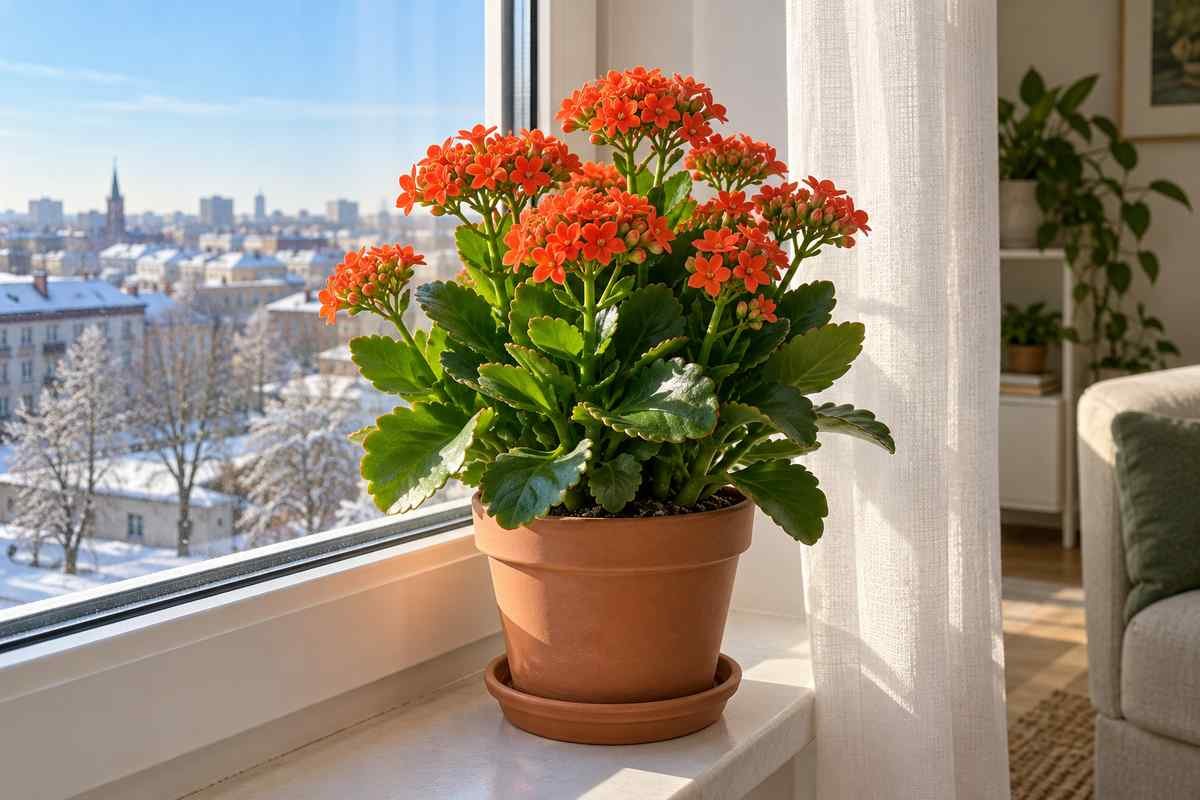
Kalanchoe care comes down to three things: a bright window, a potting mix that dries out between waterings, and, if you want flowers again next winter, about six weeks of long, unbroken nights. The florist kalanchoe (Kalanchoe blossfeldiana) is a succulent from Madagascar, and Clemson Extension notes that it gets spindly in low light.
That last point decides where it can live. I spent years in a north-facing apartment, and kalanchoe was never going to cope there. It belongs in your sunniest window for most of the year, then, for six weeks or so in fall, in real darkness every evening, because the dark nights are what make it flower. The ASPCA lists it as toxic to cats and dogs, so the spot also has to be out of a pet’s reach.
How much light does a kalanchoe need?
A kalanchoe needs six to eight hours of bright light a day to keep blooming, NC State Extension says, and in most homes that means a south- or west-facing window. Clemson Extension goes further and says it grows best in full sun, tolerating bright indoor light.
The two extension pages split on direct sun. NC State prefers bright indirect light or partial shade, warns that prolonged direct sun can scorch the leaves and recommends afternoon shade. Some of the gap closes once you remember how weak indoor light is. University of Maryland Extension puts outdoor sun at a peak of about 10,000 foot-candles, while its brightest indoor band, an unshaded south window with four to six hours of direct sun, begins at just over 1,000.
Here is how UMD’s foot-candle bands line up with a kalanchoe:
- North window, 25 to 100 foot-candles. This is UMD’s low-light band. A kalanchoe here stretches toward the glass and stops flowering.
- East or west window, 100 to 500 foot-candles. Workable with the pot right at the glass. Turn it every week or so, because UMD notes that plants lit from one side develop a lean.
- South or bright west window, 500 to over 1,000 foot-candles. UMD puts succulents and cacti in the top band, and this is the kalanchoe spot. In summer, if the leaves turn pale or brown, pull the pot back from the glass or hang a sheer curtain, which is UMD’s fix for too much sun.
A reply on r/plantclinic, to someone holding a pair of gifted kalanchoes, put the light part bluntly:
“Water only when soil is quite dried out. When you do water, give it a good drink. Needs a lot of light, more than you think”
– r/plantclinic (4 upvotes)
If no window gets there, a grow light can make up the difference. I use them for the darkest corners of my home, and grow lights for indoor plants walks through distance and hours. The catch comes in fall, when the plant needs long nights and the light has to be off by early evening. To compare a window with a lamp in numbers, the DLI calculator turns a foot-candle or lux reading and the hours into a daily light total.
If the plant will only ever have a north window, enjoy the flowers it came with. In UMD’s low-light band it won’t get enough light to set a second round.
Watering, soil and the pot it came in
Water a kalanchoe thoroughly, then wait until the mix has dried before watering again. NC State says to let the soil dry out between waterings and then water deeply, and Clemson says to let it dry slightly, warning that kalanchoe can be damaged by overwatering. Neither gives a number of days, because that depends on the pot, the light and the season.
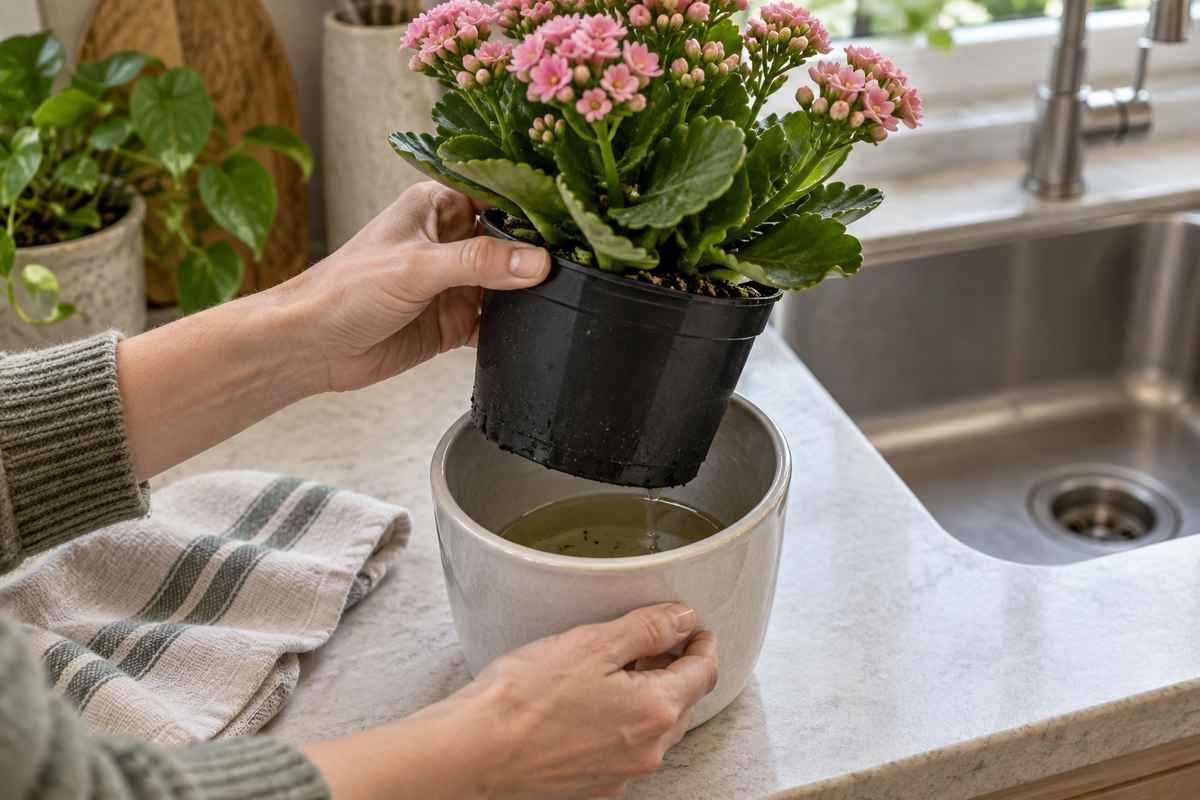
Gift kalanchoes often arrive in a decorative sleeve or a ceramic pot with no drainage hole. One owner on r/plantclinic described exactly that: two gifted plants with flimsy, dull leaves, sitting in a ceramic pot without holes, which they watered and repotted. Clemson backs the repot. Root rot usually comes from a mix that drains slowly or from watering too often, and the plant should never sit in water. If you want to keep the pretty pot, set the plastic nursery pot inside it and tip out whatever collects after watering.
For the mix, Clemson suggests 60% peat moss and 40% perlite when you move the plant into a slightly larger pot after flowering. NC State simply says a cactus or succulent mix. Both drain fast, and that is the property that matters.
What temperature keeps the flowers going?
Cool nights keep kalanchoe flowers going longer. Clemson Extension puts the ideal at 45 to 65 °F at night and 50 to 70 °F during the day, and says cool night temperatures prolong flower life.
NC State’s figures run a little warmer, 60 °F at night and 70 °F by day, and both agree that frost kills it: NC State says to bring a plant indoors before temperatures drop to 45 °F. While it blooms, snip off flower clusters as they fade, which NC State recommends to encourage more flowers. Feed it once a month only while it is actively growing, as Clemson advises.
How do you get a kalanchoe to bloom again?
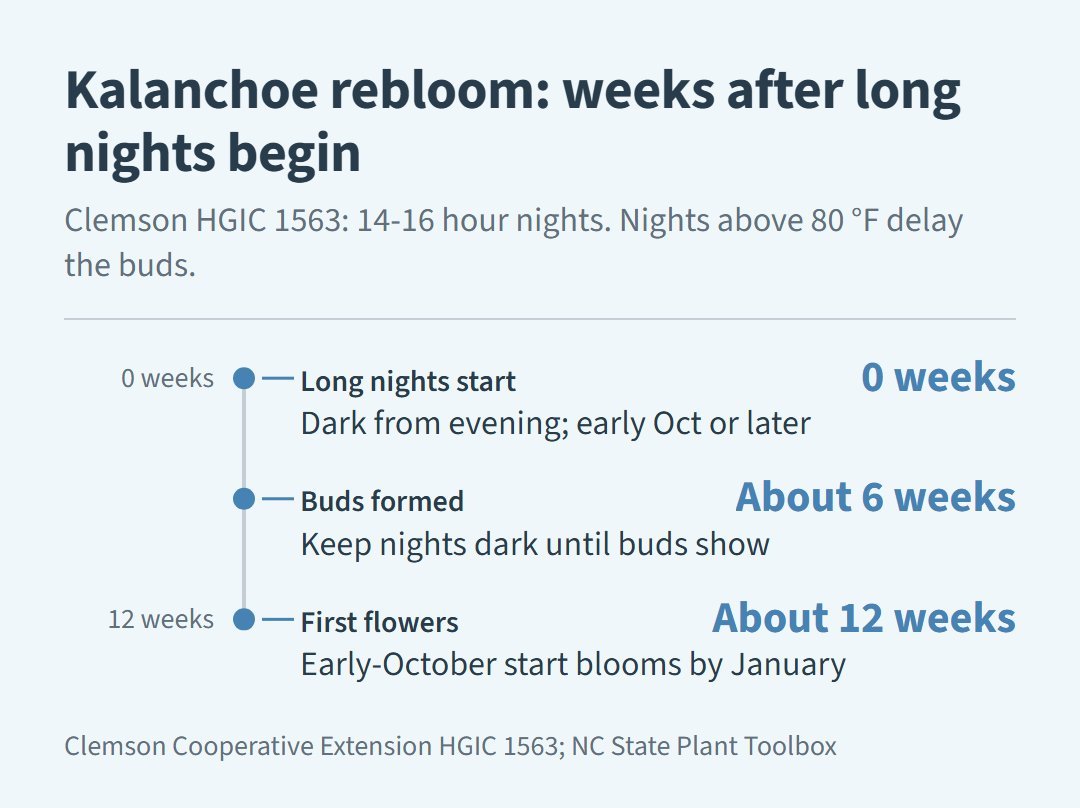
A kalanchoe sets flower buds only after weeks of long nights. Clemson Extension says it needs a 14- to 16-hour dark period each night for about six weeks, and a plant that begins in early October usually starts flowering by January.
NC State asks for 14 hours of total darkness a day for at least six weeks, and University of Maryland Extension puts the trigger at days of 11 hours of light or less. So aim for 14 to 16 hours of dark, the range both extension pages fall within. Here is the year, step by step, from Clemson’s kalanchoe fact sheet:
- After the last flowers fade, cut back tall growth and the old flower stems, and move the plant into a slightly larger pot.
- Keep it well watered in a sunny, warm window through spring and summer. After frost it can go outdoors to a bright, lightly shaded spot, moved out gradually so the leaves don’t burn.
- Bring it indoors before the first frost, or about three months before you want flowers.
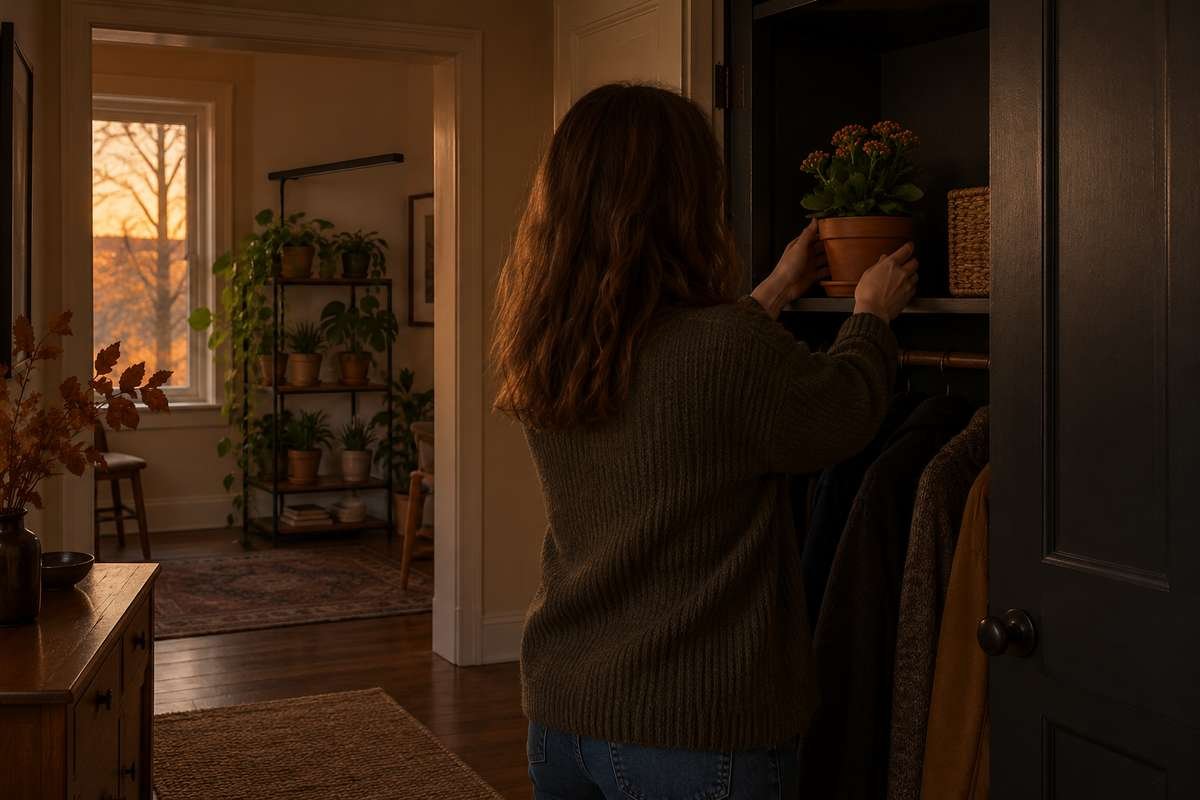
- Give it long nights. Between October 1 and March 1, natural day length does the job, as long as no lights come on in that room after dark. If that isn’t possible, move the plant into a closet in late afternoon and back into bright light each morning.
- Keep the nights below 80 °F. Clemson says warmer nights cause a “heat delay” that holds back flower buds.
- Once the buds are big enough to see over the leaves, stop. Day length no longer matters, and the plant can sit anywhere.
The sign that it worked is buds after roughly six weeks. If none appear by week seven, look for a light that comes on in the room at night, or a warm spot near a heater.
Grow lights and lamps during long nights
A dim-home setup works against reblooming. Clemson’s instruction is a room where lights are not turned on during the naturally dark hours, and UMD says most plants should get no more than 16 hours of light a day in total, natural and artificial together. A grow light on a timer that stays on into the evening, a living-room lamp or a hallway light falling across the shelf can all read as daytime to the plant. For those six weeks, move the kalanchoe out from under the grow light, or set the timer so the light ends in the afternoon and the dark hours follow straight after.
To time the flowers, count back from Clemson’s figure of roughly 12 weeks: for blooms around Christmas, start the long nights about October 2, and for Valentine’s Day, around November 22. That is simple arithmetic. A warm room pushes the dates later, and NC State expects the flowers in spring, so a later show than you planned is still a normal result. Christmas cactus runs on the same long-night trigger, and getting a Christmas cactus to bloom follows a similar routine.
Rooting new kalanchoe plants from stem cuttings
Stem cuttings root easily in spring or early summer, and Clemson says they are usually ready to transplant in 14 to 21 days.
- Cut a 2- to 3-inch tip with two pairs of leaves from a shoot that isn’t flowering.
- Pull off the bottom leaves and leave the cutting out for several days so the cut end calluses.
- Push it into a clean pot of half peat moss and half perlite. Clemson says no rooting hormone is needed.
- Set the pot in bright, indirect light inside a large closed plastic bag to keep the humidity high.
- After two to three weeks, tug gently. If the cutting resists, it has rooted and can move to its own pot.
NC State adds that leaf cuttings work too, though it recommends stem cuttings.
Leggy stems, rot and bugs
Most kalanchoe trouble comes from light or water. Clemson says diseases are rarely a problem indoors; the usual culprits are too much or too little water, and insects.
- Long, stretched stems with gaps between the leaves: too little light. UMD lists spindly growth, a lean toward the window and fewer flowers as the signs. Move it to a brighter window and cut the stretched growth back after flowering.
- Soft stems at the soil line: NC State says overwatering causes root or stem rot. Let the mix dry, and if the roots are brown and mushy, repot into fresh, fast-draining mix.
- Fine webbing, mottled or yellow-spotted leaves: powdery mildew, which Clemson says can be hard to recognize on kalanchoe. Plenty of air movement around the plant helps prevent it.
- White, cottony clumps: mealybugs. Clemson suggests wiping them off with a cotton swab dipped in alcohol, and how to get rid of mealybugs deals with heavier infestations. Aphids, brown scale and spider mites turn up too.
- Healthy leaves, no flowers: NC State says a kalanchoe that won’t bloom usually missed its dark period.
Is kalanchoe toxic to cats and dogs?
Kalanchoe is toxic to cats and dogs. The ASPCA’s kalanchoe entry names bufodienolides as the toxic principle, with vomiting, diarrhea and, rarely, an abnormal heart rhythm as the signs. It’s one of several succulents on the ASPCA’s toxic list, and are succulents toxic to cats sorts the common ones.
NC State also flags it as a problem for children, dogs and cats. With Miso in the house, I look up every plant on the ASPCA list before it comes home, and a kalanchoe only works on a sill the cat can’t reach. If a pet has chewed one, call your vet or the ASPCA Animal Poison Control Center at (888) 426-4435. Other plants can be looked up in the plant toxicity checker, and the ASPCA lists Christmas cactus as non-toxic to cats, which makes it the easier winter-flowering gift for a pet household.
Kalanchoe care FAQ
How big does a kalanchoe get?
A florist kalanchoe grows 6 to 18 inches tall and 6 to 12 inches wide, NC State Extension says. It grows slowly, so a gift plant stays close to the size it arrived at for a long time.
Can kalanchoe live outdoors?
Kalanchoe can live outdoors year-round only in USDA zones 10 to 12, NC State says. Elsewhere it can spend summer outside in a bright, lightly shaded spot after frost, then come back in before temperatures drop to 45 °F.
How do you care for kalanchoe in winter?
Winter kalanchoe care means your brightest window and a room that stays cool and dark at night. Clemson says those long, cool nights set the buds and make the flowers last; keep the plant away from heaters, since nights above 80 °F delay the buds.
How often should you water a kalanchoe?
Water a kalanchoe only once the mix has dried out. NC State and Clemson both say to let the soil dry between waterings, so water until it drains from the hole, empty the saucer, and wait for the mix to dry again.

Ellie Marsh
Houseplant grower who spent years in a north-facing apartment. Writes practical care guides for low light homes, checked against extension and botanical garden sources.