Last updated on October 12, 2026
Christmas trees are only mildly toxic to cats. Pet Poison Helpline says eating fir, pine or cypress usually causes mild, self-limiting drooling and vomiting from the sap and sharp needles, and that the trees’ essential oils are too dilute to cause major toxicity. The stand water and the tinsel are the bigger risks.
So are Christmas trees toxic to cats enough to skip a real one? Not usually. A cat lapping from the tree stand, or swallowing a strand of tinsel, is what the veterinary sources below stress most, more than a cat chewing a branch. Here is where each risk sits and how to handle it.
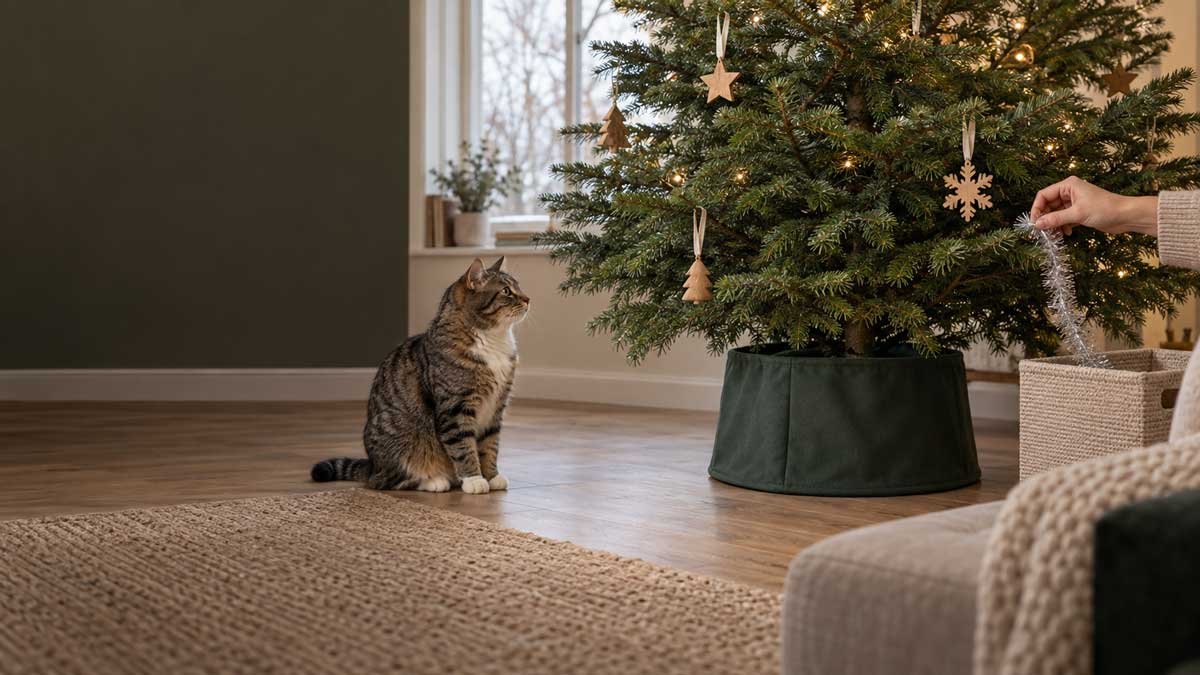
What happens if a cat eats pine needles?
A cat that eats pine or fir needles usually drools or vomits, and the signs pass on their own. Pet Poison Helpline lists Douglas fir, balsam fir, Fraser fir, pines and cypress as the common Christmas trees and says ingestion usually causes only mild irritation from the sap or the needles.
Needles are sharp, and Pet Poison Helpline’s page on cats and trees says needles, sap and tree water can cause nausea, vomiting, skin irritation or injury to the stomach, and it notes that cats are very sensitive to pine oils, so a cat that chews the tree day after day could run into problems.
One nibble is minor, but a habit is worth stopping.
Tree, water and decorations: where the real risk is
Split the tree into three parts and the risks look very different. Cornell’s Feline Health Center points out that even an undecorated tree carries some risk, but the serious cases tend to come from what’s in the stand and on the branches.
| Part | What can happen | How serious | What to do |
|---|---|---|---|
| Needles, sap, cones | Drooling, vomiting, mouth and stomach irritation (Pet Poison Helpline) | Mild | Discourage chewing; Cornell suggests something distasteful on the lower branches |
| Stand water | Bacteria and mold that cause nausea, diarrhea or stomach upset (ASPCA; Illinois) | Mild to moderate | Cover the stand, use plain water with no chemicals (Cornell), keep the cat’s own water bowl full |
| Tinsel | Severe vomiting, blocked intestines, dehydration; may need surgery (ASPCA); can perforate the intestines (Cornell) | Serious | Leave it off the tree |
| Light strands and cords | Electrical burns or a lethal shock (ASPCA; Illinois) | Serious | Tie cords up or use a heavy plastic cord protector (Cornell) |
| Glass bulbs and ornaments | Cuts to the mouth and throat if bitten or swallowed (Illinois; ASPCA) | Serious | Non-breakable ornaments low on the tree, tied on with cloth loops (Cornell) |
| Batteries | Burns to the mouth and esophagus if punctured (ASPCA) | Serious | Keep battery decorations out of reach |
| The whole tree tipping | Injury from a falling tree (ASPCA; Cornell) | Varies | Anchor it; Cornell suggests a cup hook in the ceiling with wire or string |
Stand water deserves a closer look. Dr. Michael Biehl, a veterinary toxicologist at the University of Illinois, points out that the water gets topped up all season but never emptied or cleaned, which makes it a good place for bacteria and mold. Cornell’s advice is to keep the cat away from it and use plain water without additives.
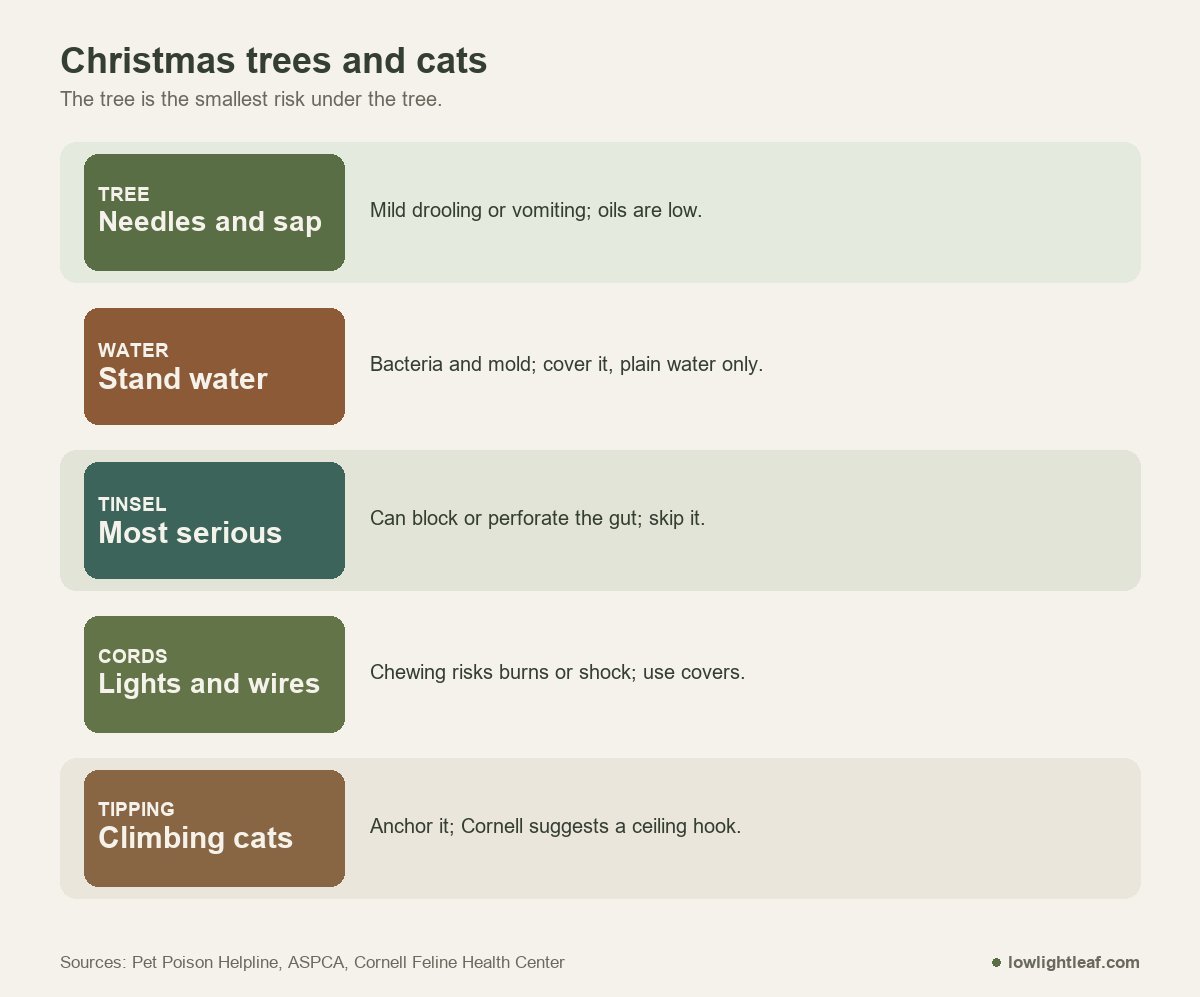
Tinsel is the one to take most seriously. Biehl explains that it catches on the tiny barbs of a cat’s tongue, so the more the cat tries to get it off, the more it swallows. The ASPCA says swallowed tinsel can block the digestive tract and may need surgery.
Real, artificial or potted Norfolk Island pine?
A potted Norfolk Island pine carries the fewest risks, a real tree adds sap, needles and stand water, and an artificial tree removes those without stopping a chewer. None of the three makes the decorations any safer.
- Real tree. Brings sap, needles and a water basin. Pet Poison Helpline suggests an artificial tree for this reason, and says to keep cats away from the water if you choose a live one.
- Artificial tree. No sap or stand water. Cornell warns that a fake tree may not stop a determined chewer from treating the branches as a snack.
- Potted Norfolk Island pine. The ASPCA lists Norfolk Island pine as non-toxic to cats and dogs, and it needs no stand water. A small one with cloth ornaments avoids both the sap and the stand water, but it still needs the same care with cords and tinsel.
Cat-proofing a Christmas tree, step by step
Set up the tree with the cat in mind from the start. Moving a tree after it has crashed at 2 a.m. is harder.
Expect the cat to try the tree anyway. A first-time owner asked Reddit how to keep their cat out of the tree, and the most-upvoted replies were not optimistic:
“Right. There’s about a 0% chance the kitty stays out of the Christmas tree and a 100% chance of kitty free soloing the tree.”
– r/cats, November 2025 (1,385 upvotes)
That is why the steps below focus on making a climb safe, not on stopping it.
- Anchor it. Secure the tree so it can’t tip, which the ASPCA recommends; Cornell suggests a cup hook in the ceiling and some wire or string.
- Cover the stand. Fill it with plain water only, and keep a full water bowl elsewhere so the stand isn’t the most interesting drink in the house.
- Skip tinsel. Both the ASPCA and Cornell single it out.
- Tame the cords. Tie light cords up and run the rest through a hard plastic cord protector.
- Hang safe ornaments low. Cornell suggests cloth, straw or wood ornaments at a cat’s eye level, tied with cloth loops, and the breakable ones higher up.
- Close the room when you’re out. Biehl suggests keeping pets out of decorated areas when they’re home alone, and a baby gate does the job.
Skip scented sprays and oils as deterrents. Pet Poison Helpline says cats are sensitive to pine oils, so adding more oils near the tree works against you, and Cornell’s own suggestion for the lower branches is simply a light coating of something that tastes unpleasant, which keeps the focus on making the tree boring to chew while the stand stays covered, the cords stay tied up and the tinsel stays in the box.
Are Christmas trees toxic to cats FAQ
Are pine trees toxic to cats?
Pine trees are mildly toxic to cats. Pet Poison Helpline says eating pine causes mild, self-limiting drooling and vomiting from the sap and sharp needles, and that a cat that chews it often can have problems because cats are sensitive to pine oils.
Is balsam fir toxic to cats?
Balsam fir is mildly irritating to cats, like the other common Christmas trees. Pet Poison Helpline names balsam fir, Douglas fir and Fraser fir among the trees that usually cause only mild drooling and vomiting.
Is Christmas tree water bad for cats?
Yes, Christmas tree water can make a cat sick. The ASPCA says it’s a breeding ground for bacteria that can cause nausea, diarrhea or stomach upset, so cover the stand and use plain water.
Why do cats love Christmas trees?
A tree is something new to climb and explore. Cornell describes a holiday tree as bringing the excitement of the outdoors inside for a climbing cat, and Illinois’s Biehl notes that animals investigate anything new with their mouths.
If your cat chews something on or under the tree and seems unwell, call your veterinarian or ASPCA Animal Poison Control at (888) 426-4435. The plants that often sit under the tree have their own pages on poinsettias and Christmas cactus. For year-round plants that are safe with cats, see pet friendly indoor plants.

Ellie Marsh
Houseplant grower who spent years in a north-facing apartment. Writes practical care guides for low light homes, checked against extension and botanical garden sources.