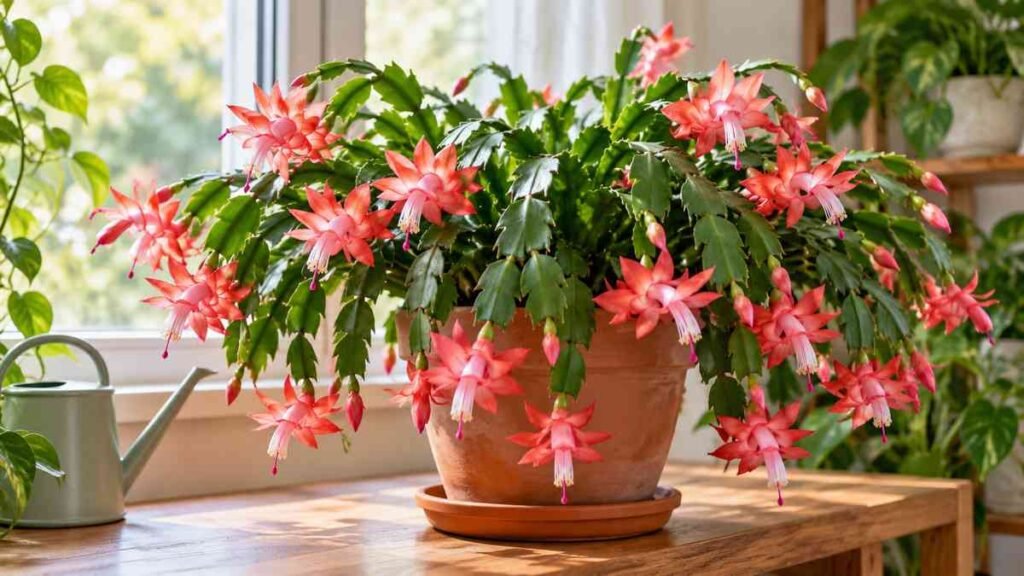
Pinch or twist off a piece with 2 to 5 segments, let the cut end dry, push it about an inch into moist perlite or well-drained potting mix, and keep it bright. Iowa State Extension puts roots at 6 to 8 weeks; Wisconsin says 2 to 3.
I read seven university extension pages on Christmas cactus propagation. They agree on the job and disagree on three details: how long the cut end should dry, what to root in, and how long the roots take. Where they split, I’ve said so and picked a middle path. Iowa State covers Christmas, Thanksgiving and Easter cacti together, so the steps hold for a Thanksgiving cactus sold as a Christmas one.
Taking a cutting and getting it to root
Take 2 to 5 segments at a joint, let the end callus, set it about 1 inch deep in moist perlite or coarse sand, and water only when the medium starts to dry. That’s Iowa State’s method, and it’s the most detailed of the seven.
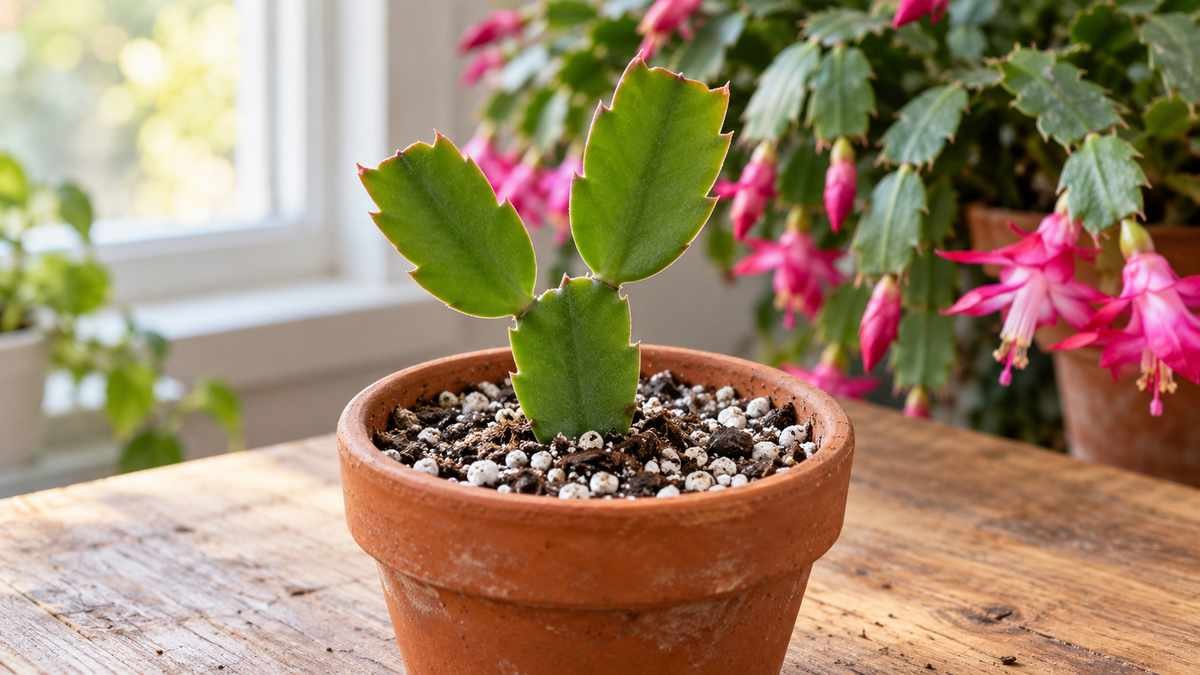
- Take the piece. Pick a healthy stem and pinch or twist off 2 to 5 flat segments at a joint. Iowa State says cut or pinch; Penn State says pinch or twist. Either works.
- Let the end dry. The cut surface should callus before it touches damp medium. Iowa State says overnight, Clemson says a day or two, and Wisconsin says two to three days in a shady spot.
- Fill a pot with something gritty. Iowa State uses perlite or coarse sand, watered and left to drain for a few minutes. Wisconsin and Minnesota both accept a well-drained potting mix.
- Plant it right way up. Insert the cut end about 1 inch deep and firm the medium so the piece stands. Iowa State warns that a cutting set upside down won’t root.
- Water lightly, keep it bright. Water when the medium begins to dry. Minnesota says moist but not wet, and Wisconsin says moist but not saturated. Bright light is the hard part in a dim room like the north-facing apartment I lived in for years, and a grow light is the usual fix.
- Look for roots once. Minnesota Extension says to lift a cutting gently with a spatula or popsicle stick after 2 weeks and check for new roots. Iowa State says to move it into well-drained potting mix once the roots are an inch or longer.
Christmas cactus propagation: where the sources split
Seven extension services give seven versions of the same job. Segment counts run from 1 to 5 and drying time from overnight to 3 days, and only a couple of sources use rooting hormone or a plastic bag.
| What you’re deciding | Range across sources | Who says what |
|---|---|---|
| How many segments? | 1 to 5 | Wisconsin: single joints work, or 2 to 3. Florida: 2 to 3. Iowa State: 2 to 5. Penn State and Clemson: 3 to 5. |
| How long should the end dry? | Overnight to 3 days | Iowa State: overnight. Clemson: a day or two. Wisconsin: 2 to 3 days in shade. |
| What goes in the pot? | Perlite, sand, vermiculite or a well-drained mix | Iowa State: perlite or coarse sand. Purdue: moist vermiculite. Minnesota: damp builder’s sand or well-draining mix. Wisconsin: perlite or well-drained mix. Florida: well-drained sterile media. |
| Rooting hormone? | Mentioned by 2 of 7 | Minnesota and Penn State use it. Iowa State, Wisconsin, Purdue and Florida don’t mention it. |
| Plastic bag over the pot? | Penn State only | Penn State: a bag as a humid “greenhouse” until roots form. |
| What time of year? | After flowering through summer | Purdue: after blooming. Clemson: May or June. Wisconsin: any time of year, though rooting may be better in late spring through summer. |
If I were starting one tomorrow, I’d take three segments, let the end dry for two days and use a gritty, fast-draining mix. That sits inside the range on every row except Iowa State’s overnight drying, which is a day shorter, and it skips the two steps most of the sources never mention.
How long do Christmas cactus cuttings take to root?
Two to eight weeks, depending on the source: Wisconsin Extension says 2 to 3 weeks, Penn State and Clemson say 3 to 8, and Iowa State says 6 to 8.
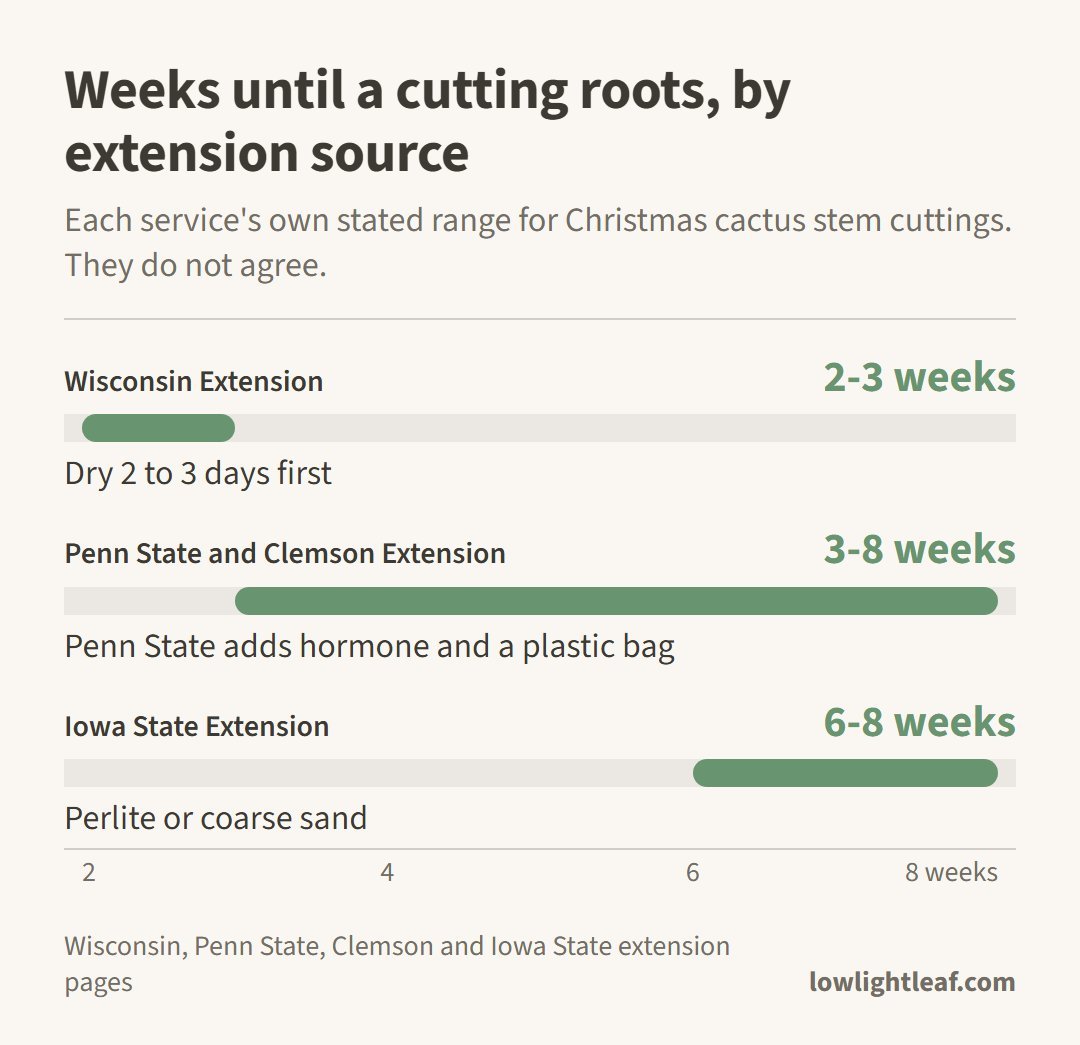
The gap is wide enough that one cutting can look stalled by one page’s clock and on schedule by another’s. Week four is early by Iowa State’s range, late by Wisconsin’s, and inside Penn State’s and Clemson’s, so a cutting with no roots at four weeks hasn’t failed yet. None of the pages says why the numbers differ. Medium, temperature and season are the obvious suspects, but nobody tests that, so I’d treat the ranges as a window rather than a deadline.
Minnesota’s check is the useful one: lift the cutting gently at two weeks and look, and if there’s nothing yet, press it back in and wait.
Water or soil?
Penn State Extension is the only one of the seven where I found water rooting mentioned: set the cutting in water until a good root system develops, then move it to well-draining mix. The other pages root in perlite, sand, vermiculite or potting mix.
I’d start in a gritty medium. It’s what most of the pages describe, and it skips the second step of moving a watery cutting into a pot. If you’d rather watch roots form, water is a documented option, not a mistake.
Can you take cuttings while it’s blooming?
The extension pages I read don’t cover taking cuttings from a plant in flower. Purdue says to pinch off sections after blooming, Clemson gives May or June, and Wisconsin says any time of year, with rooting better in late spring through summer.
Minnesota gives a reason to wait: once buds develop, they dislike being disturbed. Florida says not to prune beyond mid-summer but doesn’t say why. My reading is that late pruning cuts into the flower buds, though that’s my inference, not Florida’s wording.
So for a plant in bud or bloom, I’d wait until the flowers fade, then pinch off a few segments, which also makes the plant branch, according to Purdue. A piece that breaks off in December is a different case. Wisconsin says new plants can start any time of year, so root it instead of binning it.
What to do with a broken piece
A broken segment or arm is already a cutting. Let the end dry and root it as above. An arm of 5 segments or fewer can go in whole, and a longer one can be split at a joint into pieces of 2 to 5.
That’s the question a grower asked in r/succulents after the healthiest arm of a decade-old plant snapped off:
“I was just picking off dead leaves on my ~10 year old Christmas cactus and the healthiest looking arm broke off (maybe I let it get too heavy and should have pruned it earlier?) I want to propagate it, but I’ve never done that before. For this specific arm, for best chances of success, should I leave it as is? Or should I break it up into two pieces at the first joint?”
– r/succulents, August 2026 (24 upvotes)
By the extension counts, it depends on how many segments the arm has. Whole is fine up to 5; past that, split it so each piece keeps 2 or more. Wisconsin goes lower and says a single joint can root, so a stray segment that snapped off on its own is worth trying too.
One reply in the thread suggests a different method:
“Hijacking this comment to suggest OP lay the plant flat on the soil instead of pinching the segments. You can also just stick the main stem in soil. I’ve successfully propagated thanksgiving/ Xmas cacti using both methods. This photo accurately shows the nodes, and where roots will grow.”
– r/succulents, August 2026 (7 upvotes)
The extension pages describe upright cuttings only, so the flat method is one grower’s report. If you try it, let the cut ends callus first, as the pages say.
Check the tag for “propagation prohibited”
If a plant’s tag says propagation is prohibited or lists a plant patent, don’t take cuttings. A US plant patent lasts 20 years from filing, and the owner can exclude others from reproducing the plant asexually. The USPTO names rooting cuttings as one form of asexual reproduction.
Plant tags sometimes carry a line like that, and “Christmas cactus propagation prohibited” shows up as a related search. I don’t have a list of which holiday cactus varieties are patented, so the tag is the check I’d use. I’m not a lawyer and the USPTO page doesn’t discuss home growers, so I’d read a prohibition on a tag as a no.
After the roots form
Move a rooted cutting into well-drained potting mix once its roots are an inch or longer, per Iowa State, or into cactus soil, per Minnesota.
Wisconsin Extension pinches new plants back to encourage branching and often pots three together for an instant full pot. From there the plant needs the same light, water and routine as its parent, and the fall schedule that sets flowers is in how to get a Christmas cactus to bloom.
With Miso in the house, I check every plant against the ASPCA first. Its entry for Christmas cactus (Schlumbergera bridgesii) lists it as non-toxic to cats, dogs and horses, and the fuller answer is in Is Christmas cactus toxic to cats?

Ellie Marsh
Houseplant grower who spent years in a north-facing apartment. Writes practical care guides for low light homes, checked against extension and botanical garden sources.