Last updated on November 10, 2026
Bromeliad care indoors means bright, indirect light, a porous potting mix that dries between waterings, a little fresh water in the center cup that you change regularly, and humid air. Clemson Extension adds the part most buyers don’t know: the main plant flowers once and then dies, leaving pups to replace it.
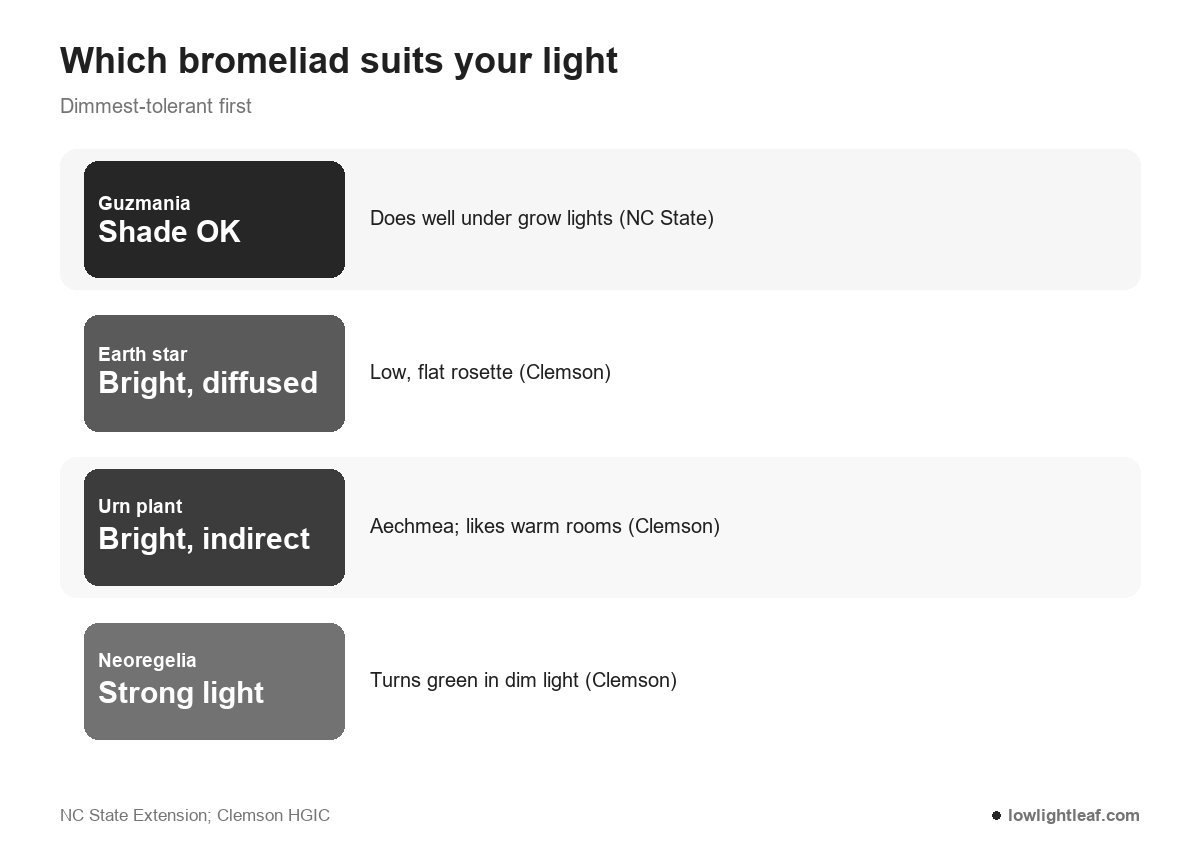
Plenty of bromeliads are sold with a “low light” tag, which is only half true. A Guzmania can live in a dim room for a long while. A Neoregelia loses its color there. Which one you bought decides how far from the window it can go.
Which bromeliads handle a dim room
Guzmania is the bromeliad most suited to a dim room, since NC State Extension says it grows well in part to full shade and does well under artificial lights. Clemson says bromeliads in general need indirect sunlight to grow well and to flower, and that Neoregelia needs strong light to keep its leaf color.
UF/IFAS Gardening Solutions describes what too little light looks like: leaves grow long, thin and greener than they should. On a colorful Neoregelia that’s easy to spot, because Clemson says too little light (or too much fertilizer) turns the leaves green. One exception is the cultivar ‘Morado’, which Clemson says reaches its best color in low light.
The tag problem comes up often. A Reddit owner who bought a blooming bromeliad labeled low light got this reply:
“I was gifted one and read that they’re tropical plants that grow well in low light blah blah blah. Sounded perfect for my dingy dark apartment. Nope. It died”
– r/houseplants, March 2020 (5 upvotes)
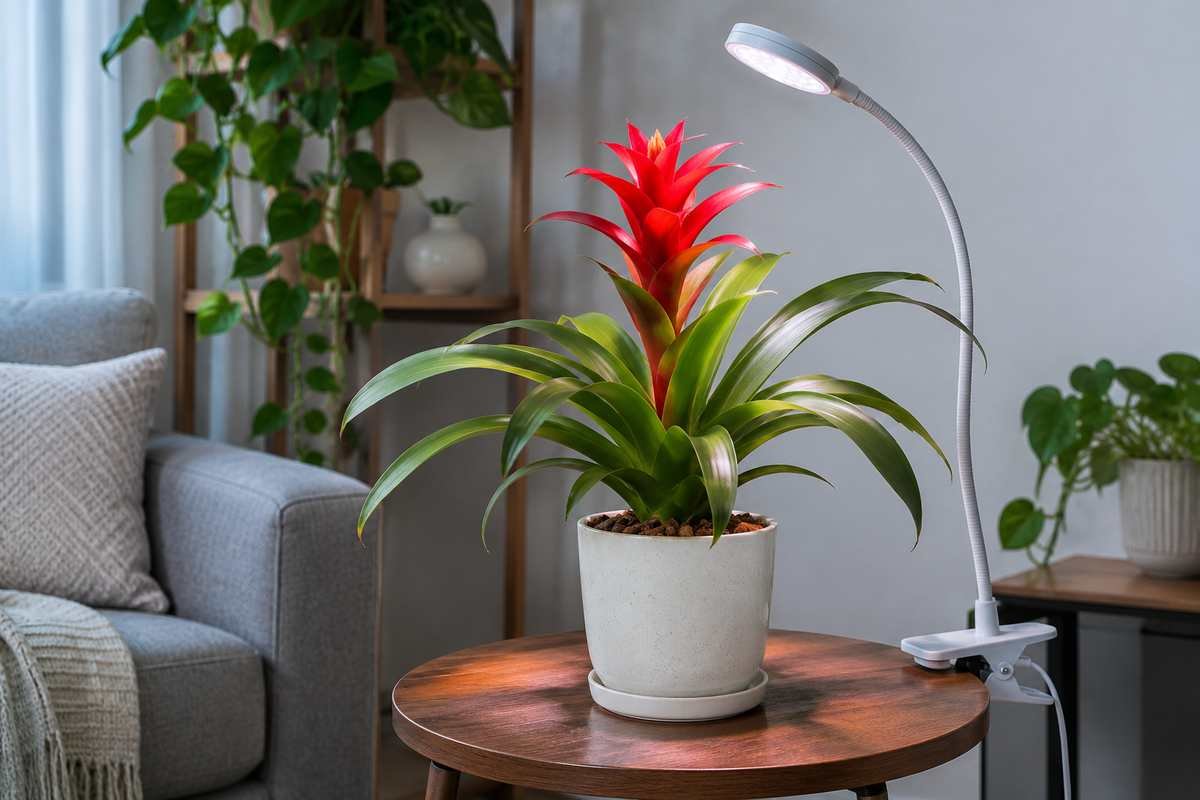
Give a bromeliad the brightest spot you have that stays out of direct sun; UF says indoors it wants bright, diffused light, not direct sun. I spent years in a north-facing apartment, and the darkest corners there only worked with a grow light, which NC State says Guzmania handles well. Air plants are bromeliads too, and the air plant page goes through how their light needs differ.
Watering the cup and the potting mix
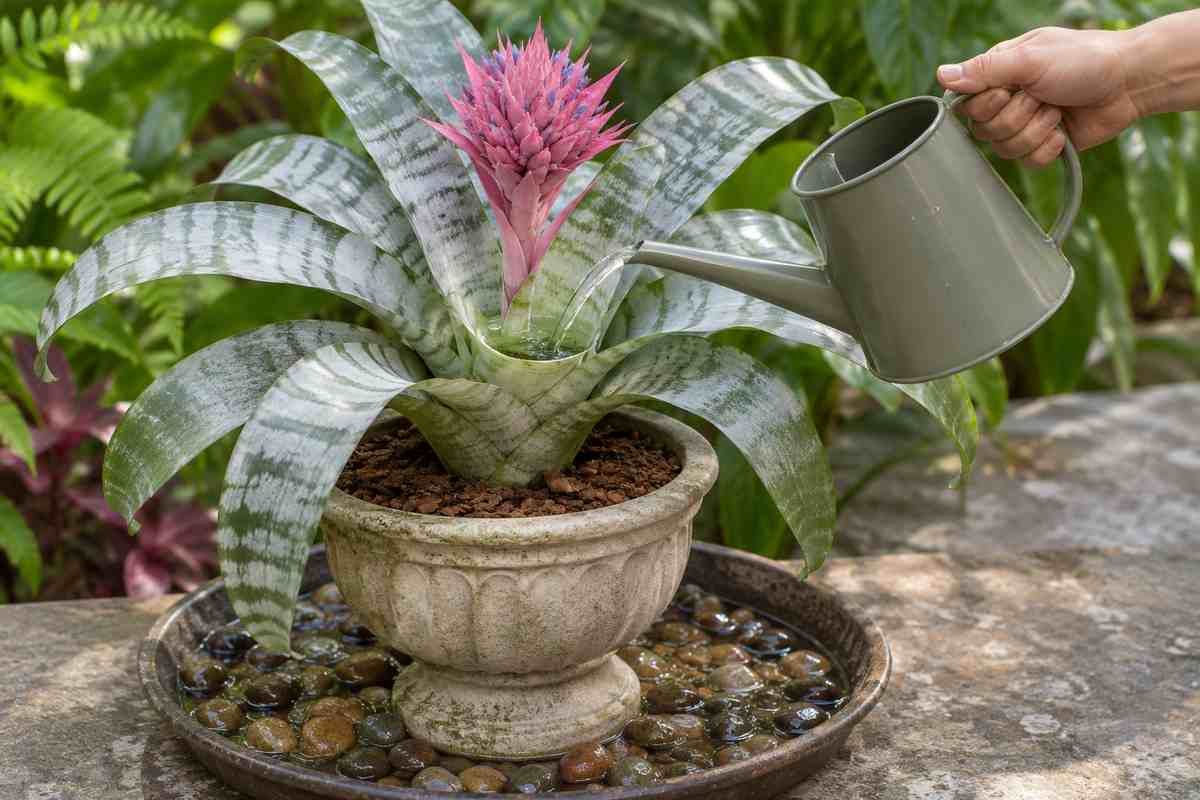
Water the potting mix well and let it dry before watering again, and keep a little fresh water in the center cup. Clemson says to keep the cup filled and to stop the water from soaking the soil, because bromeliads rot when the mix stays wet. NC State suggests about an inch of water in the cup, changed once a month.
UF explains why the cup matters: bromeliads take in water and nutrients mainly through their leaves and that cup, and their small roots work mostly as anchors. That’s also why soggy soil is the faster way to lose one. Here is a routine that follows those sources:
- Pour fresh water into the center cup until there’s about an inch in it (NC State).
- Water the potting mix only when it has dried, and let the pot drain completely (Clemson).
- Once a month, flush the cup: tip the plant to empty it and refill with fresh water. Clemson says this prevents stagnant water and mineral salt buildup, and NC State says stale water can breed insect pests.
- In winter, water less. NC State says to reduce watering during the winter months.
For potting, UF suggests a loose mix of one part peat, one part bark and one part coarse sand, and NC State recommends an orchid mix.
Humidity, warmth and feeding
Bromeliads want warm rooms and humid air: Clemson gives 60 to 85°F as the range they prefer, says most houses aren’t moist enough, and suggests misting often to make up the difference. NC State suggests a humidifier or a tray of wet pebbles under the pot.
Guzmanias are the fussiest about this. Clemson calls them more sensitive than many bromeliads, needing stable warm temperatures, constantly moist air and good air movement, so the low-light pick is also the one to keep away from cold windows and heater drafts. The humidity page covers the other ways to raise moisture in a dry room.
Feed lightly.
Clemson suggests fertilizer at half strength or less during the summer months, and warns that heavy feeding turns Neoregelia leaves green.
What happens after a bromeliad flowers?
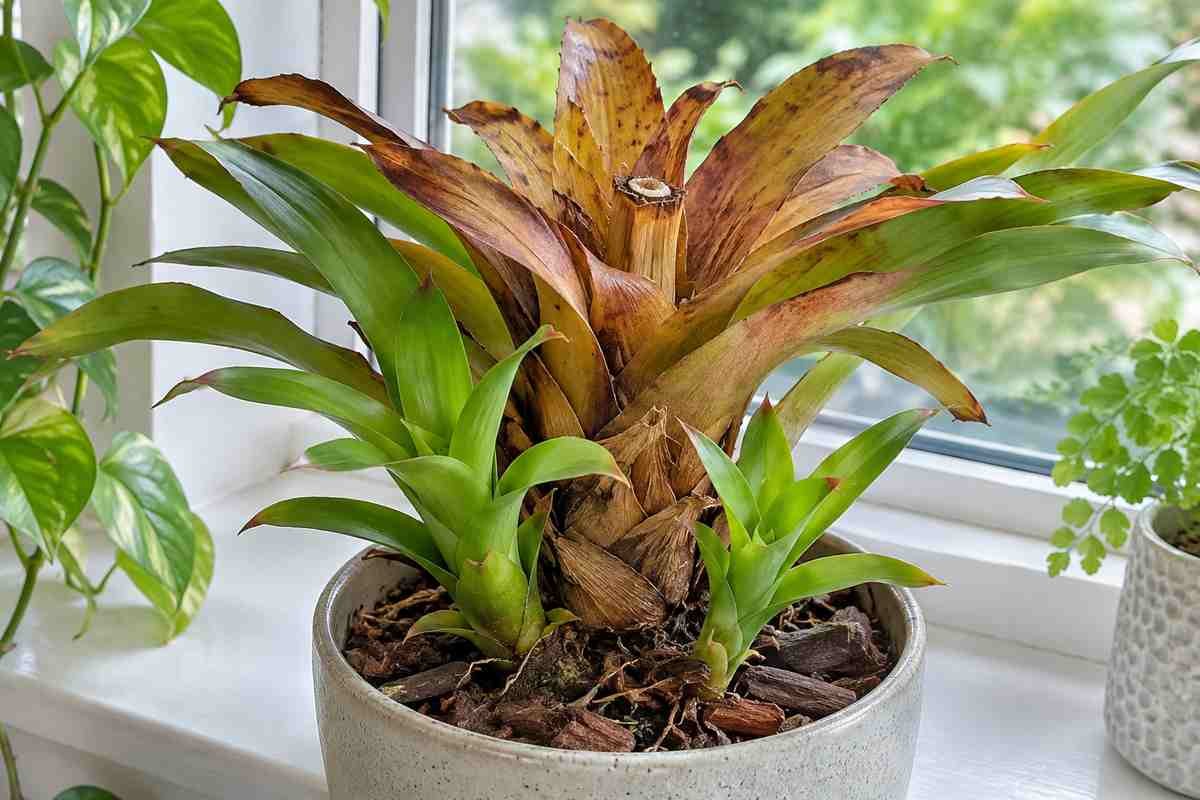
After a bromeliad flowers, the main plant slowly dies. That’s normal. NC State says the urn plant blooms only once, then forms offsets, or pups, at its base before the parent dies. Those pups are the plant’s future, and they can be separated once they’re big enough.
How big is big enough? NC State says urn plant pups should be about 6 inches tall before you move them. Growers on Reddit tend to wait longer. When someone posted a dying bromeliad with small pups at the base, the top reply said:
“Yes, those are pups, and they should be left with the mother plant until they are at least 2/3 the size of the parent, as they get a lot of their strength from the main plant.”
– r/bromeliad, February 2024 (23 upvotes)
Leaving them attached a while longer costs nothing. Cut off the spent flower stalk and the parent’s leaves as they brown, and move the pot to your brightest spot so the pups have the light the parent never got.
If a mature pup won’t bloom, Clemson describes a trick: seal the plant in a clear plastic bag with a ripe apple for two to three days. Depending on the type, flowering begins six to fourteen weeks later.
Rot, scale and mealybugs
Most indoor bromeliad problems come from water, not disease.
Clemson lists too much or too little water as the main troubles, with root rot from a slow-draining mix or watering too often. Scale and mealybugs are the most common insect pests it names, so look along the leaf bases when you flush the cup.
Are bromeliads safe for cats and dogs?
The common houseplant bromeliads are listed as non-toxic. The ASPCA lists blushing bromeliad (Neoregelia) and earth star (Cryptanthus) as non-toxic to dogs and cats, and NC State tags Guzmania and the urn plant as non-toxic for cats, dogs and horses.
The ASPCA has no single entry for “bromeliad”, so check the type you own rather than the family. UF also points out that Aechmea leaves carry small spines along the edges. With Miso at home, I look up every plant before it comes inside, and the plant toxicity checker covers the rest of a pet-friendly shelf.
Bromeliad care FAQ
How long do potted bromeliads last?
The bloom lasts the longest part. UF says urn plant flower spikes can last from a few weeks to six months, and Clemson says many bromeliad flowers last for months. After that the parent declines, so with good bromeliad care the plant carries on through its pups rather than the original rosette.
In a dim home, think of a bromeliad as a bloom you enjoy for months and a set of pups you raise in better light.

Ellie Marsh
Houseplant grower who spent years in a north-facing apartment. Writes practical care guides for low light homes, checked against extension and botanical garden sources.