Last updated on October 17, 2026
The plant shelf ideas that work are the ones matched to their light. Put a window shelf where the sun reaches, a wall shelf within a few feet of the glass for low-light plants, and a grow-light shelf anywhere farther. University of Illinois Extension’s light bands show how fast that distance runs out: at a north window, medium light only exists right at the glass.
Most plant shelf ideas you’ll find online are photographed in bright rooms. In a dim apartment the same shelf can hold healthy plants or slowly starving ones, and the difference is a few feet. So start with the distance, then pick the style.
How far from the window each shelf can go
A shelf can hold low-light plants a few feet from a north window, 3 to 10 feet from an east or west window, and 15 to 20 feet from a south window, per University of Illinois Extension’s houseplant lighting guide.
Its scale: low light is about 75 foot-candles, medium 150, high 300.
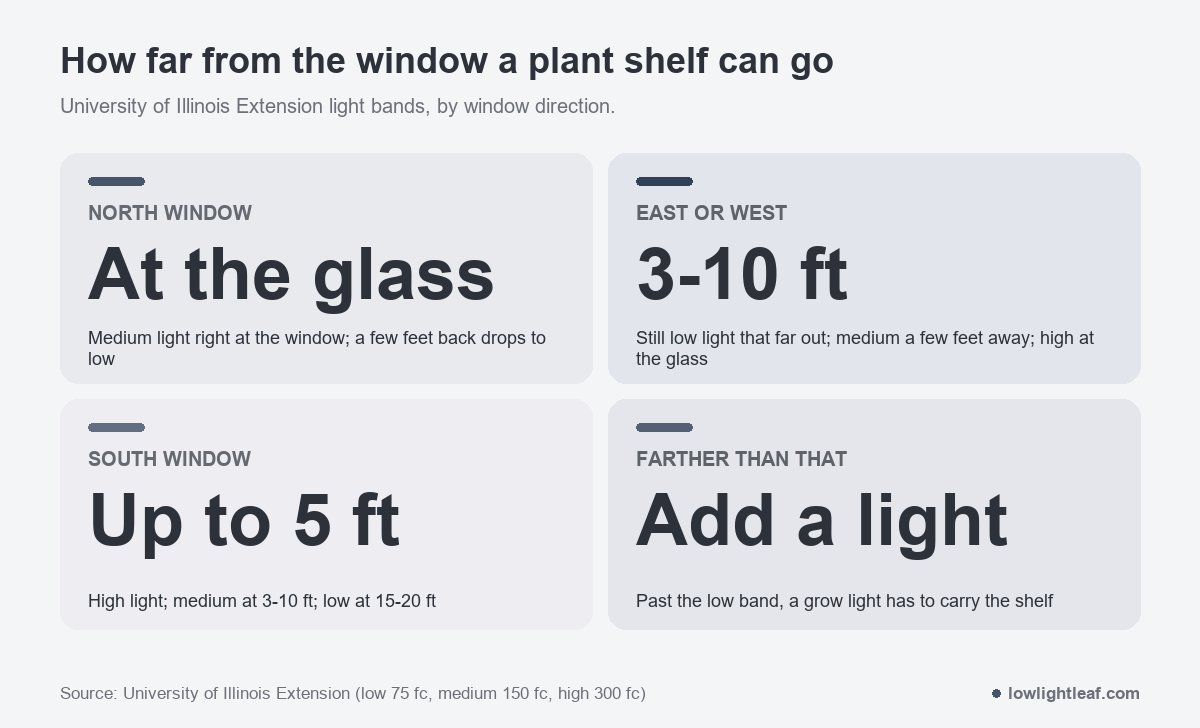
The brighter bands are tighter. Medium light sits directly in front of a north window, a few feet from an east or west one, or 3 to 10 feet from a south one. High light means directly in front of an east or west window, or up to 5 feet from a south window. Only the spot right at an unshaded south window counts as direct light.
Light falls off fast. University of Maryland Extension says light intensity drops rapidly with distance from the source, and that curtains, screens, dirty glass and shade from trees or nearby buildings all cut it further. Light-colored surfaces bounce some of it back, Maryland says, so a pale wall behind the shelf helps a little.
“Plants barely get enough light pressed up to window glass never mind in the middle of a room, however some plants seem to do ok with lower light levels, you might need plant lights”
– r/houseplants, January 2026 (40 upvotes)
Treat the bands as a starting point. Penn State Extension says county extensions, horticulturists and engineers don’t agree on exactly what counts as low, medium or high light, though 100 foot-candles is a common baseline for low. A cheap light meter settles it for your own shelf.
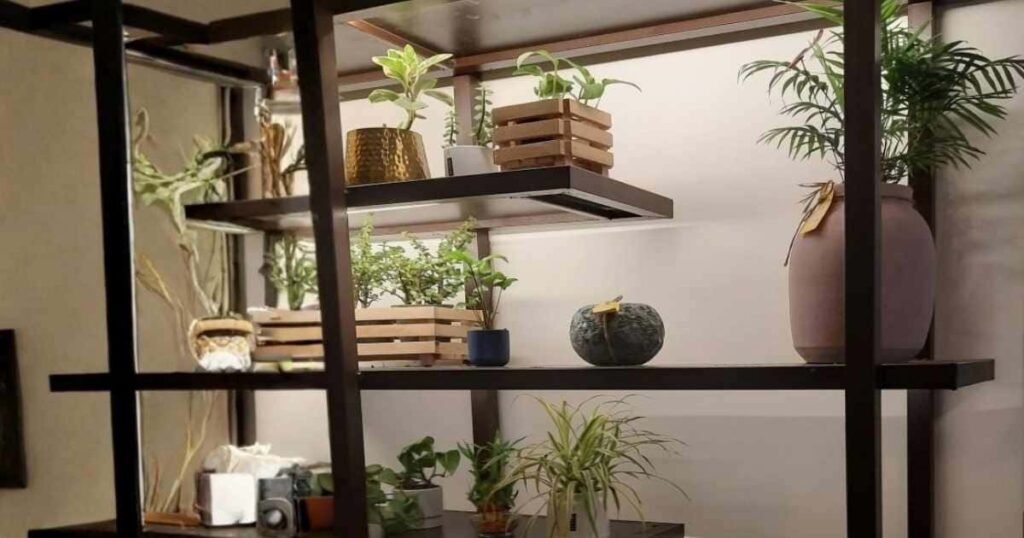
Plant shelf ideas, sorted by the light they get
Each idea below is listed with the spot it suits and the plants that fit that light. The plant lists come from Maryland’s low, medium and high groupings.
- Glass or wood shelves across a south or west window. The brightest shelf in the house. Maryland puts jade plant, hoya and croton in its high-light group and succulents and cacti in direct light, so this is where they belong. In summer, a sheer curtain keeps strong sun from bleaching foliage, which Maryland lists as the sign of too much light.
- A ladder or tiered stand beside an east or west window. The tiers nearest the glass get medium light; the far end of a deep stand drops toward low. Put Chinese evergreen, rubber plant or dracaena (Maryland’s medium group) on the near tiers, and turn the stand now and then, since plants lit from one side lean toward it.
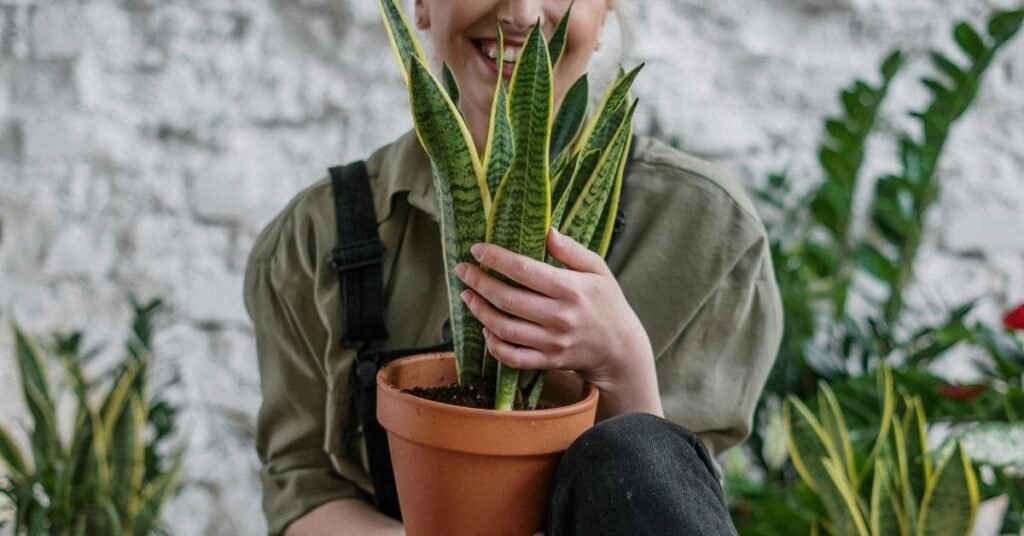
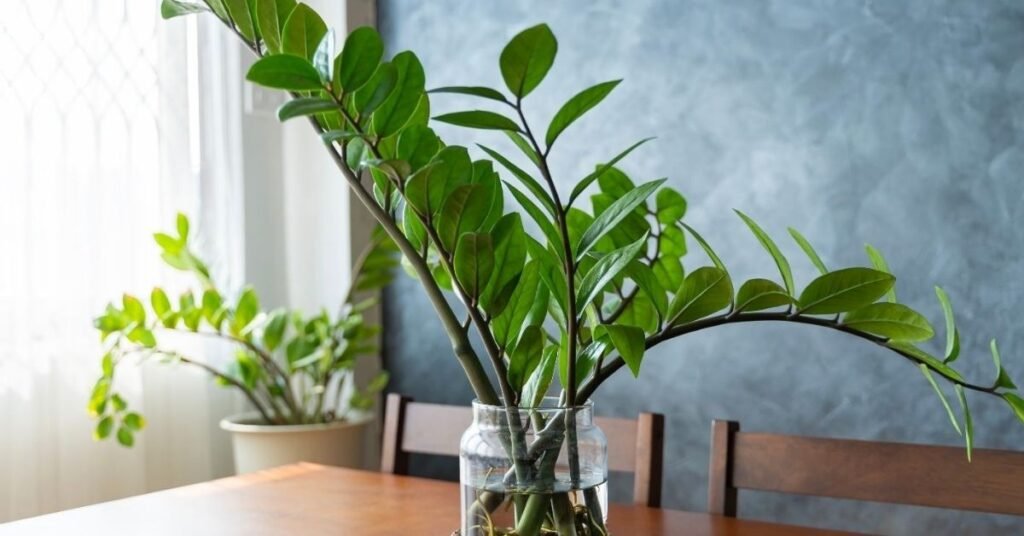
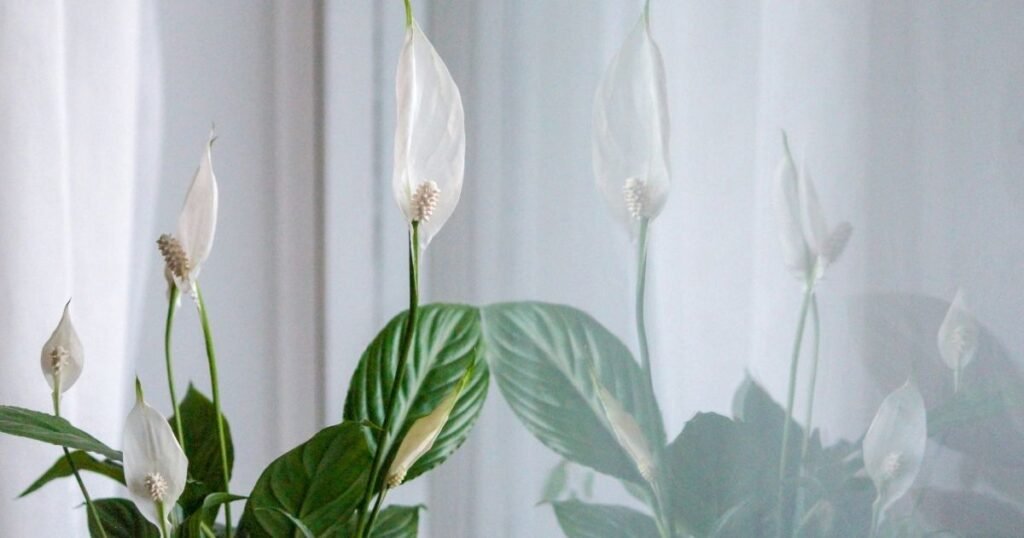
- Floating shelves right beside a north window. Keep them within a few feet of the frame and stock them with low-light plants: ZZ plant, snake plant, cast iron plant and peace lily. The north-facing window guide sorts more plants by how close they can sit to the glass.
- A hanging shelf in front of a window. Hung from ceiling hooks, it puts trailing plants in the window’s light without using the sill. A Jade pothos, with darker leaves, copes with lower light than most pothos, per Penn State.
- A bookcase across the room. Across from a north window, that’s past the low band, so it either holds plants that tolerate the dimmest light or gets a grow light along the top. Across from a big south window, 15 to 20 feet can still count as low light.
- A corner shelf. Corners are often the spots farthest from a window. Measure the distance before you buy, and if it’s beyond the low band, plan for a lamp from the start.
- A grow-light shelf or rack in a dark spot. The one idea that works anywhere. It’s how I keep plants in the darkest corners: a shelf unit with a light above each level, set up as described in the next section.
- A glass cabinet for a home with cats. Covered in the pet section below, and it needs a light inside unless it stands at a bright window.
Trailing plants look best on high shelves, but check them against your light. A string of trailing stems from a shelf above eye level still has to reach the band its pot sits in. The hanging and trailing plants guide sorts them by light level.
When a shelf needs a grow light
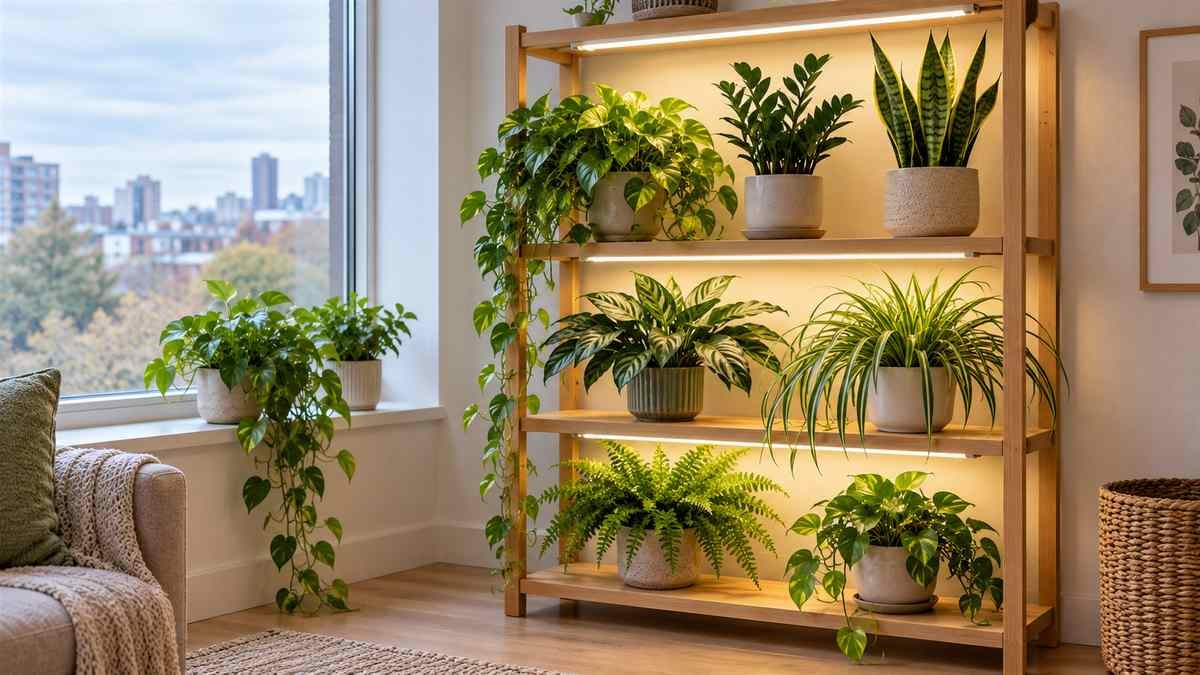
A shelf needs a grow light once it sits beyond the low-light distance for its window, or when its plants get leggy, lean hard toward the glass or lose leaf color, the low-light signs Maryland lists.
For leafy houseplants, the site’s grow light guide uses University of Minnesota Extension’s range: an LED fixture 12 to 24 inches above the leaves for 12 to 14 hours a day.
Iowa State University Extension gives a simple shelf setup: a standard 4-foot plug-in shop fixture with full-spectrum (“daylight”) light, 18 inches from the foliage, at least 3,000 lumens, on for 14 hours a day. Don’t run any of it around the clock. Illinois and Maryland both cap total light at 16 hours a day, since plants need a dark period.
Mount the fixture under the shelf above, so each level lights the one below. That also keeps the bare bulb out of your line of sight when you walk past.
Shelves in a home with a cat or dog
A high shelf keeps pots off the floor, not out of reach. Cats climb, and trailing stems hang down. So the safest shelf plants are ones that are non-toxic to begin with. The ASPCA lists spider plant, Boston fern and hoya (wax plant) as non-toxic to dogs and cats. With Miso around, those are the ones I’d let trail.
Pothos is the trailing plant to keep off a cat’s route. The ASPCA lists golden pothos as toxic to dogs and cats, with insoluble calcium oxalates that cause mouth irritation, drooling, vomiting and trouble swallowing. The pet-friendly plants list has more shelf-sized options.
“finished this plant cabinet today, i am so happy with how it turned out and to have my plants back without worrying about my cats getting sick from messing with toxic ones and also not having to worry about them just messing with my plants in general lol”
– r/houseplants, May 2026 (1,324 upvotes)
A glass cabinet solves the cat problem and creates a light one. Unless it stands right at a bright window, plan on a grow light inside.
Hanging it safely and watering the top shelf
Wet pots are heavy, and a floating shelf holds its load on a lever. Screw brackets into wall studs or into anchors rated for the weight, and don’t load a shelf past what its hardware is sold for.
“flew too close to the sun trying to get them sun. woke up to what i thought was a home invasion but was actually worse – my friends \*almost\* dying”
– r/houseplants, May 2026 (1,131 upvotes)
For watering, grow the top-shelf plants in light plastic nursery pots inside the decorative ones. Lift the inner pot down, water it at the sink, let it drain and put it back, so no water ends up on the shelf or the books below. How often each one needs it is in the low-light plants guide.

Ellie Marsh
Houseplant grower who spent years in a north-facing apartment. Writes practical care guides for low light homes, checked against extension and botanical garden sources.