Last updated on November 11, 2026
For air plant care, keep the plant beside a bright window with indirect light, wet it once or twice a week by rinsing or soaking, and let it dry within a few hours. Air plants are not low-light plants. Penn State Extension says they do best with bright, indirect light, and nights above 55°F.
Air plants (Tillandsia) are bromeliads, relatives of the pineapple, and epiphytes: they cling to trees or rocks and use their roots only to hold on. They take in water and nutrients through tiny scales on their leaves called trichomes, which is why they live without soil and why they still need watering.
Air plant care starts with light
An air plant needs a spot right next to a bright window. UF/IFAS Gardening Solutions says to keep it near a south, east or west window in bright but not direct sun. Penn State prefers an east or west window. NC State Extension goes further: most species take full sun in nature, so the sunniest window in the house is not too much, and air plants need high light to flower.
The sources differ on direct sun because air plants differ. Penn State splits them into two groups:
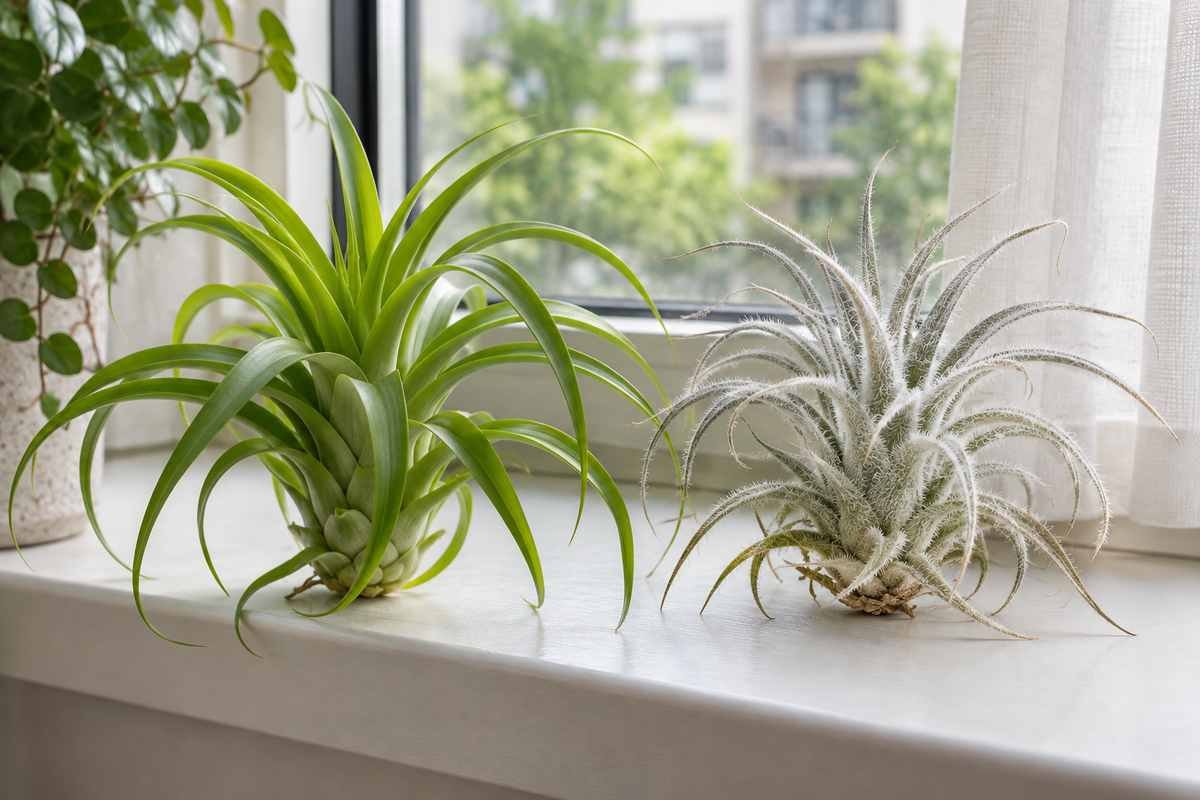
- Mesic types come from moderately humid forests, grow under a tree canopy and prefer more filtered light. Their leaves are deeper green, smoother and slightly cupped.
- Xeric types come from dry, desert-like places, often on rocks. Their leaves carry many more trichomes, which gives them a gray, fuzzy look.
For a dim home, that is the useful part. A green, smooth air plant is the better bet for a window that gets little sun, while a silvery, fuzzy one is built for strong light.
Neither type is a plant for the middle of a dark room. Anywhere away from the window, it is decor on a timer.
In a north-facing room, the real options are the sill itself or a grow light; NC State notes that LED grow lights can make up the difference. The DLI calculator shows how much light a spot gets over a day.
How often to water an air plant
Water an air plant once or twice a week by rinsing or soaking it, and less often in a dim, cool room. NC State says air plants need water at least once a week to thrive, even though they cope with drought. Penn State describes three methods:
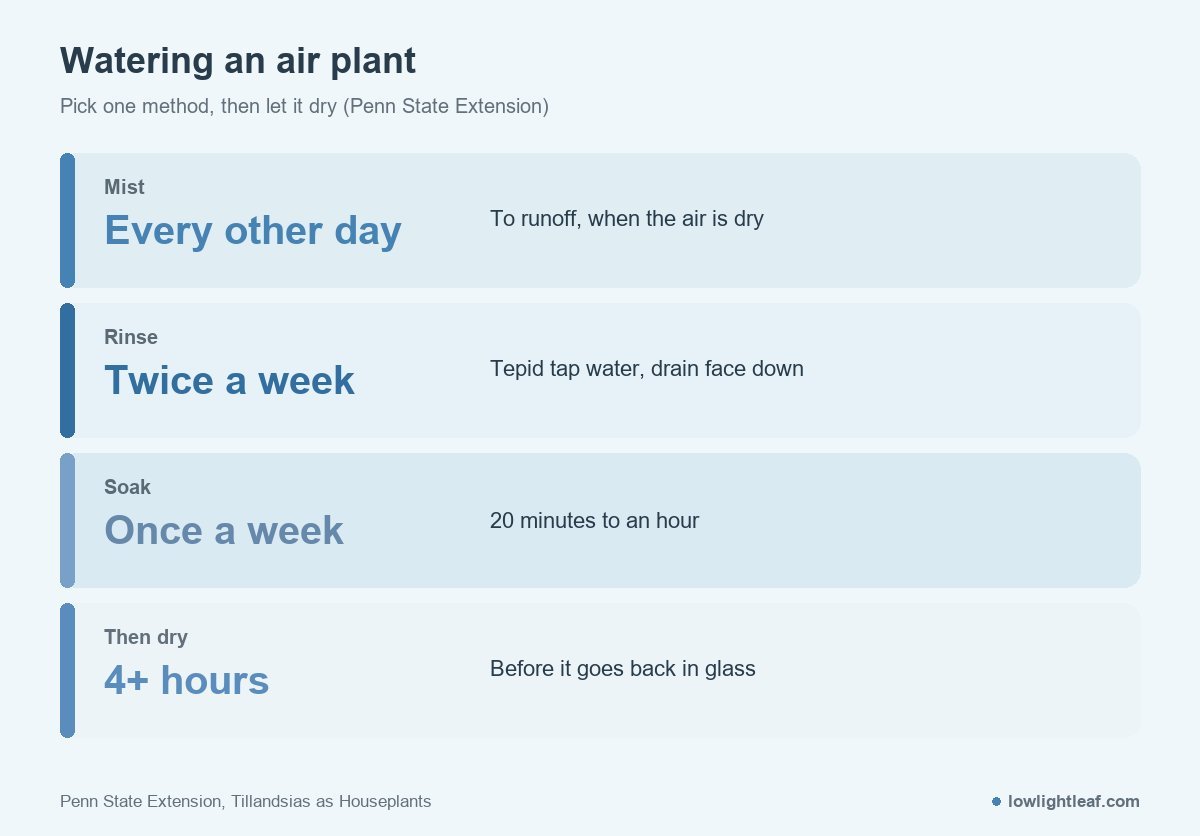
- Misting to the point of runoff, which Penn State says may be needed every other day when household humidity is low. UF/IFAS gives weekly misting to runoff as its routine.
- Rinsing under the faucet with tepid water twice a week, then laying the plant face down on a paper towel to drain.
- Soaking once a week for 20 minutes to an hour, then draining it well.
The light decides how often. A plant in bright light uses up the water it stores, while one in a dim spot stays damp longer. When a new owner on r/houseplants asked why their air plant was going downhill, the top reply was short:
“I have a couple of them. „Watering“ means make it wet under the faucet, shake the water of, let it dry, repeat once every two weeks. My guess is you‘re overwatering.”
– r/houseplants, July 2026 (118 upvotes)
Every two weeks is less than the extension guidance. Treat it as the floor for a cool, dim room, and use the leaves to tell you: UF/IFAS says curled or rolled leaves mean the plant is dehydrated.
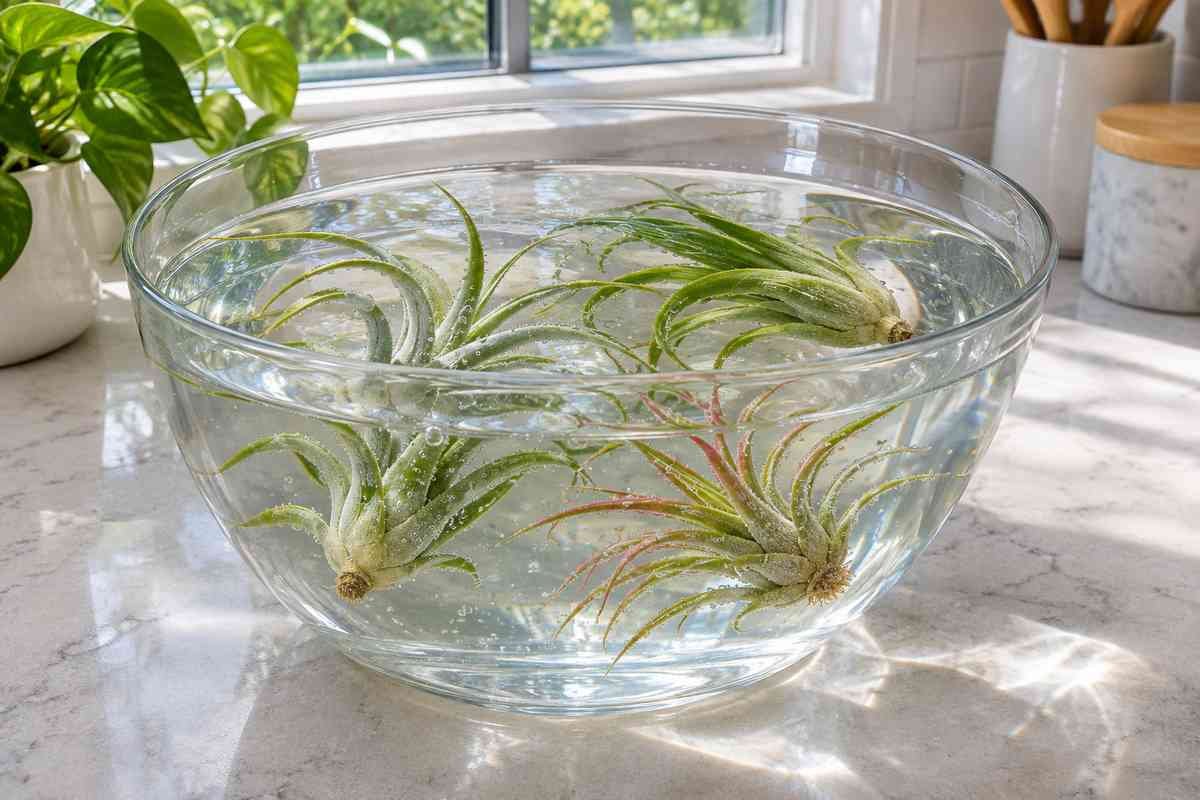
Drying, air flow and glass globes
After watering, an air plant has to dry. Penn State Extension calls good air circulation essential and says to let plants dry for at least four hours before putting them back in a terrarium. Shake off the extra water, or lay the plant face down to drain as Penn State suggests.
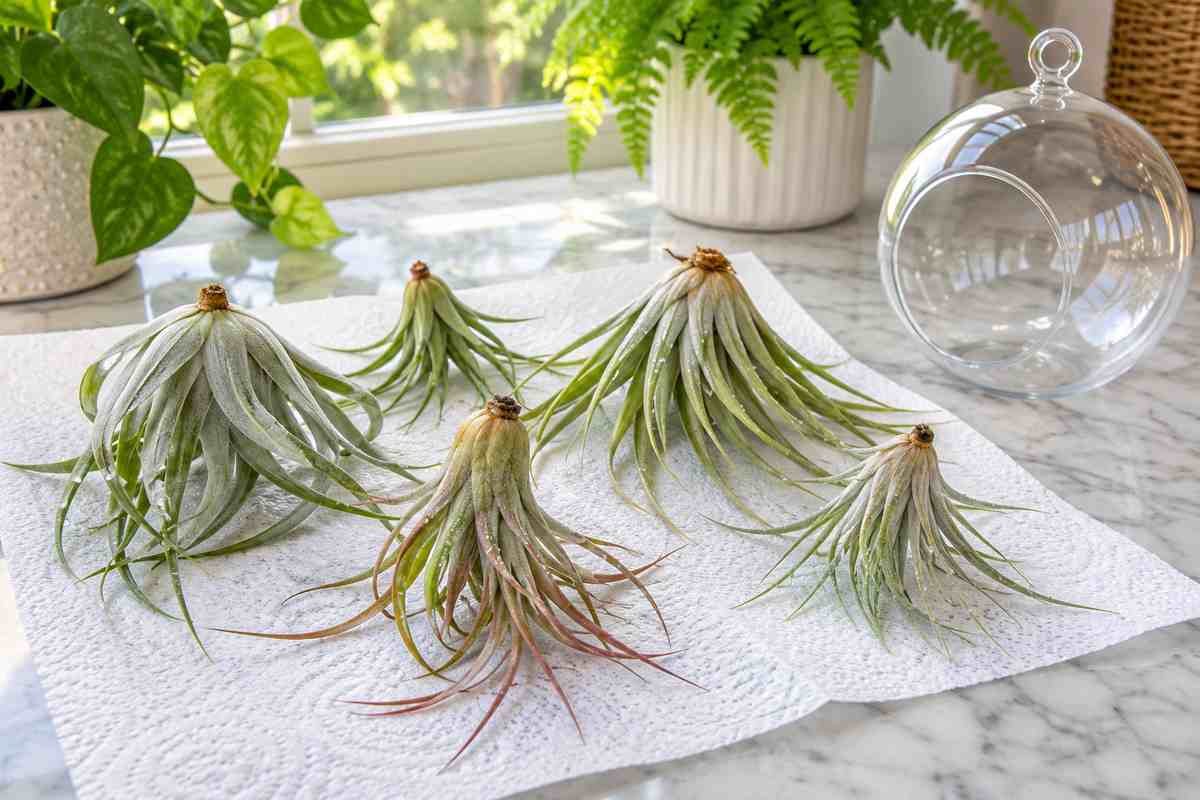
Glass globes are where that goes wrong, since a damp plant goes back into still air; that’s what the four-hour rule is for. UF/IFAS adds that whatever you mount an air plant on should not hold water. Penn State also says to keep air plants away from air conditioners and heating vents, which dry them out quickly.
Temperature and feeding
Penn State says air plants prefer nights above 55°F and days between 65 and 90°F, a range most homes cover. Outdoors in summer, keep them in shade so they don’t scorch.
Feed once a month with a fertilizer made for bromeliads or orchids. Penn State cites Clemson Extension’s advice to dilute liquid fertilizer to a quarter of the label rate and add it to the regular watering.
Blooms, pups and how long an air plant lives
An air plant flowers only once in its life. After it blooms, the mother plant slowly dies, but it first produces new plants, called pups, from its base, according to UF/IFAS and Penn State. So a single plant doesn’t last forever, but the clump can.
Penn State says pups can be separated once they reach about a third of the mother’s size, or left in place to form a clump. To encourage flowering at all, it recommends the most light the plant will take, plus enough water and fertilizer. UF/IFAS notes that air plants don’t always bloom indoors.
Thirst, pests and pets
Curled or rolled leaves are the clearest sign of a thirsty air plant, per UF/IFAS. NC State lists mealybugs, scale and crown rot as the problems to watch for; drying the plant properly after each watering is the guard against rot.
The ASPCA has no entry for Tillandsia, so there is no verdict for cats or dogs either way, though it lists some other bromeliads as non-toxic. With my cat Miso in mind, the plant toxicity table marks air plants as not listed, so keep one out of reach of a pet that chews leaves.

Ellie Marsh
Houseplant grower who spent years in a north-facing apartment. Writes practical care guides for low light homes, checked against extension and botanical garden sources.