A string of pearls (Curio rowleyanus, still sold as Senecio rowleyanus) is a succulent that needs bright light, a gritty mix in a shallow pot, and water only when the soil has dried and the pearls start to wrinkle. It is not a low-light plant. University of Missouri Extension puts succulents in its high-light group, at least 1,000 foot-candles, and says a north window suits only low-light plants.
Get the light right and the rest of string of pearls care is short: a light hand with water, a cool winter rest around 55 to 60°F, and fresh cuttings every few years. It is mildly toxic, so keep it away from pets that chew.
Why a string of pearls isn’t a low-light plant
A string of pearls needs high light because it is a succulent, and its round leaves have less surface for catching light than flat ones.
UW-Madison Extension explains the trade-off: the bead shape cuts water loss in dry South African habitat but also cuts the area for photosynthesis, which is why each pearl has a dark, translucent stripe, an “epidermal window” that lets light into the leaf.
MU Extension’s light groups make the point in numbers. Low-light plants need 50 to 250 foot-candles, medium-light plants 250 to 1,000, and cacti and succulents belong with the high-light plants at 1,000 and up. MU also says most succulents do poorly under home grow lights unless the light is strong and close.
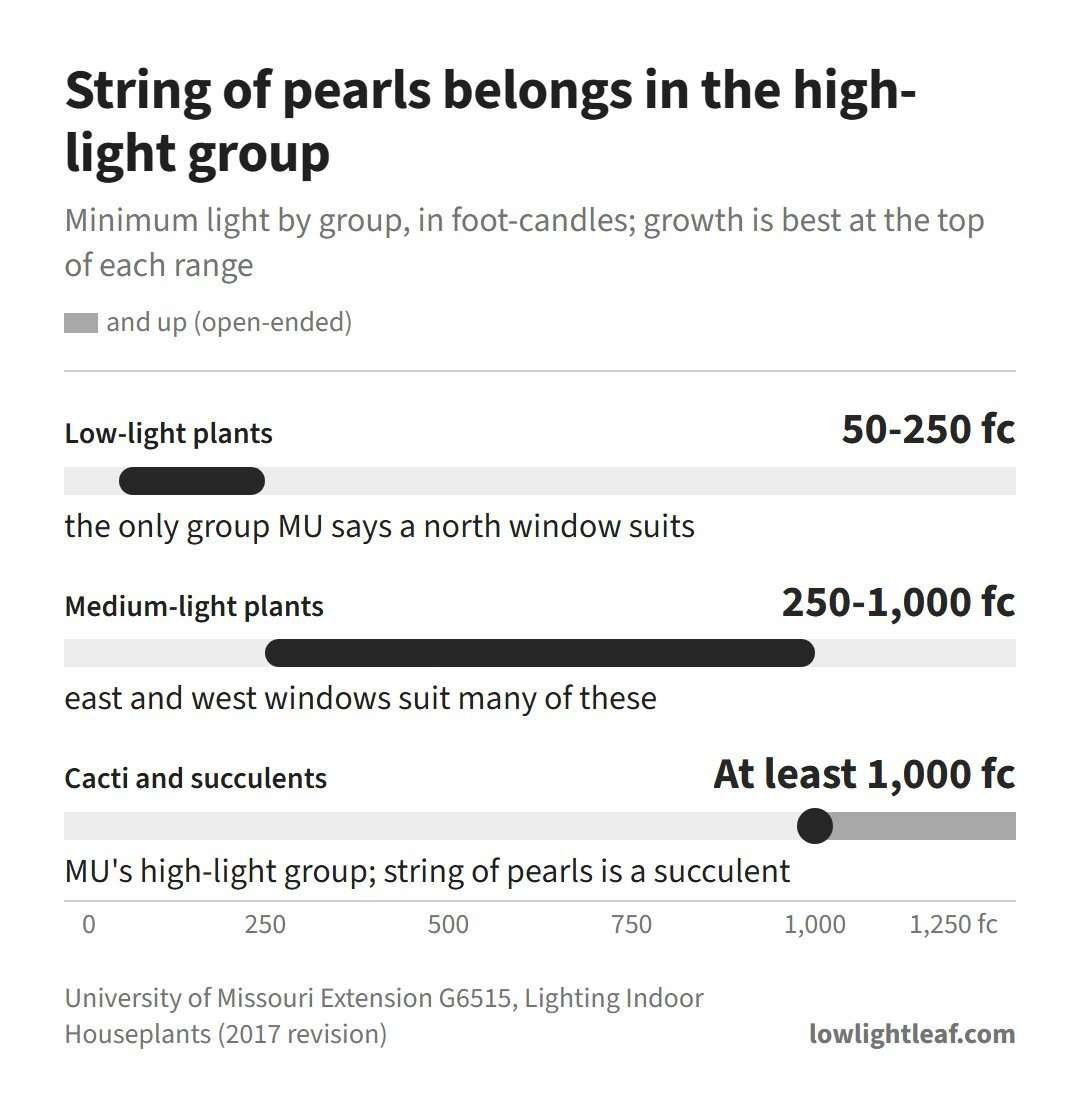
A north window won’t do. MU says north windows are satisfactory only for plants in the low-light group, and NC State Extension describes string of pearls as “very particular” about its conditions, a plant that won’t tolerate overwatering, underwatering or inadequate light. The best spot is a south window, or an east or west window right at the glass.
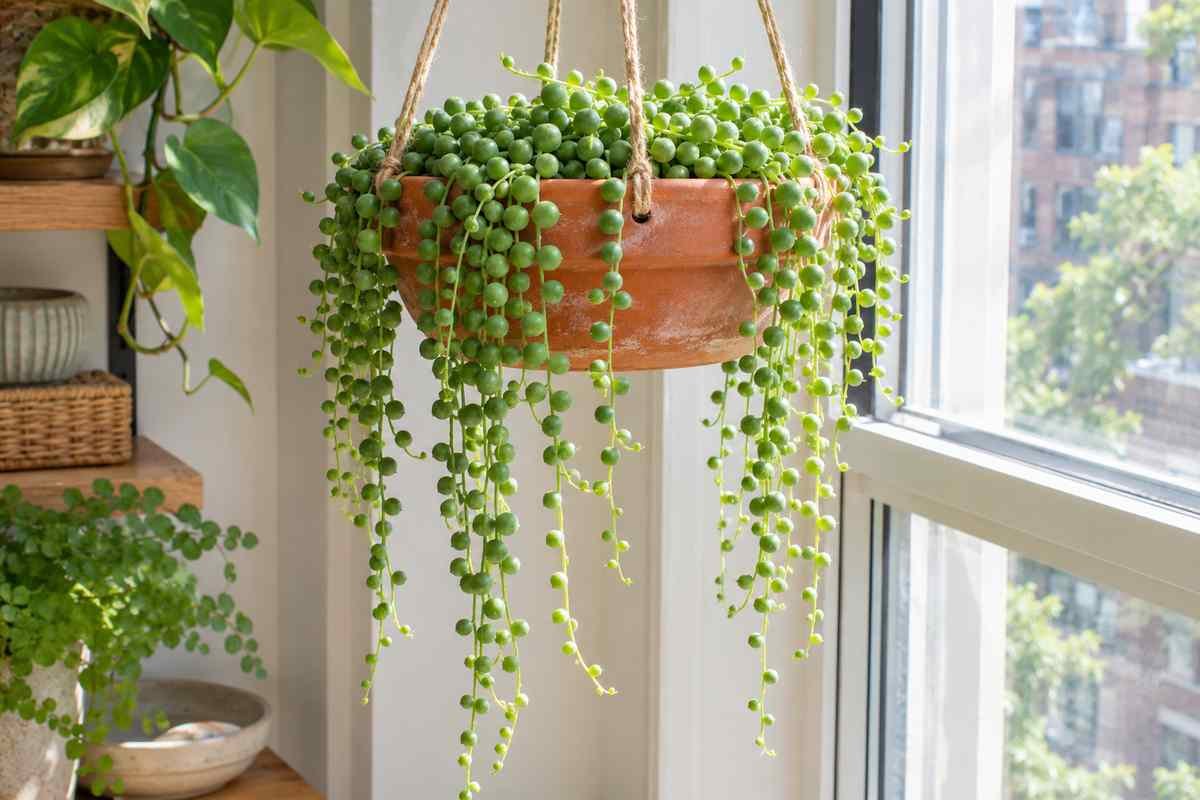
Direct sun needs a little care. NC State warns that direct sunlight can scorch the leaves, and in the wild UW-Madison says the plant grows under bushes and between rocks that shield it from intense sun. So give it bright light with some gentle sun, and move it back if the pearls start to scorch in hot afternoon sun.
String of pearls care in a dim home
In a dim room, a string of pearls doesn’t die overnight. It thins out. MU Extension’s general signs of too little light are long gaps between leaves, smaller new leaves, pale growth, and lower leaves that yellow and drop. On a string of pearls that means long bare stretches of stem between widely spaced pearls.
Growers also report the top of the pot thinning first when light comes only from the side. One put it this way on Reddit:
“Also, the top will die and go bald if you don’t have the light coming from above, hope this helps!”
– r/StringofPlants, January 2026 (3 upvotes)
So what are the options if your windows are poor? There are three, and only two of them keep this plant. Hang it in your sunniest window, as close to the glass as it will go. Put it under a strong grow light mounted above the pot, close to the crown, since MU’s advice for succulents under lights is high intensity at short distance. Or choose a different plant.
I spent years in a north-facing apartment, and a string of pearls is the plant to steer a friend away from in a home like that. The succulents that handle lower light and the trailing plants in the hanging plant guide are better bets for a dim room. If you aren’t sure which side of the line your window falls on, a lux reading and the DLI calculator will settle it.
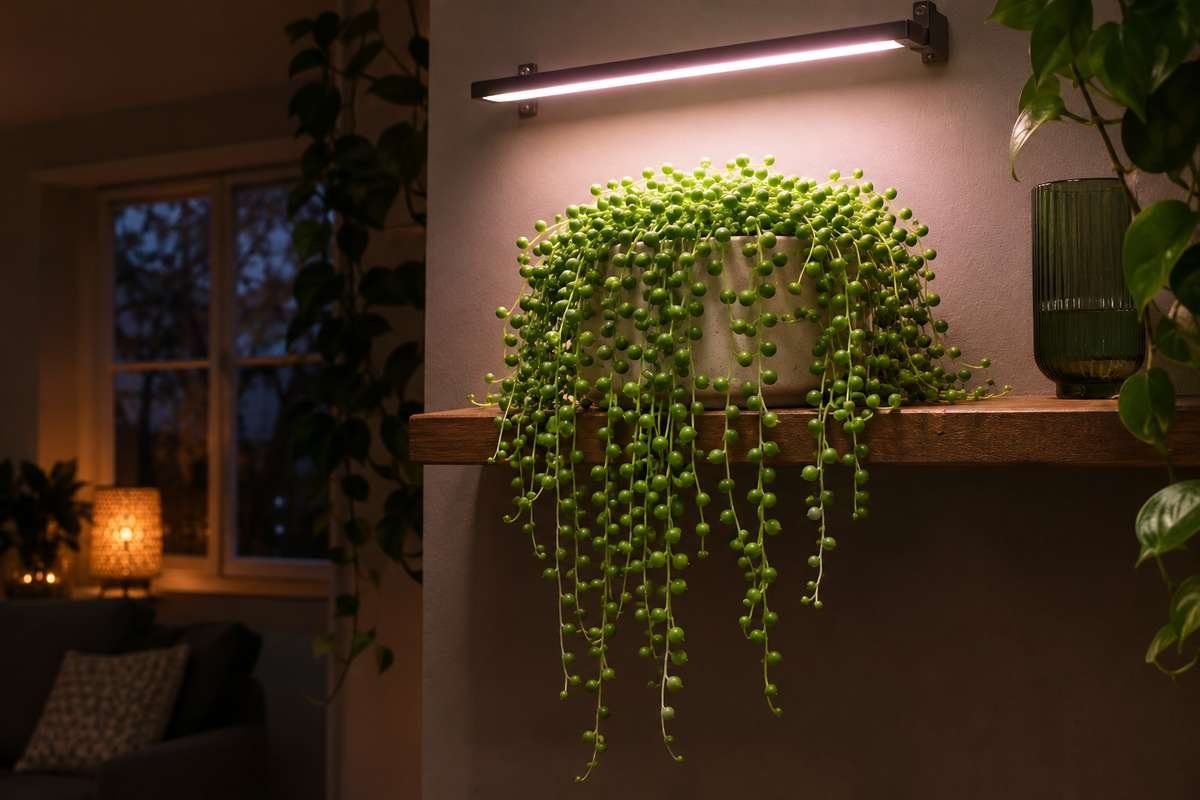
A reply in a Reddit thread for a new owner summed up the light half of the routine bluntly:
“Very bright direct light. Multiple hours of direct sunlight. Indoors dedicated grow light or south facing window.”
– r/houseplants, December 2025 (17 upvotes)
Watering without rot
Water a string of pearls when the mix has dried and the pearls look slightly shriveled, then soak it and let it drain. UW-Madison says root rot from overwatering is the most common way these plants die, and gives the shriveled-leaf cue as the sign it’s time to water.
The sources disagree on how dry is too dry. UW-Madison says to let the potting mix dry out completely between waterings, while NC State says never to let it dry out completely. The leaves settle it. A plump pearl has water in reserve; a pearl that has started to wrinkle is asking for a drink.
Water more in summer than in winter, UW-Madison says, because the plant rests in the cool months.
Soil and pot
Use a fast-draining mix and a shallow pot. UW-Madison suggests cactus mix, or ordinary potting mix with pea gravel, sharp sand, poultry grit or pumice added up to half and half. The roots are shallow, so a deep pot just holds wet soil the plant can’t reach, and that is where rot starts.
Terra cotta dries faster through its walls, which UW-Madison counts in its favor. Make sure the pot has a drainage hole. UW-Madison suggests repotting every year or two, or a light feed in spring in the years you don’t.
Temperature and the winter rest
NC State gives 70 to 80°F in summer and a cooler 50 to 60°F in winter. UW-Madison recommends a winter rest at 55 to 60°F with drier soil, and notes that a cool, dry winter may help it bloom in summer. A spot near a cool window that still gets good light is ideal.
Outdoors, NC State limits it to USDA zones 9b through 11b, so it is mostly grown as a houseplant. If yours spends summer outside, UW-Madison says to introduce it to the sun gradually so it doesn’t burn, keep it out of heavy rain, and bring it in before frost.
Why a string of pearls dies
Most string of pearls deaths come from soggy roots, and the other usual cause is too little light. Match what you see to the cause:
- Soft, collapsing pearls with soil that stays wet: root rot. NC State says soggy soil leads to root rot and the plant’s demise, and UW-Madison names rot the most common cause of death. Take healthy cuttings and start over.
- Flat, shriveled pearls on dry soil: it’s thirsty. NC State notes wilting can come from under- or overwatering, so feel the soil first.
- Bald top, long bare stems: not enough light, as above.
- Scorched or discolored patches: direct sun, per NC State.
- An old plant thinning out no matter what you do: NC State says these plants tend to die back after several years and recommends starting new plants from cuttings instead of trying to revive the old one.
Mealybugs and aphids are the usual pests, according to UW-Madison, and NC State adds whiteflies, gnats and ants.
Propagating string of pearls from cuttings
String of pearls roots easily from stem cuttings. UW-Madison’s method is to cut 3 to 4 inch tips, strip the bottom 3 or 4 pearls, and lay or press the bare stem onto moist potting mix with the last few nodes lightly covered. Roots form at each node. Mist the surface instead of soaking it until they take hold.
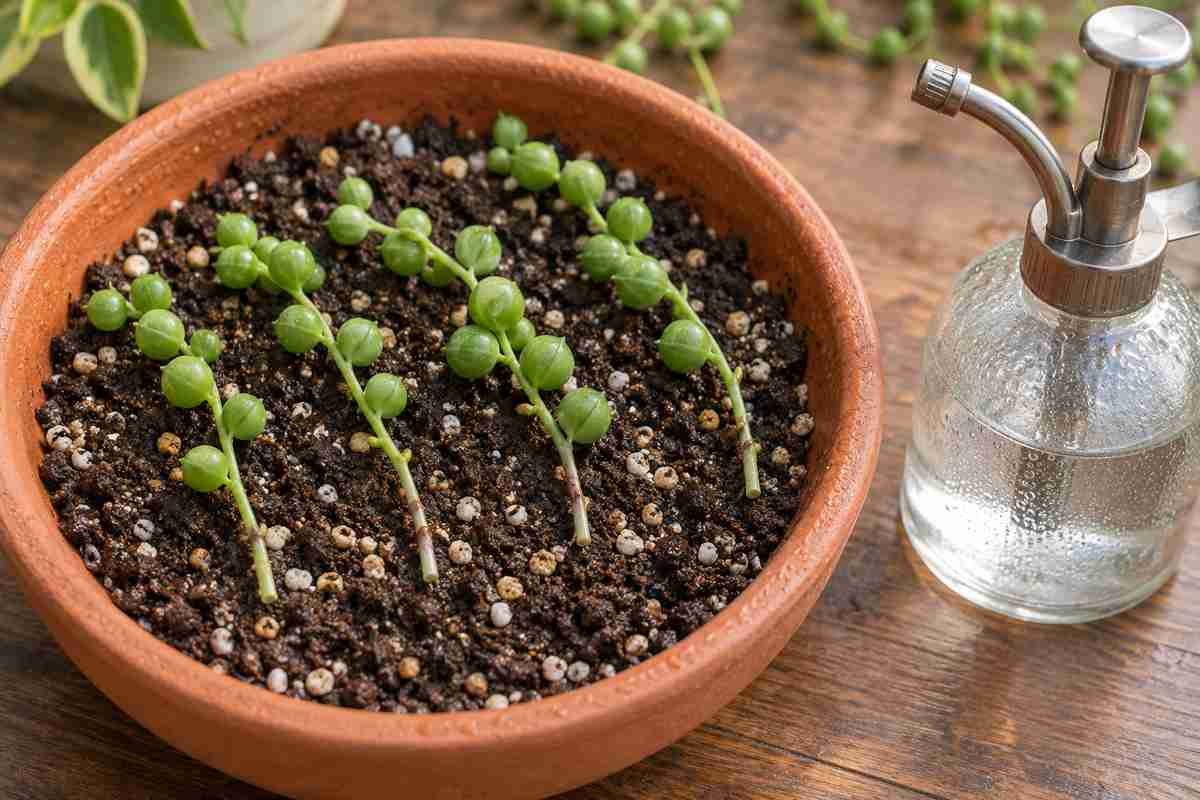
Can you grow one from a single pearl? NC State says dropping a leaf onto soil can work, but it is slower and less reliable than a stem cutting.
Is string of pearls safe for cats and dogs?
Treat string of pearls as mildly toxic to pets. The ASPCA has no entry for it, which is not the same as calling it safe, and NC State says the leaves and sap are slightly toxic, with ingestion causing vomiting and diarrhea and the sap irritating skin.
With a cat like my Miso in the house, a hanging pot well above reach is the simple answer, and the succulent toxicity guide and the plant toxicity table list ASPCA verdicts for the common alternatives.

Ellie Marsh
Houseplant grower who spent years in a north-facing apartment. Writes practical care guides for low light homes, checked against extension and botanical garden sources.