Last updated on October 16, 2026
For good prayer plant care, give it bright, indirect light, soil kept evenly moist with water that isn’t hard, humidity above 50% and temperatures of 65 to 70°F. The New York Botanical Garden gives those numbers for Maranta leuconeura, and NC State Extension adds that the plant won’t tolerate direct sun, dry air or cold drafts.
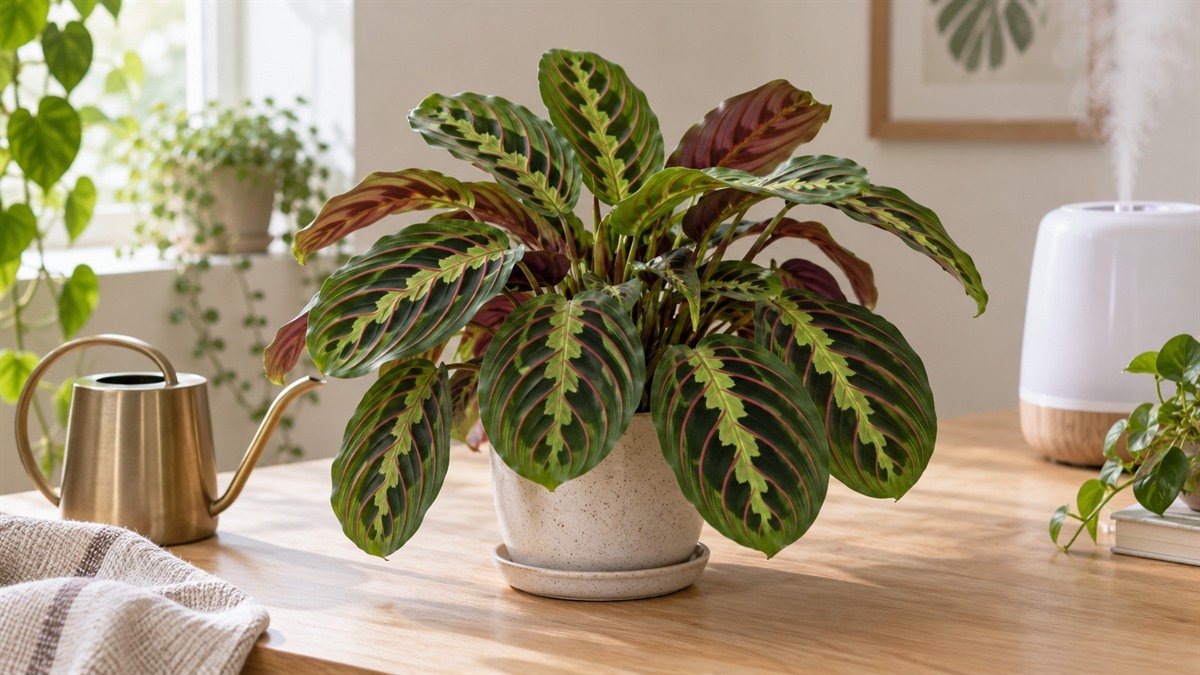
It has a reputation for being fussy, but most problems trace to three things you can control, water, humidity and light, and the leaves tell you which one is off.
Prayer plant light: bright, indirect, never harsh sun
A prayer plant wants bright, indirect light, such as a shady window or a spot behind a sheer curtain, as NYBG suggests. NC State Extension says it tolerates low to medium light but is intolerant of direct sun, and the Missouri Botanical Garden warns that strong sun bleaches the leaf colors.
Too little light fades it as well, since NC State notes that the leaves lose color in low light, so a north window like the one I had for years works only right at the glass, and a dark corner leaves it pale.
Watering a prayer plant, and what water to use
Keep the soil evenly moist from spring through summer and let the top inch dry in winter. NYBG suggests thorough watering with tepid water from March through September, then emptying the saucer about 15 minutes later.
- Water type matters. NYBG says hard water leaves mineral deposits on the leaves, and NC State says high fluoride burns them.
- Don’t let water stand on the crown. University of Illinois Extension warns that the stems rot easily.
- Use a pot with a drain hole. NYBG calls it a must, and NC State lists root rot in poorly drained soil.
The pot material changes how fast the soil dries, as one grower explained to an owner whose plant was struggling:
“Calathea are moisture loving plants. They do best potted into plastic, glazed ceramic etc. Terracotta and unglazed ceramics wick excess moisture from the soil and can make maintaining moist soil (which they prefer) more difficult. I’d repot but keep a similar watering cadence and your plant should start to improve.”
– r/plantclinic, December 2025 (110 upvotes)
Humidity and temperature
Aim for humidity well above 50%, which NYBG suggests checking with a simple hygrometer near the plant. A humidifier or a terrarium raises it. NC State also suggests a tray of wet pebbles under the pot, but Penn State Extension found that a tray’s moisture spreads into the whole room with almost no effect on the reading, so treat the tray as optional. For ways to raise humidity around the plant without dampening the whole house, see how to increase humidity in house air. Temperature should stay steady. NYBG lists 65 to 70°F and says to keep it above 55°F, while the Missouri Botanical Garden prefers it never dips below 60°F, so keep it away from cold windows and drafty doors in winter.
Prayer plant leaves curling, browning or fading: what each sign means
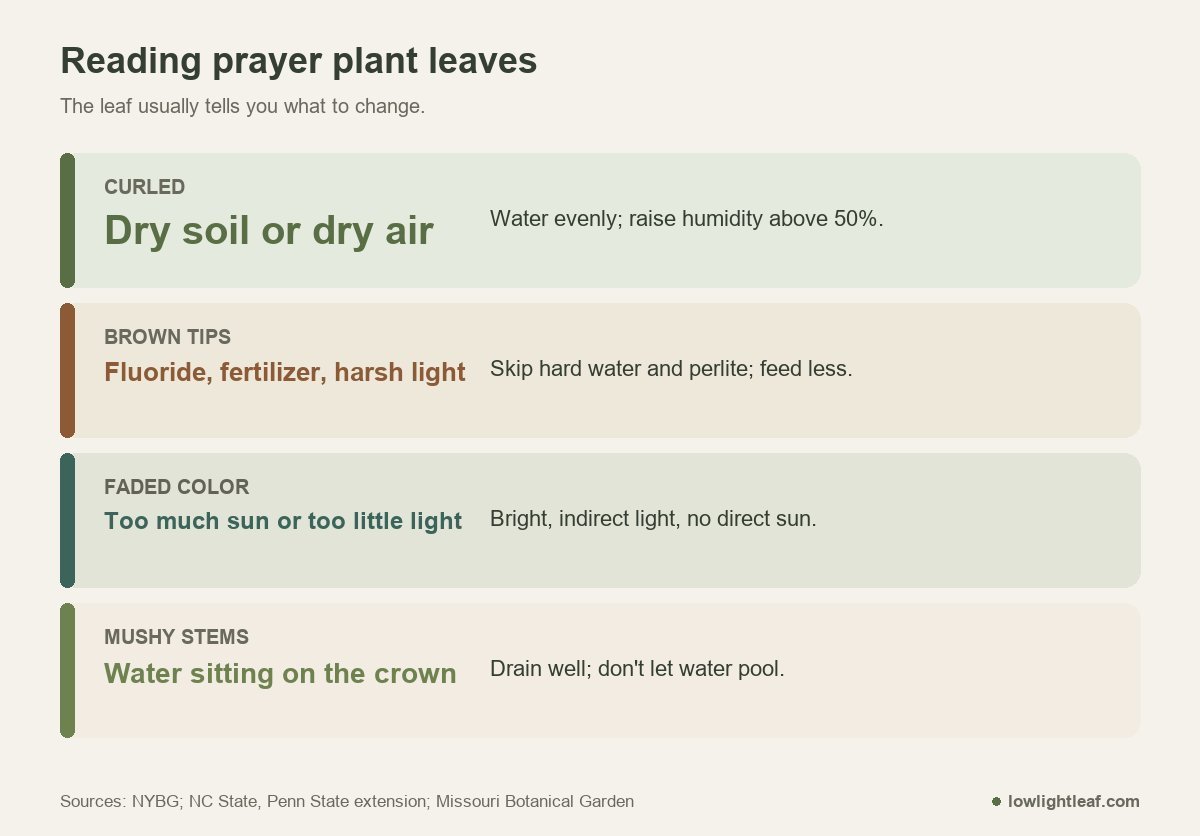
Prayer plant leaf problems usually point to water, humidity or light, so find the sign in the first column.
| What you see | Likely cause | What to change | Source |
|---|---|---|---|
| Leaves curling, edges browning, leaves dropping | Soil drying out or air too dry | Keep soil evenly moist; raise humidity | NYBG |
| Brown, dead tips and margins | Fluoride, phosphate fertilizer or harsh light | Avoid fluoridated water, superphosphate and perlite; feed less; move out of strong light | Penn State; NC State |
| Faded, washed-out color | Too much sun, or too little light | Bright, indirect light with no direct sun | Missouri Botanical Garden; NC State |
| Small water-soaked spots turning tan with a yellow halo | Helminthosporium leaf spot, a fungal disease | A fungicide protects the plant | Penn State |
| Mushy stems at the base | Water standing on the crown or soggy soil | Water the soil, not the crown; use a draining pot | Illinois; NC State |
| New leaves coming in yellow | Too little fertilizer or iron deficiency | Feed in the growing season; keep soil pH near 6 | Penn State |
| Small, distorted leaves with bright yellow line patterns | Cucumber mosaic virus | Discard the plant; propagate only from healthy plants | Penn State |
Penn State lists superphosphate and perlite as sources of excess fluoride, so a perlite-heavy mix can feed tip burn even if you water carefully.
Pests are rarely serious. NC State lists occasional spider mites and mealybugs, so look at the leaf undersides when a plant declines without an obvious cause.
Curling and praying are different movements, and growers point that out often:
“The leaves curl from lack of humidity or temperature extremes. You have it next to a window but a vent underneath. When prayer plants pray the leaves move up and down. They do not curl to pray. And they are crawlers so holding them up with chopsticks is not a good idea.”
– r/houseplants, October 2025 (50 upvotes)
Why prayer plant leaves fold at night
Prayer plant leaves fold up at night as part of a daily movement. NC State describes leaves held flat, parallel to the ground, during the day, then raised to a near-vertical “prayer” position after dark, and NYBG says the plant takes its name from the habit.
“These plants move so much at night.”
– r/houseplants, April 2026 (365 upvotes)
A note on names. Shops sell several relatives as “prayer plants,” and the ASPCA’s own prayer plant entry is filed under Calathea insignis, with maranta listed as another name. NYBG notes that Maranta is closely related to Goeppertia, the genus most calatheas now belong to, so care is similar, but the folding described here is the true Maranta‘s.
Dividing a prayer plant
Divide a prayer plant when you repot it in spring. NC State and Illinois both list division as the way to propagate it, and NYBG repots every one or two years in spring.
- Slide the plant out and find where the short, rhizomatous stems separate.
- Pull or cut the clump into pieces, each with roots and several leaves.
- Pot each piece in a soil-based mix with some peat and sharp sand, as NYBG suggests, in a pot with a drain hole.
- Keep the soil evenly moist and the humidity high while the divisions settle.
Prayer plant care FAQ
Are prayer plants toxic to cats?
No; the ASPCA lists prayer plant as non-toxic to cats, dogs and horses, and its separate maranta and calathea entries are non-toxic too.
Do prayer plants like to be root bound?
None of the sources here say a prayer plant benefits from being root bound. NYBG simply repots it every one or two years in spring, which is also the time to divide it.
Do prayer plants flower?
Rarely indoors. NC State says the flowers are small, white to purple, and held on slender stalks, so the leaves stay the main event.
How often should you fertilize a prayer plant?
NYBG feeds with a standard liquid fertilizer every two weeks from March through September, but go lightly, since NC State and Penn State both link over-fertilizing to burned leaf tips.
Because it’s non-toxic, a prayer plant is one of the easier picks for a home with cats; more are in pet friendly indoor plants. For plants that handle even less light, see low light indoor plants.

Ellie Marsh
Houseplant grower who spent years in a north-facing apartment. Writes practical care guides for low light homes, checked against extension and botanical garden sources.