Last updated on October 14, 2026
To get a Christmas cactus to bloom, give it long nights or cool nights for about six weeks in fall. Purdue University’s consumer horticulture team says about 12 hours of uninterrupted darkness each night from mid-October brings blooms by the holidays, and that nights of about 50 to 55°F trigger flowering without the dark treatment.
So the first question in how to get Christmas cactus to bloom is how cold your house gets at night. A cool room can do the work of the closet. A warm living room with lamps on every evening is the most common reason a plant stays green all winter.
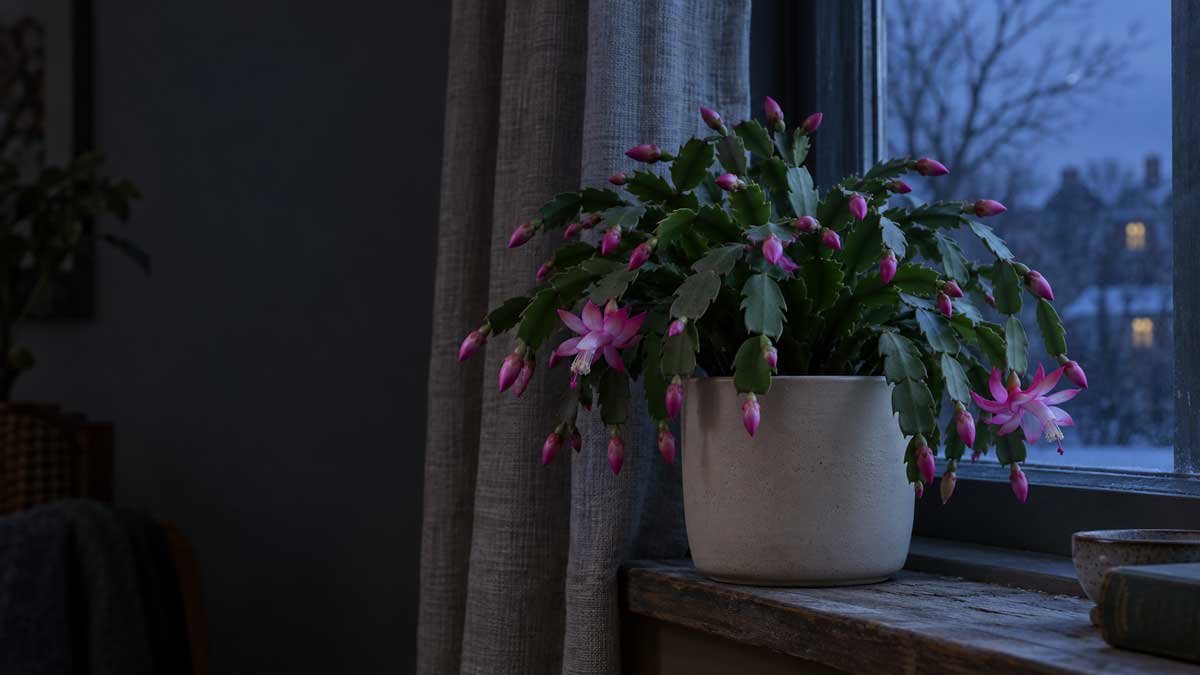
Long nights or cool nights: the night-temperature rule
University of Minnesota Extension describes holiday cacti as short-day plants that set flower buds in fall as the nights get longer, and it says they need cool nights as well. Temperature counts. Put a thermometer where the plant sits, read it late in the evening, and find your row below.
| Night temperature | What else the plant needs | Time to buds | Source |
|---|---|---|---|
| About 50 to 55°F | Nothing extra; the cool nights replace the dark treatment | Start by early November for holiday bloom | Purdue |
| 55°F | Blooms sometimes regardless of day length | About 5 to 6 weeks | University of Minnesota Extension |
| 60 to 65°F | At least 12 hours of complete darkness every night | About 6 weeks | University of Minnesota Extension; Iowa State calls this range ideal |
| Above 65°F | Unlikely to bloom | No buds | University of Minnesota Extension |
| Above 70°F | Flowers may fail to develop | No buds | Iowa State University Extension |
The sources draw the warm cutoff in different places. Minnesota says blooming is unlikely above 65°F, while Iowa State puts the failure point above 70°F. If your nights fall between the two, treat the plant as warm and give it the full 12 hours of darkness.
The 12-hour rule is the part people doubt most. One grower in Las Vegas asked whether a neighbor’s advice was true:
“Even though I live in Las Vegas, I have the hardest time growing succulents. They always seem to die on me! I was given these two Christmas cactuses last year when they were blooming, and I’d really love to get them to bloom again. My neighbor told me they need 12 hours of complete darkness every night to produce buds. Is that true? If so, when should I start doing this, and for how many weeks? They’re under grow lights right now. Any advice would be greatly appreciated. I really don’t want to…” [excerpt — 519 characters in full]
– r/christmascactus, September 2026 (31 upvotes)
It is true, with one condition. Purdue and Minnesota both say cool nights near 55°F can replace the darkness, so a cold room changes the answer.
A fall schedule for blooms by the holidays
Purdue’s timing works backward from December. Start long nights in mid-October, or cool nights by early November, and keep going until buds show.
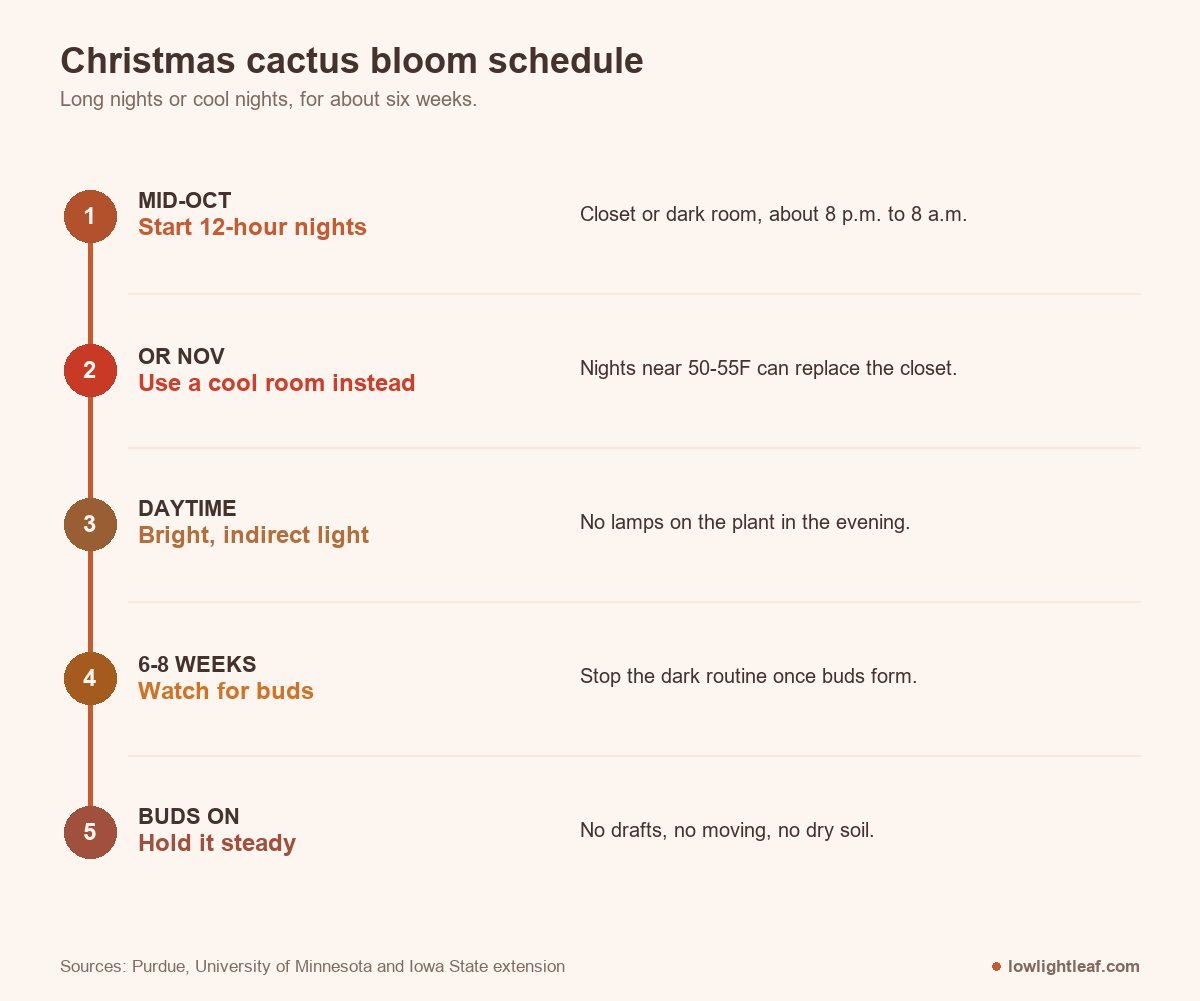
- Mid-October: start 12-hour nights. Purdue suggests a dark closet from about 8 p.m. to 8 a.m. each night. An unused bedroom or a basement can work too, Iowa State says, as long as no lamp reaches the plant.
- Or by early November: move it somewhere cool. With nights near 50 to 55°F, Purdue says you can skip the closet altogether.
- Keep the days bright. Bring the plant back to bright, indirect light every morning. Purdue says direct sun can burn the leaves and may turn them red.
- Water when the top half of the soil is dry. Purdue’s rule is to water thoroughly at that point. Minnesota says to let the soil dry between waterings and never leave the pot standing in water.
- Feed for flowers. Minnesota suggests switching to a fertilizer low in nitrogen and high in phosphorus and potassium in fall, when buds are forming.
- Stop when you see buds. Purdue runs the dark routine for 6 to 8 weeks or until buds form, whichever comes first.
Carrying a pot into a closet every night for six weeks is a chore. A cool spare room or a spot near a cold window does the same job with less work, if its nights stay in the 50s.
Why is my Christmas cactus not blooming?
A Christmas cactus that won’t bloom usually has nights that are too warm, or it gets artificial light in the evening. Iowa State Extension says the plant won’t bloom properly if it gets artificial light at night in fall, and Minnesota says nights above 65°F make blooming unlikely.
- Lamps or a TV nearby. Even ordinary room lighting in the evening breaks up the long night the plant needs.
- A warm room. Use the night-temperature table and move the plant or start the dark routine.
- Too little light during the day. Purdue says the plant adapts to low light but blooms more with more light.
- Too much room in the pot. Minnesota says holiday cacti bloom best when kept somewhat pot-bound, so skip the fall repotting.
- Soggy soil. Minnesota lists root rot as one of the most common causes of death in these plants.
Low light is the hard one to fix. I spent years in a north-facing apartment, and a north window is where a Christmas cactus will survive without putting on much of a show. If that is your only window, a spot near the glass or a grow light during the day helps, as long as the light goes off at night.
Why do Christmas cactus buds drop?
Christmas cactus buds drop when the plant’s conditions change suddenly. University of Minnesota Extension lists drafts, quick swings in temperature or humidity, and a change in the direction or amount of light, and Purdue adds soil that gets too dry.
Growers on Reddit see the dry-soil side of this often, because people water a Christmas cactus like a desert cactus:
“These plants are not like a desert cactus and require more water. I water mine when the top inch or two feels dry and I water it thoroughly until water run out the bottom.”
– r/plantclinic, September 2026 (96 upvotes)
Pink buds on the floor under the pot usually mean one of those.
Moving the plant is where the sources part ways. Iowa State says not to move it while buds develop, and to wait until the first flowers open before taking it to another room. Minnesota says that if it is going into a warmer room for display, move it as soon as the buds appear. Either way, move it once, and keep it away from heat vents, fireplaces and outside doors.
Christmas, Thanksgiving or Easter cactus?
Three holiday cacti are sold under similar names and bloom at different times, and the edges of the stem segments are the quickest way to tell them apart.
- Christmas cactus (Schlumbergera bridgesii): scalloped, rounded segment edges. Blooms after about 6 weeks of short days, late fall to winter.
- Thanksgiving cactus (Schlumbergera truncata): two to four pointed teeth on each segment. Purdue says it blooms earlier than a Christmas cactus under natural day length.
- Easter cactus (Schlumbergera gaertneri in Minnesota’s list): rounded teeth. Minnesota says it needs 8 to 12 weeks of short days and flowers in late winter or early spring.
A plant with pointed teeth that blooms in November is doing exactly what a Thanksgiving cactus should, and the same long-night or cool-night routine works for both.
FAQ: how to get Christmas cactus to bloom
Do coffee grounds or Epsom salt make Christmas cactus bloom?
No extension source I read recommends either one for blooming. Purdue, Minnesota and Iowa State all name night length and temperature as the triggers, and Minnesota’s only feeding advice for flowers is a low-nitrogen, high-phosphorus and potassium fertilizer in fall.
How do you care for a Christmas cactus while it blooms?
Keep a blooming Christmas cactus cool, evenly watered and out of drafts. Purdue says the flowers last longer in cooler temperatures and the plant doesn’t need fertilizer while it blooms, and that buds can drop if the soil gets too dry.
What should you do after a Christmas cactus blooms?
Water less after the flowers finish, then more again in spring when growth picks up, Minnesota says. Purdue suggests pruning after blooming to make the plant branch. More branch tips mean more places for next year’s flowers.
Is Christmas cactus safe for cats and dogs?
Yes. The ASPCA lists Christmas cactus (Schlumbergera bridgesii) as non-toxic to dogs, cats and horses, which makes it one of the safer holiday plants to keep in a home with pets. The other holiday plants are ranked in is Christmas cactus toxic to cats. For the poinsettia that often sits beside it, see how to keep poinsettia alive.
Purdue’s point about light holds all year: the plant tolerates a dim room, but brighter days mean more flowers in December. If you grow other succulents in a darker spot, the ones that cope best are in low light succulents.

Ellie Marsh
Houseplant grower who spent years in a north-facing apartment. Writes practical care guides for low light homes, checked against extension and botanical garden sources.