Last updated on October 11, 2026
When to divide hostas has two good answers: early spring, as the new shoots break the soil, or late summer, once the heat has eased and flowering is over. Iowa State University Extension names spring as the best time, and University of Nebraska-Lincoln Extension gives the same two windows.If I had to pick one, I’d pick spring. You can see exactly where each shoot sits, so every cut lands between growing points instead of through them, and the plant has a whole season to rebuild its roots. Late summer works too. It just asks for a little extra care before winter.When to divide hostas: a now-or-wait table
Match the row to what your plant looks like today. The plant’s state matters more than the calendar, and the two moments both extension services point to are shoots just emerging and a clump that has finished flowering.| What you see today | What to do | Why |
|---|---|---|
| Pointed shoots just breaking the soil, leaves still rolled tight | Divide now | The best window. Iowa State Extension advises digging the clump as soon as the leaves begin to emerge. |
| Leaves fully open in late spring | Divide if you need to, in small pieces | Iowa State Extension says hostas can be divided anytime from spring to late summer. Expect some wilting and keep the pieces shaded and watered. |
| Midsummer heat, plant in flower | Wait a few weeks if you can | UNL Extension’s summer window opens after temperatures drop and bloom has ended. |
| Flowers finished, nights cooling (September in Iowa) | Divide now | The second window. Iowa State Extension says late-summer division gives plants several weeks to re-establish before winter. |
| A hard frost is close and the ground will soon freeze | Wait until spring | A division needs those several weeks of workable soil to root in, and mulch can’t stand in for them. |
| A hollow, dead center ringed by healthy leaves | Divide at the next good window | UNL Extension calls this a fairy ring and lists rejuvenation as a reason to divide; Iowa State Extension says to discard the dead center. |
Can you divide hostas in summer?
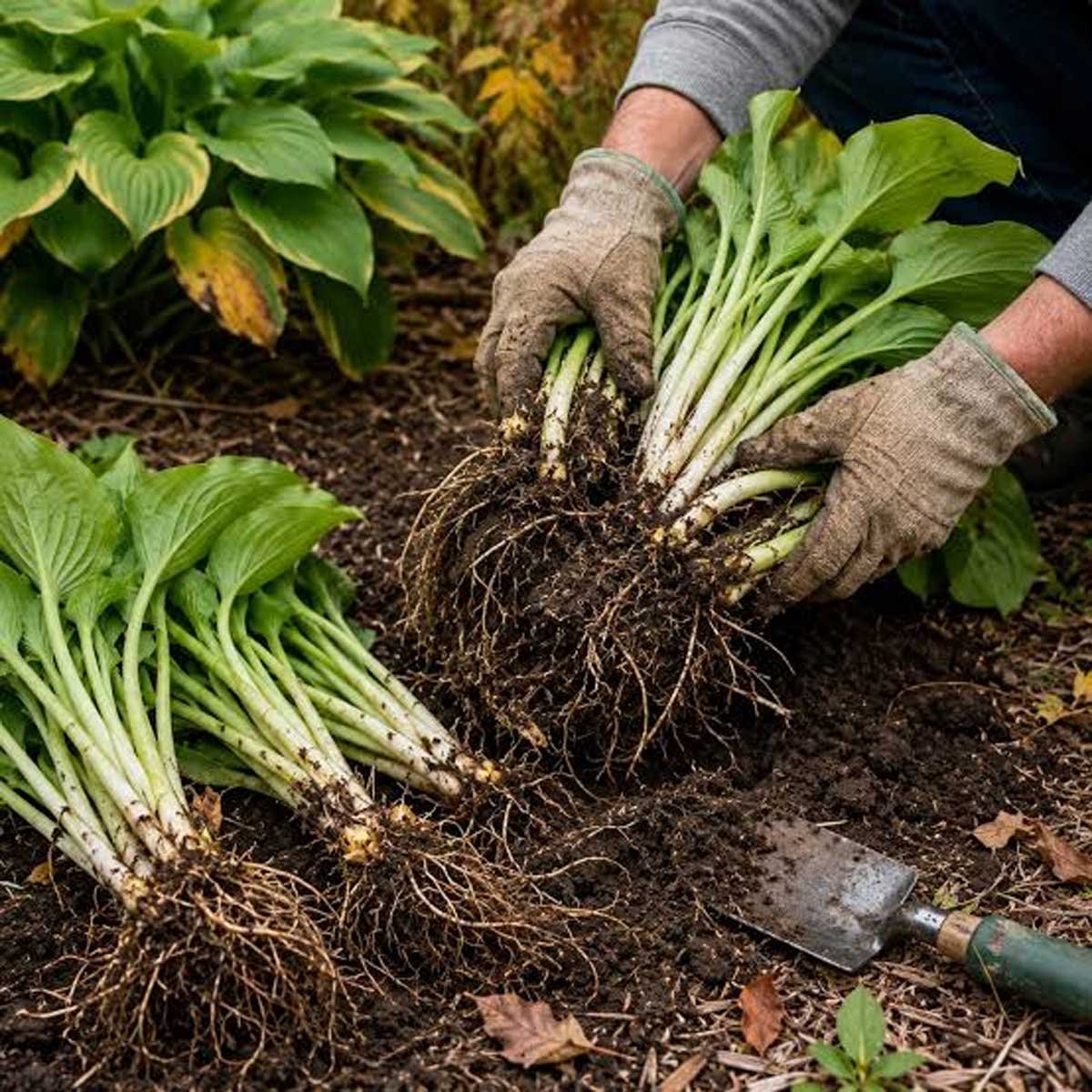 Hostas can be divided in summer, but late summer beats midsummer. UNL Extension times its summer window for after temperatures drop and the plant has finished blooming, which spares freshly cut roots the hottest, driest weeks of the year.Sometimes a midsummer move can’t wait, say a patio going in where the hosta sits. In that case I’d take a smaller section with plenty of soil around the roots, replant it the same day in shade, and water it more often than feels necessary for the next few weeks. A few leaves will probably flop or brown. Cut those off at the base; the roots are what you’re protecting.
Two ways to split a hosta, including the spade method
Hostas can be divided two ways, and UNL Extension gives both: slice a section off the clump where it grows, leaving part of the plant in place, or lift the whole clump and split it into separate plants. In both cases the tools should be clean and sharp.Slicing in place is the “just cut it with a spade” approach people ask about, and it is a legitimate method. It suits a big, healthy clump when you only want one or two new plants and would like to leave the rest undisturbed. Cutting a healthy plant in half feels wrong the first time you do it. What decides the outcome is that each piece leaves with its own roots and shoots attached.Slicing a section off in place
- Water the bed the day before so the soil holds together around the roots.
- Push a sharp spade straight down through the clump, the way you’d cut a pie, so the wedge has its own shoots, crown and roots. Iowa State Extension asks for at least two or three shoots in every section.
- Lever the wedge out with as much soil on its roots as you can keep.
- Fill the gap with soil and water the plant you left behind.
Lifting and splitting the whole clump
- Dig a circle a few inches outside the leaves and lift the clump with a fork or spade.
- Shake or hose off enough soil to see where the shoots join the crown.
- Cut between groups of shoots with a sharp knife or spade, giving each piece two or three shoots and a good share of crown and roots.
- Throw away any dead, hollow center instead of replanting it.
Replanting divisions so they settle in
Replanting is where divisions succeed or fail, and UNL Extension’s instructions are specific. Keep the roots moist, dig a hole slightly shallower than the root ball and at least 1 1/2 times as wide, set the crown just above soil level, and fill the hole without tamping it down.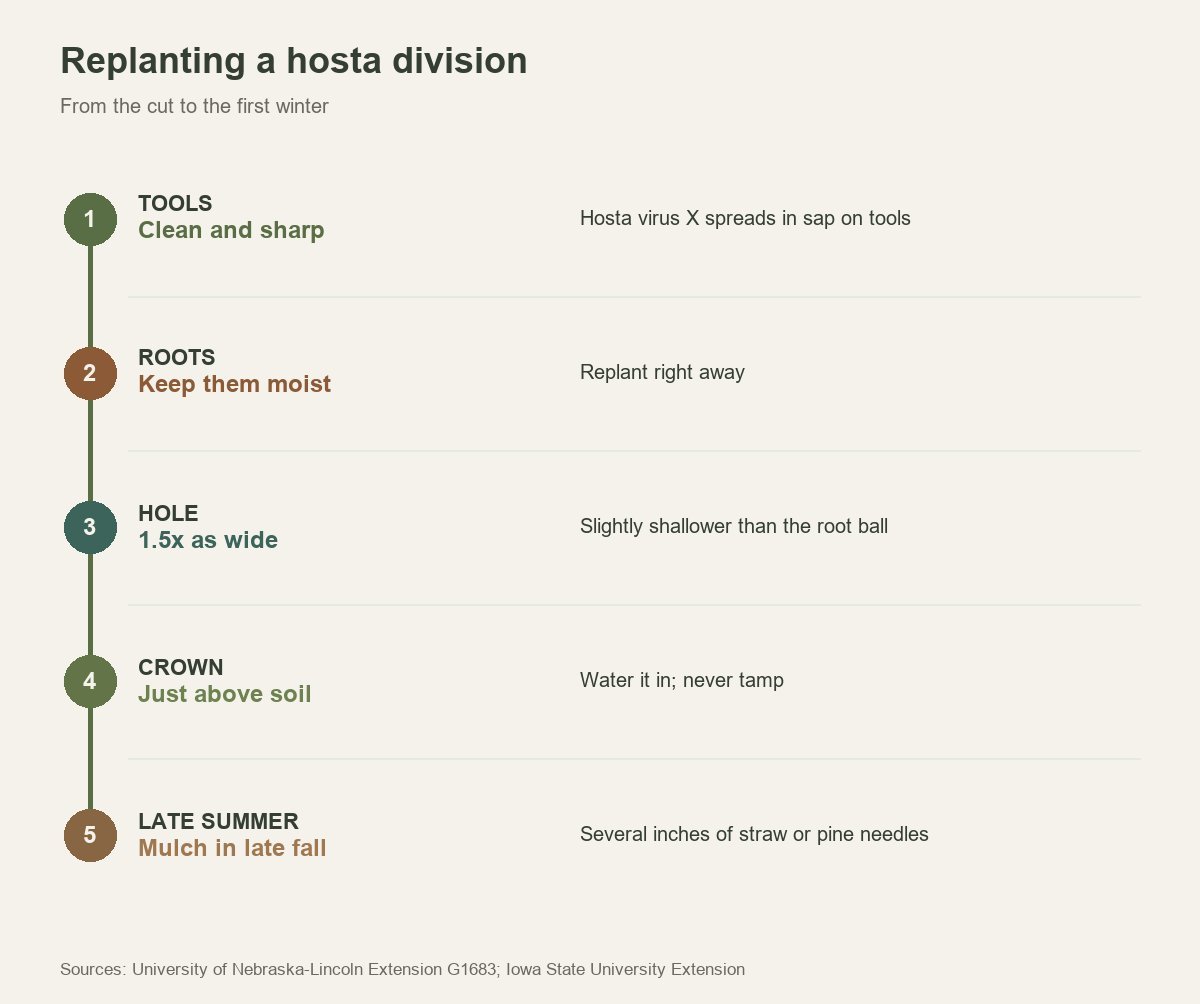
How often do hostas need dividing?
Hostas don’t need dividing on a fixed schedule. Iowa State Extension suggests every 5 to 7 years, or more often, to keep plants healthy and a manageable size, while UNL Extension points out that frequent division delays a hosta’s spread toward its mature size.So let the plant decide. A dead center, a clump that has outgrown its spot, or wanting more plants for a bare corner of the yard are all good reasons to dig. A full, healthy hosta can be left alone for years, and Iowa State says so in its late-summer advice.I’d hold off on young plants. UNL notes that a hosta’s adult leaf size, shape and color can take three or more years after planting to show, so splitting a clump in its first couple of years mostly sets that clock back.Hosta division FAQ
Can you plant hostas in the fall?
Hostas can be planted in late summer or early fall if they get several weeks to root in before the ground freezes. Iowa State Extension puts that window in September for Iowa, and the same logic that sets when to divide hostas applies to new plants, including a late-fall mulch. For the cleanup after frost flattens the leaves, see when to cut back hostas.When to divide hostas in a cold climate?
In a cold climate, divide hostas in spring as the shoots emerge, or move the late-summer window earlier. The deciding factor is Iowa State Extension’s several weeks of rooting time before the ground freezes, and a short fall leaves less of it, so I’d lean on spring.How long can hostas be out of the ground?
Hostas should go back in the ground the same day you dig them. Iowa State Extension says to replant divisions right away, and UNL Extension stresses keeping the roots moist; neither gives a safe number of days.If you can’t replant at once, keep the roots in a bucket of damp soil or wrapped in wet burlap, out of the sun.Is dividing the best way to make more hostas?
Division is the propagation method both Iowa State and UNL Extension explain for home gardeners. Each division is a copy of the parent plant, so it keeps the same leaf color and pattern. If you want new varieties instead, best hostas for shade sorts them by how much light your spot gets.Why does my divided hosta look like it is not growing?
A late-summer division can sit still above ground for months, and that is expected. After a late-summer move, UNL Extension expects at least one growing season to pass before active growth above the ground resumes, so judge the division by the shoots it sends up next spring.
Ellie Marsh
Houseplant grower who spent years in a north-facing apartment. Writes practical care guides for low light homes, checked against extension and botanical garden sources.